AIDA model
The AIDA Model: Attention, Interest, Desire, Action, and the Job Each One Does
The AIDA model breaks one piece of persuasion into four jobs: attention, interest, desire and action. It is credited to E. St. Elmo Lewis at the end of the 1890s and it is still the quickest way to find out which job an ad is not doing. This page gives you the four stages, what each has to do, four ads that are running right now with one stage doing the work in each, and the places where the model stops describing how people actually buy.

Key takeaways
- AIDA orders one ad, over the seconds somebody spends with it. Attention, interest, desire and action are four jobs a single piece of persuasion has to do in order.
- Attention and interest are no longer separate moments. In a feed the reader gives you both in the first frame or gives you neither.
- Desire is the stage most ads skip, because it is the only one that needs evidence rather than words: a demonstration, a customer sentence, a number.
- The model ends at the purchase, which is why it says nothing about retention, and why every later variant adds a fifth stage.
What Is the AIDA Model?
The AIDA model is a four-stage sequence for persuasion: Attention, Interest, Desire, Action. Attention is the job of getting noticed at all, in the frame or line a reader meets first. Interest is holding that reader with something specific enough to be worth a few more seconds. Desire is turning the claim into wanting, which takes evidence rather than assertion: a demonstration, a customer in their own words, or a number that can be checked. Action is asking for one defined thing, naming where to do it, and giving a reason to do it now. The sequence is credited to the American advertising executive E. St. Elmo Lewis at the end of the 1890s, and it belongs to a family of hierarchy of effects models, all of which assume a buyer moves through stages in order. Its lasting use is diagnostic: take any ad, ask which of the four jobs it is doing, and the missing one is usually the reason the ad is not working.
The Four Stages at a Glance
One row per stage: what the reader is doing at that moment, the job the ad has to do, what the failure looks like, and a line from a real ad that does it. Brief from the row rather than the letter, because the letter is the label and the row is the instruction.
| Stage | What the reader is doing | The job of the ad | How it fails | A real ad that does it |
|---|---|---|---|---|
| A. Attention | Scrolling. Nothing has been read yet. | Earn the stop with something the eye cannot file away at a glance. | The ad looks like the category it sits in, so it is skipped before it is read. | An actor people recognise, sitting on the roof of a doll house, with no line on the image at all. |
| I. Interest | Deciding whether to give this another few seconds. | Name the one specific thing that makes the product worth reading about. | The ad restates the category benefit, so there is nothing to learn by staying. | Tuned with a little help from your room, over a speaker in a living room. |
| D. Desire | Imagining owning it, and looking for a reason not to. | Move from claim to evidence. Show the outcome rather than asserting it. | The ad repeats the promise louder instead of proving it, which reads as the least trustworthy ad in the feed. | A runner on a yellow kerb, in the kit and the shoes, under three words: Triple stacked. |
| A. Action | Deciding whether to act now or later, which means never. | Name the action, the place and the reason to do it today. | No clear ask, or an ask with no reason attached to this moment. | Sometimes you need a second look, so we saved your cart. $180, beside the shoe. |
The four jobs are in order, but the time given to each is not equal. On a feed, attention and interest share one frame and about a second between them, while desire usually gets the middle of the ad and action the last line.
The Four Stages, in Ads Running Right Now
Every ad below is live on Meta and was harvested from the Meta Ad Library for this page. Each one leans on a different stage, which is the useful part: read them in order and you can see what an ad looks like when one of the four jobs is carrying it.
Attention
Welcome to New Balance, @ayoedebiri.
Headline: New Balance 574
A face people recognise, sitting on the roof of a doll house in a sweatsuit, shot like a magazine cover. Nothing is claimed and nothing is offered. The whole frame is spent on being looked at, which is the only job the first stage has.
See it in the Meta Ad Library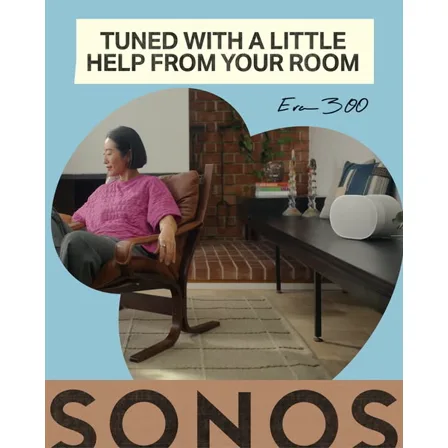
Interest
Tuned with a little help from your room
Headline: Sonos Era 300, featuring Trueplay. Trueplay reads your walls, floors and furniture, then tunes Sonos to fit.
One named mechanism, in one line, about the thing every speaker ad glosses over: the room. Swap the logo for a competitor and the sentence stops being true, which is the test an interest line has to pass.
See it in the Meta Ad Library
Desire
The Cloudmonster 3. Triple stacked. Fully Alive.
Headline: Hexagonal CloudTec pods, made to load energy on impact and release it on take-off
The shoe is barely in the frame. What is in the frame is the person you would be after the run, shot on a yellow kerb in the same colourway as the product. Desire is sold as identification here rather than as proof, which is the move a performance brand can make and a new one cannot.
See it in the Meta Ad Library
Action
BONDI SR. Professional Use.
Headline: Sometimes you need a second look, so we saved your cart. $180
The plainest creative of the four, and deliberately so: a product on grey, a price and a saved basket. It is aimed at somebody already persuaded, and every part of it removes a step between wanting the shoe and owning it.
See it in the Meta Ad LibraryWhat Each Stage Has to Do
-
1
A. Attention
Attention is whatever the reader meets first, which on a feed is the image and the type set inside it. The test is whether somebody who does not know your brand can tell in one second that this is not the ad they scrolled past a minute ago. Most ads fail here for a dull reason: they look exactly like the four ads around them, because everyone in the category briefed from the same reference.
-
2
I. Interest
Interest is bought with specifics. A number, a constraint, a named material, a thing the product does that the reader did not expect. Adjectives do not hold anyone: "premium", "effortless" and "game changing" are the words a reader has already learned to skip. If your interest line would still be true with a competitor logo on it, it is not doing this job.
-
3
D. Desire
This is the stage most ads skip, because it is the only one that needs material the copywriter cannot invent. Desire comes from a demonstration, a customer in their own words, a before and after, a number somebody can check. Assertion does not create wanting. It is also where your reviews and comments earn their keep, because the sentence that makes somebody want the product has usually already been written by a customer.
-
4
A. Action
An action step is three things: the verb, the destination and the reason it is today. Two of the three is the common miss. "Shop now" with no reason is a button, not an argument, and a strong reason with no destination leaves the reader to work out where to go, which they will not do. The offer does not have to be a discount. A deadline, a restock, a size running out and a place they are already going all work.
Where AIDA Came From, and Why It Survived
The sequence is credited to E. St. Elmo Lewis, a Philadelphia advertising man who ran an agency in the 1890s under the slogan "Ask Lewis about it" and who was elected to the Advertising Hall of Fame in 1951. The attribution that the textbooks have carried ever since comes from the psychologist Edward K. Strong, who credited Lewis with the formula in his 1925 book The Psychology of Selling and Advertising. Lewis himself started with three steps, attention, interest and desire, and action arrived later.
It has lasted more than a century on one property: the four jobs are easy to audit. Put any ad next to the list and the missing job is usually obvious within a minute, which is more than most frameworks give you. That diagnosis matters more as media gets more expensive and the targeting levers disappear into automation: Nielsen's creative-effectiveness research credits creative, not targeting or media spend, with up to 89% of a digital ad's in-market success. The argument the ad makes is the part still under your control, and AIDA is a cheap way to find the hole in it.
It also pairs with the two frameworks that tell you what to say rather than in what order. The five levels of awareness tell you how much your reader already knows, and market sophistication tells you how tired the market is of hearing your claim. AIDA orders the parts of one ad. Those two decide what those parts are allowed to say. For the first stage on its own, the hook generator writes opening lines by mechanism, and the free ad tools works on the argument underneath them. If you would rather read the four jobs off ads other people are already running, competitor ad analysis is the same audit applied to somebody else's account.
How to Write an Ad With It
-
1
Write the action first
Decide what you are asking for and why today, before you write a word of the rest. Everything above it exists to earn that ask, and an ad written from the top down usually arrives at the ask with nothing left to say.
-
2
Find the evidence before you write the claim
Open your reviews, your comments and your support inbox, and pull the sentences where a customer describes the outcome in their own words. That is the desire stage, already written. If no such sentence exists, the honest conclusion is that the product has not produced the outcome often enough to advertise it yet.
-
3
Give the interest line exactly one specific
One number, one constraint, one material. Two specifics compete and the reader remembers neither. The others belong on the landing page, where somebody has already decided to read.
-
4
Write the attention frame last, out of the strongest specific you found
The opening is easier to write once you know what the ad has to prove. Written first, it turns into a clever line with nothing under it, and the ad spends its best asset earning a stop it cannot pay off.
-
5
Read it back on a phone, muted, at arm length
That is the real test conditions. If the first frame does not survive being seen sideways and silent, the other three stages will never be reached, however good they are.
Where the Model Stops Being True
-
It describes one ad, not a customer journey
AIDA is a sequence inside a single piece of persuasion. It is neither a channel plan nor a funnel report. When a deck maps ad spend to A, I, D and A as though they were campaign stages, it is using a copy framework as a media framework, and the two answer different questions.
-
Real buying is not a clean line
Buyers loop. They see an ad, forget it, read a review six weeks later, ask a friend, come back through search, and only then buy. Hierarchy of effects models like this one assume an order that research on purchase behaviour keeps failing to find. The sequence is still useful for writing one ad, because a reader does meet the parts of that ad in an order. It is a weak description of a quarter.
-
Attention and interest have collapsed into the same frame
When the model was written, attention was a headline and interest was the paragraph under it, and the reader had already bought the magazine. In a feed the reader gives you both or neither, usually inside the first second and inside the first image. Treating them as two separate beats is how an ad ends up with a clever opening frame and nothing on it.
-
It ends at the purchase
There is no stage for the second order, the review, the referral or the churn, which is most of the money in a subscription or a repeat-purchase business. Later versions added one, usually satisfaction or conviction, and those extensions exist because the original stops at the till.
The Stage You Cannot Write Your Way Out Of
Attention, interest and action are craft. Desire is evidence, and evidence has to be found. It is sitting in your reviews, your comments, your support tickets and the results of the ads you already ran, which is exactly the material nobody has time to read. Selzee reads it, finds the sentences customers actually use about the outcome, and turns them into the next set of concepts your team can make this week. Research, concepts, create, then learning from what ran.
AIDA Model: FAQ
01 What does AIDA stand for? +
Attention, Interest, Desire, Action. It is a sequence for one piece of persuasion: earn the stop, hold the reader with something specific, make them want the outcome by showing evidence for it, and then ask for a defined action with a reason to take it now.
02 Who created the AIDA model? +
It is credited to E. St. Elmo Lewis, a Philadelphia advertising man elected to the Advertising Hall of Fame in 1951. The attribution the literature has carried since comes from Edward K. Strong, who credited Lewis with the sequence in his 1925 book The Psychology of Selling and Advertising.
03 Is the AIDA model still relevant? +
As a checklist for one ad, yes, and it is the fastest way to find which of the four jobs an ad is missing. As a description of how somebody buys over weeks, no. People loop between discovery, comparison and delay rather than moving down a line, so use AIDA to write the ad and something else to plan the quarter.
04 What is the difference between AIDA and the marketing funnel? +
AIDA is about what happens inside one ad, in the seconds somebody spends with it. The marketing funnel is about what happens across a market over months, where the stages are populations of people rather than moments of attention. They get confused because both draw as a triangle with purchase at the bottom.
05 Which AIDA stage do most ads get wrong? +
Desire. Attention and interest are craft problems a good writer can solve in an afternoon, and the action step is mostly discipline. Desire needs evidence that has to be gathered: a demonstration, a customer sentence, a number somebody can check. Ads that skip it assert the outcome louder, which is the move a tired market trusts least.
06 How do I apply AIDA to a short video ad? +
Compress the first two stages into the opening frame, because a scrolling viewer decides inside a second, and give desire the middle. Reserve the last three seconds for the action, spoken as well as shown, since a large share of the audience watches muted and the on-screen ask is the only one they get.
07 What are AIDAS, AIDCA and the other variants? +
Extensions that add a stage the original leaves out. AIDAS adds satisfaction after the purchase, AIDCA adds conviction between desire and action, and several later models add retention or advocacy. Each one exists because the four steps stop at the sale and say nothing about what happens after it.
Find the Missing Stage in Your Own Ads
Auditing one ad against four jobs takes a minute. Finding the evidence that makes the third one work is the slow part, and it is the part Selzee does from the material you already have.
Get started for freeKeep exploring: the marketing funnel, the 5 levels of awareness, the 5 stages of market sophistication, ten advertising hook mechanisms.