Facebook Ad Spy Tools: 9 Compared, With Prices (2026)
Short answer: start with the free Meta Ad Library to look at a brand's live ads. Pay for Minea or PiPiADS to find products, Foreplay to save and track competitors, and AdSpy or PowerAdSpy for affiliate offers. Use Selzee to turn what's working into your own ads.
 Simon Beno
17 min read
Simon Beno
17 min read
Choose the tool by the job
- Choose the Meta Ad Library if you want to look at a brand's live ads for free.
- Choose Minea or PiPiADS if you hunt for products to sell.
- Choose Foreplay if you want to save ads and track a few competitors.
- Choose AdSpy or PowerAdSpy if you run affiliate offers.
- Choose Selzee if you want to turn what's working into your own ads.
Our articles are still written by HUMANS! Get human written articles in your Google feed.
Add as preferred sourceFacebook ad spy tools compared
The table puts all 9 tools side by side on price, free access, platforms and what each shows about an ad. The free Meta Ad Library comes first, because every paid tool has to beat it. One column goes against us: Selzee has no ad library you can browse. For a wider list, see 13 ad intelligence tools compared.
| Tool | Price | Free plan or trial | Platforms | What it shows | Browse ads yourself | Best for |
|---|---|---|---|---|---|---|
| Meta Ad Library | Free | Free, no login needed | Facebook, Instagram, Messenger, Audience Network, Threads | Start date per ad; reach, age, gender and location only for ads shown in the EU; no engagement | Yes | Looking at a brand's live ads for free |
| Selzee | From $19/week or $75/month, credit-based | Start free, no card | Reads competitors' Meta and TikTok ads in the background | No ad library: builds new ads for your brand from proven formats | No | Turning what's working into your own ads |
| AdSpy | $149/mo, one plan | No free plan or trial on its page | Facebook, Instagram (per AdSpy) | Last seen, likes, comments, landing page; sorts by run time (per AdSpy) | Yes | Affiliate offers |
| BigSpy | $69 to $499/mo | Free plan advertised; search needs a login | 11 networks, Facebook among them | Date range per ad (guest view) | Yes | A wide scan across many networks |
| PiPiADS | $49 to $900/mo | 500 free test credits, not a time-limited trial | TikTok, Facebook | Days running, likes, comments, shares; ad cost estimate | Yes | Finding products |
| Minea | $49 to $199/mo | No free plan on the pricing page; a free account can search ads | Meta, TikTok | Days running; reach and spend for EU ads; no likes or comments | Yes | Finding products |
| PowerAdSpy | $69 to $399/mo | No free plan; paid 3-day trial from $1 | Facebook, Instagram, YouTube, Google, TikTok and more (per PowerAdSpy) | Days running, engagement, landing page, targeting (per PowerAdSpy) | Yes | Affiliate offers |
| Foreplay | $59 to $459/mo | 7-day free trial, card charged after; no free plan | Facebook, Instagram, TikTok, LinkedIn (per Foreplay) | Running time, engagement, estimated spend, landing page (per Foreplay) | Yes | Saving ads and tracking competitors |
| Winning Hunter | €49 to €249/mo | No free trial stated on the pricing page | Facebook, TikTok, Pinterest (per Winning Hunter) | Ad spend, scaling signals, ad creation dates (per Winning Hunter) | Yes | Dropshippers tracking a few competitors |
Prices read from each vendor's own pricing page on 2 Oct 2026. Minea and Winning Hunter showed euro prices to our browser, and PiPiADS shows its Basic and Advanced prices as discounts on higher list prices. Cells marked with a (per ...) note come from that tool's own site; the rest we checked in the tool on 2 Oct 2026. Verified 2026-10-02.
We searched Gymshark in every free tier
We searched Gymshark on 2 Oct 2026 in the free Meta Ad Library and in the free tiers of Minea, PiPiADS and BigSpy. Each tool showed something different, and the three that answered gave three different oldest Gymshark ads: 92 days in Meta, 59 in Minea, 468 in PiPiADS. Treat how long an ad has run as a signal you check, not a fact a tool hands you.
Meta Ad Library: free, but noisy and with no run-time sort
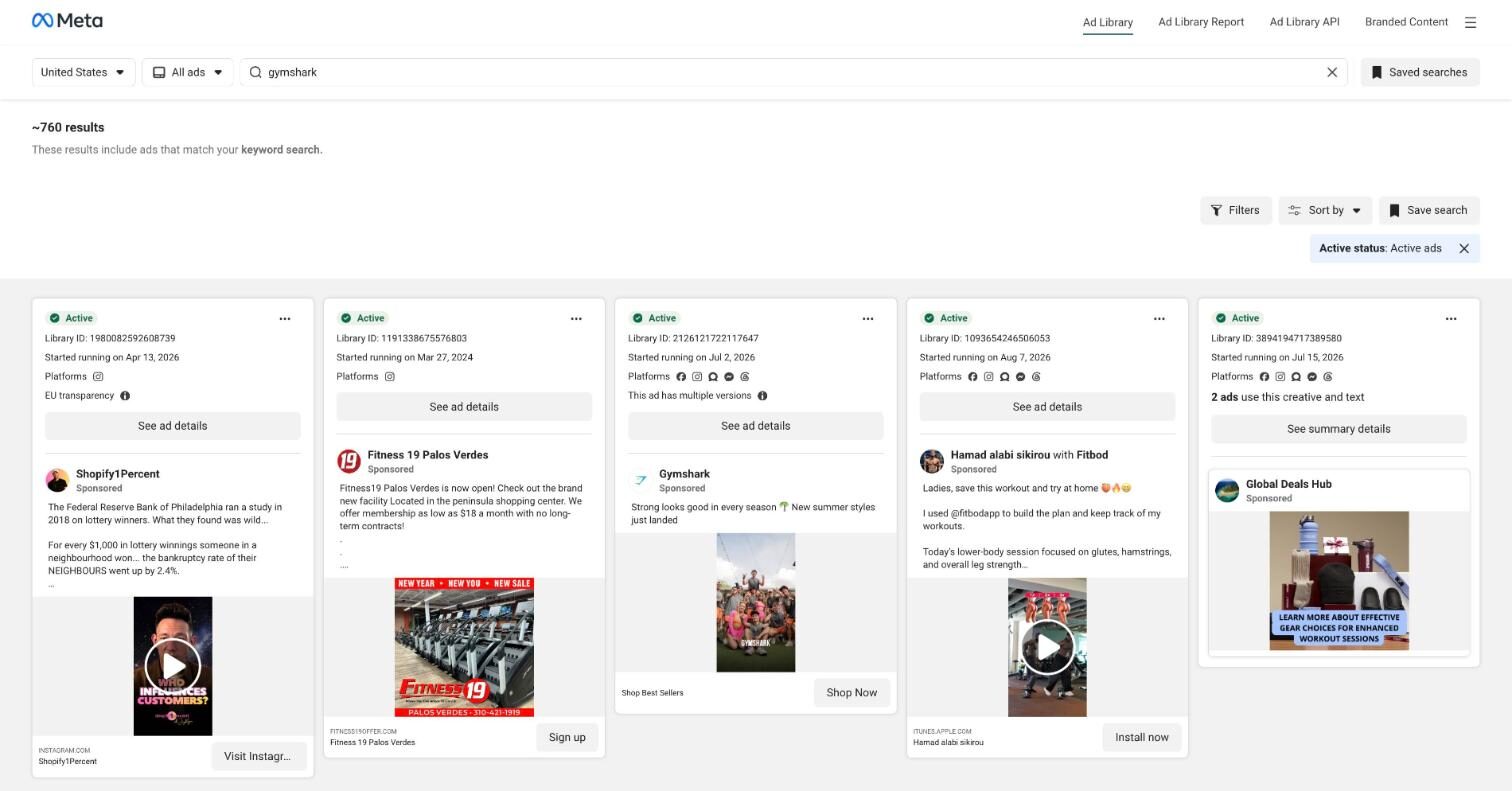
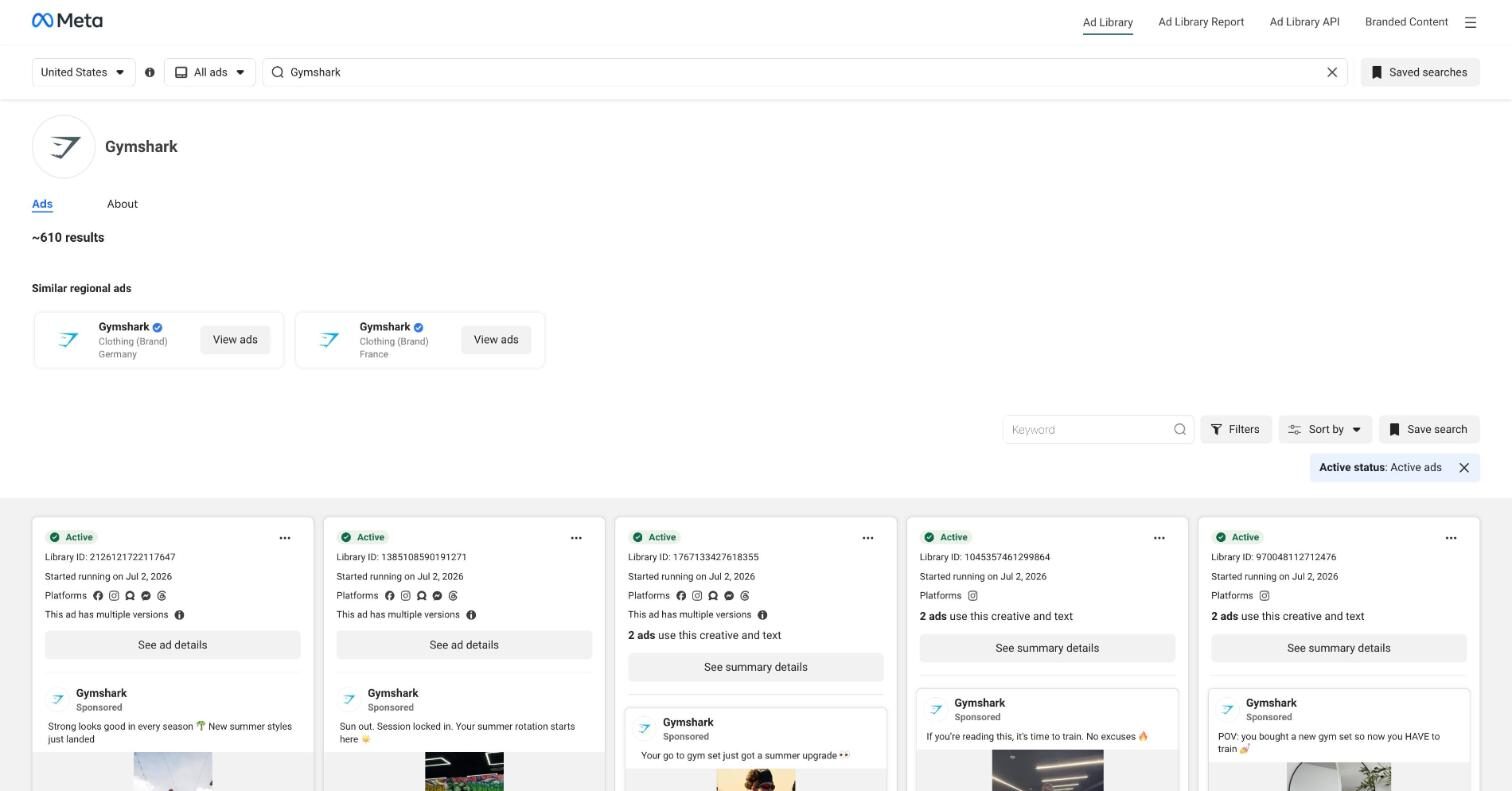
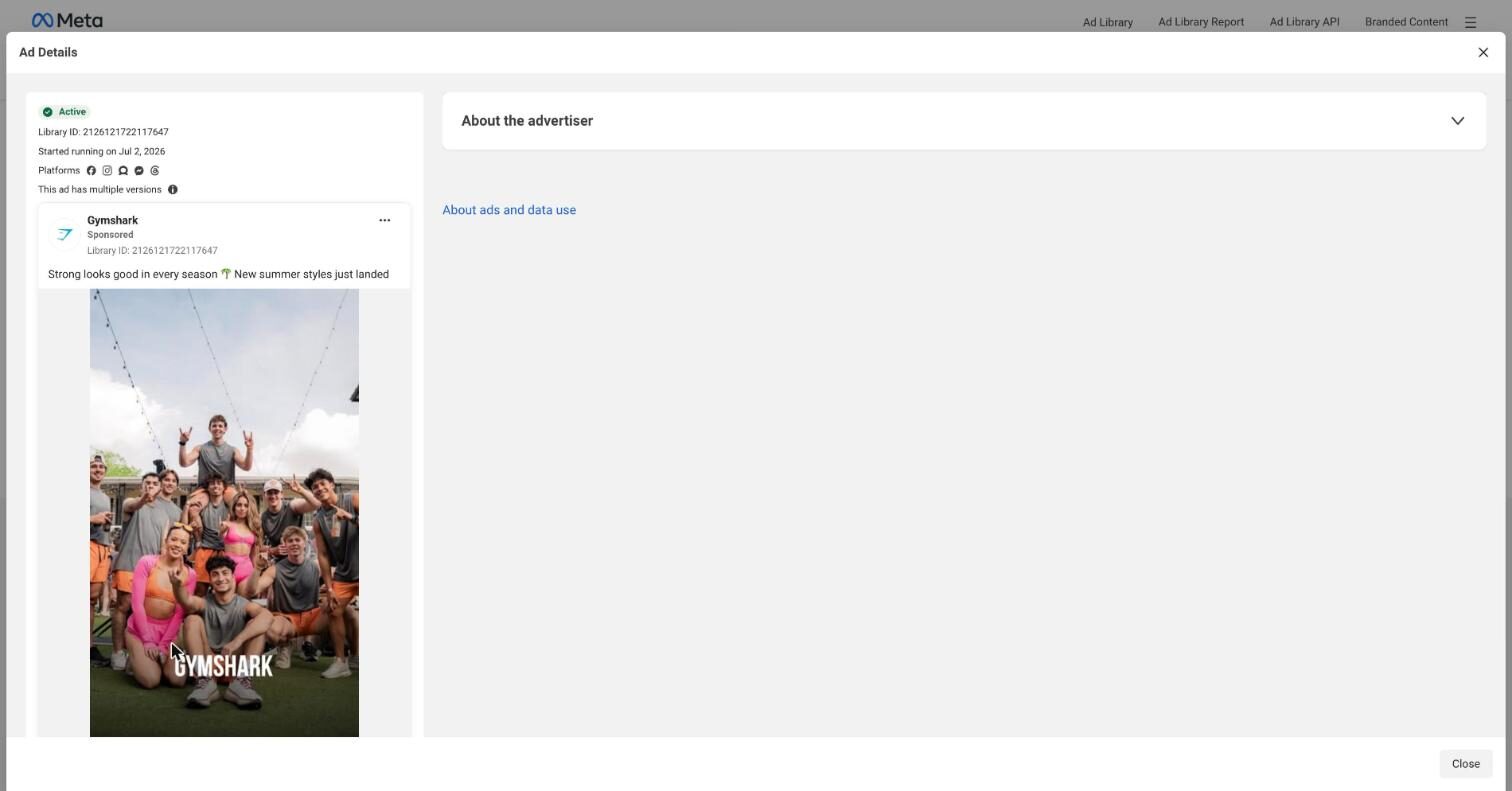
A keyword search for "gymshark" (US, active ads) returned about 760 results, and only 3 of the first 8 advertisers were Gymshark. Picking Gymshark's own Page from the Advertisers suggestions gave about 610 active US ads. The only sorts are impressions and newest, so there is no way to list the longest runners first. The oldest ad we could load had run 92 days, and the list stopped loading after 62 cards. The details of a US ad showed the advertiser and nothing else: no engagement, spend, reach or targeting.
Minea: EU reach and spend for free, once you switch the search
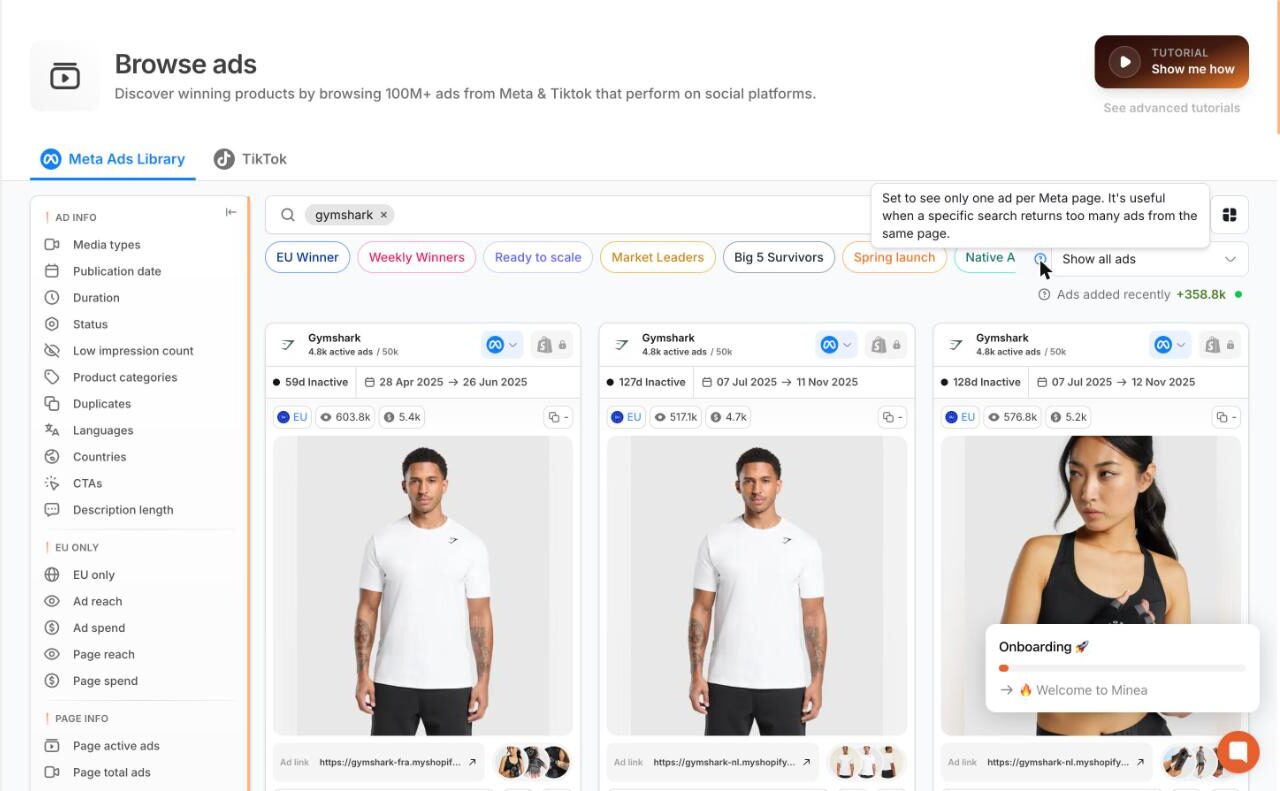
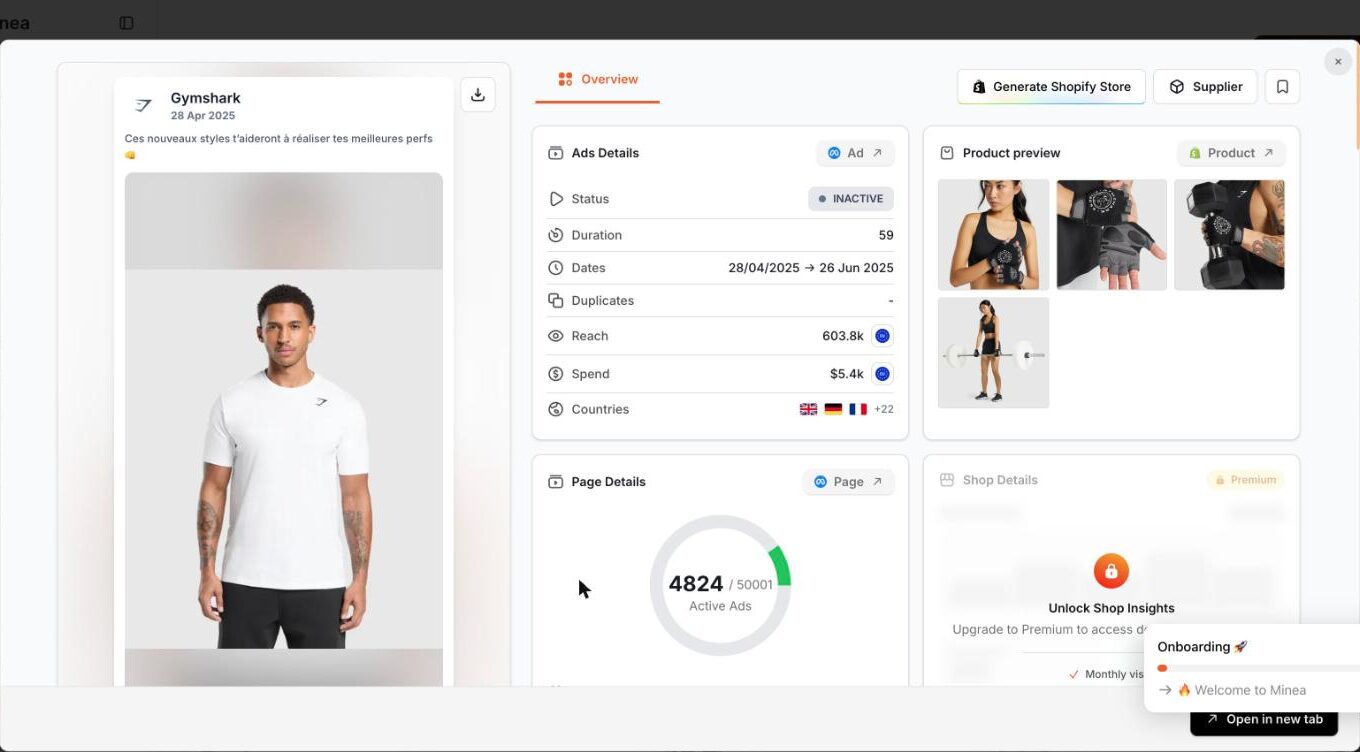
Minea searches ad copy by default, which returned other brands. Switching the target to Page name gave one Gymshark card: 4.8k active ads, 50k in total. Ads shown in the EU carry reach and spend on the free account. There is no sort by days running; sorting by publication date, oldest first, put a 59-day ad at the top (28 Apr to 26 Jun 2025, reach 603.8k, about 5,400 dollars of spend in the EU). Shop insights are locked behind Premium.
PiPiADS: the only real days-running sort, paid for in credits
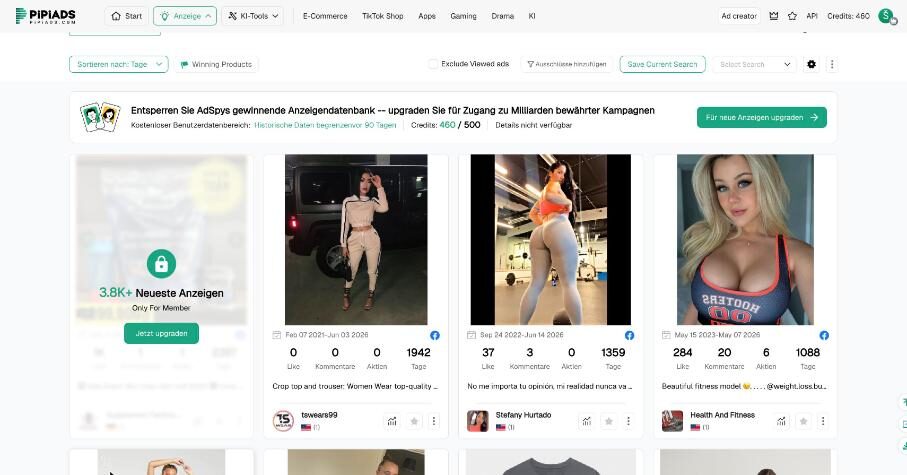
On the Facebook tab, PiPiADS was the only tool with a true sort by days running, and each card shows likes, comments and shares. Sorted by days, the top "gymshark" result was a reseller at 2,397 days. Gymshark's own longest ad ran 468 days, from Dec 2022 to May 2025. Each search, sort or detail view cost 20 of the 500 free credits, and the total count and the ad's links stayed locked.
BigSpy: search blocked for guests
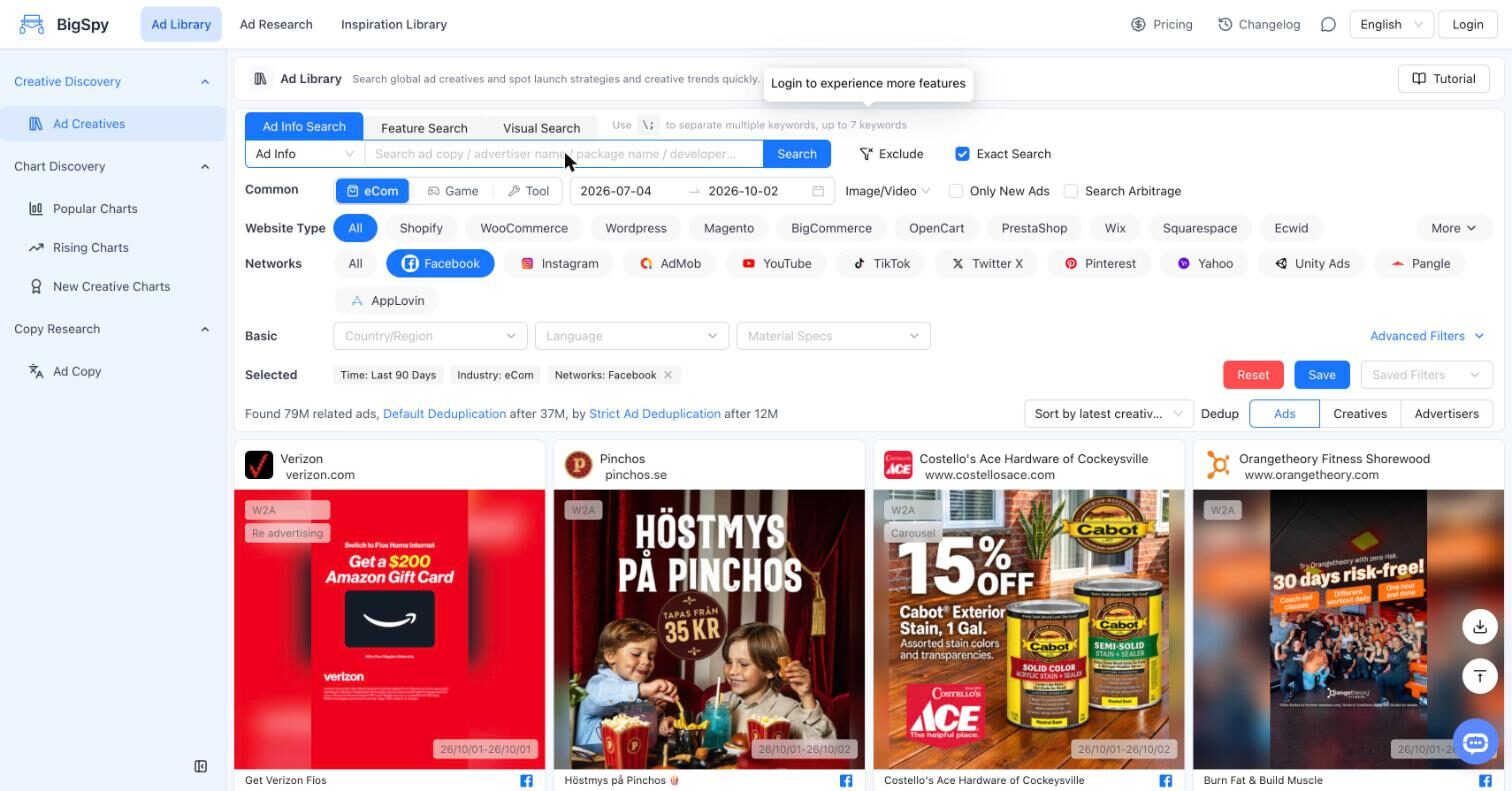
As a guest, typing "gymshark" and pressing Enter did nothing; a tooltip said "Login to experience more features". We got no result count, no ad detail and no run time.
Time per brand
About 10 minutes and 12 clicks in the Meta Ad Library, 5 minutes and 12 clicks in Minea, 5 minutes and 10 clicks in PiPiADS. BigSpy took 4 minutes and gave no answer.
Which spy tool fits you?
Question 1 of 4
What do you sell?
Question 2 of 4
What do you want from other people's ads?
Question 3 of 4
Monthly budget for tools?
Question 4 of 4
Where do you get stuck?

PiPiADS
The only true sort by days running in our test, with 500 free credits to try it.
500 free test credits
Get started with PiPiADS
Meta Ad Library
Free and no login: every active ad on a brand's Page, with its start date.
Free
Get started with Meta Ad Library
Minea
Search a store's Meta and TikTok ads, with reach and spend on EU ads.
from $49/mo
Get started with Minea
Foreplay
Save the ads you like and keep tabs on the brands you watch.
from $59/mo
Get started with Foreplay
Minea
Product hunting across Meta and TikTok ads, with EU reach and spend.
from $49/mo
Get started with Minea
PiPiADS
Sort by days running and see likes, comments and shares on every ad.
from $49/mo
Get started with PiPiADS
Winning Hunter
Our pick for dropshippers who track a few competitors.
from €49/mo
Get started with Winning Hunter

PowerAdSpy
Our affiliate pick on a smaller budget. The trial is paid.
from $69/mo
Get started with PowerAdSpy


Selzee
Recreates ads winning right now for your brand, with new ads every day.
Start free, no card. Then from $19/week or $75/month, credit-based
Get started with Selzee
Selzee
Selzee finds what's already working in your market and makes new ads in your brand from it.
Start free, no card. Then from $19/week or $75/month, credit-based
Get started with Selzee-
Budget free, wants products (any q1)
PiPiADS
The only true sort by days running in our test, with 500 free credits to try it.
500 free test credits
-
Budget free, wants ideas, tracking or a wide scan (any q1)
Meta Ad Library
Free and no login: every active ad on a brand's Page, with its start date.
Free
-
Dropshipping, wants ideas, paid budget
Minea
Search a store's Meta and TikTok ads, with reach and spend on EU ads.
from $49/mo
-
Own brand, agency or affiliate, wants ideas, paid budget
Foreplay
Save the ads you like and keep tabs on the brands you watch.
from $59/mo
-
Wants products, under 100 dollars (any q1)
Minea
Product hunting across Meta and TikTok ads, with EU reach and spend.
from $49/mo
-
Wants products, 100 dollars or more (any q1)
PiPiADS
Sort by days running and see likes, comments and shares on every ad.
from $49/mo
-
Dropshipping, wants tracking, paid budget
Winning Hunter
Our pick for dropshippers who track a few competitors.
from €49/mo
-
Own brand, agency or affiliate, wants tracking, paid budget
Foreplay
Save ads and track a few competitors over time.
from $59/mo
-
Affiliate, wide scan, under 100 dollars
PowerAdSpy
Our affiliate pick on a smaller budget. The trial is paid.
from $69/mo
-
Wide scan, 100 dollars or more (any q1)
AdSpy
One flat plan for a wide search, with no free trial.
$149/mo
-
Own brand, dropshipping or agency, wide scan, under 100 dollars
BigSpy
One search across 11 networks, Facebook among them.
from $69/mo
-
In the top 2 on every answer: first if you get stuck turning what you find into new ads, second if you get stuck finding what works.
Selzee
Recreates ads winning right now for your brand, with new ads every day.
Start free, no card. Then from $19/week or $75/month, credit-based
What to look for in a Facebook ad spy tool
Five things decide whether a Facebook ad spy tool is worth paying for: how far back its ads go, whether you can search by brand instead of ad copy, a sort by how long an ad has run, the platforms it covers, and what you do with what you find.
How far back the ads go
Meta's library drops a normal ad once it stops running and keeps ads shown in the EU for a year. Minea and PiPiADS still listed Gymshark ads that stopped in 2025.
Brand search, not ad-copy search
In our test, a keyword search for "gymshark" in Meta's library returned mostly other advertisers. Minea also searches ad copy until you switch it to Page name.
A sort by days running
Brands keep paying for the ads that work, so run time is the signal to sort by. In our test, only PiPiADS could sort by days.
The platforms it covers
Meta's library covers Facebook, Instagram, Messenger, Audience Network and Threads. Minea and PiPiADS add TikTok. For Google, see our Google Ads Transparency Center guide.
What you do with what you find
A list of other brands' ads is research. Your next ad still has to be made, which is where the steps below start.
The tools, one by one
Each card gives the tool's strength, its catch, its price as read on 2 Oct 2026, and who should pick it. We ran Gymshark through the Meta Ad Library, Minea and PiPiADS ourselves. BigSpy blocked our search without a login, and the other cards come from each vendor's own site.
Meta Ad Library
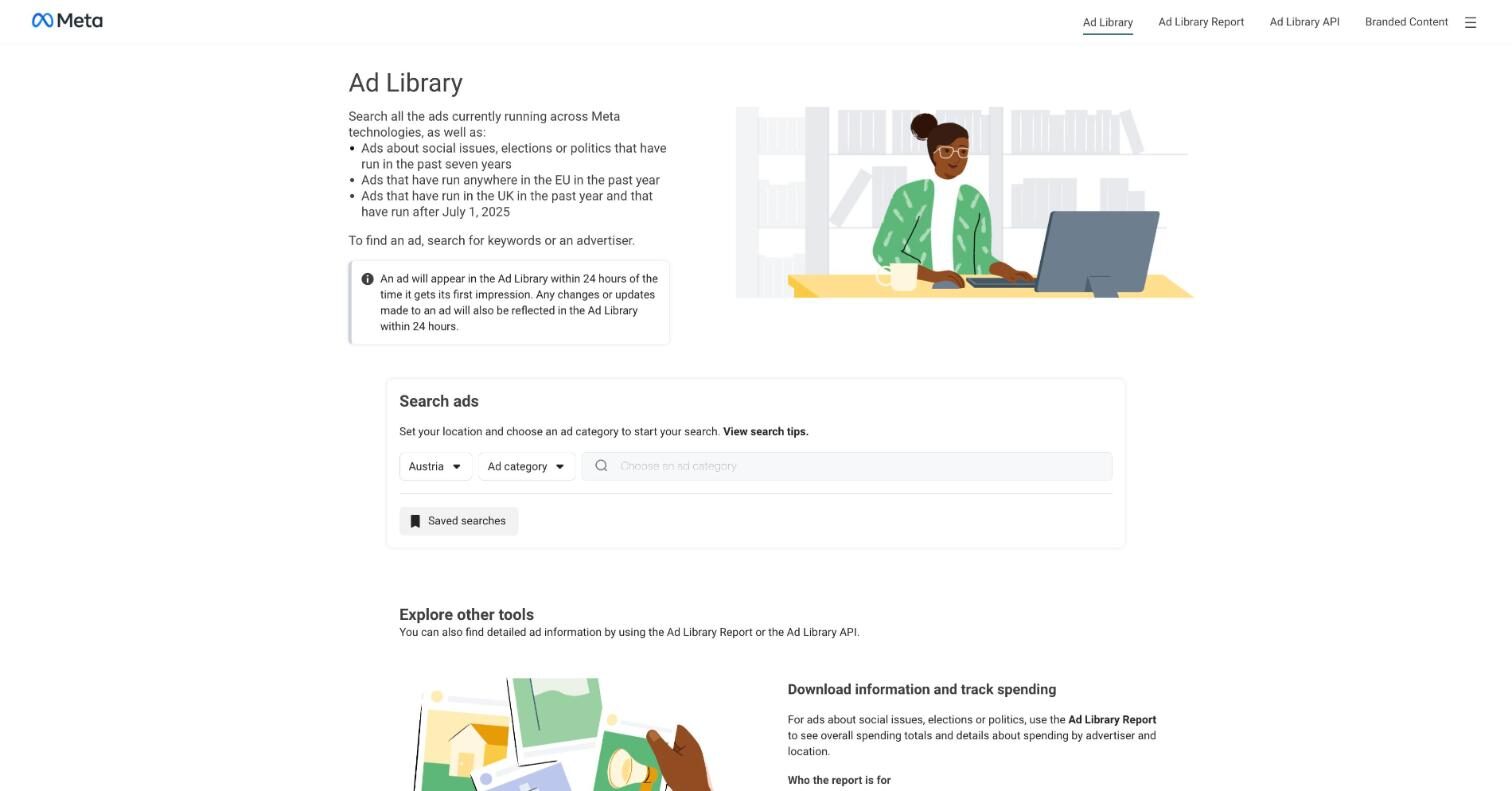
Meta's own free search of the ads running on its apps, with no login needed.
The catch: No sort by how long an ad has run, a keyword search returns mostly other brands, and a US ad shows no spend, reach or engagement. Ordinary ads drop out once they stop.
Pricing: Free
Best for: Looking at a brand's live ads for free.
Choose it if: you check a short list of brands and can read start dates by eye. Our Meta Ad Library guide shows how to search it by brand.
Selzee
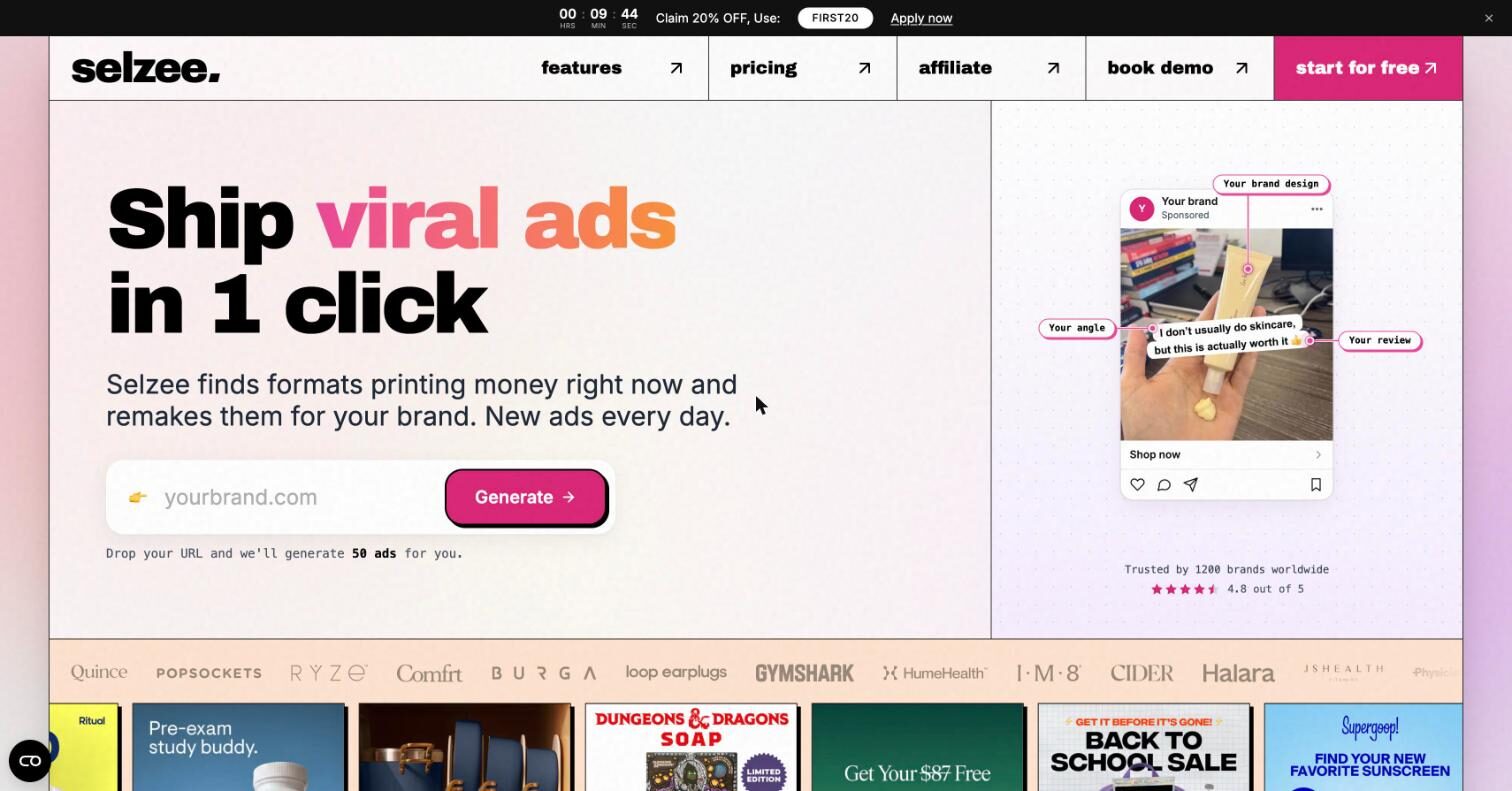
Selzee is an AI ad generator that recreates ads winning right now for your brand. It scrapes competitors' Meta and TikTok ads in the background and builds new ads for your brand from proven formats.
The catch: Selzee has no ad library you can browse, search or filter. If you want to dig through ads yourself, pair it with one of the tools here.
Pricing: Start free, no card. Then from $19/week or $75/month, credit-based. See pricing.
Best for: Turning what's working into your own ads.
Choose it if: finding good ads is not your problem, and making your own version of them is.
AdSpy
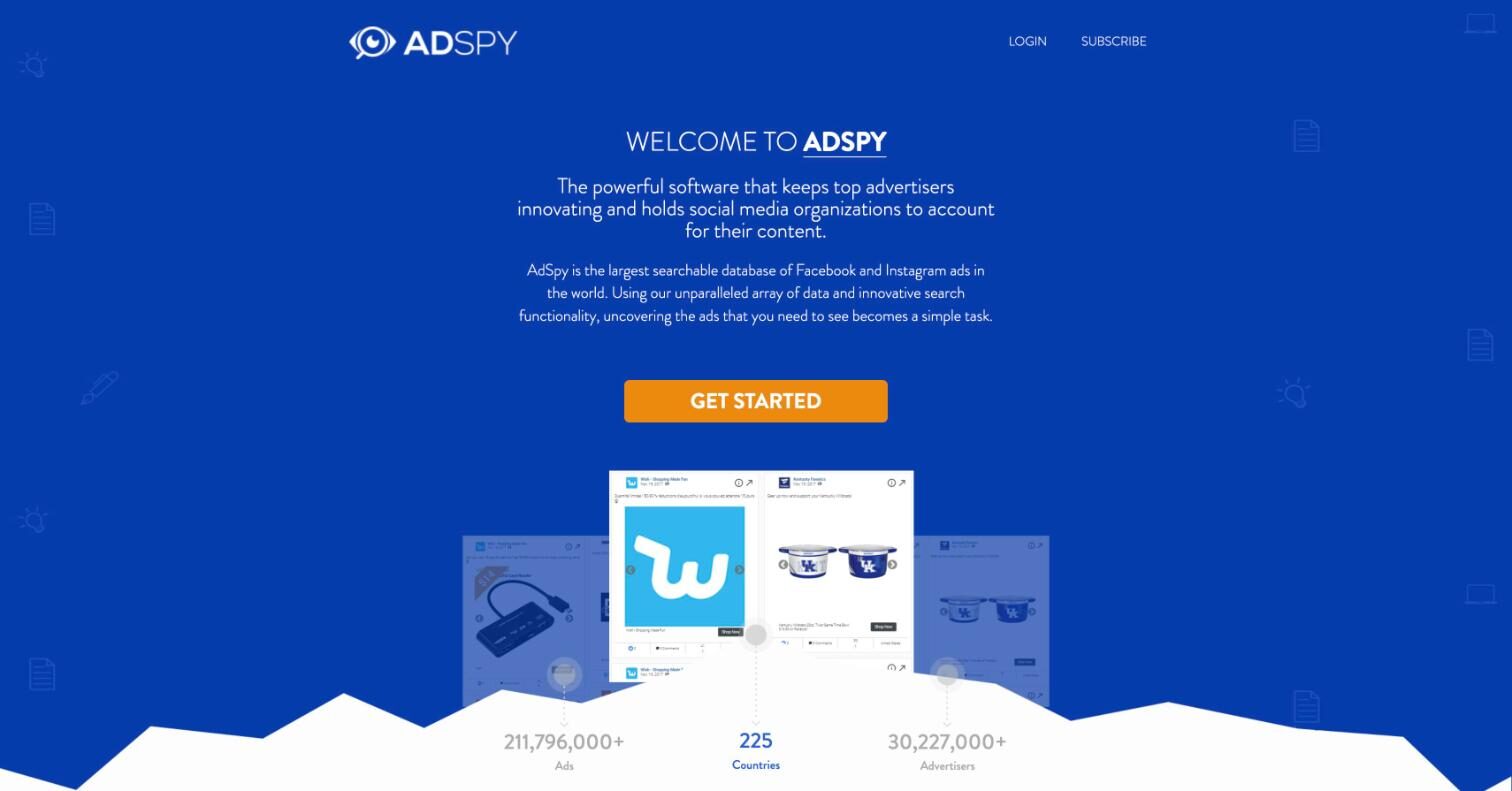
A paid ad search tool sold as one flat monthly plan.
Its site says: AdSpy lists 211.8 million ads across Facebook and Instagram, searchable by ad text, advertiser, URL and affiliate network, with a sort by run time.
The catch: Its page lists no free plan or trial, and calls the price an introductory offer that "will not be the same for long".
Pricing: $149/mo
Best for: Affiliate offers.
Choose it if: you work affiliate offers and can pay for a month before you try it. We covered the cheaper options in AdSpy alternatives.
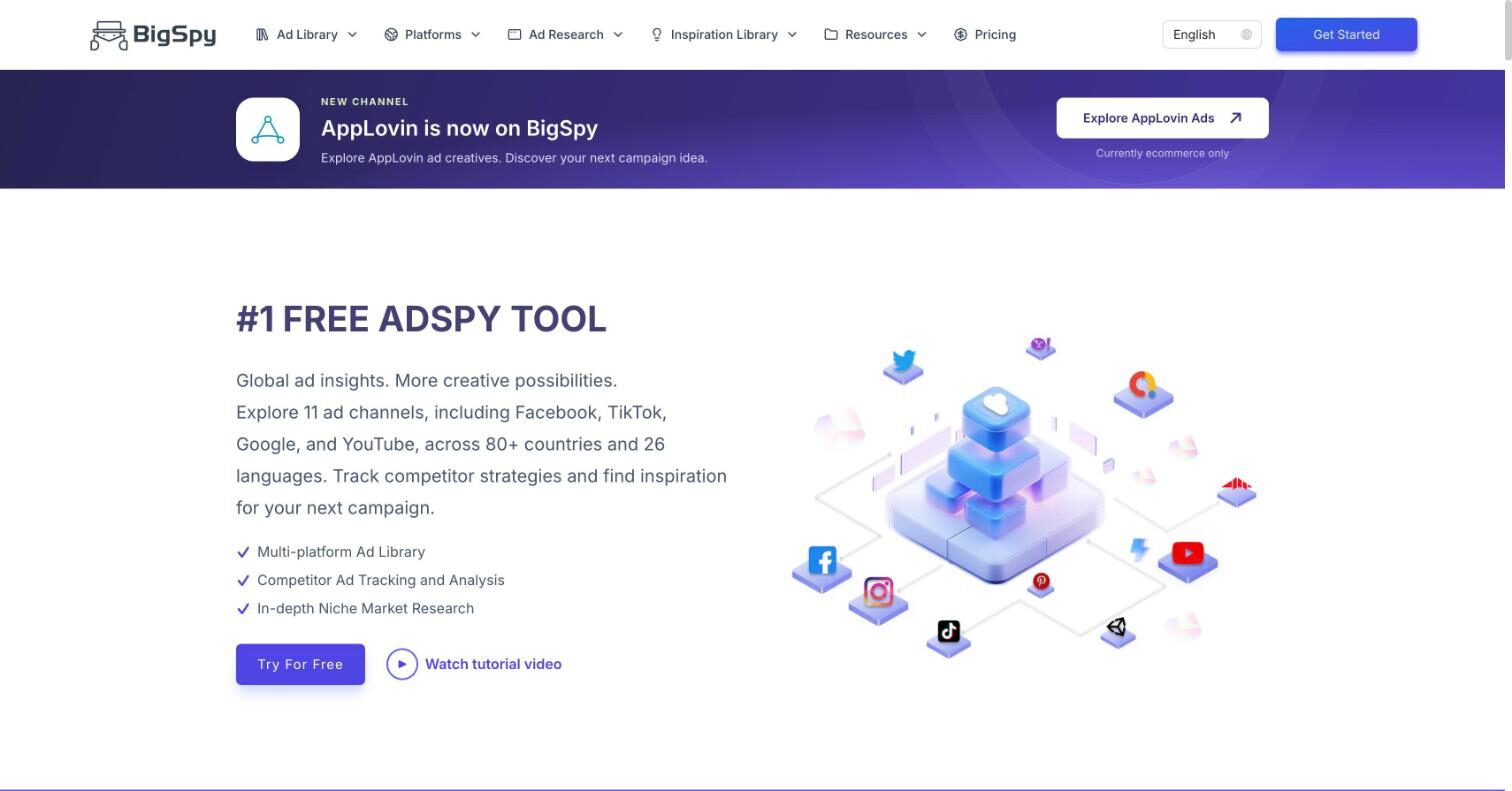
BigSpy
One ad search across 11 networks, Facebook among them, with industry filters such as ecommerce and games.
The catch: Search needs a login. As a guest, our Gymshark search was blocked with "Login to experience more features".
Pricing: Free plan advertised, then $69 to $499/mo (pricing page)
Best for: A wide scan across many networks.
Choose it if: you want breadth across networks more than depth in one, on a small budget.
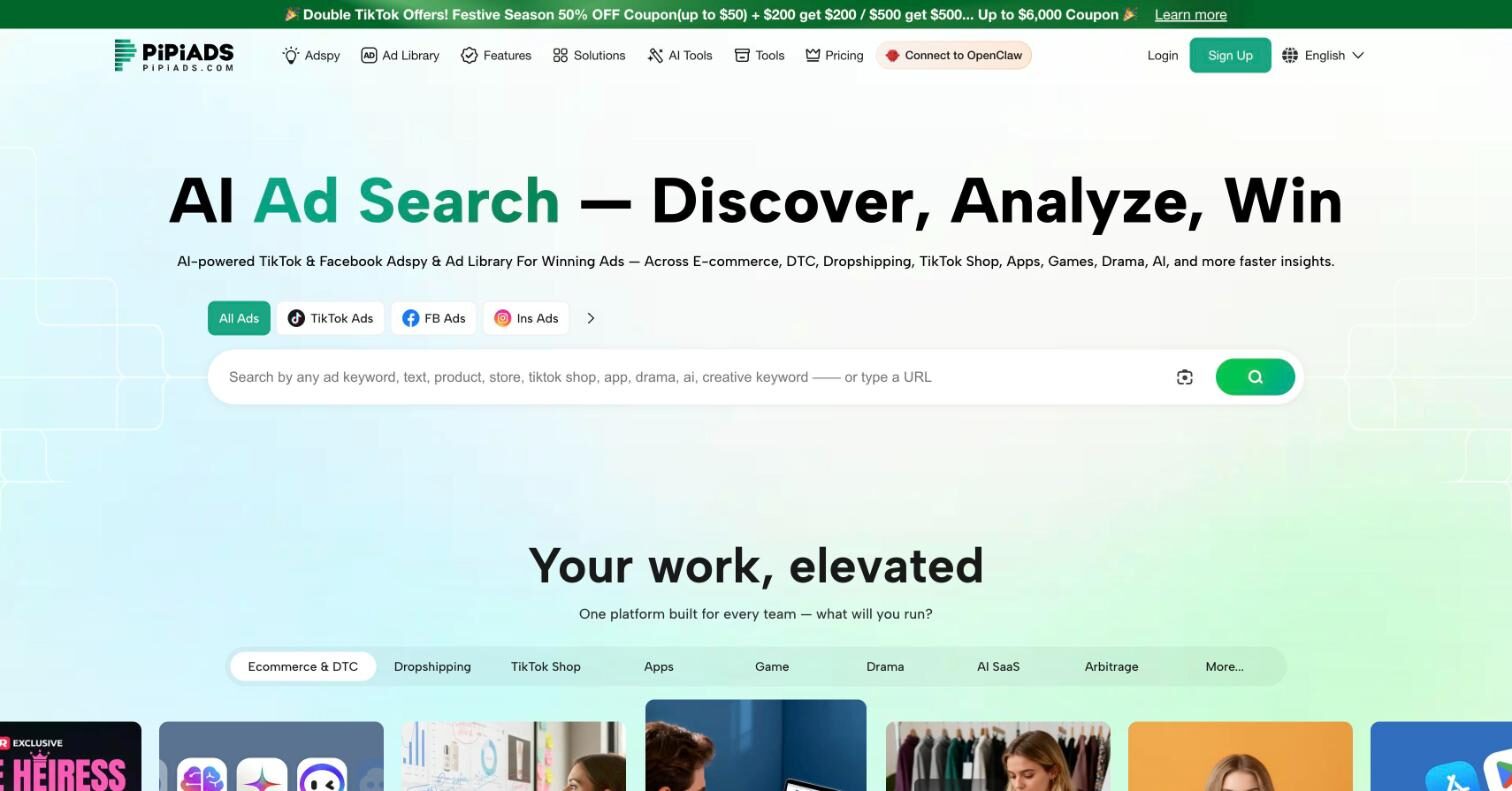
PiPiADS
TikTok and Facebook ad search with the only true sort by days running in our test, plus likes, comments and shares on every card.
The catch: The free tier is 500 credits, not a trial, and each search, sort or detail view costs 20. Its pricing page shows Basic and Advanced as discounts on higher list prices.
Pricing: $49 to $900/mo
Best for: Finding products.
Choose it if: run time is the signal you trust and you hunt for products to sell.
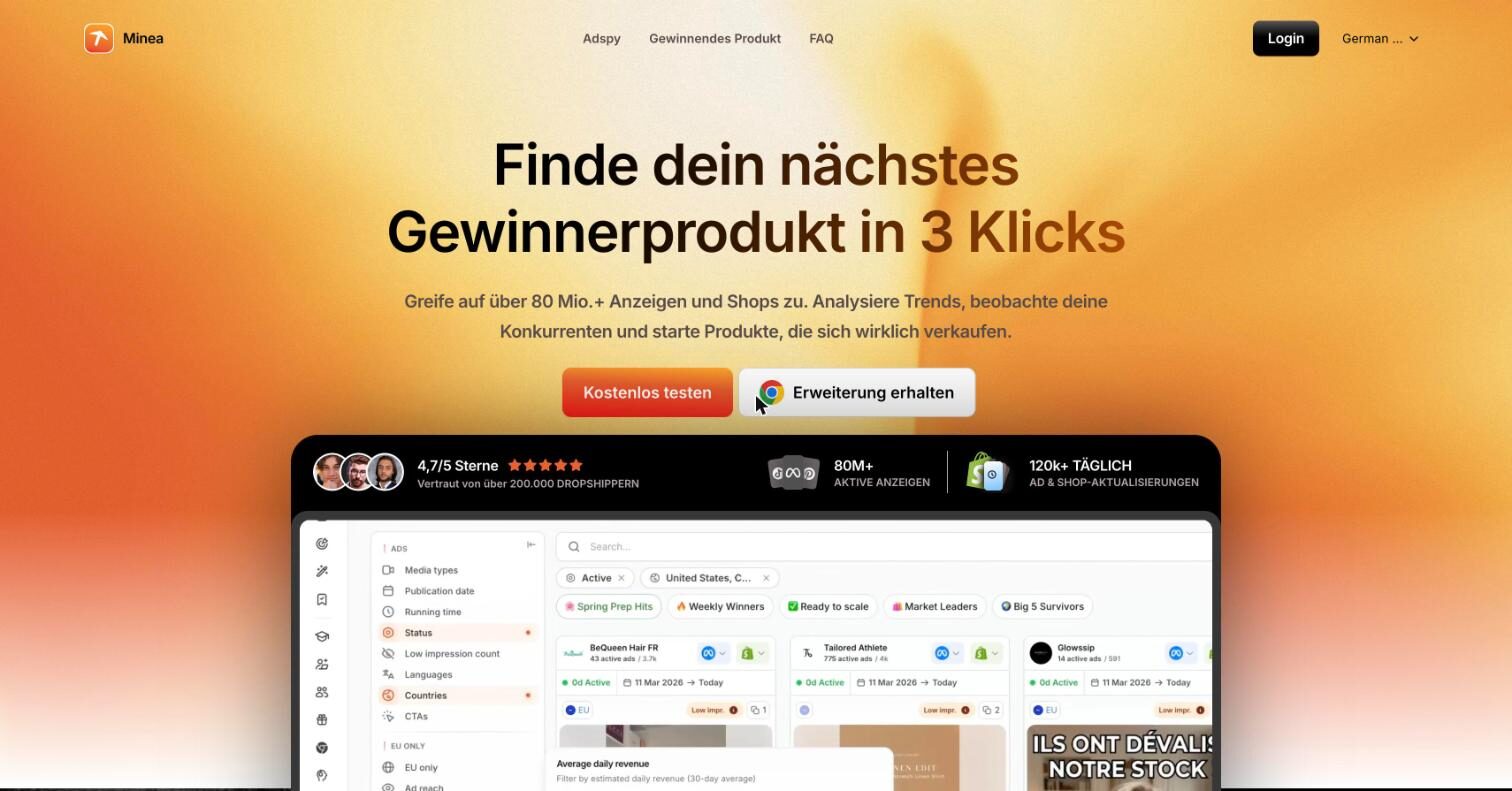
Minea
Meta and TikTok ad search that shows reach and spend for ads shown in the EU, on a free account.
The catch: No sort by days running, the default search is by ad copy, and Shop insights are locked behind Premium. The pricing page lists no free plan.
Pricing: $49 to $199/mo
Best for: Finding products.
Choose it if: you want spend and reach estimates on EU ads while you hunt products.
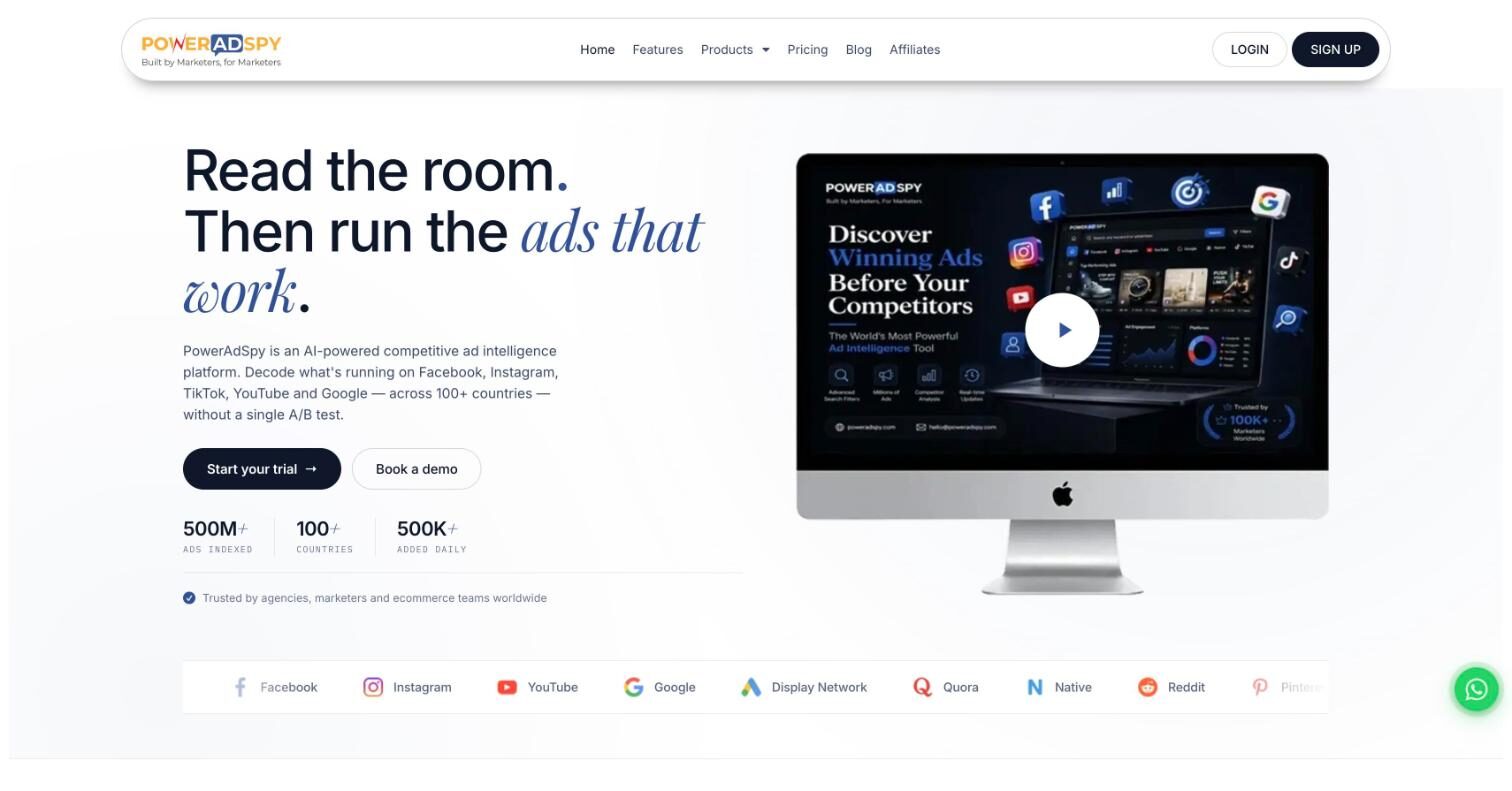
PowerAdSpy
A paid ad spy tool with four plans, from Basic to Palladium, and yearly billing at 50 to 70% off.
Its site says: PowerAdSpy lists ads from Facebook, Instagram, YouTube, Google and TikTok, among others, with a sort by ad lifespan.
The catch: No free plan: even the 3-day trial is paid.
Pricing: $69 to $399/mo; trial $1
Best for: Affiliate offers.
Choose it if: you work affiliate offers on a smaller budget than AdSpy needs.
Foreplay
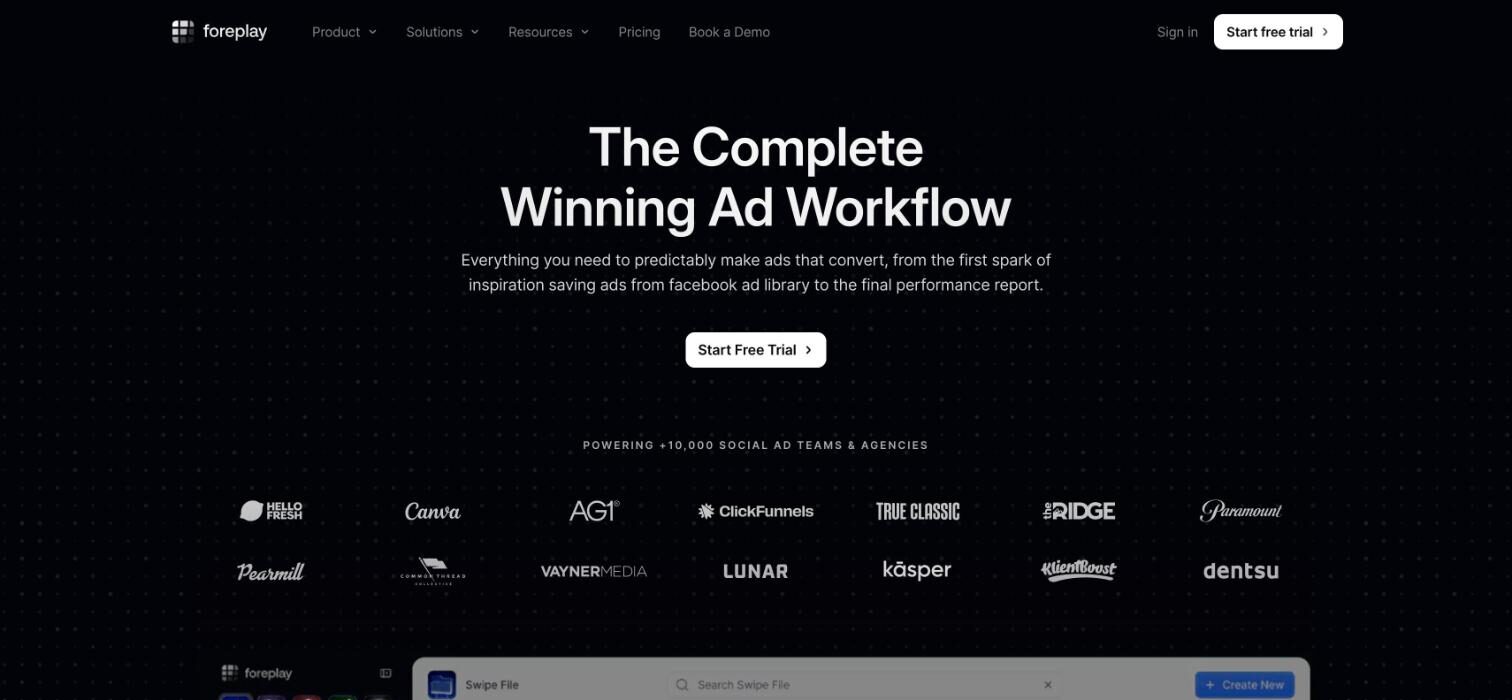
A place to save ads you like and track the competitors you watch.
Its site says: Foreplay shows running time, engagement and estimated spend for Meta, TikTok and LinkedIn ads, with a sort by running time.
The catch: No free plan, and the 7-day trial charges your card when it ends. It is built for saving ads, not as an archive of old ones.
Pricing: $59 to $459/mo
Best for: Saving ads and tracking competitors.
Choose it if: your team wants one shared place for the ads it saves. We compared it with Selzee in Foreplay vs Selzee.
Winning Hunter
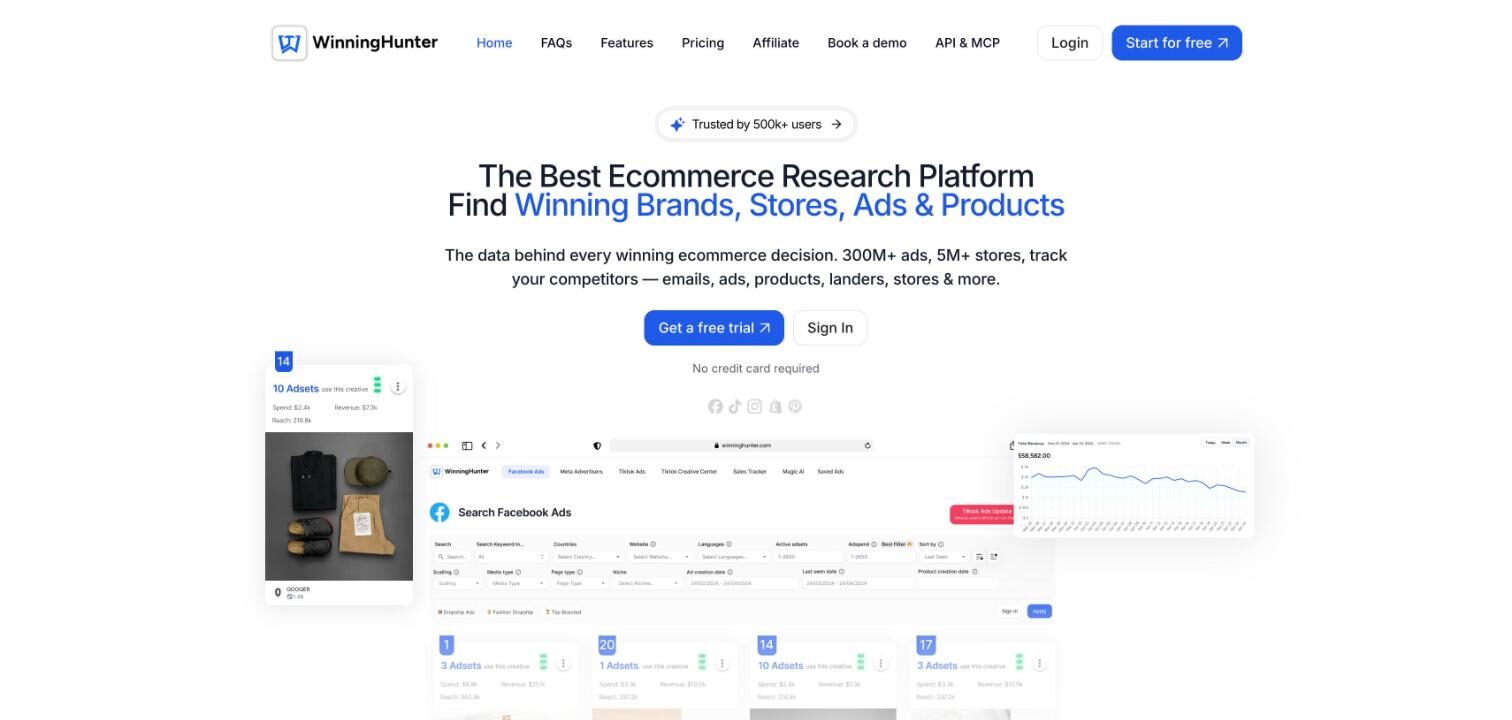
An ad spy tool for dropshippers, with Basic, Standard and Premium plans priced in euros.
Its site says: Winning Hunter shows ad spend, scaling signals and creation dates for Facebook, TikTok and Pinterest ads, and tracks Shopify stores.
The catch: The pricing page states no free trial: its "Start for Free" button is a signup link. Its site lists no Instagram ads.
Pricing: €49 to €249/mo
Best for: Dropshippers tracking a few competitors.
Choose it if: you run a store and want to keep an eye on a handful of rival stores.
What no spy tool can show you
No spy tool shows a competitor's real targeting, spend or results for a US ad. The most you get are estimates: PiPiADS shows an estimated ad cost, and Minea shows spend only for ads shown in the EU. In our test, the details of a US Gymshark ad in Meta's own library showed the advertiser and nothing else.
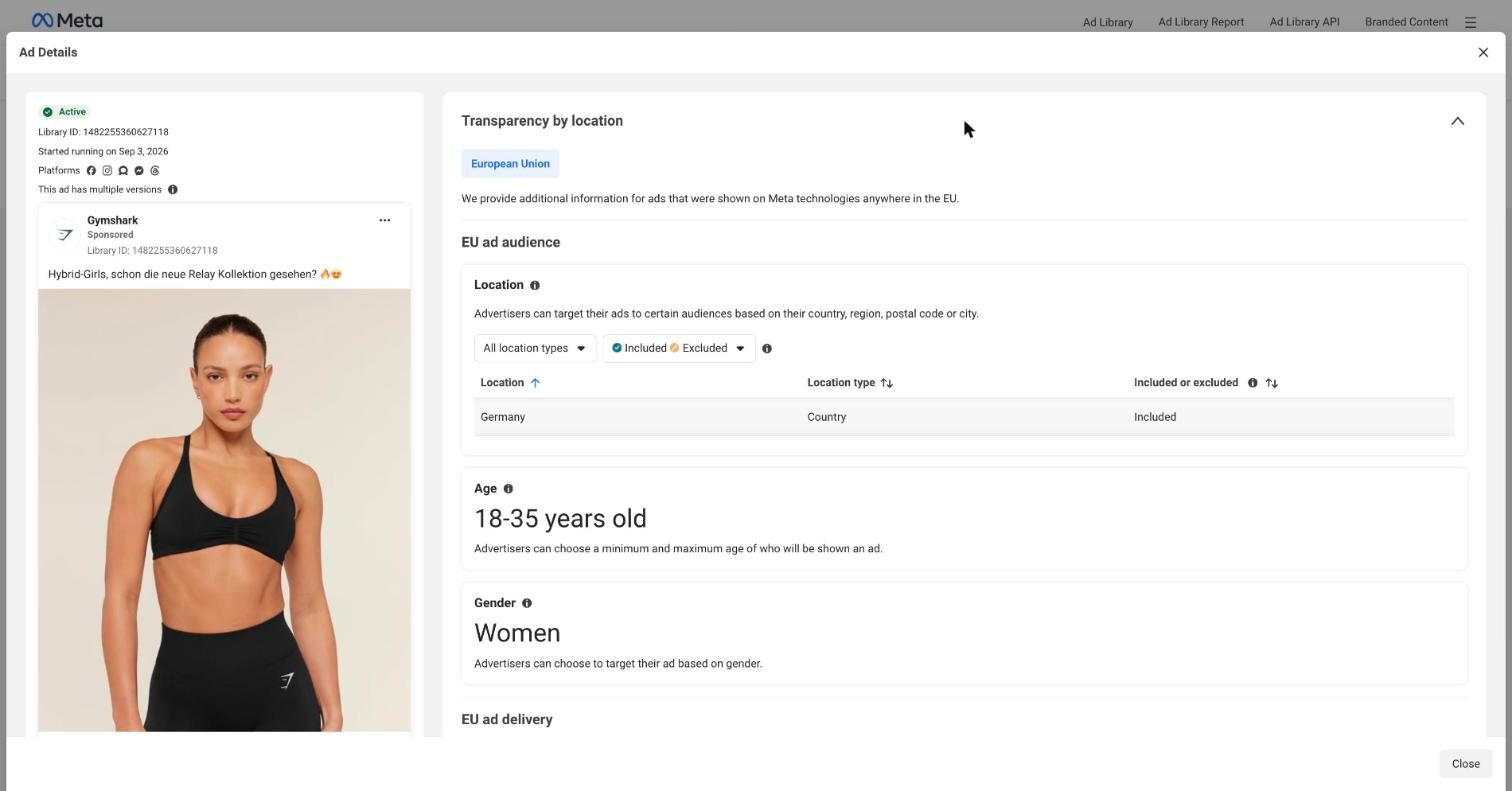
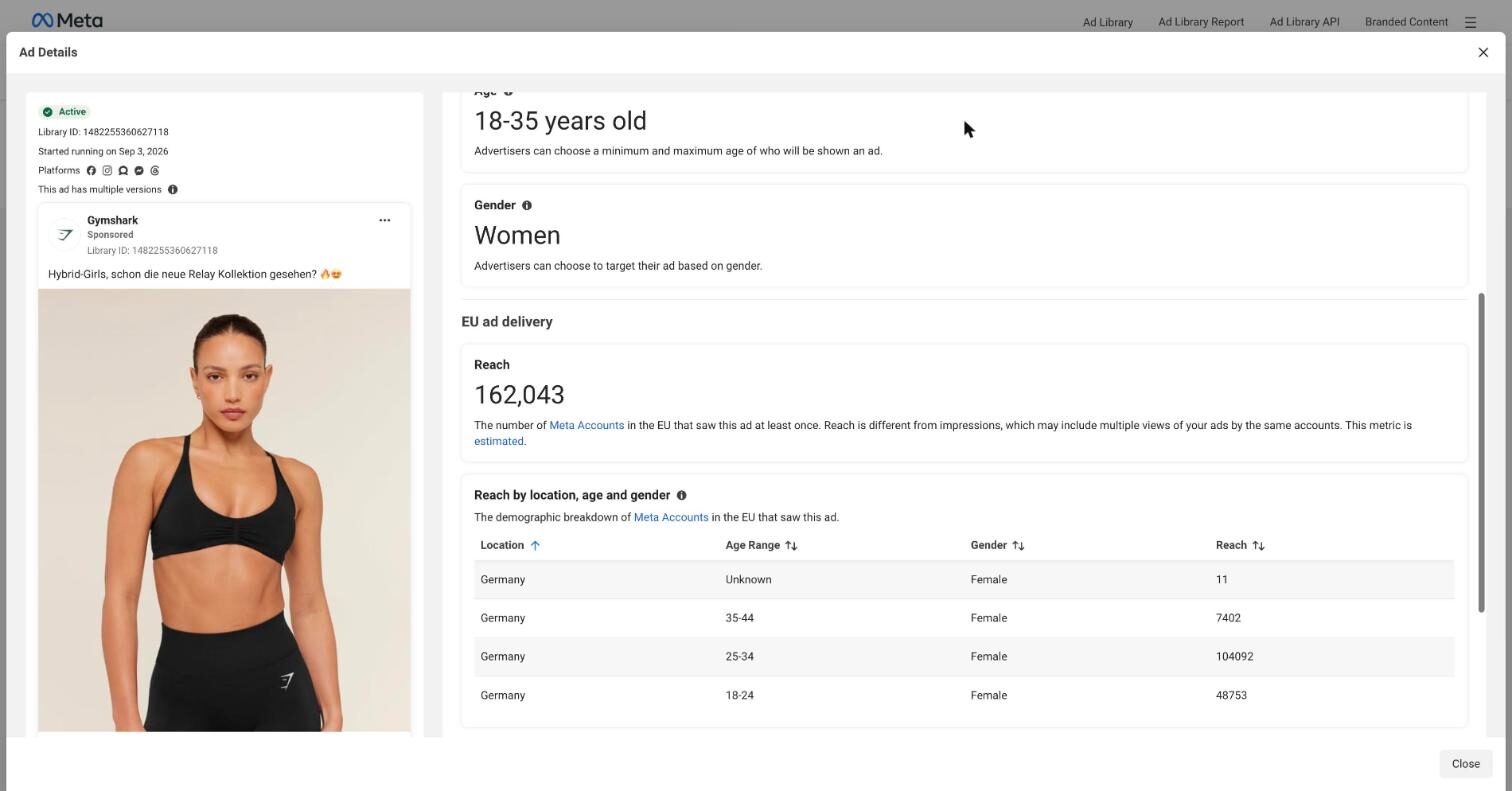
Ads shown in the EU are the exception. Meta gives more information for ads delivered in the EU, and the library shows the targeted location, age and gender, the reach, and who paid. When we searched Gymshark on 2 Oct 2026, an ad shown in Germany listed women aged 18 to 35, a reach of 162,043, and GYMSHARK LTD as advertiser and payer.
Old ads are the other gap. Outside ads about politics and social issues, the library only shows ads that are active. Ads shown in the EU stay archived for a year after their last impression; any other ad is gone once it stops.
From found ads to your own ads
Turning found ads into your own takes four steps. The long runner is your winner signal: a brand rarely keeps paying for an ad that doesn't sell. Take its pattern, the hook, the format and the length, and leave the ad itself alone. By the time a winner shows up in a spy tool, other sellers have often copied it, so a copy lands on a tired angle. We covered how to read a rival's ads in more depth in competitor ads analysis.
-
Find the brand's own ads
Search by the brand's Page, not a keyword. A keyword search mostly returns other advertisers.
-
Sort for the longest runners
Use a days-running sort where the tool has one. Otherwise, read each ad's start date.
-
Take the pattern, not the ad
Write down the hook, the format and the length. Leave the creative and the words behind.
-
Make your version
Rebuild the pattern in your brand. Selzee does this step: it recreates ads winning right now for your brand.
Facebook ad spy tools: FAQ
How do I spy on a competitor's Facebook ads for free?
Is using an ad spy tool legal?
Can I see a competitor's ad targeting or spend?
Is the Meta Ad Library enough, or do I need a paid tool?
What's the best ad spy tool for dropshipping?
How do I choose an ad spy tool as a beginner?
Is Selzee an ad spy tool?
How much does Selzee cost?
Make your own version of what's working
Selzee finds formats printing money right now and remakes them for your brand. New ads every day.
Turn winning ads into yoursKeep exploring
The free options, and what the paid ones cost.
The free ad libraries the platforms publish, and how to use them.
Search any competitor's live ads by brand.
Tools that go beyond Facebook ads.