Playbook · Creative ops
Creative Asset Management: A 2026 Guide for Ad Teams
How DTC paid social teams keep every asset traceable, rights-safe and tied to what it did in market, so the library stops being storage and starts driving the next brief.
You can feel it the moment a paid social account starts moving too fast for its own file system. A winning hook gets cut into six variants, a creator sends three more revisions in Slack, someone on the media side launches the wrong export, and no one can tell which version made it into the campaign. The result isn't just annoyance, it's slower iteration, more rework, and creative decisions made on incomplete information.
That's where creative asset management stops being a storage problem and becomes a performance system. For DTC teams shipping on Meta and TikTok, the job isn't just keeping files tidy, it's keeping every asset traceable, reusable, rights-safe, and tied back to what it did in market. That's the difference between a library and an operating model.
Why Creative Asset Management Matters for Paid Social
A paid social team can have strong concepts and still lose money because the asset operation is a mess. The winning cut is buried in Drive, Slack, desktop folders, email threads, and an archive nobody trusts. The buyer wants the latest creator edit, the designer wants the approved version, and the account manager is staring at an export that looks current enough to launch.
That chaos is expensive because it slows down the one thing paid social cannot afford to lose, iteration speed. In practice, paid social is a high-frequency testing system, which means asset control affects how quickly a team can learn, cut waste, and move budget toward what works. The what paid social means in practice view matters here because assets are not just creative files, they are the working inputs behind every test, variation, and retest.
The performance case for creative asset management is hard to ignore. IDC research, reported by Adobe back in 2015, found 97% of organizations reduced asset creation costs by 10% or more with DAM, and 57% cut costs by at least 25% through reuse and less rework. The same research found 97% increased productivity by 10% or more, with 34% reporting gains of 40% or more from reduced search time, faster approvals, and easier collaboration with external stakeholders (IDC research, via Adobe). The figures are old, but the mechanism has not changed. For a growth team, that kind of lift shows up in output, not theory. Every saved edit can become a new hook, a new cut, or a localized variant without starting from zero.
What is the real job of creative asset management?
The real job of creative asset management is to keep the right file active and the wrong file out of circulation. A 2023 survey of 300 marketers and creatives found that 95% said DAM mattered more than ever, even as most were still using the wrong logo versions. That is the gap that breaks paid social teams. Having a folder structure is not the same thing as having control.
Practical rule: if a media buyer cannot tell whether an asset is approved, current, and tied to its performance history, the library is slowing paid social down.
For growth teams, the system has a plain purpose. It should let you ship more winning creative without piling on manual work, and it should keep the assets tied to the outcomes that matter, especially CPA and ROAS. When the workflow is tight, a concept can move from brief to edit to launch to verdict without losing context in the middle.
A basic folder hierarchy never does that job on its own. A directory can hold files, but it cannot tell you which version won, which creator clip is safe to reuse, or which stale edit is still floating around in a campaign. Creative asset management has to connect intake, production, versioning, governance, distribution, and performance analysis, because that is how ad teams operate at scale.
The End-to-End Creative Asset Workflow
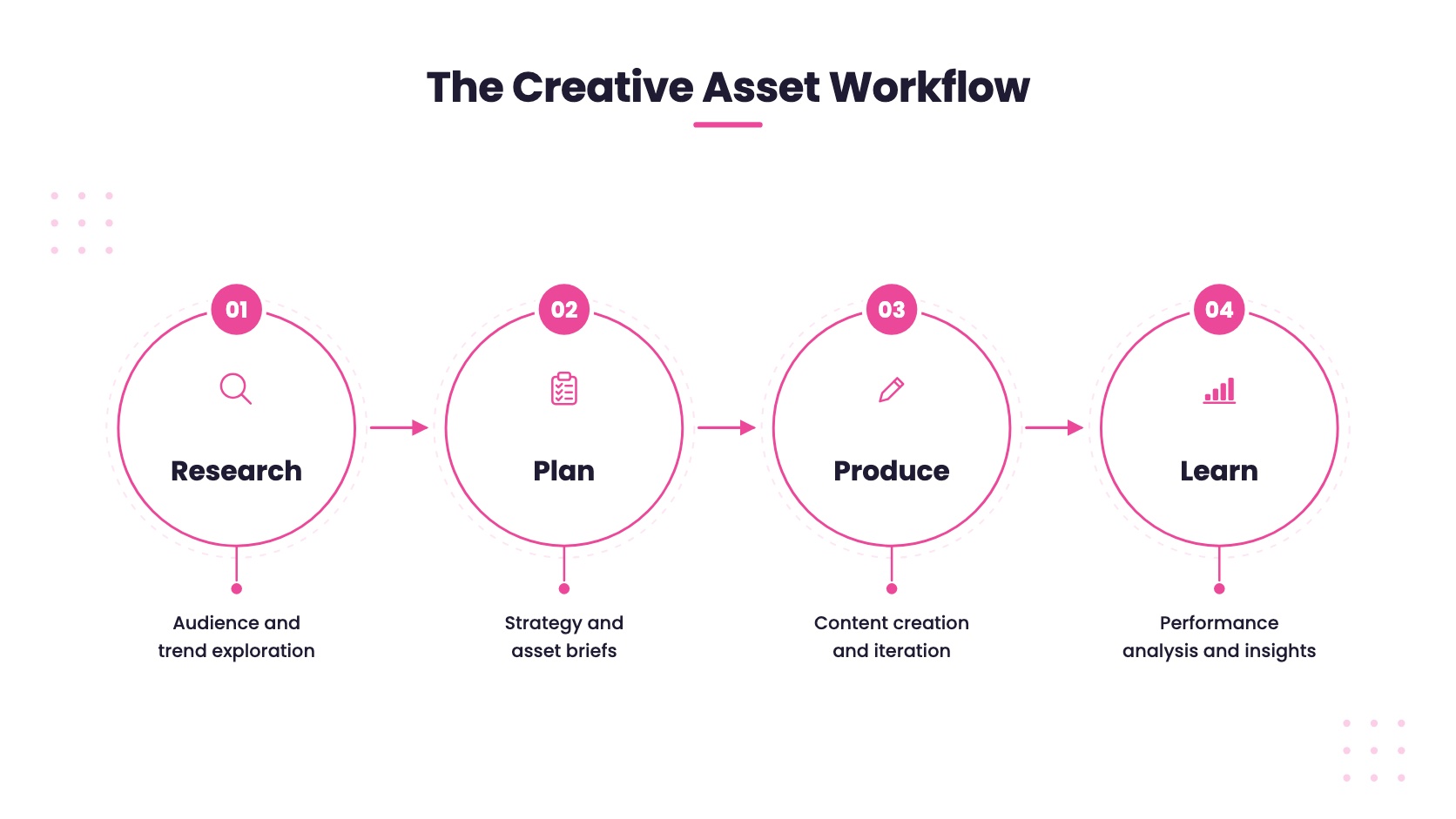
A performance team can have strong ideas and still lose momentum if the workflow breaks between research, planning, production, and learning. Creative asset management closes those gaps by keeping provenance, version history, and outcome data attached to every file. A file by itself is just media. A file with its origin, brief, edits, and results attached becomes something the team can reuse with confidence.
How do you make creative research usable later?
You make creative research usable later by storing it as a tagged asset with enough context to feed the next brief. Competitive screenshots, customer review excerpts, comment themes, and existing ad patterns all matter, but only if they are stored in a way that can feed the next brief. A screenshot dropped into Slack disappears into chat history. A tagged research asset can move into planning with enough context to explain why a hook, claim, or visual pattern deserves attention.
That difference matters at scale. Creative teams waste time when the same observations get rediscovered every cycle because the original evidence was never attached to the asset. If a concept comes from a repeated objection, a recurring customer complaint, or a visible pattern in the market, that context should travel with the research file before production starts. Otherwise, the team keeps arguing about the same inputs instead of building on them.
What should a creative brief define before production starts?
A creative brief should define the test condition, the target audience, the creative angle, and the rule for what counts as a win or a kill. That is a good deal more than a description of an idea. Production moves faster when the team knows exactly what it is trying to prove, and what result should end the test.
A practical structure usually includes this:
- Research asset. A tagged reference item, such as a customer quote or competitor pattern, that explains where the idea came from.
- Testable concept. The hook, claim, or visual frame the team wants to validate.
- Win and kill logic. The rule for what stays in rotation and what gets cut.
- Production notes. Aspect ratio, voice, creator type, or edit constraints that keep the asset aligned with the test.
When those pieces stay connected, the asset retains its strategic meaning through production instead of turning into a generic request. That is the difference between a creative queue and a working performance system.
What metadata should every production file carry?
Every production file should carry enough metadata to show who made it, what it is for, how it differs from earlier cuts, and where it sits in the approval path, which only works once you know which internal stakeholders own each gate. Raw footage, AI-generated variants, UGC submissions, and final exports each need different handling, but they should still live inside one traceable system. The controls that keep a high-volume library usable are asset-level metadata, version control, time-based video comments, role-based permissions, AI auto-tagging at the scene level, and natural-language search.
In practice, the file should never be reduced to something like "final_v3." Compare what that filename tells a buyer with what a real record does:
| Field | Value |
|---|---|
| Master concept | Cold sleeper objection |
| Variant | Creator B, kitchen setting |
| Hook type | Direct question |
| Claim category | Comfort, no efficacy claim |
| Platform target | Meta Reels, TikTok In-Feed |
| Derived from | Concept v1, hook swapped only |
| Rights | Creator B, paid usage, expires with the authorization window |
| Status | Approved, in rotation |
| Verdict | Won on hold rate, lost on CPA |
The second version answers who made it, what it is for, how it differs from the earlier cut, and whether it is safe to reuse. That lets a media buyer or creative lead search by intent instead of digging through filenames and guessing at lineage. It also makes it easier to reuse a strong edit without reintroducing an old mistake.
How do you make performance learning stick to the asset?
You make performance learning stick by linking the launch outcome back to the original asset inside the library. If performance results live only in the ad platform, the library never gets smarter. A better setup links outcomes back to the original asset, so the next brief uses actual performance history instead of a vague memory of what seemed promising.
That feedback loop is what compounds over time. Teams learn which hooks, creator styles, or visual settings are worth repeating, and the library becomes a knowledge base rather than a graveyard. The asset is no longer just something the team shipped. It is something the team can study, compare, and build from on the next round.
Organizing and Versioning Assets for High-Volume Testing
Once a concept starts winning, the operational work begins. One core idea can turn into localized edits, creator variants, aspect-ratio cuts, and AI-assisted remixes across multiple channels. At that point, generic folder structures fall apart because they were built to store files, not answer a performance question.
How should you structure a taxonomy for paid social assets?
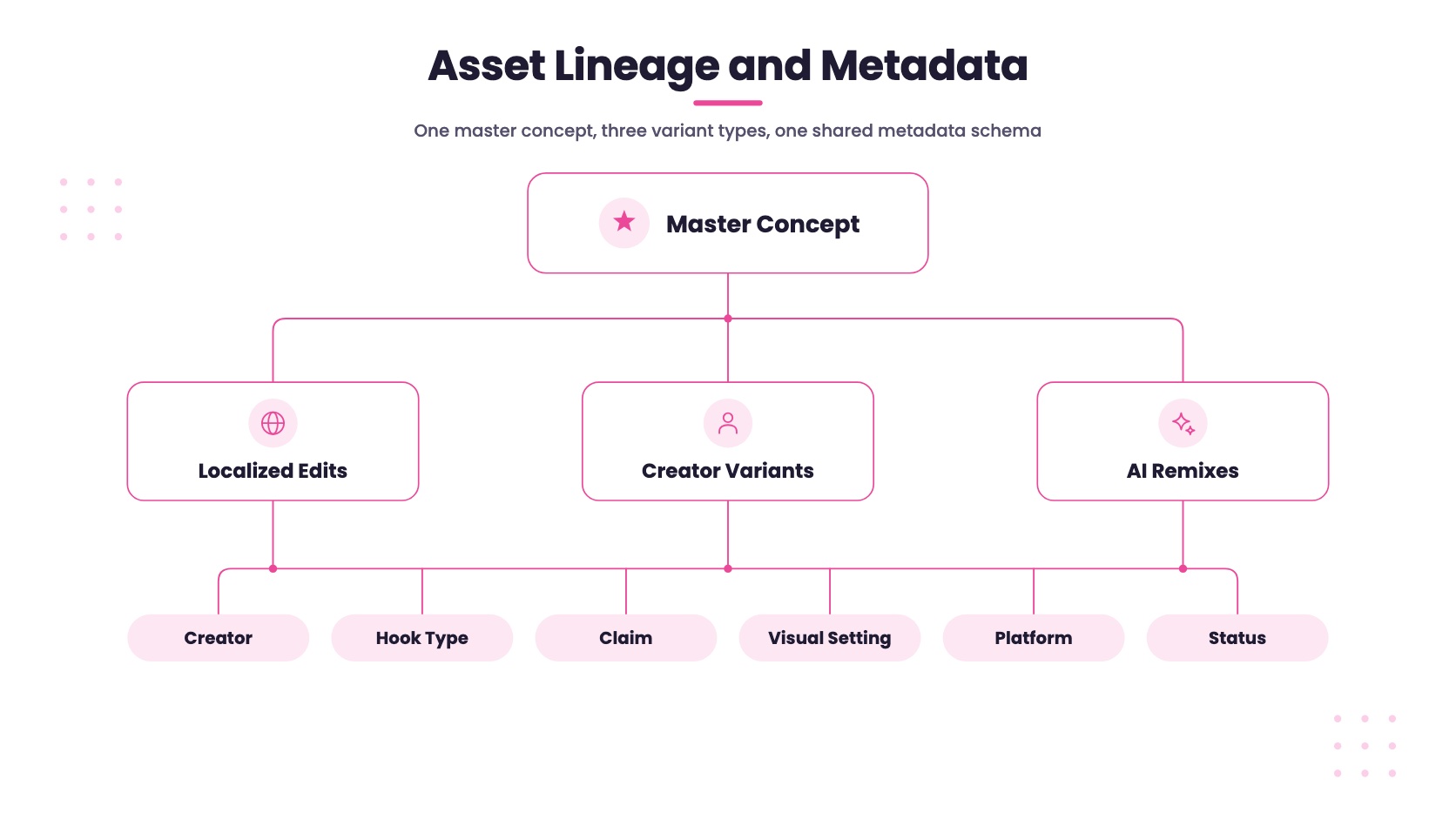
You should structure a paid social taxonomy around the fields the team actually searches under pressure. For high-volume testing, the core metadata dimensions should usually include creator name, hook type, claim category, visual setting, platform target, and performance status. Those fields let the team search by what matters instead of by who remembered where a file was saved.
A practical naming pattern keeps the parent concept visible while separating the variants. Build around a master concept, then branch into localized edits, creator variants, and AI remixes. Written out, a variant reads left to right from most stable to most disposable:
coldsleeper_creatorB_question_comfort_kitchen_meta-reels_v2_approved
The concept stays first so every derivative sorts under its parent. The volatile parts, version and status, stay last so they can change without breaking the sort. A buyer scanning that string knows the concept, the creator, the hook, the claim, the setting, the placement, the version and whether it is cleared to run, without opening the file. That structure preserves lineage, which matters when a winning cut needs to be reused or audited later.
How do you stop the team from launching the wrong version?
You stop the team from launching the wrong version by separating drafts from approved assets, preserving lineage, and making current status visible at a glance. In that same 2023 survey, 60% of participants still used incorrect logo versions, which is the same class of problem in paid social, just with more expensive consequences. In ad operations, stale assets do not just look sloppy, they can waste spend and muddy test results.
A strong versioning habit does a few things at once:
- Preserves parent-child lineage so the team can see which cut came from which concept.
- Separates approvals from drafts so a working file cannot masquerade as launch-ready.
- Labels derivatives clearly so localization, creator changes, and AI remixing do not blur together.
- Keeps performance status visible so the team can tell whether a file is a winner, a test, or a retired asset.
An asset library should make the approved version obvious at a glance. If a buyer needs a Slack thread to confirm it, the system is not doing its job.
That same discipline belongs in ad testing tools, because version control only works if the team can tie each file back to the test that produced it.
How do you keep variant lineage clear when one concept branches out?
You keep variant lineage clear by anchoring every derivative to a visible parent concept and labeling what changed in each branch. When one concept produces many cuts, the asset tree has to show both the common origin and the differences. That way, a strategist can look at a derivative and understand whether it changed the hook, the creator, the language, or the platform-specific framing. Without that lineage, people start testing near-duplicates because they cannot see how similar they are.
For DTC teams, that usually means building the system around a master concept first, then attaching the variants beneath it with clear labels. The point is not just neatness. It is so the team can move fast without losing the ability to compare apples to apples.
Governance for AI-Generated and UGC Creator Assets
The governance problem changed once creator content and AI-assisted edits became part of the normal workflow. A static asset library could survive with broad labels and a basic approval path. A paid social library cannot, because the team has to know who owns the rights, where the asset can run, when permission expires, and what happened between the original capture and the version that launched.
The cleanest fix is to build governance into the brief, not treat it as cleanup after production. If creator scope, usage limits, and market permissions are spelled out before anything is shot, legal and creative teams do not have to reverse-engineer the intent later. That matters even more when one asset can be edited into multiple market-specific variants.
What rights information needs to stay attached to the asset?
The asset should carry where it can run, how long it can run, which version is approved, and who owns the source trail. Time-sensitive permissions and short campaign windows need to stay attached to the file itself, not sit in a contract folder that nobody checks during reuse. Clear metadata and version control matter here too, because the people who reuse the asset later are usually the ones most likely to miss the fine print.
A good governance record should make it obvious:
- Where the asset can run, by platform and market.
- How long it can run, if the permission is time-bound.
- What version is approved, especially if AI remixing created multiple branches.
- Who owns the provenance trail, so the original source stays visible.
Spark Ads make the cost of getting this wrong concrete. A Spark Ad runs on an authorization code the creator issues from their own post, and TikTok's own guidance is to "customize the duration of your authorization code to meet campaign needs" (TikTok Spark Ads). That duration is a property of the creative, not of the campaign, so it does not renew when a buyer duplicates an ad set.
Play out what that means for a DTC brand. A creator video wins in month one. Two months later a buyer scaling into a new market duplicates the winning ad set and relaunches it. If the authorization window sat in a signed PDF rather than on the asset, nobody checks it, and the team finds out it lapsed from the ad rather than from the library. Storing the window on the asset itself turns that into a filter the buyer sees before launch.
That structure cuts confusion when an asset performs well and everyone wants to reuse it. It also keeps the team from rebuilding the same rights check every time a winning cut gets pulled into a new campaign.
Why does provenance matter more once AI starts editing?
Provenance matters more once AI starts editing because the team has to distinguish the original asset from each edited or generated version. AI-generated variants make the old "approved or not approved" split too simple. If a creator's original footage gets remixed into several cuts, the library has to preserve what was original, what was edited, and what was generated. The core issue is provenance, the ability to trace where the asset came from and how it changed, especially when briefs and approvals move across teams.
That trace matters because paid social teams rarely use one asset once and move on. A strong concept gets localized, recut, and redeployed across Meta, TikTok, Pinterest, and YouTube. If the provenance trail breaks, the team can end up reusing a stale or unauthorized variant that looks valid but is not. Metadata and version control both point in this direction, but the operating rule is simpler. If an asset can be remixed, it needs a paper trail that survives the remix.
Practical rule: if an asset can be remixed, it also needs a paper trail that survives the remix.
The goal is not to slow production. It is to keep speed from outrunning rights management. When governance is built into the workflow, the team can move faster without creating cleanup work for the next campaign, and ad performance analytics stays tied to the correct source file instead of a half-remembered copy.
Building Performance Feedback Loops Into Your Asset Library
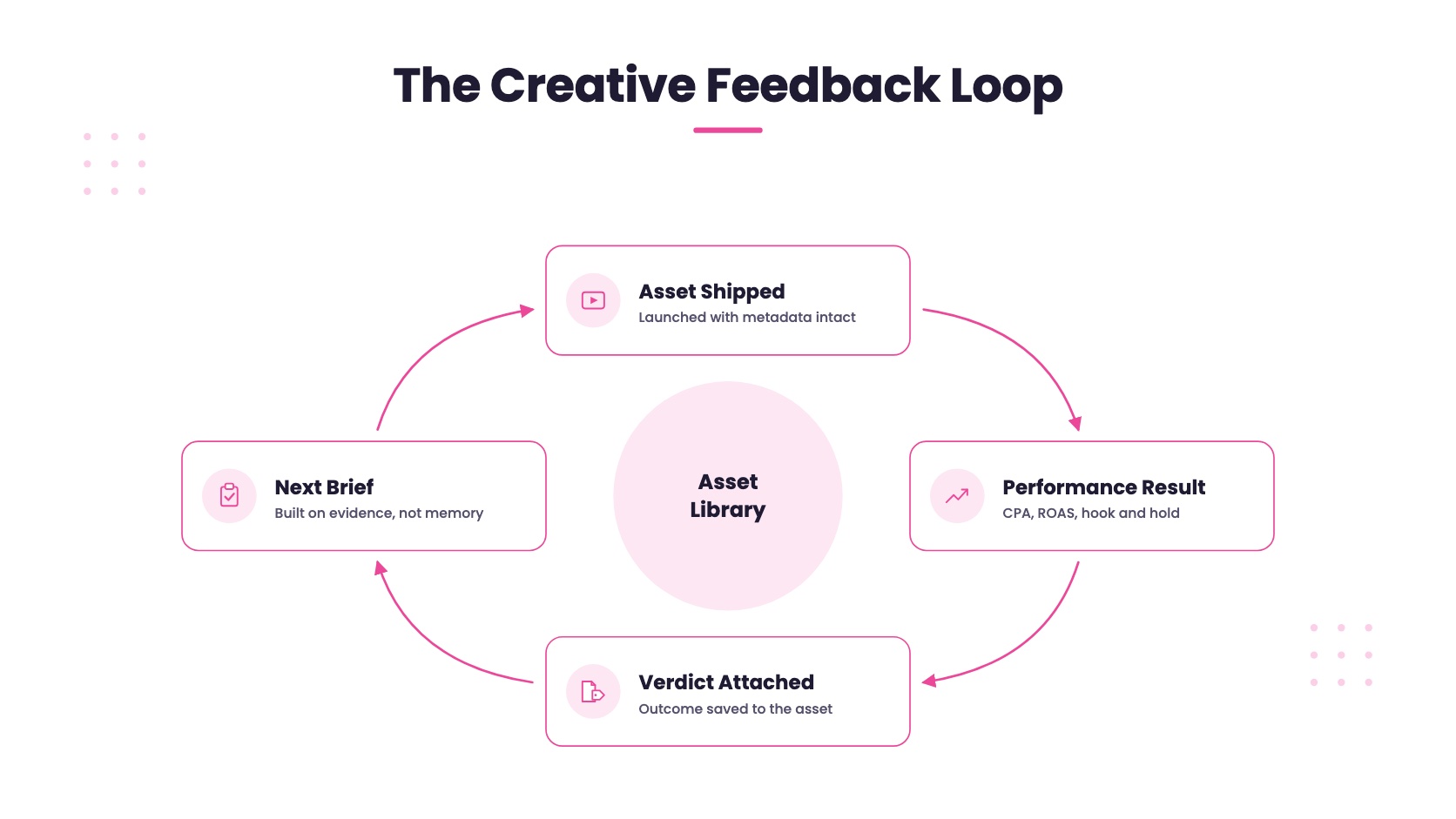
A creative library that does not track performance is expensive storage. The value appears when each asset is tied to what happened after launch, so the next brief comes from evidence instead of memory. For performance teams, that means connecting the asset to CPA, ROAS, hook behavior, and hold behavior, then making those outcomes visible inside the system.
What should the asset library know about each creative?
The asset library should know whether each creative won, lost, or should be retired, based on what happened after launch. The easiest mistake is to judge an asset only by whether it shipped on time or saved correctly. That tells you very little about whether the asset earned its keep. Strong creative asset management ties the file to outcome data, so a winning hook, a weak cut, or a stale variation all leave a visible record.
That record is what turns the library into a creative intelligence system. If the team can see which assets moved the needle, the next brief can draw from patterns that already proved themselves. If it cannot, every cycle starts from instinct again.
Which operational signals show that the library is creating friction?
The clearest friction signals are repeated searches, duplicate assets, outdated files being opened, and retrieval patterns that show the team cannot find the current version quickly. The retrieval signals worth tracking are average weekly downloads, search success rate, duplicate-asset volume, and the frequency of outdated assets being accessed, because those measures expose retrieval friction and governance gaps. The same problems that slow a general brand library also slow a paid social test machine.
Treat those signals as warning lights, not vanity metrics. If outdated files keep getting touched, the system is failing to surface the current version. If duplicate assets keep piling up, the library is not preventing waste, it is multiplying it.
A worked example makes the difference visible. Two editors both need a hook variant for a Reels test. In a library where hook type is a searchable field, the second editor finds the existing cut and branches from it. In a folder tree, the second editor never sees it, rebuilds a near-identical variant, and both go live. The account now spends against two assets that differ by nothing meaningful, which does not just waste budget. It splits the learning, because neither variant reaches a clean read and the test returns no usable verdict.
How do you turn asset verdicts into better future briefs?
You turn asset verdicts into better future briefs by carrying win or loss context into the next round of concepting. The feedback loop matters because it compounds. A team that knows which hook types tend to work for which audience segment can brief the next round with more precision. That kind of historical memory separates a library that holds files from a system that improves creative decisions.
A compact way to think about it is this:
| Asset-level question | Why it matters |
|---|---|
| Did the asset win or lose? | It determines what should be iterated, retired, or reused. |
| What variant won? | It shows which changes were meaningful, not cosmetic. |
| What context produced it? | It connects the result back to the original insight. |
If your library also carries ad performance analytics, the next creative cycle starts with a stronger premise. That is the point of the system, not just to preserve assets, but to make better ones next time.
Choosing the Right Tools for Your Creative Operation
A DTC team can have strong ideas and still lose time every day if the tool stack cannot keep up with how creative gets shipped. The test is not whether the system looks organized in a demo. It is whether it can handle variant volume, rights tracking, search, approvals, and performance history without making launch work slower.
For paid social, the tool is part library, part control layer. Every asset should carry provenance, version history, and a link to what happened after it went live. If the system cannot support that chain from file to outcome, the team ends up guessing which asset earned the result and which one should be retired.
Which tool category fits your creative operation best?
The best tool category depends on whether your main problem is storage, workflow control, or connected creative output.
| Tool Category | Best For | Key Limitation |
|---|---|---|
| Dedicated DAM platform | Teams that need strong storage, search, and governance | Can be strong on library control but weak on creative iteration |
| Creative operations platform with asset management | Teams that need workflow, approval, and versioning in one place | May require more setup to match paid social testing habits |
| AI-native creative system | Teams that want research, brief generation, and connected asset output | Can be overkill if the team only needs library discipline |
The category matters because the pain point should drive the purchase. If the team's main issue is launch confusion, version control and approval logic matter most. If the core issue is that assets are not being reused with enough discipline, the system has to connect library structure to performance so the team can see what paid back and what did not.
Which features actually matter for paid social asset management?
The features that matter most are the ones that help the team find the right variant, confirm approval status, preserve rights and provenance, and connect each asset to its result. For a Meta and TikTok operation, the useful checklist is specific. Look for native ad platform connectivity, AI auto-tagging, version control granularity, creator collaboration controls, and performance data connectivity. Without those, the team ends up managing the system by hand, which wipes out the advantage of using a system at all.
The feature set should answer a few direct questions:
- Can the team find the right variant quickly?
- Can the team tell which version is approved?
- Can the team preserve rights and provenance?
- Can the team connect the asset to its result?
If the answer to any of those is "not really," the tool may still work for storage, but it will not support a high-volume testing motion. That is where a lot of teams get stuck. The archive gets cleaner, but the creative operation does not get faster.
How do you choose a tool for your current volume, not your ideal future state?
You choose for current volume by prioritizing the system that supports your real testing pace with the least operational drag. A lot of teams overbuy. They choose a system built for broader brand operations, then spend months forcing it into a paid social workflow. The result is usually more process than the team needs, more places for approval to stall, and the same daily friction when it is time to move fast.
The better question is whether the system helps the team create, version, govern, and learn at the pace of active testing. If it does, it is probably the right fit. If it only makes the archive prettier, keep looking.
Your 30-Day Implementation Checklist
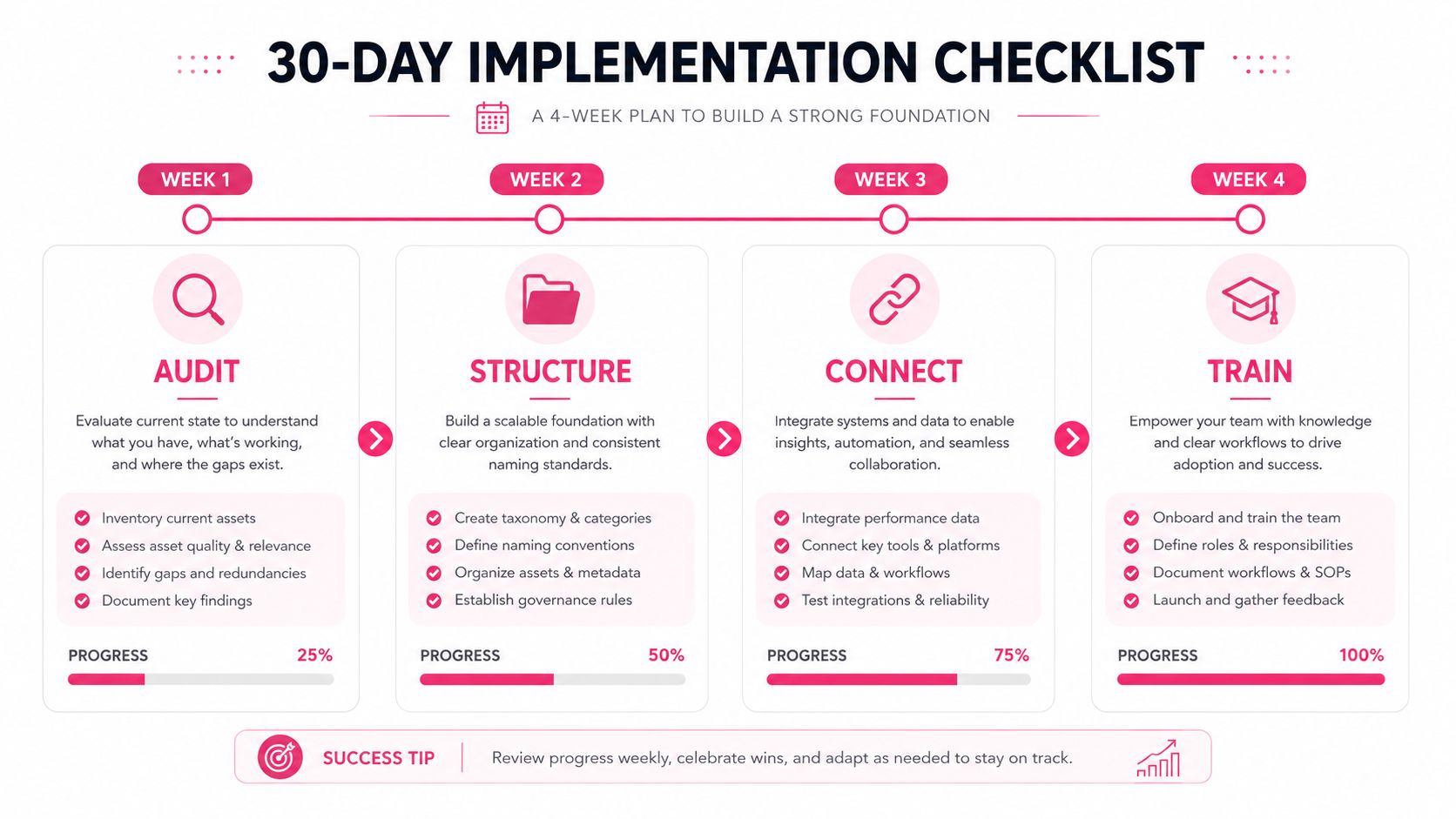
The fastest way to improve creative asset management is to treat the first month like a rebuild of the control layer, not a software rollout. The goal is to make the system usable by the people who launch, edit, review, and analyze ads every week. That means starting with what's broken now and fixing the parts that create the most rework.
What should you audit in week 1?
In week 1, you should audit where assets actually live, where retrieval breaks, where duplicate versions appear, and where approvals keep getting confused. Start by mapping where assets live, not where they're supposed to live. Pull together the places your team uses most often, then note the retrieval problems, duplicate versions, approval confusion, and stale files that keep showing up. You're looking for friction, not perfection.
A useful output from this week is a simple inventory of asset sources, launch blockers, and governance gaps. Once the team sees where time is being lost, the rest of the rollout gets easier to justify.
What should you lock down in week 2?
In week 2, you should lock down the metadata fields, naming conventions, and version rules that match how the team searches and launches assets. Keep them tied to how the team searches in real life, not to how a folder tree looks on a whiteboard. The taxonomy should make it easy to separate core concepts from localized edits, creator variants, and remixes.
This is also the week to define version rules. The goal is to make approval status obvious and old exports easy to retire.
What should happen in week 3?
In week 3, you should connect the platform, the surrounding workflow, and any performance tagging that lets the asset leave launch with context attached. Choose the platform and connect the parts of the stack that need to talk to each other. If the system can surface performance data alongside asset context, the team can start grading creative based on what it did, not just what it looked like. That's where the library starts acting like a decision system.
This is also the point to set automated performance tagging if the tool supports it. The asset should come out of launch with a verdict attached, not with a note in someone's head.
What should the team finalize in week 4?
In week 4, the team should finalize the approval path, rights rules, expiration handling, and the operating rules for draft, approved, stale, and retired assets. Then walk everyone through it, because the point is to reduce ambiguity before the next production cycle starts. If people don't know how to use the system, they'll drift back to Slack and old folders.
A simple rollout checklist helps:
- Audit the chaos first, so you're fixing the actual bottlenecks.
- Standardize the naming and metadata, so search works under pressure.
- Connect asset context to performance, so learning compounds.
- Train the team on the launch rules, so governance holds at speed.
How Selzee Keeps Asset Context Attached From Research to Verdict
Most teams already understand the loop in this article. The hard part is holding it together while the account keeps moving, because the context that makes an asset reusable is exactly the context that gets dropped first.
Selzee runs that layer as your AI content team, in its own workspace rather than scattered across chat threads and spreadsheets. It works the same four stages this guide describes:
- Research: customer reviews, ad comments, account data, competitor ads and the organic feed become usable signal instead of screenshots nobody can find later.
- Concepts: those signals turn into angles and testable concepts, with the reason the concept exists carried along rather than reconstructed from memory.
- Create: concepts become briefs, test plans and creator matches, so the production request arrives with its test condition attached.
- Learning: results come back against the thresholds you set, and that verdict feeds the next brief.
The distinction that matters for asset management is that the verdict never detaches from the work that produced it. The next brief starts from what actually happened, not from a vague sense of what felt promising last month.
FAQ
How is creative asset management different from a normal shared drive?
A shared drive stores files, but it does not reliably show which asset is approved, reusable, or tied to a specific result. Creative asset management adds structure, lineage, permissions, and operational context, so the library supports decisions instead of just storage.
When does a paid social team need a real asset management system?
A team usually needs one when asset volume, variant count, and handoffs start creating launch confusion or reuse mistakes. If people are checking Slack to confirm versions, rebuilding context from memory, or duplicating work because they cannot trust the library, the need is already there.
What is the biggest mistake teams make when setting up asset management?
The biggest mistake is designing the system around storage neatness instead of launch and reuse behavior. A library can look clean and still fail if buyers cannot find the current file, understand its status, or trace it back to the test it belongs to.
How often should you clean up or retire assets?
Teams should treat retirement as part of the normal workflow, not as an occasional cleanup project. Once an asset is outdated, superseded, or no longer safe to reuse, its status should change immediately so it stops confusing the next launch.
Should research assets live in the same system as production files?
Yes, if the goal is to preserve the reason an asset exists and make that context reusable later. Keeping research separate often breaks the chain between insight, brief, production, and performance, which makes future iteration weaker.
What should happen to assets from losing tests?
They should stay searchable, but with a clear status that prevents accidental reuse without context. Losing assets still matter because they show what was tested, what changed, and what the team should avoid repeating blindly.
If you want the loop in this article running without the manual upkeep, that is what Selzee does. It works from your own signals, customer reviews, ad comments, account data, competitor ads and the organic feed, and turns them into briefs, test plans and creator matches, then closes the loop with a verdict against the thresholds you set. See how Selzee works.