UGC creators: how a DTC brand finds, vets and pays the right ones
What UGC creators are and are not, where a DTC brand finds them, how to vet one before you book, what they cost, and the usage rights, Spark Ads codes and FTC labels to settle before anything goes live.
 Marián Cabadaj
9 min read
Marián Cabadaj
9 min read
UGC creators are people a brand pays to make videos and photos that look like a customer made them: an unboxing on a kitchen table, a skincare routine in a bathroom mirror, a "here is why I switched" talk to camera. The brand then posts the content on its own channels or runs it as ads. The creator's audience is not part of the deal.
That last point is where most brands go wrong. They book a UGC creator the way they would book an influencer, judge them on followers, and then wonder why a 200,000-follower account made a flat ad. You are buying a piece of content and the right to use it.
To see finished UGC ads before you book anyone, browse our UGC ad examples.
What is a UGC creator, and how is one different from an influencer?
A UGC creator sells you content. An influencer sells you access to an audience. Both make videos with your product in them, so the two get mixed up.
The difference in one table
| UGC creator | Influencer | |
|---|---|---|
| What you buy | Videos or photos, plus the right to use them | A post to their followers |
| Where it runs | Your ads, your product pages, your feed | Their account |
| What to judge them on | How well they hold attention on camera | Who follows them and how those people react |
| Follower count | Mostly irrelevant | The main input to the price |
| Usual deliverable | 1 to 3 short videos, often with hook variants | A post, a story or a series |
| Who controls the edit | You | Mostly them |
Why brands want creator content in their ads
TikTok's own Spark Ads playbook reports that 87% of the top 200 high-spending Spark Ads involved creators, and that creator Spark Ads beat non-creator Spark Ads on click-through rate, view-through rate and engagement (TikTok Creative Center, 2023).
What this means for a DTC brand: the biggest spenders on TikTok put a person on camera. If your ads are all product shots and logos, test a creator video against them before you assume the platform does not work for you.
A creator-style ad does not always need a creator in it. The ad below copies a phone screen and reads like something a friend sent you.

Our articles are still written by HUMANS! Get human written articles in your Google feed.
Add as preferred sourceWhere do you find UGC creators?
Start with the people who already like your product, then go to marketplaces when you need volume.
The main sources, compared
| Source | How it works | Good for | Watch out for |
|---|---|---|---|
| Your own customers | Email buyers who left a 5-star review or tagged you | Real experience, low cost | Uneven on-camera skill |
| UGC marketplaces (Insense, Billo and similar) | Post a brief, creators apply, the platform handles payment | Volume, fast turnaround | Platform fees, many creators making videos for 20 brands a week |
| Meta's Creator Marketplace | Brands search creators inside Meta's tools | Creators already set up for partnership ads | Built for influencer deals as much as UGC |
| TikTok One | TikTok's hub for brand and creator collaboration | Creators who know TikTok formats | Built around TikTok, less useful for Meta-only brands |
| Reddit, Facebook groups, X | Post a call for creators in UGC communities | Hungry new creators, low rates | You do all the vetting yourself |
| Your social mentions and comments | Search for people who already filmed your product | Content that already exists | They may not want a paid deal |
Meta tells creators they can join its creator marketplace to be found by brands, and in September 2025 it said its Facebook Creator Discovery API lets brands search for creators using keywords or filters (Meta for Developers, 2025).
If you plan to run creator content as Meta partnership ads, look in Meta's own marketplace first. Those creators already expect that kind of deal.
Start with your customers
The cheapest good UGC creator is a customer who already loves the product. Pull your last 50 reviews with 5 stars, email the authors of the 10 most specific ones, and offer a paid shoot. Their script is half written: it is the review. The FTC rule on fake reviews also works in your favor here, which we come back to below.

How do you vet a UGC creator before you book?
Judge the work first. Ask for 3 to 5 pieces they made for other brands, and watch only the first 3 seconds of each. If you would scroll past, so will your buyers.
What to check in the portfolio
The hook: does each video open on a problem, a result or a strong visual, or on "Hey guys"? Our UGC script guide breaks down the openings that hold attention.
Range: can they do a talking head, a voiceover over B-roll and a product demo? You will want all three for testing.
Sound and light: clear audio and a lit face. Viewers forgive a phone camera. They do not forgive bad sound.
Real use: do they look like they use the product, or like they are holding it for the first time?
Check their engagement rate when their handle runs the ad
If the content will run from your account only, the creator's audience does not matter much. If you will run it as a Spark Ad or a partnership ad from their handle, it does: their name sits on top of the ad. Meta's discovery API for brands returns a creator's audience demographics and average engagement rate (Meta for Developers, 2025).
Put their recent likes, comments, shares and followers into the calculator below. It grades the result against the published average for the platform.
One post's numbers
Open the post in the app, read the insights, and copy the figures across.
The formula never changes. The median it is graded against does.
Leave this empty to match the published benchmarks, which count likes and comments only.
Your engagement rate
Median 0.48%
Engagement rate by followers
—
Total interactions
—
Scale: 0% to 1.92%
Interactions per 1,000 followers
—
Engagement Rate Calculator: the full tool, with the benchmarks and the FAQ
A rate far above average on a small account is fine. A big account with a rate far below average often means bought followers or a dead audience, and you do not want that name on your ad.

What do UGC creators cost, and how are they paid?
Most UGC creators charge per video, and usage rights decide most of the final price. A creator who also posts to their own account, or lends their handle for ads, charges more.
A published price point
Insense, a creator marketplace, says on its pricing page that UGC campaigns "start at $100 per video", that its Brand plan starts at $500 a month, and that creator payments are not included and must be budgeted separately. The marketplace fee on that plan is 10% of creator payments (Insense, pricing page, checked October 2026).
So a first test of 5 videos through a marketplace costs at least $500 in creator fees plus the subscription. Budget for that before you decide UGC "did not work" after 1 video.
The usual payment models
Flat fee per video: the default. Agree on the number of revisions up front.
Product only (seeding): cheap, with no control and no guaranteed content.
Fee plus commission: a flat fee plus a share of sales through their code. Fits creators who also post to their own audience.
Retainer: a monthly fee for a set number of videos, once you know a creator's videos win.
What usage rights and ad permissions do you need?
Settle the rights in writing before the shoot. Disputes about where an ad runs and for how long start after it wins.
Ownership and usage terms
Insense's pricing FAQ says creators keep the copyright and grant brands full digital rights once content is approved and the creator is paid, and it describes those rights as perpetual. A creator you book directly will often offer far less, such as organic use only, or paid use for a fixed number of months.
| Term to agree | What to ask for | Why |
|---|---|---|
| Organic use | Your feed, site and emails | The base case |
| Paid use | All paid social, no end date, or a clear term | A winning ad can run for months |
| Raw footage | All clips, not only the final edit | You can cut new hooks without a reshoot |
| Hook variants | 2 to 3 different openings per video | Hooks are what you test first |
| Whitelisting or Spark access | Permission to run ads from their handle | Needed for Spark Ads and partnership ads |
| Exclusivity | No competing brand in your category for a set time | Only pay for it if you need it |
Spark Ads and partnership ads
On TikTok, you can publish ads using organic posts made by other creators, with their authorization. The creator generates the code in the app: on the video, they tap the three dots, then Ad settings, then Generate (TikTok Ads Manager help). Our TikTok Spark Ads guide covers the setup step by step.
On Meta, partnership ads "allow advertisers to run ads with creators, brands, and other businesses" (Meta for Developers, 2025).
What this means for a DTC brand: put "authorization code within 48 hours of posting" in the contract. A creator who disappears after posting leaves you with a video you cannot boost.

What goes in a UGC creator brief?
A brief says what must be true and leaves the wording to the creator. One page is enough.
The one-page brief
| Part | What to write |
|---|---|
| The buyer | Who the video speaks to, in one sentence |
| The problem | The moment before they found the product |
| The proof | The one claim they must show on camera |
| Must say | Product name, the offer, any claim legal has approved |
| Never say | Medical or results claims you cannot back, competitor names |
| Format | Length, 9:16, talking head or voiceover, number of hook variants |
| Delivery | Raw footage, deadline, file names |
Do not script every word. A creator reading your copy sounds like an ad. Give them 3 hook options and let them pick.
What does the FTC require from UGC creators and brands?
If you give a creator money or free product, the content is an endorsement, and the connection has to be disclosed. The brand is on the hook as well as the creator.
Disclosure rules that apply to you
The FTC's endorsement guide FAQ says disclosure is needed when the endorser was paid or got something of value, free product included. It says starting a post with "Ad:", "Paid ad", "#ad", "Advertising:" or "Advertisement" would likely be effective, that "Gifted" alone is likely to be ambiguous, and that "your company is ultimately responsible for what others do on your behalf" (FTC, guides revised 2023).
On TikTok, the branded content policy says creators "must enable the commercial content disclosure toggle" when they post branded content (TikTok).
Write the disclosure into the brief and check it before you pay. When the creator posts for you, it is your problem too.
The creator must have used the product
In August 2024 the FTC announced a final rule against fake reviews and testimonials. It covers reviews by people who did not have actual experience with the business or its products, and it bars buying such reviews when the business knew or should have known they were fake (FTC, 2024).
Ship the product early enough for the creator to really use it. A "30 days in" video shot on day 2 puts you at risk under that rule.
How Selzee makes the ads around your creator content
Selzee does not find, book or manage UGC creators. It makes the static ads you test next to them. Selzee researches your market, your customers and the ads running longest for other brands, then recreates the winning ads for your brand with your products, logo, fonts and colors. Every ad comes with the angle and the insight it is built on.
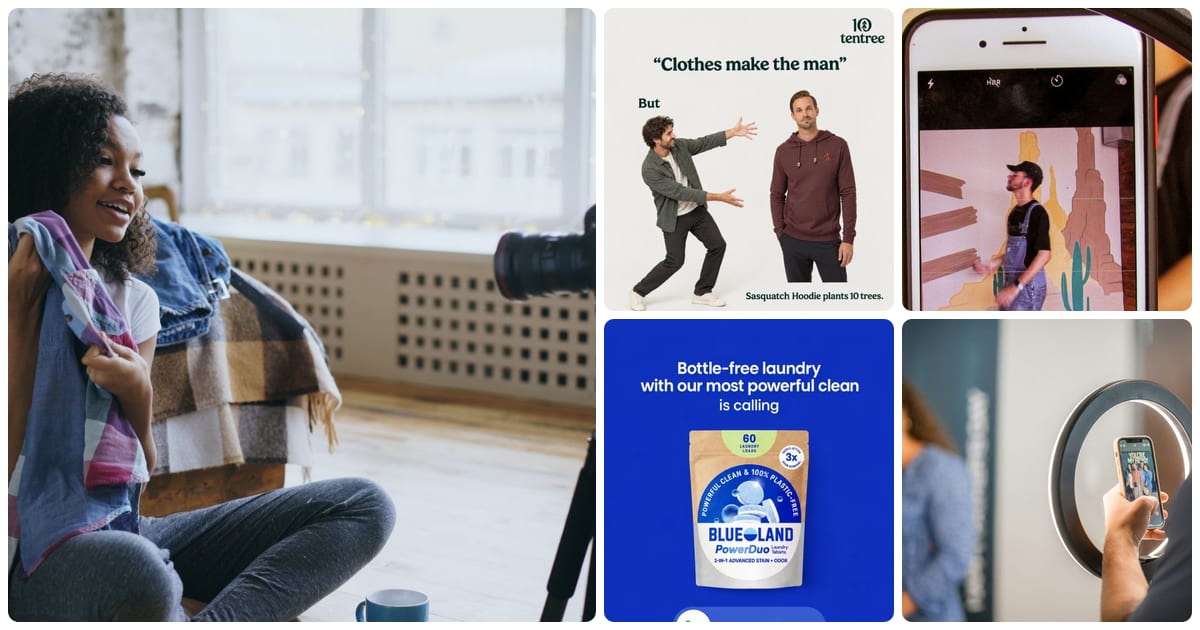
That angle is useful for the creator brief. If a static ad built on one angle wins, give that angle to your next creator and see if it holds on video. The ad below is a Selzee-made static for tentree, built on a joke you could hand a creator as a hook.

UGC creators: FAQ
What does a UGC creator do?
A UGC creator makes photos and short videos that look like a real customer made them. The brand pays for the content and the right to use it, then posts it or runs it as ads. The creator does not have to post it to their own followers.
How much do brands pay UGC creators?
Most UGC creators charge per video. Insense's pricing page says UGC campaigns start at $100 per video, with creator pay budgeted separately from the platform fee (checked October 2026). Paid usage rights, raw footage and extra hooks raise the price.
Do UGC creators need a lot of followers?
No. You are buying the video, so on-camera skill matters far more than reach. Followers only matter when the ad runs from the creator's handle, as a Spark Ad or partnership ad. Then check their engagement rate before you book.
Is UGC the same as influencer marketing?
No. Influencer marketing pays for a post to the influencer's audience. UGC pays for content the brand controls. Some creators do both and charge more when the deal includes a post on their own account.
Do UGC videos need an #ad label?
Yes, when a creator posts content you paid for with money or free product. The FTC lists "#ad", "Ad:" and "Paid ad" at the start of a post as likely effective. On TikTok, creators must also switch on the commercial content disclosure toggle.
Before you book your first creator
Book 3 creators, not 1, with the same brief and 2 to 3 hooks each. Get paid usage and raw footage in writing. Run the videos against your current best ad, and keep the creator whose videos win.
If you want static ads made for your brand to test against them, see how Selzee works on your own brand.