You have a Shopify store with active traffic and a solid product line. The question is: are you maximizing the revenue potential of every visitor? Standard apps and basic analytics only get you so far. The next leap in growth isn't another theme redesign; it's deploying intelligent automation that converts browsers into buyers, 24/7. This isn’t a beginner’s guide. It's a tactical playbook for established merchants serious about scaling.
We're bypassing the generic theory to break down 12 specific, high-impact AI agent use cases that directly solve your most persistent challenges: cart abandonment, stagnant Average Order Value (AOV), and inefficient customer support that bleeds resources. While you're focusing on bringing traffic to your store, perhaps by leveraging AI for Facebook Ads, these agents work tirelessly on-site to ensure that traffic actually converts.
This list details the "how-to" behind the hype. We will dive into proven tactics, replicable conversation flows, and the costly mistakes to avoid. You’ll see exactly how to turn passive browsing into active purchasing and optimize your store for maximum profit. Forget simply answering questions; we’re talking about creating proactive, personalized shopping experiences that build loyalty and drive sales automatically.
1. 24/7 AI Customer Support & Live Chat
Capturing every customer question, day or night, without missing a beat is now table stakes. AI-powered 24/7 customer support is one of the most transformative ai agent use cases for any Shopify store. These intelligent agents integrate directly into your site’s live chat, instantly handling everything from "Where is my order?" to detailed product feature inquiries. By providing immediate, accurate answers, they slash response times, prevent cart abandonment, and significantly boost customer satisfaction.
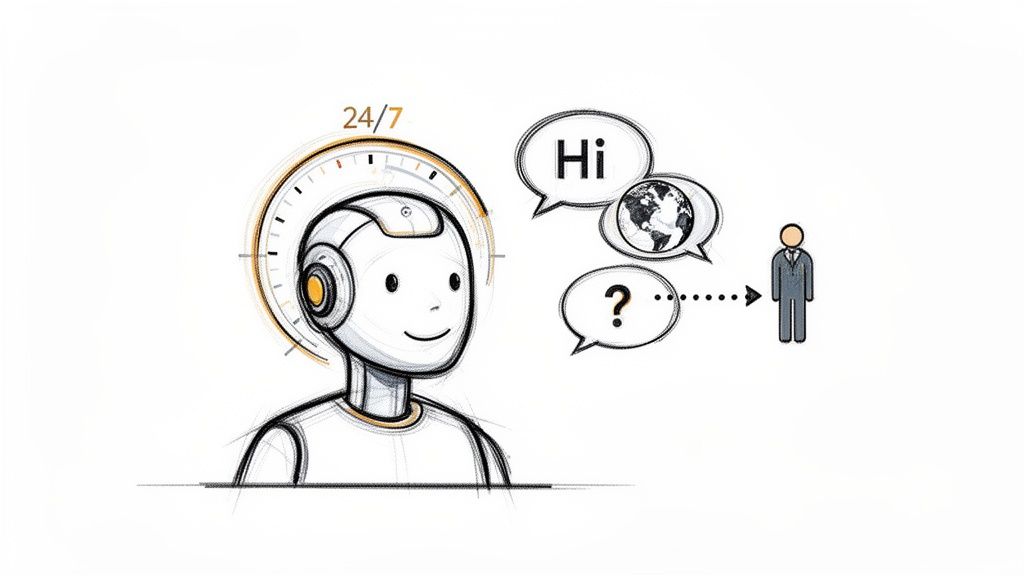
This isn't just about deflecting tickets; it's about creating a seamless shopping experience that converts. For instance, merchants using an AI agent like Selzee have achieved over a 94% AI-only resolution rate, freeing up human teams to focus on high-value, complex issues. For advanced customer interactions, explore how automated texting software is transforming business communication.
Implementation & Strategy
- Train with Precision: Your AI is only as good as its data. Feed it your complete product catalog, detailed shipping policies, return procedures, and FAQs. The more context it has, the fewer escalations you'll see. Mistake to avoid: Using a generic, untrained bot that frustrates customers with "I don't understand."
- Set Smart Escalation Rules: Define clear triggers for when the AI should hand off a conversation to a human. Key triggers include multiple negative sentiment detections, requests for a manager, or complex order issues.
- Weekly Log Analysis: Dedicate time each week to review conversation logs. Identify common unanswered questions or areas where the AI struggled. Use these insights to continuously refine its knowledge base. One case study shows how an AI agent handled 18,000+ support tickets and achieved a 94.6% resolution rate through this iterative process.
2. Personalized Product Recommendations
Stop showing every customer the same generic "bestsellers." Start personalizing the shopping journey. By analyzing browsing behavior, purchase history, and real-time cart contents, AI agents can serve as expert personal shoppers for every visitor. This is one of the most powerful ai agent use cases for boosting AOV. Instead of static suggestions, the AI delivers hyper-relevant recommendations that feel uniquely tailored, turning passive browsers into buyers.
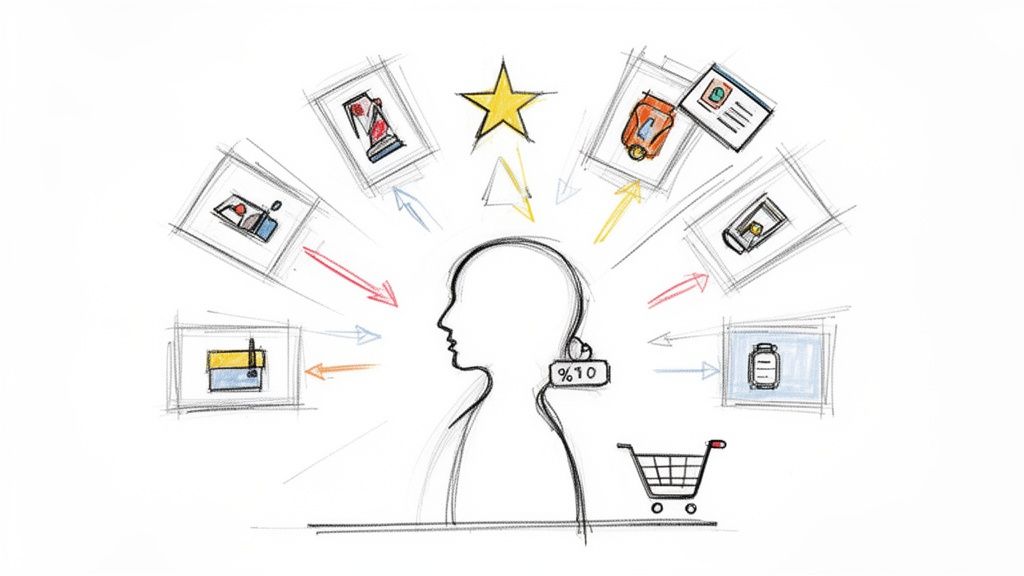
The impact is massive. Amazon's recommendation engine famously drives a significant portion of its sales. This isn't just for giants; Shopify stores in fashion and beauty are seeing double-digit AOV lifts by implementing similar AI strategies. This approach directly increases basket size and encourages repeat purchases by making customers feel understood. See how one brand transformed its customer journey in this case study of an AI Beauty Assistant.
Implementation & Strategy
- Segment for Precision: Don't treat all customers the same. Use your AI to create segments based on purchase frequency, AOV, or product category affinity. Tailor recommendation models to each group, such as upselling high-value accessories to VIP customers.
- Strategize Bundles: Go beyond single-item suggestions. Program your AI to recommend complementary product bundles. If a customer adds a shampoo to their cart, the AI should intelligently suggest the matching conditioner and a styling serum at a slight discount. Mistake to avoid: Recommending irrelevant products that break the user experience.
- Test and Optimize Placement: The best recommendations are useless if they aren't seen. A/B test different placements for your AI-powered suggestions—on product pages, within the shopping cart, or in post-purchase follow-up emails—to see what drives the highest conversion.
3. Abandoned Cart Recovery
Clawing back 20-40% of lost revenue automatically is a reality with AI agents for abandoned cart recovery. This is a mission-critical ai agent use cases for any serious Shopify brand. These agents don't just send a generic "You left something behind!" email. They proactively identify high-intent shoppers who drop off at checkout and engage them with personalized, timely messages directly in the chat window or via SMS, addressing potential barriers before the customer is gone for good.
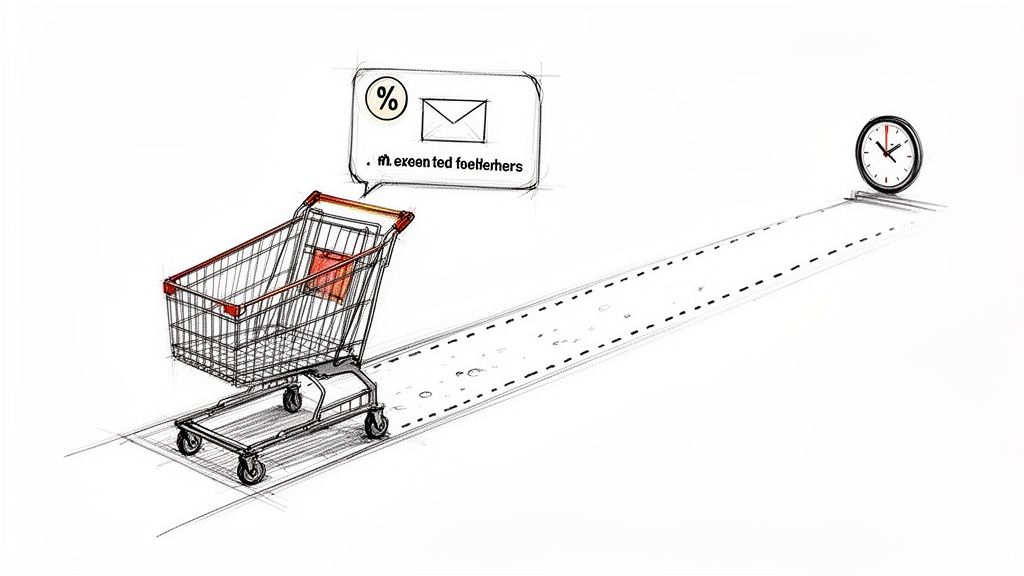
This is about being genuinely helpful at the most crucial moment of the buying journey. By answering a last-minute shipping question or offering a small, targeted incentive, the AI agent overcomes friction and secures the sale. For example, an AI agent can be configured to trigger a message like, "Hey, I saw you were looking at the UltraBoost Pro. Did you have any questions about the 2-day shipping before you check out?" This single interaction can turn a lost sale into a completed order.
Implementation & Strategy
- Time Your Engagement: Don't be too aggressive. Wait 30-60 minutes after cart abandonment before the AI initiates contact. This avoids interrupting users who might just be comparing options or looking for a coupon code.
- Segment by Abandonment Reason: Use AI to analyze behavior. Did the user hesitate on the shipping page or the payment page? Tailor the recovery message to address likely concerns, such as offering free shipping for a high cart value or clarifying payment options.
- Offer Value, Not Just a Plea: Your recovery message must provide a reason to return. This could be a limited-time discount, a free shipping offer, a stock level confirmation ("Only 3 left!"), or a direct answer to a common question. Mistake to avoid: Over-discounting and training customers to abandon carts just to get a coupon.
- Personalize with Dynamic Content: The AI should pull in the customer’s name and images of the exact products left in their cart. This hyper-personalization dramatically increases engagement.
4. Proactive Sales Guidance & Upselling
Why wait for customers to find the best products when your AI can guide them directly to a bigger, better cart? This is one of the most powerful ai agent use cases for boosting AOV. AI agents analyze a shopper's real-time behavior, like products viewed or items added to the cart, to proactively suggest relevant upsells, cross-sells, or premium bundles. This isn't just a generic popup; it's a contextual, conversational recommendation that adds genuine value.
This proactive engagement turns your live chat into a revenue-generating channel. For example, supplement stores have seen double-digit AOV growth by having their AI agents suggest a larger size or a bundled "starter pack" at the perfect moment. This shifts the customer mindset from a simple transaction to a guided shopping experience, directly increasing your store's profitability.
Implementation & Strategy
- Frame as Value, Not Price: Train your AI to position suggestions as a "better value," a "customer favorite bundle," or a "better fit for your needs" rather than just a more expensive option.
- Use Social Proof Triggers: Implement prompts based on social proof. For instance, if a customer adds a popular moisturizer to their cart, the AI can chime in with, "Great choice! Over 85% of customers who bought that also added our Vitamin C serum. Would you like to see it?"
- Monitor Frustration Signals: Your AI must be smart enough to back off. Set rules to stop upselling if the customer expresses negative sentiment, uses words like "no" or "stop," or ignores multiple suggestions. Mistake to avoid: Annoying customers with aggressive, irrelevant upsells that lead to them abandoning the site.
- Test Strategic Placements: Don't just trigger upsells in the cart. Experiment with different touchpoints. Test recommendations immediately after a product is added, on the cart page before checkout, or when a user has been browsing a category for a specific amount of time.
5. Smart Pricing Optimization & Dynamic Offers
Unlock maximum profitability on every product by moving beyond static pricing. AI agents can analyze market demand, competitor pricing, inventory levels, and customer behavior in real time to suggest the most effective prices. This is one of the most powerful ai agent use cases for high-SKU stores, helping them dynamically adjust offers to maximize revenue without manually repricing thousands of items.
This strategy is about presenting the right offer to the right person at the optimal moment. An AI agent interacting with a customer can learn their price sensitivity and offer a personalized, time-sensitive discount to close the sale. Platforms like Selzee can learn from every customer chat, gathering data that informs which discounts are most effective for specific customer segments, turning support interactions into valuable pricing intelligence.
Implementation & Strategy
- Set Price Boundaries: Establish clear minimum and maximum price floors and ceilings for your AI. This protects your brand perception and ensures you never sell at a loss. Mistake to avoid: A "race to the bottom" that erodes margins and brand value.
- Segment Your Offers: Instead of a store-wide sale, empower your AI to offer targeted discounts based on user behavior. For example, a 10% discount for a first-time visitor or free shipping for a high-value cart.
- Monitor Competitor Data: Feed your AI agent with competitor pricing data. It can then recommend adjustments to stay competitive on key products while maintaining higher margins on items where you have an advantage.
- Test and Iterate: Start by testing dynamic offers on a small segment of your catalog. Analyze the impact on conversion rates and overall margin, then use those insights to refine the rules and expand the strategy.
6. Dropshipping Operations Management
For dropshippers juggling thousands of SKUs and multiple suppliers, manual management is a direct path to overselling and shipping delays. AI agents are a game-changer here, creating one of the most operationally critical ai agent use cases by automating the backend. These agents can manage supplier communications, sync inventory levels in real-time, track order fulfillment, and handle out-of-stock scenarios automatically. This eradicates manual work, preventing costly errors.
This isn't just about saving time; it's about building a scalable and reliable business. Imagine an AI agent automatically routing an order to a backup supplier when the primary one is out of stock, with zero human intervention. This level of intelligent automation transforms a fragile operation into a resilient one. It ensures you never disappoint a customer due to a supplier’s inventory hiccup.
Implementation & Strategy
- Create Fallback Supplier Rules: Don't get caught by a single point of failure. Program your AI to automatically re-route orders to a pre-approved backup supplier if the primary one reports low stock or fulfillment delays.
- Set Up Smart Alerts: Configure your agent to send instant alerts for critical events. Key triggers include significant shipping delays from a supplier, multiple consecutive out-of-stock products, or sudden data mismatches in inventory feeds.
- Regularly Audit Supplier Data: Your automation is only as reliable as its data source. Schedule weekly AI-driven audits to check for inconsistencies in supplier inventory feeds, pricing errors, or changes in product data. Mistake to avoid: "Set it and forget it" automation that relies on outdated supplier data, leading to incorrect stock levels.
7. Multi-Market & Localized Selling
Scaling your brand globally without ballooning your payroll with regional support teams is now possible. This is where AI agents revolutionize international ecommerce, making it one of the most powerful ai agent use cases for ambitious brands. These agents automatically detect a visitor's language and location, instantly adapting conversations, product recommendations, and support answers to match local nuances. This means unlocking new markets profitably from day one.
This goes far beyond simple translation; it's about true localization. An AI can be trained on market-specific shipping policies, currencies, and even cultural norms. Brands can provide real-time, multilingual support in over 50 languages, ensuring every customer feels understood, which directly impacts conversion rates and builds international brand loyalty.
Implementation & Strategy
- Prioritize Top Markets: Don't try to conquer the world overnight. Identify your top 3-5 expansion markets based on traffic data. Train your AI on the specific FAQs, currencies, and shipping rules for these regions first.
- Create Localized Bundles: Program your AI to promote market-specific product bundles. For example, an agent can be programmed to suggest a "UK Winter Skincare Set" only to visitors from the United Kingdom.
- Monitor Regional Performance: Track conversion rates, cart abandonment, and AI resolution rates separately for each market. Mistake to avoid: Using direct, literal translations that miss cultural nuances and sound robotic or offensive to local buyers.
8. Intelligent CRM & Customer Data Integration
Stop treating customer interactions as isolated events. AI agents can act as the central nervous system for your customer data, syncing every conversation with your CRM (like Klaviyo or HubSpot) to build rich, unified profiles. This is one of the most powerful ai agent use cases for turning one-time buyers into loyal fans. The agent automatically updates contact records, tags customers based on their inquiries, and triggers personalized marketing workflows.
This integration provides a 360-degree view of the customer journey. For instance, when a customer asks about a specific product feature, the AI can tag their profile in Klaviyo, adding them to a targeted email segment for a future campaign on that exact item. An AI agent with native integrations ensures every piece of data from a support chat enriches the customer's primary store profile.
Implementation & Strategy
- Map Your Customer Journey First: Before integrating, outline key customer touchpoints and the data you want to capture at each stage. This ensures you create CRM fields that are truly valuable.
- Establish Consistent Naming Conventions: Use a standardized system for tags and properties (e.g., "inquired_about_shipping" vs. "shipping_question"). This prevents data fragmentation and keeps your segments clean.
- Start with Core Data Sync: Begin by syncing essential fields like name, email, and order history. Once stable, add custom properties based on specific business goals.
- Set Up Data Validation Rules: Implement rules within your CRM to prevent bad data from being synced. Mistake to avoid: Syncing messy, unstructured chat data that pollutes your CRM and makes segmentation useless.
9. AI-Driven Quality Assurance & Issue Resolution Monitoring
What if your AI agent could not only handle conversations but also grade its own performance? That's the advantage of AI-driven quality assurance, a crucial element among ai agent use cases for maintaining high standards. This system acts as an internal supervisor, automatically monitoring interactions to flag conversations with negative customer sentiment, unresolved issues, or situations where human intervention is needed.
This self-monitoring capability is fundamental to building trust in automation. An AI agent can achieve a 94% AI-only resolution rate by catching potential issues before they impact the customer. The AI essentially tells you where it needs more training, creating a powerful feedback loop for constant improvement.
Implementation & Strategy
- Define 'Resolved' Clearly: Establish what a successful resolution looks like for your business. Is it a tracked order, a product question answered, or a successful upsell? Your AI needs a clear goalpost.
- Set Sentiment Thresholds: Configure the AI to flag conversations where customer sentiment drops below a certain point. This allows your human team to proactively step in.
- Review Flagged Conversations: Dedicate time each month to review conversations the AI has flagged. This is your primary source for identifying knowledge gaps and refining escalation rules.
- Create a Feedback Loop: The process is cyclical: monitor performance, use insights from flagged conversations to train the AI, improve its knowledge base, and repeat. Mistake to avoid: Letting the AI run without any monitoring, assuming it's performing perfectly.
10. Category-Specific Expertise & Vertical Solutions
Imagine a customer support agent who is also a certified nutritionist or a beauty advisor. That's the edge offered by AI agents trained with deep, industry-specific knowledge. This is one of the most powerful ai agent use cases, transforming generic chatbots into vertical specialists that can provide expert-level guidance on everything from skincare ingredients to furniture measurements.
These specialized agents understand the unique nuances, terminology, and customer concerns within your niche. For a beauty brand, an AI can recommend the perfect foundation shade. For a supplement store, it can detail the benefits of specific ingredients. This builds customer trust and drives conversions by delivering precise, credible answers that would otherwise require hiring expensive human specialists.
Implementation & Strategy
- Build a Vertical Knowledge Base: Go beyond basic FAQs. Feed your AI agent with technical specifications, ingredient glossaries, sizing charts, and common industry-specific questions.
- Implement Smart Disclaimers: For sensitive verticals like supplements or healthcare, program your AI to include disclaimers. For example, "While I'm not a medical professional, here is the information from our product specifications..." This manages expectations and mitigates risk. For an in-depth look at how this works in a regulated industry, see how one business deployed a successful AI Healthcare Assistant.
- Create Expert Escalation Paths: Define clear triggers for when the AI must transfer a conversation to a human expert. Mistake to avoid: Allowing the AI to give advice in highly regulated areas (e.g., medical, legal) without proper disclaimers and human oversight.
11. Human Override & Team Collaboration Controls
Combine the tireless efficiency of an AI with the nuanced, empathetic touch of your best support agent. That’s the power of human override, a critical ai agent use cases feature that creates a safety net for automation. While an AI can handle over 90% of inquiries, this hybrid model allows your staff to seamlessly take over any chat, adjust an AI-generated response, or add a personal touch to close a high-value sale.
This isn't just a backup plan; it's a strategic advantage. It ensures that complex, sensitive, or VIP customer issues always receive a human touch. Platforms like Selzee and Intercom build this functionality into their core, allowing human agents to monitor AI conversations and intervene with a single click. This ensures customers get the best of both worlds: the speed of AI and the wisdom of human experts.
Implementation & Strategy
- Set Clear Escalation Rules: Define non-negotiable triggers for human takeover. These should include high-value carts, repeated negative sentiment, or specific keywords like "complaint."
- Train Staff on AI Collaboration: Your team's role isn't to replace the AI but to enhance it. Train them to review the AI's chat history quickly and take over without making the customer repeat themselves.
- Use Escalation Logs for Training: Analyze every instance of human override. These logs are a goldmine for identifying gaps in your AI's knowledge base. Mistake to avoid: Creating a clunky handoff process where customers have to re-explain their problem to a human agent.
12. Easy Implementation & Native Integrations
Forget 6-month development cycles and massive IT overhead. One of the most game-changing ai agent use cases for busy store owners is the shift toward plug-and-play deployment. Modern AI agents are built to integrate seamlessly with platforms like Shopify, often requiring just a single line of code to get started. This compresses a process that once took months into just a few hours.
The real power lies in native integrations. An AI agent that can instantly connect to your CRM, inventory system, or shipping provider becomes a central hub for your business logic. Instead of just answering questions, it executes tasks and pulls live data. For instance, Selzee’s Shopify app and Zapier connections allow you to sync data across your entire tech stack, automating workflows that previously required manual effort.
Implementation & Strategy
- Prep Your Data: Before setup, gather your essential documents: your complete product catalog, detailed FAQs, and all store policies. This makes the AI training process smooth and quick.
- Test in a Safe Environment: Whenever possible, deploy the AI agent on a staging version of your store first. This allows you to test its responses and workflows without impacting live customers.
- Start Lean, Then Expand: Begin with core features your customers need most, like order tracking. Once solid, gradually introduce advanced functions like personalized recommendations.
- Block Out Time: While implementation is fast, it isn't instantaneous. Allocate 2-3 dedicated hours for the initial configuration, knowledge base upload, and a thorough round of testing. Mistake to avoid: Rushing the launch without testing, leading to a poor first impression with customers.
12-Point AI Agent Use Case Comparison
| Use Case | 🔄 Implementation Complexity | ⚡ Resource & Speed | 📊 Expected Outcomes & ⭐ Effectiveness | Ideal Use Cases | 💡 Key Advantages / Tips |
|---|---|---|---|---|---|
| 24/7 AI Customer Support & Live Chat | Medium — integration + ongoing training | Moderate resources; instant availability | Reduces wait times; cost cut 60–80% — ⭐⭐⭐⭐ | High-volume ecommerce support, global customers | Provide product/policy data; set escalation rules |
| Personalized Product Recommendations | Medium–High — data pipelines & models | Requires historical data & real-time inference | Increases AOV 10–40% — ⭐⭐⭐⭐ | Catalog-rich stores, repeat customers | Segment users; update models weekly |
| Abandoned Cart Recovery | Low–Medium — trigger setup & messaging | Low resources; fast ROI via automated channels | Recovers 10–30% of carts — ⭐⭐⭐ | Stores with high cart abandonment | Wait 30–60 min before outreach; use personalized offers |
| Proactive Sales Guidance & Upselling | Medium — context-aware logic & product data | Moderate resources; real-time suggestions | AOV +15–35% when targeted — ⭐⭐⭐⭐ | Premium products, cross-sell opportunities | Frame upsells as value; use social proof |
| Smart Pricing Optimization & Dynamic Offers | High — forecasting, competitor feeds, guardrails | High data & compute needs; continuous monitoring | Revenue +5–15% (margin protection) — ⭐⭐⭐ | High-SKU retailers, price-sensitive markets | Set min/max price bounds; monitor weekly |
| Dropshipping Operations Management | High — multi-supplier integrations & rules | High setup effort; large automation gains | Reduces manual ops ~80–90% — ⭐⭐⭐⭐ | Dropshippers scaling thousands of SKUs | Maintain backup suppliers; audit supplier data |
| Multi-Market & Localized Selling | Medium–High — localization + compliance | Moderate resources; timezone/language handling | Improves international conversion 10–20% — ⭐⭐⭐ | DTC brands expanding globally | Start with top 3–5 markets; validate messaging locally |
| Intelligent CRM & Customer Data Integration | Medium — bi-directional sync & mapping | Requires clean data & integration work | Retention +10–25%; better personalization — ⭐⭐⭐⭐ | Brands needing unified customer view | Map journey first; enforce data validation rules |
| AI-Driven Quality Assurance & Monitoring | Medium — analytics, thresholds, dashboards | Moderate resources; ongoing review cadence | Fewer callbacks; faster issue detection — ⭐⭐⭐⭐ | Support teams wanting QA at scale | Review flagged conversations monthly; define “resolved” |
| Category-Specific Expertise & Vertical Solutions | High — domain training & regulatory review | High initial training; expert oversight needed | Higher trust & conversions in complex verticals — ⭐⭐⭐⭐ | Regulated or complex categories (beauty, health) | Have experts review responses; add disclaimers |
| Human Override & Team Collaboration Controls | Low–Medium — handoff UI & workflows | Requires staffed coverage; hybrid speed tradeoffs | Maintains brand voice and trust — ⭐⭐⭐⭐ | Brands needing human touch for exceptions | Set clear escalation rules; train staff on AI collaboration |
| Easy Implementation & Native Integrations | Low — single-line embed, pre-built connectors | Low resources; deploy in days (fast time-to-value) | Faster ROI; lower setup cost — ⭐⭐⭐ | Small merchants, rapid pilots, Shopify stores | Gather catalog/FAQ before setup; test on staging |
Your Next Step: From Use Case to Revenue Case
We've just walked through a dozen powerful AI agent use cases, moving beyond generic theory and into tactical execution for modern ecommerce. The landscape is clear: the gap between stores that are merely surviving and those that are aggressively scaling is being defined by intelligent automation. This isn't about replacing your team; it's about amplifying their impact and executing perfectly on revenue-driving tasks, 24/7.
The common thread through every example is the shift from a passive to an active storefront. Your Shopify store is no longer just a digital catalog. With an AI agent, it becomes a dynamic, consultative sales floor, actively guiding customers, resolving issues instantly, and personalizing the journey for every visitor.
From Insights to Action: Your Implementation Roadmap
The sheer volume of possibilities can be overwhelming, but the path forward is straightforward. Your goal isn't to implement all twelve AI agent use cases by next Tuesday. It's to identify the single biggest friction point or revenue leak in your business right now and plug it with a targeted AI solution.
- If your cart abandonment rate is high: Start with an Abandoned Cart Recovery agent. The ROI is direct and easy to measure. You can see the immediate impact on your bottom line as the agent re-engages shoppers.
- If your support team is swamped: Implement a 24/7 AI Customer Support agent. This frees up your human experts to handle complex, high-value conversations while ensuring no customer ever has to wait for an answer.
- If your AOV is flat: Deploy a Proactive Sales Guidance & Upselling agent. Train it on your product catalog to make intelligent, complementary recommendations, turning a single-item purchase into a multi-item bundle.
The key is to view this not as a cost center but as a revenue-generating asset. Each one of these AI agent use cases is designed to either make you more money or save you more money, directly impacting your profitability.
The Strategic Advantage: Personalization at Scale
Ultimately, the most profound impact of implementing these AI agents is your newfound ability to deliver personalization at a scale that was previously impossible. A human sales associate can't be in a dozen conversations at once, remembering each customer's history. An AI agent can.
Key Takeaway: The strategic advantage isn't just automation; it's the delivery of a consistently superior, personalized customer experience to every visitor, every time. This consistency builds trust, loyalty, and repeat business.
As you move forward, metrics like AI-only resolution rate, conversion rate from recommendations, and cart recovery rate will become your new North Stars. They provide the hard data to prove that your investment in AI isn't just a tech upgrade; it's a fundamental business strategy that is paying dividends. You are no longer just reacting to customers; you are anticipating their needs and building a store that sells for you.
Ready to transform these AI agent use cases from a list into live, revenue-generating assets on your store? Selzee is built specifically for Shopify merchants to deploy these powerful agents with a simple, one-line-of-code setup. Stop losing sales and start automating your growth by visiting Selzee to see how quickly you can turn your store into an intelligent selling machine.