Ready to ramp up your Shopify sales? The secret isn't spending a fortune on new ads. It’s converting the traffic you already have. Before scaling your ad budget, let's focus on plugging the leaks in your sales funnel. This is the fastest way to see real, profitable growth.
Stop Guessing and Start Converting
Pause your ad campaigns. The biggest win for most Shopify stores isn't chasing more traffic—it's making every visitor count. Every abandoned cart and every bounce is a lost sale and wasted ad spend.
The root of the problem is often a simple disconnect: what a customer sees on your page isn't giving them the confidence to click "Buy Now."
Instead of guessing, we're going to make smart, targeted changes that remove friction and build trust. To truly improve your ecommerce conversion rates, you need a game plan focused on powerful tweaks that tap into how people actually shop online.
Find the Leaks in Your Sales Funnel
You can't fix a problem you can't see. Your customer's journey, from landing on your site to checking out, is a funnel. At every step, people are dropping off. Your job is to find out where and why.
- High Bounce Rate on Product Pages? This is a huge red flag. It likely means your product presentation is falling flat. Are your photos lackluster? Does your copy fail to sell the benefit? Is your pricing confusing?
- Low "Add to Cart" Rate? People are looking, but they aren't committing. This usually points to a weak call-to-action, lingering questions your product description didn't answer, or not enough social proof to make them feel secure.
- High Cart Abandonment Rate? The classic dream-killer. They've loaded up the cart and then vanished. The usual suspects are surprise shipping costs, a clunky checkout process, or missing their preferred payment method.
It's a simple concept: get people in the door, guide them through the funnel, and turn them into paying customers.
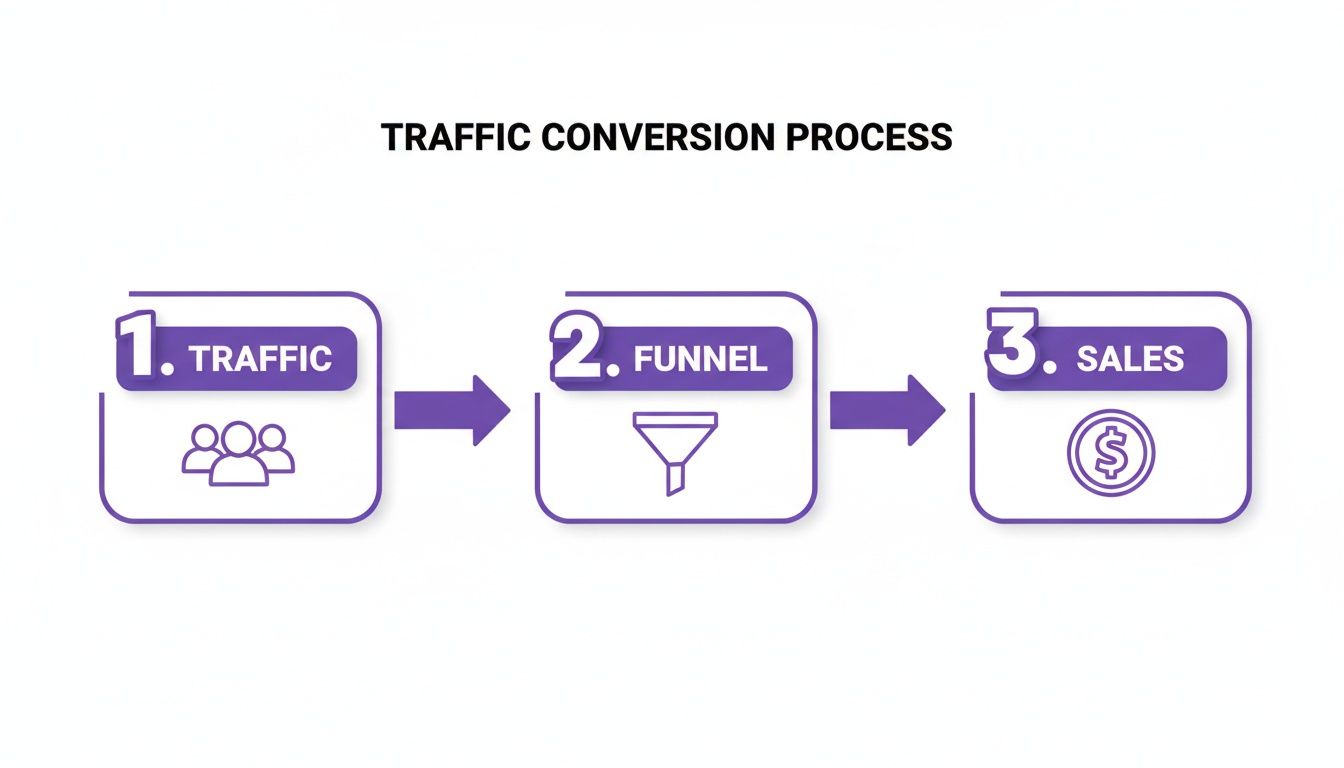
As you can see, that "Funnel" stage is where the magic happens—or doesn't. This is where your optimization efforts will pay off big time.
Quick Wins for an Immediate Sales Lift
Conversion optimization doesn't have to be a massive project. There are high-impact changes you can make right now to see results almost immediately.
This table breaks down common mistakes and provides simple, actionable solutions.
| Optimization Area | Common Mistake | Actionable Solution |
|---|---|---|
| Product Pages | Low-quality, generic product photos. | Add high-resolution images, lifestyle shots showing the product in use, and a short product video. |
| Call-to-Action | A single, boring "Add to Cart" button. | Make your CTA button a bold, contrasting color. Add trust badges (e.g., "Secure Checkout") directly underneath it. |
| Shipping Costs | Hiding shipping fees until the final checkout step. | Be transparent! Display shipping costs on the product page or offer a clear free shipping threshold (e.g., "Free Shipping on Orders Over $75"). |
| Checkout Process | Requiring customers to create an account. | Always offer a "Guest Checkout" option. A long, multi-page checkout is a conversion killer. |
| Mobile Experience | A desktop-first design that's clunky on phones. | Test your entire checkout flow on your phone. Are the buttons easy to tap? Is the text readable? Most of your traffic is likely mobile. |
These are foundational fixes that tackle the most notorious conversion killers head-on. If you're curious about how your store stacks up, plug your numbers into our handy conversion rate calculator.
Let this sink in: The average ecommerce conversion rate is a dismal 1-3%. That means for every 100 people who visit your store, 97 of them are leaving empty-handed. But if you can bump your rate from just 1.5% to 2%, you've just unlocked a 33% increase in sales—from the exact same traffic.
Focusing on conversion rate optimization (CRO) first is non-negotiable. It ensures that when you do turn the traffic faucet back on, your store is a well-oiled machine ready to capitalize on every visitor. Otherwise, you're just pouring water into a leaky bucket.
Turn Your Product Pages into Conversion Engines
Your product page is your top salesperson. If it’s not sealing the deal, it’s actively costing you money. Every bounce is a potential customer walking out the door—a clear sign your page failed to connect, convince, or build trust.
Let's fix that, starting now.
The single biggest mistake merchants make is writing product descriptions that just list features. Nobody buys a drill because they want a half-inch, variable-speed, lithium-ion drill. They buy it because they want a hole in the wall to hang a picture of their family. Your copy must sell the outcome, the feeling, the solution your product delivers.
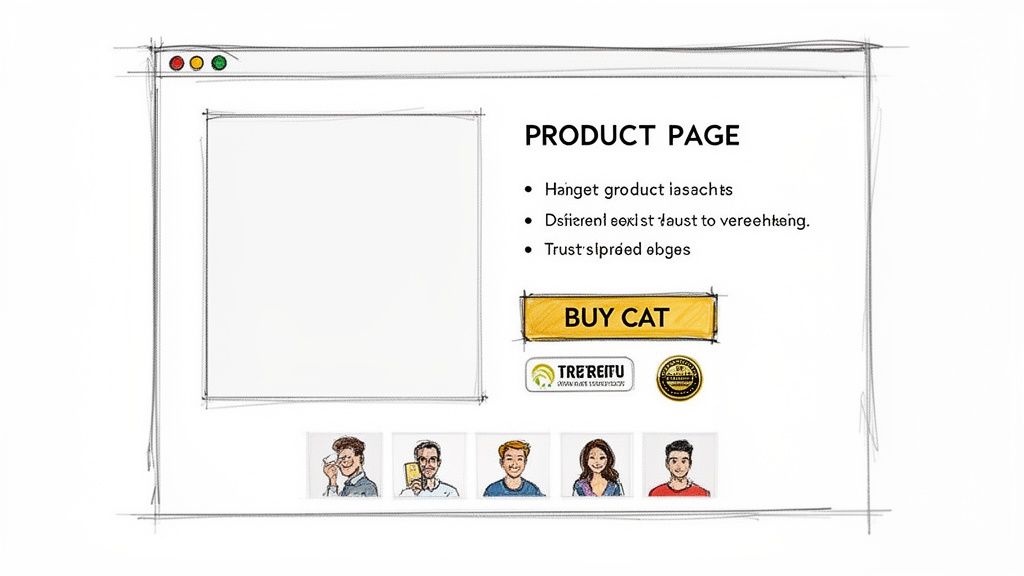
Write Copy That Sells the Transformation
Stop describing what your product is and start evangelizing what it does for your customer. Use storytelling and benefit-driven language to paint a vivid picture of their life—made better by your product.
This means ditching dry, technical jargon for emotional, persuasive language. If you're struggling to find the right words, try this tool to generate benefit-focused copy that you can then polish to match your brand’s voice.
A product page's goal isn't just to inform; it's to persuade. Every single word, image, and button should be relentlessly guiding the visitor toward one action: Add to Cart. Anything that distracts from that mission is hurting your sales.
For example, don't just say "Made with 100% cashmere." Instead, try something like, "Wrap yourself in a cloud of softness that makes every day feel like a lazy Sunday morning." The first is a fact; the second is a feeling. And feelings sell.
Structure Information for Maximum Impact
For complex products, a giant wall of text is a guaranteed conversion killer. Shoppers scan, they don't read. Your job is to make the most important information ridiculously easy to digest. This is where bullet points become your secret weapon.
- Lead with the benefit: Always start your bullet points with the most compelling benefit. Instead of "10,000mAh battery," rephrase it as "All-Day Power: Stop hunting for outlets. This battery lasts from your morning coffee to your late-night doomscroll."
- Use bolding to guide the eye: Make it easy for scanners by bolding the most important keywords in each point.
- Keep it punchy: Each bullet should nail one clear idea, fast.
This structure makes your key selling points pop. If you have a ton of features to get through, you can use a free bullet points tool to create readable, persuasive lists that give your page a clean, professional look.
Build Desire and Trust with Visuals
Killer copy is essential, but people buy with their eyes first. In e-commerce, your photos and videos have to do the heavy lifting of a physical product demonstration.
Here’s what you must have:
- High-Resolution Studio Shots: Crisp, perfectly lit photos on a clean background showing your product from every conceivable angle. Let customers zoom in and inspect every detail.
- In-Context Lifestyle Photos: Show your product in the wild. Seeing it used by real people helps customers visualize it in their own lives.
- Product Videos: A snappy, 30-60 second video can be a game-changer for conversion rates. Show it in action, highlight its best features, and prove its value.
- User-Generated Content (UGC): Featuring photos from actual, happy customers is pure gold. It’s one of the most powerful forms of social proof you can have, building massive trust and authenticity.
Sharpen Your Product Names for People and SEO
Finally, don't sleep on your product name. It’s often the very first thing a customer sees on Google or a collection page. A generic or confusing name is a one-way ticket to being ignored.
A great product name strikes a perfect balance: it’s descriptive enough for a human to understand immediately, but it's also optimized with keywords that search engines love. If you’re not sure how to nail that combo, using a product name optimizer can help you find that sweet spot, ensuring you get found and understood.
Turn Shoppers into Superfans by Boosting AOV and LTV
Getting the first sale is just the beginning. Real, sustainable growth comes from getting more value from every customer.
That’s where two key metrics come in: Average Order Value (AOV) and Lifetime Value (LTV).
Nailing these isn't just about tweaking numbers; it’s a mindset shift. You stop thinking about "making a sale" and start thinking about building a real relationship. How do you get them to add one more thing to their cart today? And more importantly, how do you get them so excited they can't wait to come back?
Forget generic "You might also like" widgets. We're talking about smart, psychologically-savvy tactics that feel genuinely helpful, not like a pushy sales pitch.
Master the Art of the Upsell and Cross-Sell
Upselling (offering a better version) and cross-selling (offering a companion product) are your fastest tickets to a higher AOV. When done right, it doesn't feel salesy—it feels like you're looking out for your customer.
Someone's buying a camera body. Offering them a compatible lens or a sturdy case isn't just a sale; it's a solution. You're helping them get the most out of their purchase.
Here are a few ways this works wonders:
- Pre-Purchase Nudges: Use in-cart pop-ups or banners to suggest must-have add-ons right before checkout. Apps like ReConvert or AfterSell are fantastic for this.
- Tiered Temptations: Set up "buy more, save more" deals. You’ve seen them everywhere because they work: 10% off two items, 20% off three or more. It encourages people to fill their carts to unlock the next level of savings.
- The Post-Purchase One-Click Offer: This is magic. Right after they’ve paid, hit them with a special, one-time-only deal they can add to their order with a single click. No re-entering credit card details. This one move can tack an extra 10-15% onto your total revenue, practically overnight.
The golden rule here is relevance. A random offer screams "desperate." A thoughtful suggestion that perfectly complements what they just bought? That feels like five-star service.
Create Product Bundles They Can’t Say No To
Bundling is one of the most powerful AOV-boosting plays. It simplifies decisions for your customers and makes them feel like they're getting an incredible deal.
Instead of hoping a new customer figures out which three products go together, you hand them a perfect, pre-packaged solution. This is a game-changer for first-time buyers.
How to Build Irresistible Bundles
| Bundle Type | Description | Real-World Example |
|---|---|---|
| The "Starter Kit" | Packages all the essentials a newbie needs to get going. | A skincare brand bundles their cleanser, moisturizer, and sunscreen into the "Perfect Morning Routine Kit." |
| The "Complete the Look" | Groups complementary fashion or home decor pieces to create a full vibe. | A clothing store bundles a best-selling dress with the perfect handbag and earrings. Instant outfit. |
| The "Bulk Savings" | Offers a sweet discount for stocking up on a consumable product. | A coffee company offers a three-pack of their top-selling roast for a lower price per bag. Win-win. |
Setting these up in Shopify is a breeze. Use a dedicated bundling app or simply create a new product that represents the bundle. Your goal is to make the bundle so compelling that buying items individually seems crazy. You'll not only see your AOV climb, but you'll move more inventory, too.
Bring in the Bots: Use AI to Automate Sales and Support
What if you could hire the perfect salesperson—one who never sleeps, knows every product detail, and can help thousands of customers at once? That’s what an AI-powered shopping assistant does for your Shopify store.
This isn't about getting rid of the human touch. It's about scaling it to capture sales you'd otherwise lose.
Modern shoppers want answers now. If they have a question at 11 PM on a Sunday, they won't fill out a contact form and wait. They'll just leave. An AI assistant turns that make-or-break moment from a lost sale into a guided buying experience.
Your 24/7 Sales and Support Crew
AI shopping assistants, like the ones from Selzee, are much more than a simple chatbot. They’re a frontline concierge for your brand, engaging in complex conversations to help shoppers find exactly what they're looking for. This turns passive window shopping into an active, consultative sale.
They can proactively engage visitors, turning a simple browse into a real sales conversation.
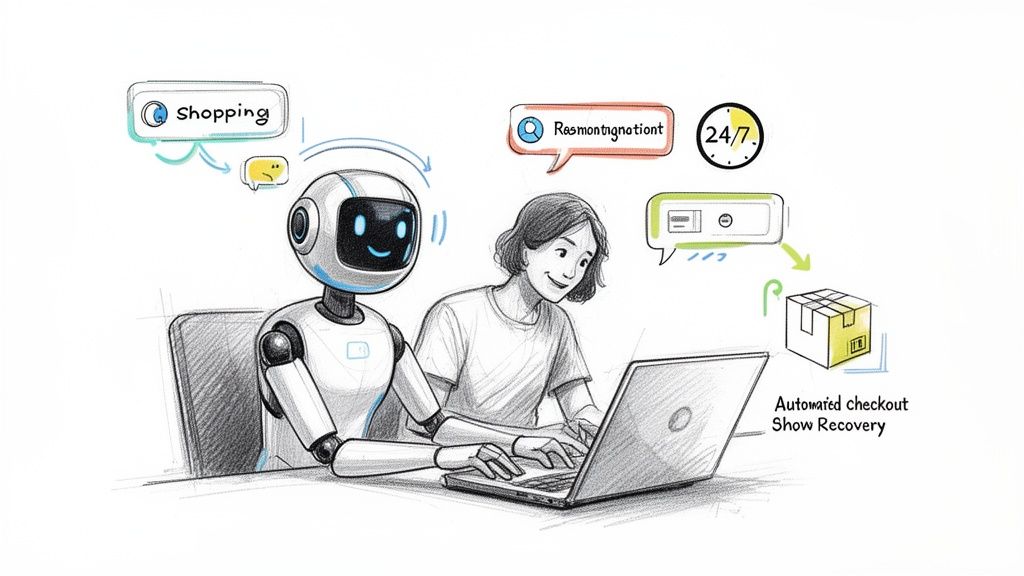
The big shift here is moving from a reactive support model to a proactive sales engine. It’s always on, ensuring no visitor with high purchase intent ever feels ignored.
This kind of immediate, intelligent help is a game-changer. Merchants adding these AI tools are seeing double-digit lifts in conversions and AOV. For example, beauty, fashion, and supplement brands are reporting up to a 94% AI-only resolution rate. That’s a massive cut in support costs, all while lifting AOV by 15-20% through smart, personalized recommendations right in the chat.
With 70% of orders coming from mobile—where speed is everything—this instant, conversational support is crucial for turning scrollers into buyers.
A Practical Playbook for AI Sales Automation
Adding an AI assistant is more than slapping a chat widget on your site. It’s about building an automated system that guides customers and drives revenue.
Here’s a simple playbook:
- Handle Complex Product Questions Instantly. Feed your AI your entire product catalog—tech specs, materials, and how-to guides. A customer asking, "Which of your serums is best for sensitive, acne-prone skin?" should get an immediate, expert answer, not a link to a generic FAQ page.
- Deliver Hyper-Personalized Recommendations. The AI can watch a visitor's browsing behavior in real-time. If they're checking out hiking boots and waterproof jackets, the AI can pop up and suggest merino wool socks to complete the kit, giving your AOV a nice bump.
- Proactively Engage High-Intent Shoppers. Set up triggers to engage people who are clearly ready to buy. If someone has been on a high-ticket product page for over 60 seconds, the AI can chime in with, "Hey, I see you're checking out the Pro Camera. Did you know it comes with a 2-year warranty and free shipping?"
Pro Tip: Don't box your AI in as just a support tool. Frame its prompts and responses around selling. Instead of "How can I help you?" try "What are you shopping for today? I can help you find the perfect fit." That simple tweak shifts the whole conversation from support to discovery.
Recovering Carts and Fine-Tuning Your Offers
One of the most powerful things AI can do is tackle cart abandonment. A smart assistant can sense when a shopper is about to bail on a full cart and step in with a targeted offer, like a small discount or a reminder about free shipping.
Even better, every conversation is a goldmine of data. The questions your customers ask are a direct roadmap to what’s missing on your product pages.
- Are lots of people asking if a shirt is true to size? That’s your sign to add a detailed sizing chart and customer photos to that page.
- Do shoppers often ask which products work best together? That's a screaming signal to create a new product bundle.
This feedback loop is priceless. You're not guessing what your customers want; they're telling you. For a real-world look at this in action, check out this case study on creating an AI fragrance concierge.
By letting AI handle repetitive questions and proactive engagement, your team is freed up to focus on the big picture—confident that your on-site experience is working around the clock to convert customers.
Drive Targeted Traffic That Actually Converts
"More traffic" is a vanity metric. It's completely useless unless it's the right traffic. Pouring money into ads to get a flood of low-intent visitors who bounce immediately is the fastest way to drain your budget.
The goal isn't just a spike in analytics; it's about building a predictable, profitable revenue engine.
This means moving beyond broad, spray-and-pray campaigns to laser-focus on acquiring customers who are already halfway to the checkout—people with a problem to solve and a search query that proves they’re ready to buy.
The Shopify ecosystem is a goldmine. A new sale happens every 26 seconds on the platform, and with 675 million buyers in 2023 alone—a 2.25x jump since 2019—the potential is enormous. You can see the full breakdown in Backlinko's Shopify report. The secret is tapping into this market with surgical precision.
Master Long-Tail Keywords for High Purchase Intent
Trying to rank for short, generic keywords like "running shoes" is a bloodbath. You're up against industry giants with bottomless pockets.
But a long-tail keyword like "best waterproof trail running shoes for wide feet"? Now that's a customer ready to buy.
These longer, specific phrases might have lower search volume, but their conversion rates are through the roof. Someone searching with that level of detail knows exactly what they want. Your only job is to show up as the perfect solution.
- Get Inside Their Head: Think about the exact problems your product solves. You're not just selling a "face cream"; you're selling a "hydrating face cream for dry, sensitive skin in winter."
- Weave It In Everywhere: Sprinkle these long-tail keywords into your product titles, descriptions, and blog content. A post titled "5 Reasons Your Feet Hurt on Long Hikes (And the Right Shoes to Fix It)" will pull in far more qualified buyers than a generic product announcement.
- Use the Right Tools: Use free tools like Google Keyword Planner or paid options like Ahrefs to uncover the exact phrases your ideal customers are typing into the search bar.
This organic approach builds a sustainable traffic source that works for you 24/7, pulling in motivated shoppers without constantly feeding the ad machine.
Key Takeaway: Stop chasing massive search volume. Instead, own the hyper-specific search queries that signal a customer is in the final stages of their buying decision. It’s the difference between shouting into a crowd and having a direct, persuasive conversation.
Get Smarter with Your Paid Ad Strategy
When you do open your wallet for paid traffic, every dollar needs to work overtime. Forget the scattergun approach. Your focus should be on high-ROI campaigns that target warm audiences—people who have already shown interest.
This boils down to two game-changing strategies: retargeting and lookalike audiences.
| Strategy | Description | Why It Works So Well |
|---|---|---|
| Retargeting Campaigns | Serving ads to people who have already visited your site, viewed a product, or abandoned a cart. | This is your lowest-hanging fruit, period. These shoppers already know you. A timely ad with a good offer is often all it takes to bring them back to finish the job. |
| Lookalike Audiences | Creating new audiences on platforms like Facebook or Google that share key traits with your best existing customers. | You're literally cloning your ideal buyer. This lets you find brand-new, high-potential customers who are statistically wired to be interested in what you sell. |
This isn't about outspending your competition; it's about outsmarting them. By zeroing in on people already familiar with your brand or who mirror your most profitable customers, you slash wasted ad spend and send your conversion rates soaring.
Ready to sharpen your e-commerce game? You might be interested in our full suite of free e-commerce tools designed to help you optimize every aspect of your store.
Build a Retention Machine with Email and SMS
Let's talk about your most profitable customer: the one you've already won over. While competitors burn through ad budgets chasing new eyeballs, the smartest brands quietly build retention machines that turn one-time buyers into a reliable, recurring revenue stream.
This is where you stop chasing sales and start building genuine relationships at scale. Email and SMS aren't just for blasting out promo codes. When done right, they create a personalized, automated conversation that keeps your brand top-of-mind and your customers clicking "buy" again. It’s about sending the perfect message to the right person at the exact moment they need to see it.
The Automated Flows Every Store Needs
If you don’t have these core automated flows running 24/7, you're leaving money on the table. These are the foundation of any serious retention strategy. To get this engine humming, you can explore great strategies for email marketing for small business.
- The Welcome Series: This is your digital handshake. The second someone trusts you with their email, use a 3-5 email sequence to share your brand story, show off your bestsellers, and sweeten the deal with a first-purchase offer.
- The Abandoned Cart Sequence: This is a strategic, multi-step nudge. The first message is a simple reminder. The second can dial up urgency ("Your items are selling out fast!"). The third could be a small, time-sensitive discount to seal the deal. Test different timings and offers to see what clicks.
- Post-Purchase Follow-Ups: The conversation can't die after checkout. A brilliant post-purchase flow confirms the order, builds excitement in transit, follows up to ask for a review, and then cleverly introduces complementary products. This turns a transaction into a relationship.
- The Win-Back Campaign: Got customers who haven't bought in 90 or 180 days? Don't let them fade away! A targeted win-back campaign with a "we miss you" offer can reactivate a surprising number of old customers.
Personalization is Your Superpower
Generic, one-size-fits-all email blasts are dead. Today’s shoppers expect you to know them—their purchase history and what they like. This is where segmentation becomes your secret weapon.
Your email list isn't a faceless mob; it's a collection of individuals. Segmenting your audience based on their actual behavior—what they've bought, what they've browsed, or how much they spend—lets you send hyper-relevant messages that feel less like marketing and more like a personal recommendation.
For instance, create segments for:
- VIP Customers: Give your biggest fans the red carpet treatment with early access to sales, exclusive products, and special rewards.
- First-Time Buyers: Guide them. Send content that helps them get the most out of their new purchase and introduces them to other items in your catalog.
- Category-Specific Shoppers: If someone has only ever bought skincare, stop spamming them about your new haircare line. Send them targeted offers based on interests they've already shown you.
This thoughtful personalization skyrockets customer lifetime value (LTV). Global ecommerce is projected to hit $6.88 trillion in 2026. Shopify stores are at the heart of this, with 4.82 million active shops driving $292.3 billion GMV in 2024. In a market this crowded, automation and personalization are essential.
As you build this retention machine, think about how an AI customer service tool can work alongside it, providing 24/7 support and personalized recommendations. You can discover more insights about these Shopify statistics. This integrated approach ensures every touchpoint is fine-tuned for loyalty and repeat business.
Ready to turn more conversations into conversions? With Selzee, you can deploy a powerful AI shopping assistant that works 24/7 to guide customers, answer questions, and drive sales automatically. Find out how it can transform your Shopify store at https://selzee.com.