If you feel like you need to clone yourself just to keep up with your Shopify store, you’re not alone. Between answering customer questions, chasing down abandoned carts, and trying to nurture leads, there's hardly any time left to actually grow your business. This is exactly where sales automation steps in, and it’s a game-changer for scaling stores.
At its core, sales automation is about using smart software to handle repetitive, time-sucking sales tasks for you. Think of it as hiring the most efficient, reliable employee you can imagine—one who works 24/7, never gets tired, and executes your sales strategy flawlessly.
So, What Does Sales Automation Actually Look Like on Shopify?
Imagine a system that automatically texts a discount code to a shopper who just abandoned their cart. Or a chatbot that pops up to help a visitor find the perfect product based on the pages they've viewed. That's sales automation in action.
This isn't about turning your store into a robotic, impersonal machine. It’s the exact opposite. It’s about using technology to scale the personal touch you wish you could give every single visitor. You set up automated "workflows" or "plays"—simple if-this-then-that rules—that run quietly in the background, making sure no opportunity slips through the cracks.
This frees you up to focus on the big picture: sourcing new products, creating high-impact marketing campaigns, and building a brand that customers genuinely love.
From Manual Sales Grind to Automated Revenue Engine
Let's be clear: this isn't some fleeting trend. It's a fundamental shift in how modern ecommerce stores are built to win. The numbers don't lie—the global sales automation market was valued at a whopping $8.6 billion in 2023 and is on track to hit $19.5 billion by 2030. That's not just growth; it's an explosion. Dig into the latest automation statistics to see just how fast this is moving.
For you, this means trading in the endless to-do list for a powerful, proactive system. Instead of just reacting to customer questions, your store can anticipate their needs. Instead of manually sending a generic follow-up email, you can trigger a personalized offer based on their unique browsing behavior.
To make this crystal clear, let's look at the night-and-day difference between the old way and the new way.
Manual Sales Grind Vs Automated Revenue Engine
| Manual Sales Task | Automated Workflow Solution | Primary Benefit |
|---|---|---|
| Manually emailing cart abandoners one by one. | Trigger a multi-channel (SMS & email) abandoned cart recovery sequence. | Recover Lost Revenue |
| Answering the same product questions all day. | Deploy an AI chatbot to provide instant, 24/7 product recommendations. | Increase Conversion Rate |
| Guessing which leads are ready to buy. | Score leads based on browsing behavior and trigger alerts for hot prospects. | Focus on High-Value Leads |
| Sending generic "we miss you" emails. | Automatically send personalized win-back offers based on past purchases. | Boost Customer Lifetime Value |
See the difference? One is a constant, uphill battle. The other is a well-oiled machine that drives sales while you sleep.
Key Takeaway: Sales automation isn’t about becoming a tech wizard. It’s simply about setting up smart rules that deliver the right message to the right person at the perfect moment, turning your website traffic into a predictable stream of income.
That’s the essence of it. You’re using technology to do the heavy lifting, so you can pour your energy into the creative, strategic work that only you can do.
The Engine Powering Your Automated Sales
Let’s get one thing straight: sales automation isn’t a single piece of software. It’s more like a high-performance engine you build for your store, with several critical components working in perfect sync. Just like a car engine needs fuel, air, and a spark, your automation system needs data, triggers, and actions to really roar.
Nail this combination, and you've got a revenue-generating powerhouse. Get it wrong, and you're left with a sputtering machine that costs you money.
The absolute heart of this engine is your Customer Relationship Management (CRM) system. For most Shopify store owners, this is your customer list within Shopify, but it can be a more dedicated platform. Think of it as the central brain holding every byte of customer data—their purchase history, what they left in their cart, and how to reach them. This data is the high-octane fuel for everything else, so keeping it clean and organized is non-negotiable.
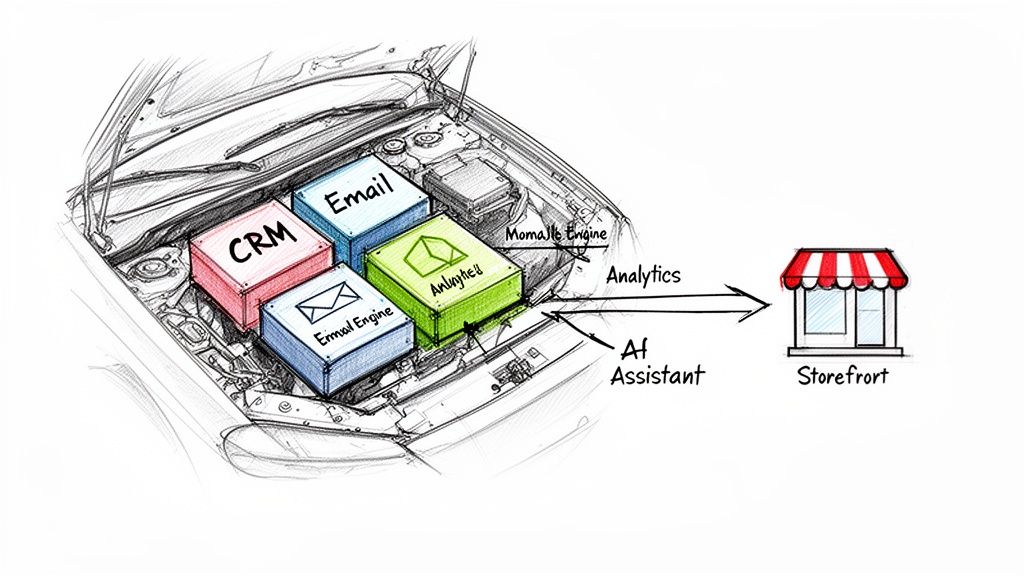
Having a unified view like this is a game-changer. It lets you see exactly what’s working, what isn’t, and where you can tune things up for better performance.
The Core Components of Your Automation Engine
With your customer data as the foundation, a few key tools come into play. These are the pistons and gears that actually turn that raw data into sales.
- Email & SMS Marketing Platforms: This is your direct line to the customer. Automation here lets you build entire conversations that happen automatically. Think of a "welcome series" that nurtures new subscribers or a multi-day abandoned cart sequence that gently nudges a customer back to complete their purchase.
- AI-Powered Sales Assistants: This is where things get really exciting. An AI assistant, like the one we've built at Selzee, acts as your 24/7 salesperson. It can greet visitors, answer their questions instantly, and even offer personalized discounts to loyal customers. It’s what turns a passive window shopper into an active, engaged buyer.
- Workflow Builders: This is the software that glues everything together. It works on simple "if-this-then-that" logic to create your automated flows. For example: IF a customer adds a product to their cart but doesn’t check out in 60 minutes, THEN automatically send them an SMS with a 10% discount code to seal the deal.
The Big Idea: An effective sales automation strategy isn't just about blasting out emails. It's about intelligently weaving together your customer data, smart communication tools, and AI assistants to create a seamless, personalized buying journey for every single shopper.
These parts don't work in isolation—they talk to each other. Your AI assistant might spot a visitor showing high buying intent, add a special tag to their CRM profile, and boom—that tag triggers a unique follow-up email sequence. This is the kind of smart coordination that drives real results and turns your store into a finely-tuned sales machine.
You can explore a whole range of powerful automation tools to see how the different pieces can fit into your own strategy.
What This Actually Does for Your Store's Performance
Theory is one thing, but let's get down to brass tacks. What results can you actually see in your Shopify dashboard? Bringing sales automation into your store isn't just about adding another app; it’s about giving your store a serious performance upgrade across the board. The impact isn't just a tiny bump—it’s a powerful engine for revenue and efficiency.
When you get it right, automation hits the three most critical metrics for any ecommerce store. We're talking about measurable lifts that turn the traffic you already have into more profit, often without spending another dime on ads.
Higher Conversion Rates
Your conversion rate is the heartbeat of your store. Sales automation makes it stronger by creating proactive, personalized shopping experiences that you could never manage manually. Instead of just hoping a visitor doesn't get confused and leave, an automated system can jump in at the exact right moment.
Think of it like having an expert salesperson on the floor for every single visitor. When the system detects someone lingering on a product page for more than 30 seconds, it can instantly pop up a chat window to offer help, answer a common question about sizing, or even present a small, time-sensitive discount to seal the deal. This proactive engagement is a game-changer, turning passive window shoppers into confident buyers.
The Bottom Line: By instantly answering questions and smoothing out the path to purchase, automation can boost store conversion rates by 10-15% or even more. That’s more sales from the same traffic you’re already getting.
Increased Average Order Value
Getting a customer to the checkout page is a huge win. The next win is getting them to spend a little more while they're there. This is where sales automation truly shines, spotting and acting on perfectly-timed upsell and cross-sell opportunities that feel genuinely helpful, not sleazy.
Here are a few tactics that just plain work:
- Smart Product Bundles: A customer adds a new digital camera to their cart. Bam! Your system automatically suggests a discounted bundle that includes a memory card and a protective case. It’s a no-brainer for them and a bigger sale for you.
- Checkout Upgrades: Someone's buying a popular face cream. At checkout, they're offered the matching serum—a classic "people who bought this also loved..." suggestion that works wonders.
- Tiered Shipping Nudges: An automated message pops up in the cart: "You're only $15 away from free shipping!" This simple prompt is ridiculously effective at getting customers to add one more item to their order.
Each of these automated plays pushes your Average Order Value (AOV) higher without you lifting a finger. If you want to see how these AOV-boosting strategies impact your bottom line, you can learn more about how to calculate your store's conversion rate and track the changes.
Better Customer Lifetime Value
Finally, automation is your secret weapon for turning one-time buyers into loyal, repeat customers. The relationship doesn't end when they click "complete purchase"—that's actually where it begins.
You can set up automated post-purchase sequences that send out personalized thank-you messages, ask for reviews at the perfect time, and then, a few weeks later, re-engage those customers with special offers based on what they bought before. This consistent, relevant communication keeps your brand top of mind and builds a real relationship, driving your Customer Lifetime Value (CLV) way up.
Proven Sales Automation Playbooks You Can Use Today
Alright, enough with the theory. Let's talk about what actually works. The point of automation is to build money-making machines that work for you around the clock, and you can start right now.
Here are a couple of battle-tested playbooks for Shopify stores. Forget needing a developer—these are smart, repeatable workflows that catch customers at just the right moment and give your revenue a serious bump.
The Advanced Abandoned Cart Sequence
Look, a single "Hey, you forgot something!" email is amateur hour. It's better than nothing, but it’s not a real strategy. Customers bail on their carts for all sorts of reasons, so a one-size-fits-all message doesn't cut it. This playbook turns a simple reminder into a multi-channel conversation that actually gets results.
Here’s how to set it up:
- Trigger 1 (60 Minutes Post-Abandonment): Hit them with an SMS. It needs to be quick, friendly, and helpful. Something like, "Hey [First Name], still thinking it over? Your cart is saved and ready when you are." It’s a gentle nudge while the purchase is still top of mind.
- Trigger 2 (4 Hours Post-Abandonment): Now, send the first email. This is where you remind them what they're missing—include pictures of the items right in the email. A clear call-to-action button is a must. Frame it as a customer service check-in: "Did something go wrong? Let us know!"
- Trigger 3 (24 Hours Post-Abandonment): Time for the second email. This is where you sweeten the deal. A small incentive, like a 10% discount or free shipping, is usually all it takes to push someone over the edge if they were hesitant about the price.
- Trigger 4 (48 Hours Post-Abandonment): This is the final push. The last email needs to create a bit of urgency. Think subject lines like "Your cart expires soon" or "Last chance for 10% off." It’s your last, best shot to reel that sale back in.
The Post-Purchase Feedback and Upsell Loop
The moments right after a customer hits "buy" are pure gold. They're excited, they trust you, and they're paying attention. This playbook takes that post-purchase high and uses it to forge loyalty and set up the next sale.
This automation turns a one-time transaction into the beginning of a long-term customer relationship. It shows you value their business beyond the initial sale and keeps them engaged with your brand.
Here’s the game plan: Set up an email to go out 7-10 days after the package has been delivered. First, thank them, and then ask for a product review. But here's the magic—based on what they bought, your system automatically recommends a perfect complementary product. Did they buy a new coffee maker? Suggest your best-selling espresso beans. To make the copy in your upsell emails compelling, try this tool to craft descriptions that sell themselves.
This flowchart shows you exactly how these targeted automations directly pump up your most important store metrics.
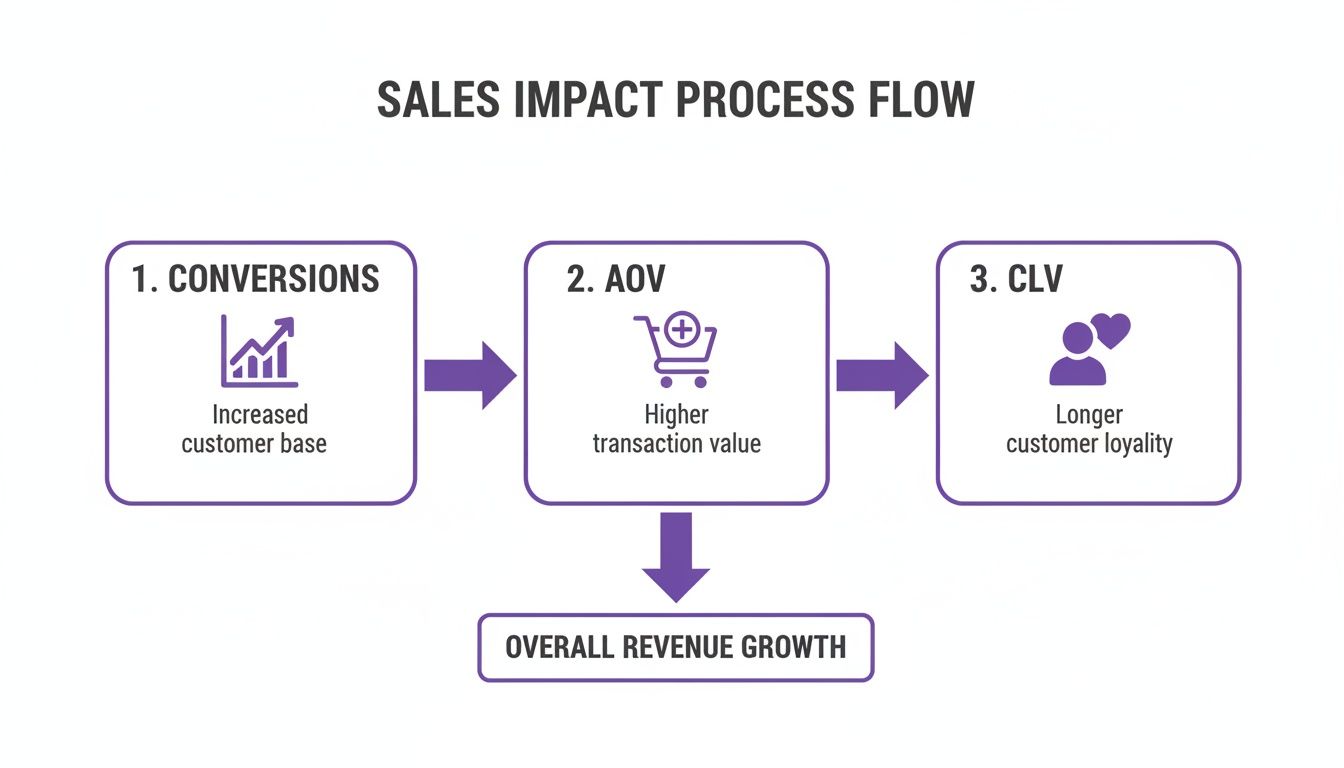
As you can see, every automated touchpoint is designed for more than just a single conversion. It's about systematically lifting your conversion rates, average order value, and, ultimately, your Customer Lifetime Value. Putting even one of these playbooks into action can create a powerful ripple effect across your entire business.
If you're curious about how a platform like Selzee makes these workflows a reality, you should get a personalized demo and see the possibilities for yourself.
Watch Out! These Costly Automation Mistakes Can Wreck Your Brand
Sales automation is a game-changer, but let’s be real: it’s not a magic wand. If you set it up carelessly, it can blow up in your face and tick off the very customers you’re trying to convert. Thinking you can just "set it and forget it" is the quickest way to turn a powerful tool into a brand-destroying nightmare.
One of the biggest blunders is sending out messages that sound like a robot wrote them. Your brand’s voice is your secret weapon! Automation should make that voice louder and clearer, not muffle it. A generic welcome email or a clunky, canned chatbot response makes your customers feel like just another number, and that connection is gone in a flash. That's not just a missed opportunity; it's lost sales.
Overlooking The Human Touch
Another classic pitfall is failing to get your tools to talk to each other. When your email platform, chatbot, and CRM are all doing their own thing, the customer experience becomes a chaotic, disjointed mess. Imagine a customer gets a sweet discount offer from your chatbot, only to receive an email two minutes later with a totally different promo. It screams amateur hour and completely shatters their trust.
Key Insight: The whole point of sales automation is to make your business feel more personal, even as you scale. Every automated touchpoint should be so timely and relevant that it feels like you're having a one-on-one chat.
Without a unified strategy, you're just creating a confusing maze that sends frustrated shoppers running straight to your competitors. Every single tool needs to be on the same page, telling one consistent story.
Ignoring Crucial Testing and Monitoring
Maybe the most terrifying mistake of all is launching your automated workflows without testing them first and then keeping a close eye on them. Seriously, what happens if you set up a discount code wrong? One store found out the hard way when it accidentally emailed a 50% off coupon to its entire list. That’s a multi-thousand-dollar goof-up that a simple five-minute test could have easily prevented.
If you aren't monitoring your automations, you're flying completely blind. You have no idea if your abandoned cart emails are actually bringing people back or if your post-purchase follow-ups are getting you those precious reviews. Automation demands a smart plan, constant attention, and the flexibility to make changes based on what the data tells you. To keep your automated messages sharp and mistake-free, you've got to nail your product copy. If you need a hand, you can always use our free product description tool to whip up high-quality descriptions that actually sell.
How to Choose the Right Automation Tools for Shopify
The Shopify App Store is a vast ocean of options. You can drown in there pretty quickly if you don't have a strategy. Picking the right sales automation tool isn't about grabbing the shiniest object; it's about finding the puzzle piece that fits your store, your team, and your workflow. A flashy, feature-packed app that just makes your life harder is a step backward, not forward.
Your entire decision should boil down to a few non-negotiable principles. The biggest one? Seamless Shopify integration. The tool has to feel like it was built for your dashboard, not some clunky add-on you have to wrestle with every day. Customer data, orders, product info—it all needs to sync up without you thinking about it.
Key Decision Factors for Smart Merchants
Next up is scalability. That app that works wonders when you have 100 orders a month needs to be just as amazing when you hit 1,000. You want tools that grow with you, not ones you'll ditch after a great sales quarter. And please, don't overlook an intuitive user interface. You shouldn't need a computer science degree to build a simple workflow.
Finally, check out their support. When things inevitably break at 10 PM on a Friday during a huge flash sale, you need to know you can reach a real, helpful human who understands the urgency of ecommerce.
The Strategic Choice: Are you a builder or a buyer? You can go the "builder" route, piecing together separate apps for live chat, email marketing, and pop-ups. The problem? You often end up with a messy, fragmented customer experience and a nightmare of data silos.
The alternative is a unified platform like Selzee, which acts as a single command center. It brings together an AI sales assistant, automated workflows, and all your analytics into one place. This approach gets rid of the integration headaches and makes sure all your automated messages are working in harmony, not against each other. It gives you one clear view of the customer journey, making it a hundred times easier to see what’s actually driving sales.
Ultimately, the best choice is the one that fits your budget, aligns with your growth goals, and makes you feel empowered, not overwhelmed. It’s all about automating smartly without adding a bunch of complexity you don't need.
Got Questions About Sales Automation? We've Got Answers.
Stepping into the world of sales automation can feel a little daunting. You've probably got a bunch of questions swirling around. We hear them all the time from Shopify store owners just like you, so let's tackle the big ones head-on.
Will Automation Make My Brand Feel Robotic?
This is the number one fear, and it’s a valid one! But the answer is a resounding no—as long as you do it right.
Great automation doesn't replace your brand's unique voice; it amplifies it. The point is to send incredibly relevant, personalized messages at the exact moment they matter most. That doesn't feel robotic; it feels like a white-glove, VIP experience. The secret is to infuse your brand's personality into every automated message and build journeys that actually help your customers.
What’s the Difference Between Sales and Marketing Automation?
It's easy to get these two mixed up, but the distinction is pretty simple.
Marketing automation is about casting a wide net. It's the stuff you do to attract people and warm them up, turning strangers into interested leads. Think email newsletters, lead magnet downloads, and welcome series.
Sales automation, on the other hand, kicks in when someone signals they're ready to buy. Its job is laser-focused on one thing: closing the deal and encouraging the next one. This is where you see killer tactics like abandoned cart reminders, post-purchase upsell offers, and loyalty rewards. They're two sides of the same coin, working together to grow your store.
How Much Technical Skill Do I Need?
Way less than you'd expect. The days of needing a developer on speed dial are long gone.
Modern tools are built for entrepreneurs, not coders. Most work on a simple "if this happens, then do that" logic. You'll find a ton of pre-built templates for the most common and profitable automations, like abandoned cart flows. If you can handle your Shopify dashboard, you've got all the skills you need to get powerful automations running in just a few hours. The only real requirement is a clear idea of what you want to accomplish.