Let's be direct: Voice of Customer (VoC) isn't another marketing buzzword. It’s the unfiltered playbook for growing your Shopify store, written by the only people who matter—your customers.
If you're ignoring it, you're leaving cash on the table. Period.
Your Customers Are Handing You a Roadmap to More Revenue
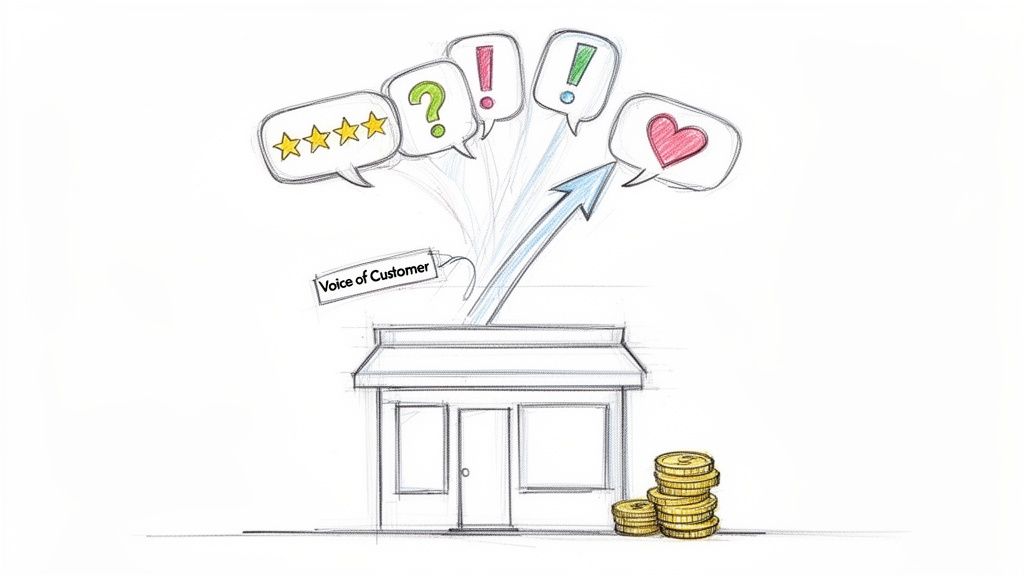
Every support ticket, product review, live chat query, and on-site search is a breadcrumb leading to more revenue. Most merchants treat this feedback as a chore. The brands that are crushing it see it as a real-time growth plan.
This guide isn’t theory. It’s a battle plan for busy Shopify merchants. We'll show you how to capture, analyze, and act on what your customers are telling you to fix the conversion killers you don't see, nail your marketing message, and boost your bottom line.
Why VoC Is a Growth Engine, Not a Cost Center
At its heart, the voice of customer concept is simple. Systematically gather what customers say about your brand, products, and shopping experience. Then, use that raw intelligence to make smarter decisions. This isn't about collecting feedback to feel good. It's about drawing a straight line from a customer comment to a measurable business outcome.
Here’s a real-world example: a customer pings support asking, "Do you ship to Canada?" That’s not a one-off question. It’s a flare signaling your shipping info is buried or confusing, and it's costing you sales from an entire country. Imagine dozens of those questions. You've just found a critical, money-draining leak in your sales funnel.
By systematically listening, you stop guessing what will improve your store and start knowing. You shift from putting out fires to proactively building a more profitable business—guided by the people who pay you.
The insights you uncover will directly fuel:
- Conversion Rate Optimization: Find and fix vague product descriptions, clunky navigation, or unanswered questions that kill sales right before checkout.
- Product Development: Uncover features customers are begging for, or spot a quality control issue before it becomes a nightmare of returns and bad reviews.
- Marketing Messaging: Steal the exact words your customers use to describe their problems. Your ads and landing pages will instantly become more resonant.
The Financial Cost of Ignoring Your Customers
In today's competitive e-commerce landscape, a VoC program is a non-negotiable growth lever. There are over 2 billion digital buyers. A tiny 1% lift in your conversion rate—driven by listening—can mean a massive revenue jump. To truly understand how your customers are telling you to grow, you must first grasp what is social listening and how it unlocks vital customer insights.
The data backs this up. Accenture found that 91% of consumers are more likely to shop with brands that provide relevant offers—something only possible when you act on customer feedback.
Failing to listen is a competitive disadvantage. Let's dive into actionable strategies you can roll out this week to turn customer chatter into cash.
Find VoC Goldmines You Already Own
You don't need fancy focus groups or a huge budget to know what your customers want. Your Shopify store is already a treasure chest of voice of customer (VoC) gold. The problem is, most merchants treat this feedback as one-off complaints instead of strategic, revenue-driving intel.
Your customers are telling you every day what they love, what confuses them, and what’s stopping them from clicking “Buy Now.” It's time to stop playing whack-a-mole with support issues and start mining this data for what it is: a direct path to higher conversions.
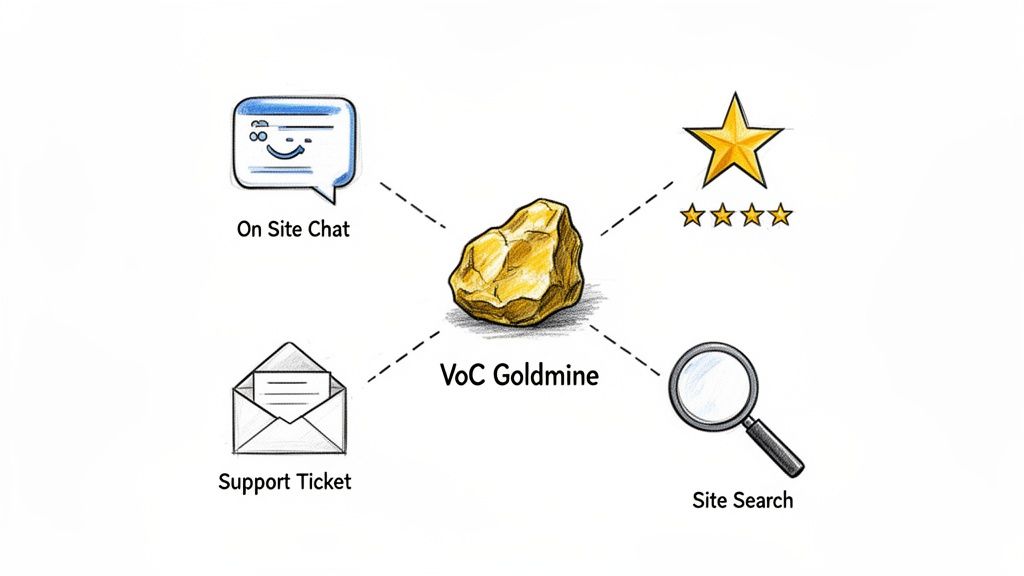
These four areas are packed with insights you can act on today. Each data source tells a different part of your customer's story. Piecing them together gives you a complete picture of where you're excelling and where you're dropping the ball.
Voice Of Customer Data Sources And Key Insights
| Data Source | What It Reveals | Implementation Effort |
|---|---|---|
| On-Site Chat | Real-time buying objections, product questions, and checkout friction. Answers the "why" behind cart abandonment. | Low |
| Reviews & Surveys | Post-purchase satisfaction, product quality issues, and fulfillment experience gaps. | Medium |
| Support Tickets | Critical pain points, confusing policies, and website bugs that are actively frustrating users. | Low |
| On-Site Search | Unmet product demand, navigation problems, and the exact language customers use to find things. | Low |
Let's break down how to tap into each of these goldmines to find actionable insights that will make a real difference to your bottom line.
Uncover Pre-Purchase Friction with Chat Logs
Your on-site chat is ground zero for pre-purchase VoC. This is where you see hesitation, confusion, and objections bubble up in real time.
Every time a shopper asks, "Do you have this in a size 12?" or "How long does shipping actually take?" they are waving a red flag, pointing directly to a gap on your product page or a lack of trust in your policies.
Key Insight: Your chat logs are not a cost center; they are your live conversion optimization report. They show you the why behind the numbers in your analytics, revealing the friction that's killing your sales.
Systematically review your chat transcripts. Are people constantly asking about your return policy? That’s your cue to make it impossible to miss on every product page. This isn't just about answering questions—it's about proactively eliminating them.
Decode Post-Purchase Feedback from Surveys and Reviews
Once an order is delivered, feedback shifts from "Should I buy this?" to "Did this meet my expectations?" This is where you learn the truth about your product quality, shipping speed, and overall brand promise.
Don't just glance at the star rating. The real magic is in the words. A 3-star review that says, "Love the dress, but it took three weeks to get here," tells you the problem isn't your product—it's your fulfillment.
Drill down into the comments to spot patterns:
- Product Quality Gaps: Look for phrases like "smaller than expected," "color looked different online," or "arrived broken." This is a direct line to your product and merchandising teams.
- Fulfillment Issues: Are people mentioning slow shipping, damaged packaging, or wrong items? A few of these could signal a problem with your 3PL or warehouse.
- Experience Mismatches: When a customer says, "I thought it would be..." they're telling you your product description or photos set the wrong expectation. Time for an update.
Pinpoint Policy and Site Flaws in Support Tickets
Your helpdesk is where your most frustrated customers end up. These tickets are a raw, unfiltered look at every single thing that can go wrong, from a broken discount code to a confusing return process.
When someone takes the time to write a support email, the problem was big enough to derail their experience. Treat these tickets like high-priority UX bug reports.
Look for recurring complaints like:
- Confusing Discount Codes: "My 20% off code isn't working!"
- Website Bugs: "I can't add this to my cart on my phone."
- Policy Frustration: "Why do I have to pay for my own return shipping?"
Every ticket represents friction that’s costing you sales and damaging your brand's reputation. Solving them isn't just customer service; it's smart business.
Find Unmet Demand in On-Site Search Data
Don't sleep on your site's search bar. Every query is a direct declaration of purchase intent. This data shows you exactly what people want to buy from you but can't find.
If you see a hundred searches for "wool-free sweaters" and you don't carry any, you've just uncovered a product opportunity. Likewise, if customers are searching for "hoodie" but you call them "pullovers," you've found an easy win to improve your site navigation and product naming.
To dive deeper into how to find and analyze these kinds of gaps, check out some of the powerful VoC analysis tools built for Shopify stores.
How to Analyze VoC Data Without Drowning in Spreadsheets
Collecting feedback is the easy part. The real challenge is turning a firehose of raw customer opinions into a clear, prioritized action plan.
If your process involves manually copy-pasting chat logs, support tickets, and reviews into a spreadsheet... stop. You're on a direct path to burnout and leaving money on the table. The goal isn’t to collect the voice of the customer; it’s to translate it into profit. This means ditching manual work for modern methods that find insights without you reading every single word.
You need a system that transforms a chaotic mess of feedback into a clean dashboard that screams, "Here's the problem that's costing you money right now."
Let AI Find the Patterns for You
Imagine finding every mention of "shipping costs" across thousands of chats from last month. By hand, that’s a nightmare. An AI tool can do it in seconds. This is the first step away from spreadsheet hell: automated theme detection.
Modern tools don't just find keywords; they understand and categorize the intent behind questions.
- Common Themes: Instantly see clusters of conversations about "sizing," "return policy," "discount codes," or "product availability."
- Purchase Intent: Automatically flag conversations where a customer shows strong buying signals, like asking for product comparisons.
- Friction Points: Surface moments of frustration, like when a customer can’t find the checkout button or a promo code keeps failing.
By automating this tagging, you get an immediate, high-level view of what’s on your customers’ minds. Suddenly, you see that 15% of all chats last week were about shipping. Now you have a data-backed reason to make your shipping policy crystal clear.
VoC analysis is about finding the signal in the noise. Automated theme detection is your filter, pulling the most urgent customer issues straight to the top of your to-do list.
Years ago, VoC programs were slow and relied on surveys. Today, AI has turned VoC into an always-on engine for store optimization. Customer expectations have skyrocketed—85% of customers now expect faster service than ever before, holding small brands to the same standards as giants like Amazon.
For merchants using AI assistants, every interaction becomes a VoC data point. AI systems trained on massive e-commerce datasets can spot patterns long before they show up as angry emails. You can read more about the state of CX in ecommerce to see how much the game has changed.
Figure Out How Your Customers Really Feel
Beyond what customers are saying, you need to understand how they're feeling. That's where text and sentiment analysis comes in. This tech analyzes feedback from reviews and surveys to assign an emotional score—positive, negative, or neutral.
This is more powerful than a star rating. A 3-star review could mean anything, but sentiment analysis tells you if that customer was mildly disappointed or genuinely furious.
By applying this lens to your feedback, you can quickly:
- Spot Problem Products: Find which products consistently generate negative emotions, even if their star ratings look decent. This is how you uncover hidden quality control issues.
- Keep a Pulse on Brand Health: Track overall sentiment over time. Did that recent site change make customers happier or more frustrated?
- Prioritize What's on Fire: A sudden spike in negative sentiment around "delivery times" is a five-alarm fire. A few neutral comments can wait.
To make this even easier, you can use a specialized AI feedback analysis tool. These platforms combine theme and sentiment analysis into one dashboard, turning qualitative comments into hard data you can act on.
The VoC to Revenue Playbook
Collecting feedback is just trivia if you don't act on it. The point of a voice of customer program is to draw a straight line from customer feedback to more money in the bank. This is where we turn rich feedback into store improvements that move the needle on conversions and AOV.
This isn't about a massive, six-month redesign. It’s about running quick, targeted "plays" based on the patterns you've found. The goal is to turn raw feedback into a prioritized to-do list that grows your revenue.
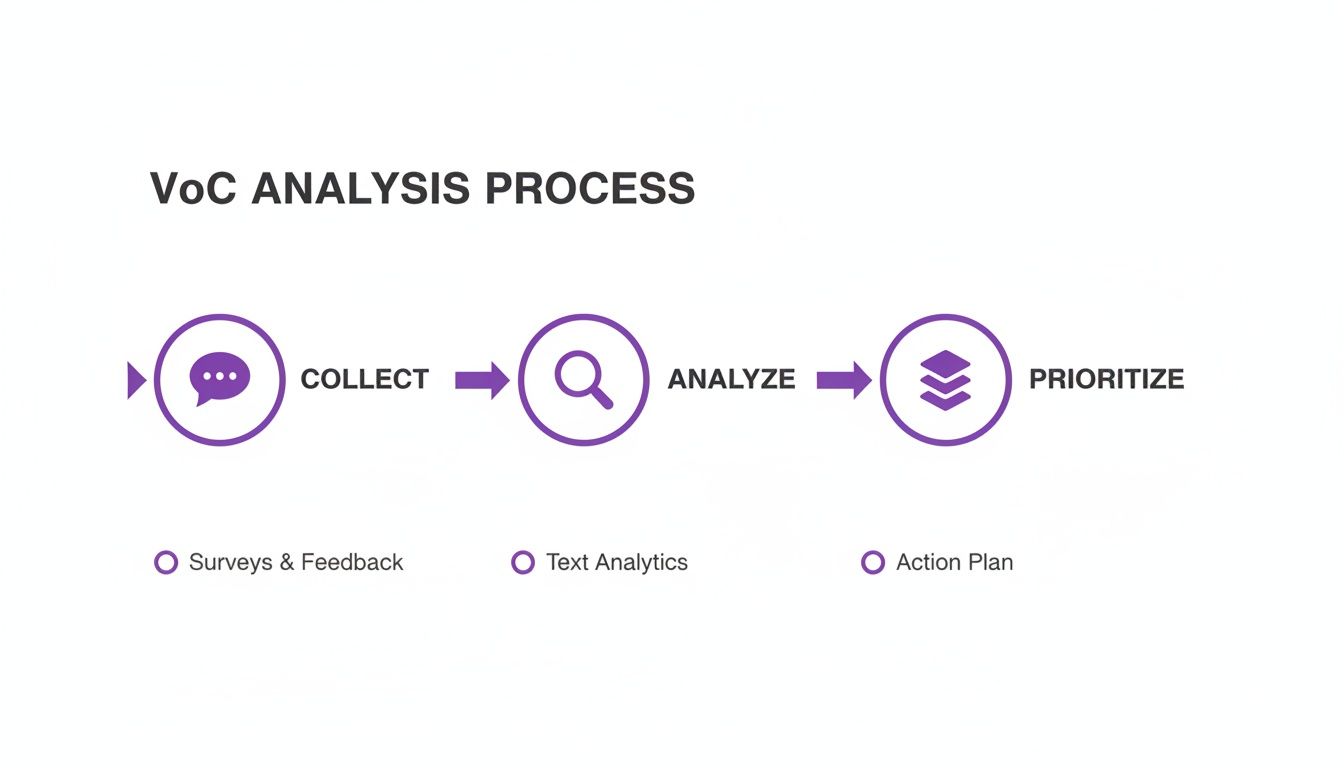
This workflow stops you from just putting out fires and helps you systematically upgrade your business based on what your customers are asking for.
Prioritize Plays by Impact and Effort
Once you start listening, you'll have a long list of issues. The key is ruthless prioritization. Ask two simple questions for every piece of feedback:
- Frequency: How many people are saying this?
- Revenue Impact: How much cash is this problem costing us?
A broken discount code that pops up in chat logs daily is a five-alarm fire. Fix it now. A single customer's suggestion for a new shade of blue can wait. This focus ensures your team works on fixes that deliver the biggest financial wins first.
Run High-Impact VoC Plays
Here are a few battle-tested plays for common issues. Adapt these and get them running on your store this week.
Play #1: The "Where Is It?" Play
- VoC Signal: Your on-site search and chat logs are full of questions like, "Do you have free shipping?" or "What's your return policy?"
- The Problem: You've buried critical information. This creates doubt and kills purchase confidence. A confused shopper doesn't dig for answers; they leave.
- The Fix: Make it impossible for anyone to ask again. Add a bold announcement bar at the top of your site with your core offers (e.g., "Free Shipping Over $50 | Easy 30-Day Returns"). Then, repeat that info in a bulleted list right under the "Add to Cart" button on every product page.
Play #2: The Product Comparison Play
- VoC Signal: Your support team constantly fields chats like, "What's the difference between Product A and Product B?"
- The Problem: Your product descriptions aren't doing their job, forcing customers to work too hard. This causes analysis paralysis and abandoned carts.
- The Fix: Build a simple comparison table on the product pages or a dedicated landing page. Highlight key differences—features, materials, best for—and make the choice easy. This solves their problem and positions you as an expert.
By proactively smoothing out these common friction points, you remove roadblocks from the path to purchase. Each play is a small tweak that can have a massive impact on your conversion rate.
Close the Loop with AI
An AI shopping assistant changes the game. It doesn't just help you find problems; it helps you solve them on the spot, in real-time.
When a shopper asks about shipping, a tool like Selzee doesn't just file that away for a weekly report. It gives the customer the right answer instantly, saving the sale. At the same time, it logs that interaction, adding another data point to the pattern that tells you to make your shipping policy more obvious.
This creates a powerful feedback loop:
- Customer asks a question, revealing a point of friction.
- AI instantly resolves their issue, preventing a lost sale.
- The interaction is tagged and analyzed, fueling your next store improvement.
This is how you plug leaks in your conversion funnel while you work on building a better ship. It’s the difference between reading a report about why you lost sales last week and actively stopping sales from being lost right now.
A killer VoC playbook transforms customer feedback from a lagging indicator of past problems into a leading indicator of future growth. See the potential upside by plugging your numbers into a handy conversion rate calculator to model how these small changes add up to serious revenue.
Common VoC Mistakes That Silently Kill Profits
Starting a VoC program isn't as simple as installing a survey app. Many merchants make critical, avoidable mistakes that make their efforts pointless or send them chasing the wrong problems.
These aren't just slip-ups; they're silent profit killers. Let's dig into the costliest mistakes and how to sidestep them.
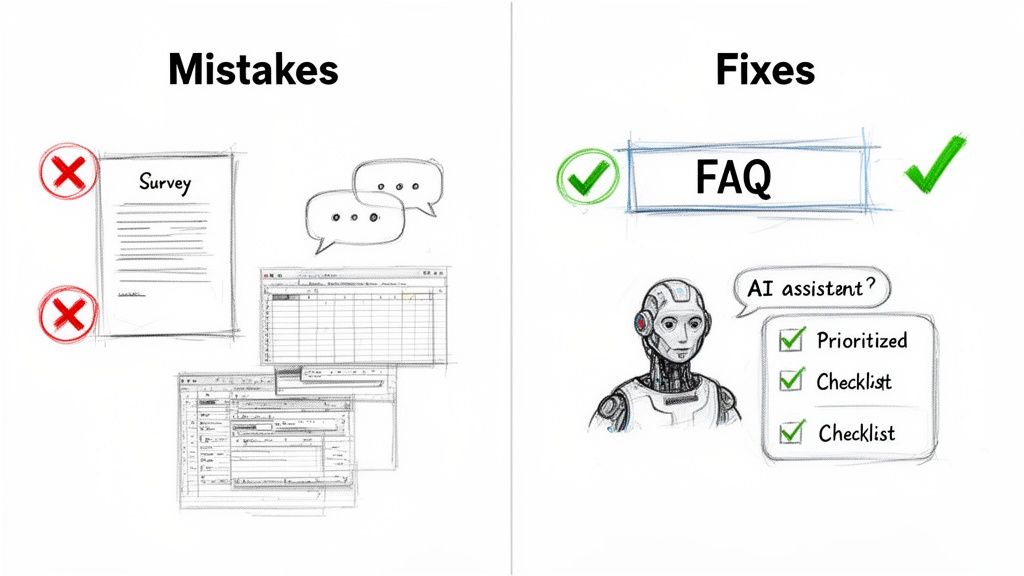
Mistake 1: Focusing Only on Post-Purchase Feedback
Obsessing over post-purchase surveys is like trying to figure out why a team lost by only interviewing the fans who stayed for the fireworks. You’re missing the real story: everyone who got frustrated and left at halftime.
- What Not to Do: Making Net Promoter Score (NPS) the single source of truth for your VoC program.
- What to Do Instead: Get laser-focused on pre-purchase friction. The real gold is in your on-site chat logs, support tickets about product questions, and failed site searches. This is where you find conversion killers—the questions and confusing policies that stop shoppers before they check out.
Mistake 2: Asking Leading or Biased Questions
Your mission is to uncover raw, unfiltered truth, not to fish for compliments. Asking, "Don't you just love our new super-fast shipping?" gets you useless, feel-good data that papers over genuine problems.
Collecting biased feedback is worse than collecting no feedback. It gives you a false sense of security while your store's real problems continue to cost you sales.
You have to stay neutral to get honest answers.
- What Not to Do: Phrasing questions in a way that implies the answer you want (e.g., "How amazing was your checkout experience?").
- What to Do Instead: Ask open-ended, neutral questions. Instead, try, "How would you describe your checkout experience?" or "Was there anything about the checkout process you found confusing?" This approach gets you genuine feedback, not an ego boost.
Mistake 3: Ignoring Conversational and Voice Data
An exploding source of customer insight that many merchants miss is "voice" and conversational data. The global voice commerce market hit $42.75 billion in 2023 and is projected to skyrocket to $186.28 billion by 2030.
Despite this shift, only about 3.8% of businesses provide correct info in voice searches. That’s a huge gap between customer behavior and brand delivery. AI shopping assistants like Selzee are designed to fill this gap, turning every natural-language question into a rich VoC data point. You can discover more insights about voice shopping trends to see how big this opportunity is.
Mistake 4: Treating All Feedback Equally
Not all feedback is created equal. A single customer pointing out a typo on your "About Us" page is not as urgent as 20 customers a week complaining that your main discount code is broken. If you treat both with the same priority, you’ll burn out working on things that don't move the needle.
Your time is your most valuable asset. Focus it where you'll see a financial impact.
- What Not to Do: Dumping every piece of feedback into one giant, unsorted to-do list.
- What to Do Instead: Prioritize ruthlessly based on frequency and revenue impact. If many customers are reporting an issue that directly stops them from buying, it goes to the top of the list. A minor cosmetic issue reported by one person can wait.
Mistake 5: Failing to Close the Loop
This is the final cardinal sin of VoC. You collect insight, make a change, and then… crickets. When you fix an issue customers pointed out, you have a golden opportunity to build massive brand loyalty by telling them you listened. Forgetting this makes customers feel like they were shouting into the void.
- What Not to Do: Quietly pushing fixes live and hoping customers notice.
- What to Do Instead: Shout it from the rooftops. Send a targeted email to the customers who reported the issue. "You spoke, we listened. Our return policy is now crystal clear, thanks to your feedback!" This small action closes the loop, shows you care, and can turn a frustrated shopper into a loyal customer.
Got Questions About Voice of Customer on Shopify? We've Got Answers.
Here are the questions Shopify merchants really ask when building a voice of customer program. No fluff, just straight answers to get you results, fast.
"Do I Have Enough Traffic to Bother With VoC?"
Yes, you have enough. It's not about a million visitors; it's about the number of conversations you're having. Don't wait for a magic traffic number to start listening.
If your store fields 30-50 support tickets or live chats a week, you're sitting on a goldmine of qualitative data. That's more than enough to spot patterns—like recurring confusion over shipping times, sizing questions, or problems with a discount code.
When you're ready for quantitative tools like on-site surveys, aim for at least 100 responses to feel confident in the insights. The most important thing is to start now. Your VoC system will only get more valuable as your store grows.
"What VoC Metrics Actually Matter for a Shopify Store?"
Forget vague corporate metrics like Net Promoter Score (NPS). For a Shopify store, you need to track metrics you can directly link to sales.
Focus on these four KPIs:
- Conversion Rate by VoC Theme: Are visitors who ask your AI assistant about the return policy converting at a lower rate? You just found a friction point killing sales.
- Cart Abandonment Correlation: Did cart abandonment spike the same day you launched a confusing BOGO deal? Did support get flooded with questions? That's not a coincidence—it's customer confusion hitting your bottom line.
- Average Order Value from Assisted Sessions: Are shoppers who get help from your on-site chat or AI spending more? You've just proven that proactive guidance drives upsells.
- Top Failed On-Site Searches: This is your customer-generated product roadmap. If people are searching for a product you don't sell, that's a hint for what to stock next. If they're searching for "hoodie" but you call it a "pullover," that’s an easy win for your navigation.
"Can I Do This Without Expensive Tools?"
Yes, you can start a VoC program on a shoestring budget to prove the concept. But be realistic about the trade-offs.
You can start now by manually sifting through your Shopify app reviews, using a free Google Form for post-purchase surveys, and creating tags in your helpdesk. This is a brilliant way to validate the value in your customer feedback.
The catch? This manual process gets out of hand, fast. It doesn't scale, and it's easy for personal bias to creep in. You'll quickly spend more time in spreadsheets than acting on insights. A dedicated platform's power is its ability to automatically capture, analyze, and even act on this data in real-time—something a manual system can't do.
"How Do I Convince My Team This is Worth Investing In?"
Want buy-in from your team? Frame the entire conversation around one thing: revenue.
Don't pitch this as "getting better at listening." Pitch it as "plugging the leaks in our sales funnel that are costing us money every day."
Start small and build your case with a clear win.
Winning Strategy: Find one specific, recurring problem. For instance, "I've seen ten people this week ask how to apply their discount code." Then, propose a simple test: "Let's add a quick GIF to the cart page showing how the code field works and measure if it reduces cart abandonment for two weeks."
Once you have data from that small win, use it to justify a system-wide approach. Show them the tangible cost of doing nothing—the lost revenue from confused customers, the support hours wasted answering the same question. When you frame it this way, VoC stops being a "cost" and becomes a high-return investment.
Turning customer conversations into revenue is the heart of any great Voice of Customer program. With Selzee, you can put the whole process on autopilot—capturing, analyzing, and acting on VoC insights in real-time so you never miss a sales opportunity. See how our AI shopping assistant can help you close the feedback loop and power your growth at https://selzee.com.