
Why Your Shopify Store Needs a True Sales Assistant, Not Another Chatbot
Let's be direct: most chatbots on Shopify stores are glorified FAQs. They sit quietly, waiting for a customer to ask "Where is my order?" or "What's your return policy?" That handles a support query, but it does nothing to persuade a hesitant browser to buy. This reactive approach leaves a revenue gap on your site every single day.
A true AI sales assistant plays a different game. It doesn’t wait. It actively engages shoppers who show buying signals, guides them through your products, and creates new opportunities to increase their cart size.
Here’s a clear example of a proactive AI sales assistant in action.
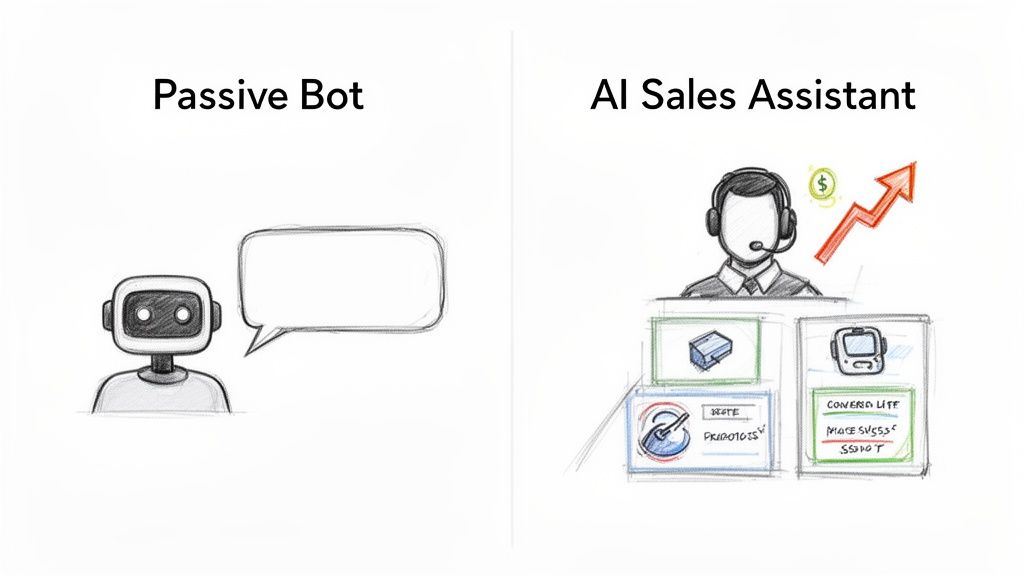
This image nails the difference—it’s the jump from a reactive bot to an intelligent assistant that understands the conversation and drives it toward a sale.
The Real Cost of Passive Engagement
Every visitor who leaves your site without buying is a lost opportunity. Standard chatbots miss critical moments, like when a shopper is comparing products or is about to abandon their cart. They can’t jump in with a timely discount or suggest the perfect accessory because they lack sales intelligence.
"The biggest mistake is treating on-site chat as a support cost center instead of a sales profit center. A passive bot might save a support ticket, but a proactive AI sales assistant makes you a sale."
This distinction is why the e-commerce world is embracing this technology. The retail segment of the AI sales assistant market is projected to grow at a blistering 27% CAGR, driven by measurable lifts in conversion rates, AOV, and cart recovery.
From Answering Questions to Creating Sales
A dedicated AI sales assistant integrates directly with your Shopify store to access your product catalog, live inventory, and customer data. This connection allows it to execute plays that put money in your pocket.
Here’s a quick rundown of what separates a basic bot from a sales-driven assistant:
| Feature | Basic Support Chatbot | AI Sales Assistant |
| Engagement Style | Reactive: Waits for the user to ask a question. | Proactive: Initiates conversations based on shopper behavior. |
| Primary Goal | Deflect Support Tickets: Answers FAQs and provides order updates. | Drive Revenue: Lifts conversions, boosts AOV, and recovers carts. |
| Product Knowledge | Limited: Knows only a pre-written knowledge base. | Deep: Syncs with your live Shopify catalog and inventory. |
| Personalization | Generic: Gives the same robotic answer to everyone. | Dynamic: Delivers personalized recommendations and offers. |
Relying on a simple chatbot is like hiring a cashier who can only take money but can't help a customer find what they're looking for. To see how this works for real businesses, check out these case studies showing how AI assistants are boosting key metrics for stores like yours. A true AI sales assistant transforms customer interactions from support queries into revenue-generating conversations.
The Core Features That Actually Drive Revenue
When evaluating the best AI sales assistant software, it's easy to get lost in feature lists. For a Shopify merchant, only a handful of capabilities will actually increase your revenue. It's time to cut through the marketing noise.
If a feature doesn't help you convert more visitors, boost your Average Order Value (AOV), or recover lost sales, it's a distraction. Let's focus on the four pillars that separate a high-impact AI sales assistant from the rest.
Proactive On-Site Engagement
A tool that just waits for a customer to type is a massive missed opportunity. Your AI assistant needs to be proactive, like a great retail associate who knows the right moment to approach a customer.
This means it should act based on visitor behavior:
- Spotting High-Intent Shoppers: Is someone clicking between three jackets? The AI should pop up to help them choose.
- Helping Hesitating Buyers: If a visitor has been on a product page or checkout for too long, the AI should step in to offer help or a nudge.
- Preventing Cart Abandonment: The moment a mouse moves toward the "close tab" button, the AI should intervene with a relevant question or offer before they leave.
A tool that only reacts is a support bot. A tool that proactively engages based on real-time behavior is a sales machine.
A Powerful Personalization Engine
Generic, one-size-fits-all recommendations kill sales. A true AI sales assistant needs a deep personalization engine that goes beyond basic "customers also bought" widgets. It must understand the full context of a shopper's journey to make suggestions that feel helpful, not robotic.
"The real magic is when the AI can answer the question a customer hasn't even asked yet. It anticipates their need and presents the perfect product or bundle at the right moment, dramatically increasing the chance of an upsell."
This is the difference between a simple chatbot and sophisticated ecommerce personalization software that uses AI. This intelligence transforms a simple question into a larger, more profitable order.
Seamless Shopify Integration
This is a deal-breaker. An AI sales assistant that isn't deeply woven into your Shopify backend is flying blind. A shallow connection won’t cut it; you need a tool that maintains a real-time, two-way sync with your store’s data.
Before choosing any provider, ask these questions:
- Does it sync with my live product catalog and inventory? It must know what's in stock to avoid recommending sold-out items.
- Can it pull a customer's order history? This is crucial for personalizing conversations with returning customers.
- Does it understand Shopify-specific details? It should know the difference between product variants, collections, and tags to give accurate answers.
Without deep integration, the AI is a fancy chat bubble. With it, the AI becomes an intelligent arm of your sales team, in tune with your products and customers.
Actionable and Revenue-Focused Analytics
If you can't measure a tool's impact on your bottom line, it’s a liability. The best AI sales assistants provide an analytics dashboard focused on sales metrics, not vanity stats like chat volume. You need clear data that shows how the AI is making you money. For a wider view, check out other analytics tools that can round out your performance picture.
Your dashboard must track:
- AI-Influenced Revenue: The dollar amount of sales where a customer interacted with the AI.
- Conversion Rate Lift: A side-by-side comparison of conversion rates between visitors who engaged with the AI and those who didn't.
- AOV Increase: Clear evidence of successful upsells and cross-sells initiated by the assistant.
These four pillars—proactive engagement, deep personalization, seamless integration, and revenue-focused analytics—are your checklist for choosing an AI sales assistant that will grow your Shopify store.
Comparing the Top AI Sales Assistants for Shopify
Picking the right AI sales assistant isn't about the flashiest feature list. For a Shopify merchant, it's about finding the tool that moves the needle on revenue. The wrong choice is more than a wasted subscription fee; it's lost sales, every day. Let’s cut through the marketing fluff and look at the top contenders from the perspective of a Shopify store owner.
You'll encounter three types of AI assistants. Each was built for a different mission, making them a great fit for some stores and a terrible fit for others. We'll break down all-in-one sales platforms, support-first chatbots, and a true e-commerce sales tool like Selzee.
The All-In-One Sales Engagement Platform (e.g., Regie.ai, Outreach)
These are heavy-duty platforms built for B2B sales teams living in a CRM. They are powerhouses for managing outreach campaigns, writing sales emails, and tracking long prospect lists.
If your Shopify store has a significant wholesale or B2B component, these tools can be a game-changer. When your process involves sales reps, demos, and nurturing large accounts, the robust features for sequencing and lead management are essential.
But for a direct-to-consumer brand, it's often overkill. These platforms aren't designed for the fast-paced, real-time world of e-commerce. They're built for a long sales cycle, not the split-second decisions of an online shopper. Their connection to your Shopify product catalog is usually an afterthought, leading to a clunky experience when a customer just wants to know if a jacket is in stock.
The bottom line: "An all-in-one platform is built around the salesperson's workflow (managing leads, sending emails). A dedicated e-commerce AI is built around the shopper's journey (finding products, getting recommendations, and checking out). For most Shopify stores, the second one is what actually boosts AOV and conversion rate."
The Support-Focused Chatbot with AI (e.g., Tidio, Gorgias)
These popular Shopify apps excel at pulling customer support messages—from chat, email, social media—into one inbox. They use AI to handle common questions and suggest replies for human agents.
These tools are ideal if you're drowning in repetitive support tickets. If your team spends all day answering "Where's my order?" and "What's your return policy?", these platforms are a lifesaver. They streamline support, slash response times, and let your team focus on complex issues.
The catch? Their DNA is 100% customer support, not proactive selling. They are fundamentally reactive. While they can answer a question, they lack the sales intelligence to proactively engage a hesitant visitor, suggest a brilliant upsell, or guide a confused shopper to the perfect product. They are designed to end conversations efficiently, not start sales opportunities.
The Dedicated Ecommerce Sales Automation Platform (e.g., Selzee)
This is a new breed of tool built from the ground up with a single focus: turning website visitors into customers. Unlike other categories, its purpose is to act like your best salesperson, working 24/7 on your Shopify site.
This is the perfect match for high-volume DTC brands, niche stores with complex products, and any Shopify merchant whose main goal is to maximize on-site conversions and AOV. The system is built around a deep, seamless connection to your Shopify catalog, inventory, and customer data.
So, how does it actually make you more money?
- It’s Proactive: It doesn't wait for a question. For a store with high traffic, a tool like Selzee can start a conversation based on what a shopper is doing, nudging them toward a purchase.
- It Upsells Intelligently: It can look at a shopping cart in real-time and suggest a relevant, high-margin add-on that a simple support bot would never identify.
- It Guides and Personalizes: For stores with large catalogs (e.g., beauty, supplements, electronics), it acts as a personal shopper, asking the right questions to narrow down options and confidently recommend the perfect item.
These are the core revenue-driving features that set this category apart.
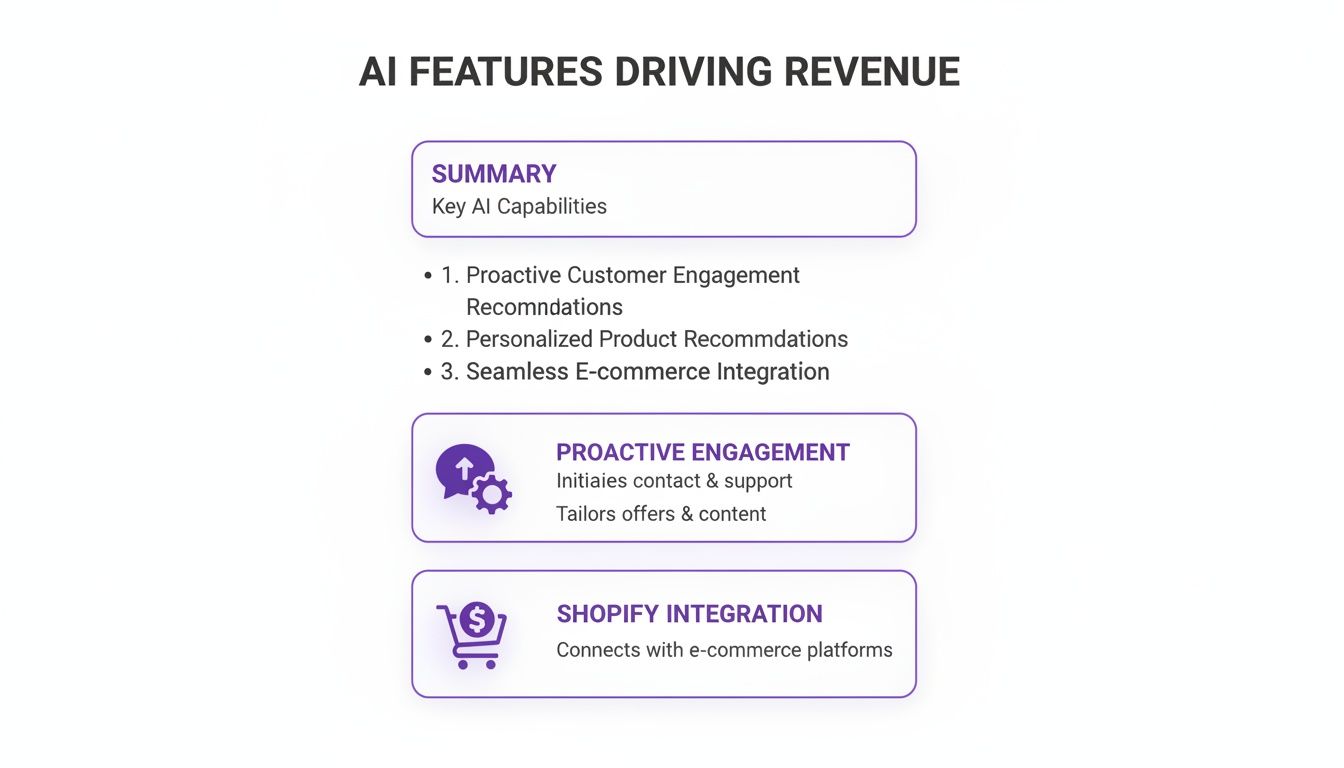
This visual nails the three pillars—proactive engagement, personalization, and deep Shopify integration—that separate a true sales assistant from a glorified FAQ bot.
The market demand is clear. The AI Sales Assistant Software market was valued at around USD 2.5 billion in 2024 and is forecast to explode to USD 24.21 billion by 2035. This growth is driven by brands demanding better personalization and CRM integration, with small and medium-sized businesses leading the charge. You can dive deeper into this trend in the full market research.
Feature Comparison for Shopify Merchants
To make this crystal clear, let's put these tools head-to-head on the features that matter most for increasing sales on Shopify.
| Feature/Capability | Selzee | Competitor A (Support Chatbot) | Competitor B (Sales Platform) |
| Proactive On-Site Engagement | ✅ Core Feature | ❌ Reactive Only | ❌ Off-Site Focus |
| Shopify Catalog Integration | ✅ Deep & Real-Time | 🟡 Basic Knowledge Base | 🟡 Limited & Clunky |
| Cart-Based Upsells/Cross-sells | ✅ AI-Powered & Dynamic | ❌ Not a feature | ❌ Not for e-commerce carts |
| Guided Selling / Product Finder | ✅ Core Feature | ❌ Limited to FAQ | ❌ Not Applicable |
| Conversion Rate Optimization | ✅ Primary Goal | ❌ Secondary Goal | ❌ Not a direct goal |
| AOV Boosting Logic | ✅ Built-in & Automated | ❌ Not a feature | ❌ Not Applicable |
| Customer Support Ticketing | 🟡 Integrates w/ Helpdesks | ✅ Core Feature | 🟡 Limited Functionality |
As you can see, the choice for the best AI sales assistant software boils down to your primary goal. If you’re managing B2B leads, a sales platform is the right tool. If you're buried in support tickets, an AI helpdesk is your solution.
But if your mission is to actively sell more on your site, boost your AOV, and convert more of your existing traffic, a dedicated e-commerce sales automation platform is the only one truly built for the job.
Putting Your AI to Work: Real-World Plays to Boost Conversions and AOV
Features are one thing, but what matters is how an AI sales assistant actually puts money in your pocket. A great AI tool isn't just another app; it's a dedicated revenue machine you can point at your store's biggest problems.
These aren't just ideas—they're proven tactics to turn more browsers into high-spending customers.
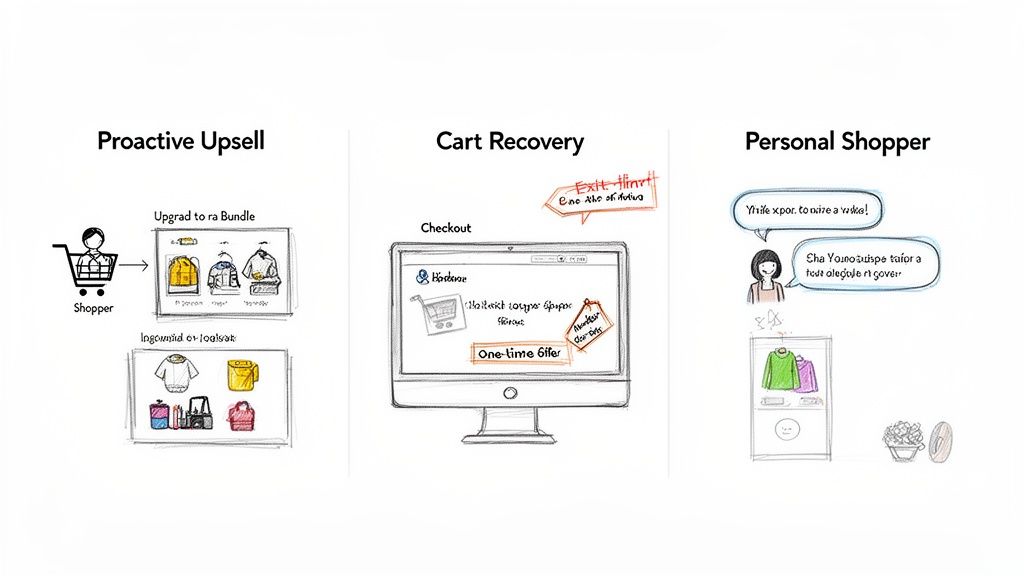
Use Case 1: The Proactive Upsell Engine
Every store owner knows the value of a good upsell, but most stores are clumsy about it. Generic pop-ups are just background noise. A smart upsell is about timing and relevance. This is where a sales-driven AI shines.
Picture this: a customer adds a mid-range skincare product to their cart. A sharp AI sales assistant sees this in real time. It knows your catalog and immediately spots a premium bundle that includes the original item plus two perfect add-ons at a higher margin.
The AI slides in with a message like: "Great choice! Just a heads-up, you can get that face cream plus our best-selling serum and cleanser in the Complete Glow Kit and save $15."
"This isn’t a blind guess. It's a calculated, automated sales play that hits a high-intent shopper at the exact moment they’re ready to buy. The lift in your Average Order Value (AOV) can be staggering—and instant."
To implement this, you define the rules in the assistant's backend. Map specific products to bundles, create logic based on profit margins, or target loyal customers with exclusive upgrade offers. The AI runs your sales playbook 24/7.
Use Case 2: The On-Site Cart Recovery Specialist
Cart abandonment is a notorious profit killer. Email recovery campaigns are reactive; by the time the email lands, your customer has already left. An AI assistant is your on-site specialist, intervening before the shopper clicks away.
The secret is exit-intent technology. The second a user's cursor moves toward the back button, the AI kicks into gear. It doesn't just plead, "Don't go!" It uses context to make a compelling offer.
For instance, it might pop up with: "Hold on! You're leaving some amazing items behind. Complete your order in the next 10 minutes and we'll throw in free express shipping."
This injects urgency and offers a tangible benefit for finishing the purchase now. It's far more effective than an email buried in an inbox. Ultimately, the goal is to improve conversion rates by plugging these leaks in your funnel.
Use Case 3: The Personal Shopper for Overwhelming Catalogs
If your store has hundreds of products—think fashion, beauty, or supplements—you're dealing with the "paradox of choice." Too many options can paralyze a visitor. An AI assistant cuts through the clutter by becoming their personal shopper.
Instead of forcing visitors to scroll endlessly, the AI starts a guided conversation, like a top retail associate.
- For a supplement store: "What are you hoping to achieve? More energy, better sleep, or sharper focus?"
- For a fashion brand: "Are you shopping for a casual weekend look or something for a special event?"
Based on their answers, the AI instantly sifts through your inventory and presents a curated list of the top 3-5 products. This transforms a frustrating search into a helpful, confidence-building experience that leads straight to a sale.
Setting this up involves creating conversational flows that connect customer needs to specific product categories or tags in your Shopify admin. This single strategy can have a massive impact on the conversion rate of first-time visitors. Curious what that lift could look like? Project the potential revenue with a conversion rate calculator.
Finding the Right AI Assistant for Your Store Isn't One-Size-Fits-All
Asking for the "best AI sales assistant" is like asking for the "best car." The best tool is the one that solves your store’s biggest, most expensive headache. Picking the wrong AI isn't just a wasted subscription fee; it's a silent leak in your revenue.
A generic chatbot might be fine for a simple store, but for a serious Shopify merchant, the stakes are higher. Your choice has to align with your products, customers, and sales process.
Selling in Complex Niches? You Need a Specialist.
If you're in beauty, supplements, or high-end electronics, your biggest battle is customer education. Shoppers get lost in specs, ingredient lists, and subtle differences. A basic FAQ bot will fail here, leading to frustrated bounces.
For this kind of store, deep product knowledge and guided selling are non-negotiable. Your AI assistant needs to act like a seasoned expert.
It must:
- Ask smart, qualifying questions. Instead of waiting, it should initiate, "Are you looking for a serum to target fine lines, or is hydration your main goal?"
- Grasp complex details. It needs to know the difference between retinol concentrations or the benefits of various active ingredients.
- Make confident recommendations. Based on the conversation, it should present a small, curated list of the perfect products.
"A generic AI can tell a customer if a product is in stock. A specialist AI can explain why it's the right product for them. For complex niches, that distinction is the difference between a bounced visitor and a high-value order."
Drowning in SKUs? You Need an Operations Guru.
If you’re running a store with a massive catalog—like fast fashion or auto parts—your worst nightmare is selling something you don't have. It’s a triple threat: a terrible customer experience, a logistical headache, and a blow to your brand's credibility.
For you, the most critical feature is flawless, real-time inventory synchronization. Your AI has to be wired directly into your store's backend. Before it recommends a product, it needs to know, down to the last unit, what’s actually on the shelf. This prevents costly errors and ensures every conversation is built on accurate data.
Going Global? You Need a Cultural Ambassador.
Taking your brand international adds complexity. Customers in different countries have unique expectations and languages. A one-size-fits-all approach is a fast-track to making international customers feel misunderstood.
The dealbreaker here is robust, multi-language support and true localization. Your AI can't just run English text through a cheap translation service. It must:
- Chat naturally in multiple languages. It needs to be genuinely fluent, handling slang and regional quirks, not just providing a clumsy, word-for-word translation.
- Understand market-specific catalogs. The AI must know which products are sold in which countries and understand local pricing or promotions.
- Adapt to cultural nuances. The tone of a conversation in Tokyo might need to be very different from one in Texas.
This sophistication is why the AI assistant market is exploding. Valued at USD 8.46 billion in 2024, it's projected to skyrocket to USD 35.72 billion by 2033. This growth is about businesses using AI to get smarter on a global scale. You can dig into the numbers on the market's rapid expansion on Grand View Research.
For merchants focused on features that directly generate revenue, require deep platform integrations, and need scalable sales automation, a tool like Selzee was built to tackle these specific challenges. Its architecture is designed to turn on-site conversations into sales, delivering a measurable lift in AOV and conversions by matching its strengths to your business needs.
Got Questions? Let's Get Real.
Even experienced merchants have questions when adding AI to their Shopify store. Let's get straight to what matters—how this affects your time, your team, and your revenue.
How Long Until I See a Return on My Investment?
This isn't a six-month project. With a native Shopify app, setup is fast. You can install the app, sync your product catalog, and have a live assistant on your site in under an hour.
The real impact comes from fine-tuning its sales playbooks. Spend a few hours the first week setting up proactive messages for key product pages or dialing in your upsell logic. Once you do, you should see measurable data on conversions and AOV lift within the first 7-14 days, once the AI has had enough time to interact with visitors.
Is This Going to Replace My Customer Support Team?
No. It's going to make them better. A true AI sales assistant software doesn't replace people; it automates the repetitive questions that consume your team's day.
"Think of it as your best salesperson, cloned, working 24/7. It handles the predictable tasks, freeing up your human team to focus on complex support tickets, build relationships with VIPs, and handle situations that require a human touch."
This frees them to solve unique problems and create loyal customers. Plus, the best platforms have a seamless human handover, so an agent can jump into an AI conversation at any time.
How Do I Actually Measure the ROI on This Thing?
If you can't tie an investment to revenue, it's just another expense. Forget vanity metrics like "number of chats answered."
You need a dashboard that gives you hard numbers. Demand these four revenue-focused metrics:
- AI-Influenced Revenue: The total cash value of every order where the AI played a part in the customer's journey.
- Conversion Rate Lift: A direct A/B comparison showing how much more likely visitors are to buy when they chat with the AI versus those who don’t.
- Increased AOV: The exact dollar amount added to your bottom line from successful upsells and cross-sells the AI initiated.
- Cart Abandonment Reduction: The amount of revenue saved because the AI intervened at the right moment to prevent a lost sale.
These are the numbers that matter. They move the conversation from "Is this working?" to "How much more money can we make with it?"
Ready to turn your site traffic into more revenue? Selzee is the AI sales assistant built from the ground up to boost conversions and AOV for ambitious Shopify merchants. Start driving more sales today.