If you're running a Shopify store with real traffic, you know the ugly truth about standard dropshipping. Competing on price for the same generic products is a race to zero profit. It's unsustainable.
The strategic pivot is private label dropshipping. This is the operational shift that stops you from being just another reseller and starts building a defensible brand—a sellable asset. This guide is your playbook for making that transition.
Stop Reselling. Start Building a Brand.
You have traffic. You're making sales and you know your Shopify dashboard. But if your revenue is flatlining despite your ad spend, it's a direct result of the standard dropshipping model's core flaw: zero differentiation.
You're selling the same products from the same suppliers as hundreds of other stores. This forces you into price wars you can't win and leaves you with zero brand equity.
Private label is the escape route. It’s the path to building a real business, not just a temporary revenue stream.
The most common mistake merchants make is viewing their store as a place to sell products. A high-growth store is a platform to sell a promise. Private labeling is the first step in creating that promise, turning a generic item into your product.
This mindset shift is critical. It gives you control over the narrative, perceived value, and most importantly, the price.
How This Directly Impacts Your KPIs
Shifting to a private label model isn't a vanity project; it's a direct lever on your most critical store metrics.
Here’s where you'll see the financial impact in your Shopify analytics:
- Higher Profit Margins: By branding a product, you escape the price-matching death spiral of generic dropshipping. You set your price based on the value your brand delivers, not on your competitor's pricing.
- Increased Customer Lifetime Value (CLV): A unique, branded product and a thoughtful unboxing experience create loyalty. A customer who has a positive experience with your brand is far more likely to make a repeat purchase than someone who bought a generic item they could find on ten other sites.
- Improved Conversion Rates: A polished, cohesive brand signals trustworthiness. Shoppers are more willing to purchase from a store that feels like a legitimate brand, not a flimsy reseller front. This confidence translates directly into a higher conversion rate.
The operational and financial differences are stark.
Generic vs Private Label Dropshipping Head-to-Head
For any established Shopify merchant, this table breaks down the operational realities.
| Business Aspect | Generic Dropshipping | Private Label Dropshipping |
|---|---|---|
| Profit Margins | Low (5-20%) due to price competition. | Higher (40-60%+) due to controlled perceived value. |
| Brand Equity | Zero. You build the supplier's brand. | High. Every sale builds your brand's reputation and value. |
| Customer Loyalty | Non-existent. Customers are loyal to the lowest price. | Strong. A branded experience encourages repeat purchases. |
| Competition | Extremely high. One of hundreds selling the same item. | Low to moderate. Your branded product is unique. |
| Marketing | Focused on price and impulse buys. High ad spend for low ROAS. | Focused on brand story, value, and customer relationships. |
| Control | None. You are dependent on supplier stock and pricing. | Full control over product, packaging, and customer experience. |
| Business Asset | Not a sellable asset; a cash flow tactic. | A valuable, sellable asset with a defensible market position. |
The takeaway is clear: one path is about short-term transactions, the other is about long-term, sustainable growth and asset building.
This isn't just an option; it's becoming a requirement. The dropshipping market is projected to exceed $1.2 trillion by 2030. With over 27% of all online retailers using dropshipping, branding is the only effective way to differentiate.
Many successful brands began with generic dropshipping to validate a niche before investing in private label. They analyzed their own data—flat margins, low repeat customer rates, and diminishing ad returns—and made the strategic move. You can see how other brands executed this pivot in various ecommerce growth case studies. This isn't just a fulfillment change; it's the core business decision that secures your store's future in a saturated market.
Finding and Vetting a Private Label Partner Who Won't Let You Down
Your supplier isn't just a vendor; they are your operational partner. A bad one will destroy your brand's reputation before it's even established. Finding the right manufacturer is the most critical decision in this process.
This requires a systematic approach to finding, contacting, and vetting potential partners. This isn't about finding the cheapest option; it's about finding the most reliable one who can scale with your business.
This process is what separates resellers from high-growth brands.
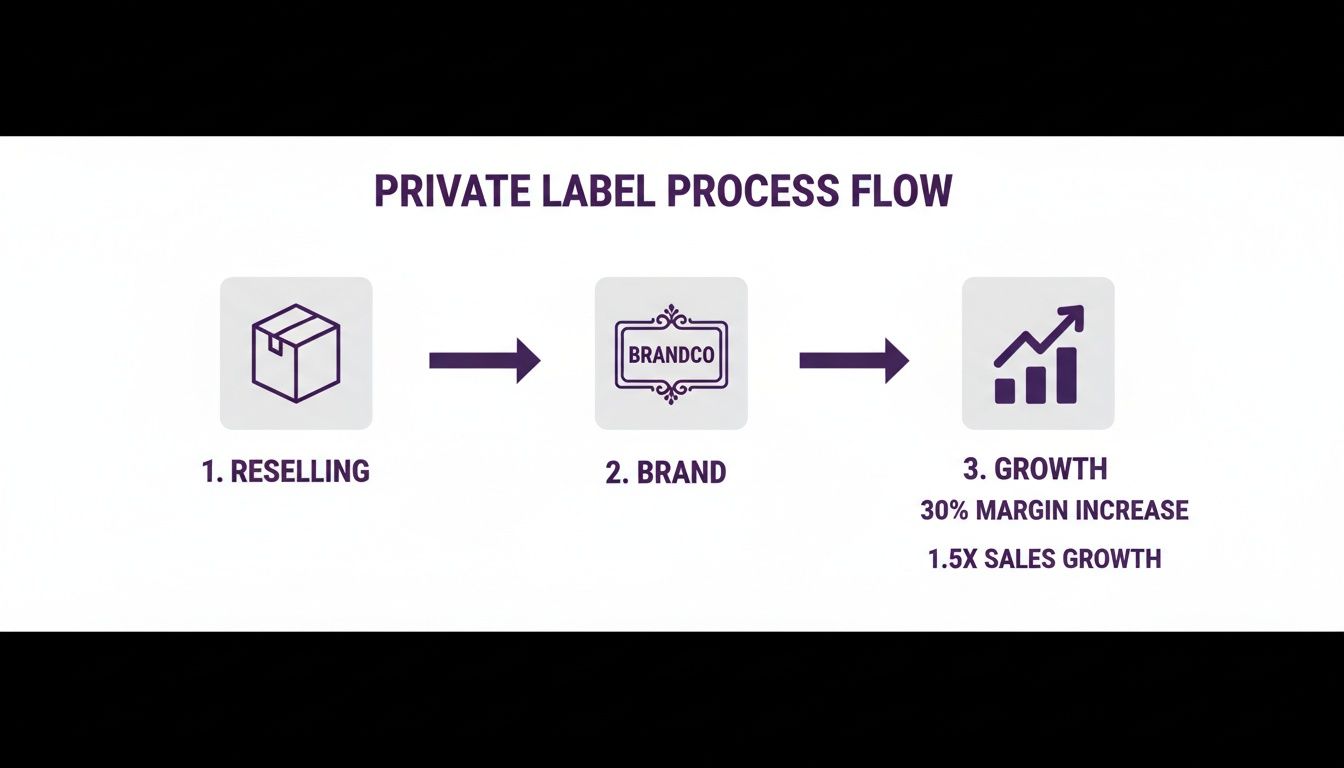
That middle step—creating a brand—is the key to sustainable growth.
Go Beyond the Usual Suspects
Alibaba is a starting point, but it's also saturated with competition. To find partners your competitors have overlooked, you must dig deeper.
Explore niche-specific directories, review exhibitor lists from trade shows (including past virtual events), and investigate country-specific supplier portals. Platforms like Global Sources or Made-in-China often feature a different caliber of manufacturers who aren't in the Alibaba scrum.
For specific niches, specialized resources are invaluable. For example, if you're in the accessories market, a dedicated guide to private label jewelry manufacturers provides targeted insights you won't find on broad platforms.
Your Vetting Checklist: The Non-Negotiables
Your initial outreach is a test. You're not just asking for a price; you're evaluating their professionalism and communication. Are they open to a private label dropshipping model? Brief, sloppy replies are a major red flag. Disqualify them immediately.
From your first message, get answers to these points:
- Minimum Order Quantity (MOQ): Get this number immediately. If their MOQ is 5,000 units and your budget supports 500, it's not a fit. Move on.
- Sample Costs and Policy: What is the cost per sample, including shipping? Ask if they credit the sample cost back on the first bulk order. Reputable suppliers often do.
- Production Lead Time: Determine the exact time required to manufacture your product after sample approval. This number dictates your launch timeline and inventory management.
- Private Labeling Capabilities: Ask directly: "Can you print my logo on the product and use my custom packaging?" Get a clear 'yes' or 'no' before proceeding.
A supplier’s initial response time and clarity will tell you 90% of what you need to know about how they'll perform when a real problem arises. Pay close attention.
Put Their Samples to the Test (and Learn to Negotiate)
Never skip ordering samples. It's a costly rookie mistake.
Order from your top 3-5 candidates. Scrutinize the product and the packaging it arrived in. Evaluate the material quality and finish. Is this a product you would be proud to put your brand on?
This is your only opportunity to physically inspect the product before your customers do. If it feels cheap to you, it will feel cheap to them, leading to negative reviews and returns.
Once you've selected a supplier based on sample quality, negotiate the terms. The MOQ is often flexible. If their stated MOQ is 1,000 units, propose an initial order of 500 at a slightly higher per-unit price. This demonstrates you are a serious buyer and can often secure a mutually beneficial arrangement.
You've secured a quality product and a reliable supplier. Now you need to build the brand that justifies a premium price. This is what separates dropshippers from brand builders.
We're moving beyond reselling to crafting a premium customer experience. This process turns a simple transaction into a relationship, which is the foundation for higher margins. It's about making your brand feel intentional, from the first ad impression to the unboxing.
Beyond the Logo: Designing Your Brand Assets
Your brand's visual identity is its first impression. A cheap or inconsistent design signals an amateur operation and undermines premium pricing. Professional design is a required investment.
This doesn't require a $10,000 agency invoice.
- Find Real Talent: Bypass contest sites. Use platforms like Dribbble and Behance to find professional designers. Search for portfolios that match your desired aesthetic and contact them directly for higher-quality, one-on-one collaboration.
- Mock It Up First: Before committing to a large packaging order, use a mockup tool like Placeit or Artboard Studio. These tools create realistic digital prototypes of your packaging and products, allowing you to identify and fix design issues before incurring printing costs.
The most expensive mistake is trying to save a few hundred dollars on design. Your brand assets are a one-time investment with returns on every sale. A strong brand builds trust, and trust drives conversions.
The Unboxing Moment: Your Secret Weapon
In ecommerce, the unboxing is your only physical touchpoint with the customer. A plain brown box is a wasted marketing opportunity. The goal is to create a memorable experience that reinforces the value of their purchase.
When you're charging a premium, your visuals must justify it. To achieve a professional look without a large photoshoot budget, you can leverage AI product photography to create high-quality, conversion-focused images.
The packaging itself must be more than a container. It should be durable, have a quality feel, and align with your price point. Discuss options with your supplier beyond standard cardboard. Small details can significantly impact brand perception.
Getting Your Supplier on the Same Page
Your brand vision is irrelevant if your supplier can't execute it. This requires clear communication and precise instructions.
Here’s how to ensure proper execution:
- Send the Right Files: Provide your supplier with high-resolution, print-ready vector files (.AI or .EPS) for all logos and designs. A low-resolution JPEG will result in a blurry, unprofessional final product.
- Create a Simple Packaging Guide: Develop a one-page PDF that serves as a visual instruction manual. Show exact placement for inserts, specify filler material, and detail how the box should be taped. This eliminates ambiguity.
- Order a Final "Production Sample": Before authorizing a full production run, order one unit packaged exactly as a customer would receive it. This is your final quality control check.
This level of detail is what separates successful brands. It builds the perceived value that supports higher prices and improves your conversion rate. To model the financial impact, use a conversion rate calculator to see how small improvements can drive significant revenue gains.
You've done the prep work. You have a product, your brand assets are ready, and it's time to launch. This isn't about adding a new SKU; it's a calculated launch designed to convert visitors immediately. Your product page is now your most critical asset.
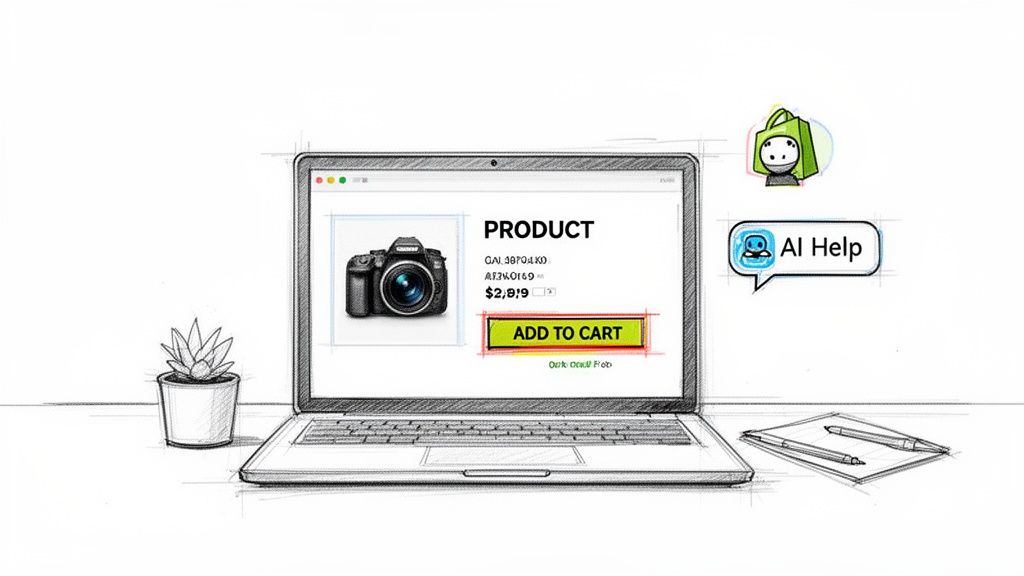
This is where you prove your product's value. Forget generic supplier-provided feature lists. Build a narrative that connects with your ideal customer, preemptively answers their questions, and makes clicking "Add to Cart" the logical next step.
Crafting Product Descriptions That Actually Convert
Delete the bullet points your supplier provided. Your product description is your 24/7 salesperson. For a private label product, it must persuade, not just describe.
Weave your brand’s story into the copy.
Instead of a generic statement like, "Made from high-quality microfiber," create a narrative: "Engineered with our signature triple-woven microfiber, this towel doesn't just absorb—it upgrades your entire post-workout ritual." One is a fact; the other sells an experience. Focus on benefits and paint a picture of how the product improves the customer's life.
A costly mistake on a product page is forcing a visitor to leave to find information. Every click away is a potential lost sale. The page must be a self-contained conversion tool.
Anticipate and answer every potential question. What are the dimensions? What are the care instructions? What makes it superior to cheaper alternatives on Amazon? Answering these questions upfront builds trust and reduces purchase friction.
Nailing Your Visuals and Pricing Strategy
Product photography is the primary communicator of quality. Grainy, low-effort photos will instantly kill your premium positioning, regardless of the product's actual quality.
- Lifestyle Shots Are Non-Negotiable: You must show your product in its intended environment. Selling a branded coffee press? Show it on a clean kitchen counter with a steaming mug. This helps customers visualize the product in their own lives.
- Highlight the Special Details: Use macro shots to showcase your custom logo, the texture of the materials, or the premium packaging. These details justify your price.
Your pricing strategy must reflect the value you've created. Do not base your price on what generic dropshippers are charging.
Instead, start with a target margin of at least 50% and work backward. Your price is a powerful signal of quality. If you’ve invested in premium branding and a superior product, price it confidently. This confidence telegraphs value to the customer.
Automating Trust and Closing Sales with AI
On launch day, you will be inundated with specific, repetitive questions: "Is this material hypoallergenic?" "Will this fit my specific car model?" "What is the warranty?" Answering each one manually creates a bottleneck that costs you sales.
An AI assistant is your force multiplier from day one.
Instead of hiring a support team, you can deploy a tool that acts as a 24/7 product expert on the page. If a shopper has a question about a specific ingredient in your new skincare product, an AI tool like Selzee can provide an instant, accurate answer without them leaving the product page.
The AI, trained on your product data, can confirm ingredients, explain benefits, and suggest complementary products, guiding the customer to checkout. This transforms a static product launch into an interactive, high-conversion sales experience. You can explore a range of powerful AI ecommerce tools to automate and optimize your store.
Scaling Your Operations and Perfecting Customer Experience
Launching is the first step. Sustainable growth is achieved by scaling operations without degrading the customer experience. This requires disciplined systems.
You need documented processes for handling returns, managing customer service for your specific products, and maintaining a quality control feedback loop with your supplier.
This operational core is the engine of your brand. It enables growth without chaos, helps you manage inevitable challenges, and turns customer feedback into actionable product improvements.
Designing a Bulletproof Returns Process
With private label, you own the entire customer journey, including returns. You cannot direct customers to send returns back to an overseas factory. This is an opportunity to build trust.
A confusing or slow returns process will kill your brand. Your policy must be clear, easy to find, and simple to execute.
- Create a Central Return Hub: All returns must come to a single location—your own facility or a third-party logistics (3PL) partner. This is non-negotiable for inspection.
- Inspect, Restock, or Report: If the item is sellable, restock it. If it's defective, you now have valuable data to send to your supplier to address the root cause.
- Be Fast with Refunds & Exchanges: Process the refund as soon as the return is received and inspected. Speed demonstrates respect for the customer.
Your returns process is a direct reflection of your brand's integrity. A seamless return can convert a disappointed customer into a loyal advocate.
Mastering Customer Service for Your Brand
Canned responses are insufficient for a unique private label product. Your support team—even if it's just you—must be the foremost expert on your product. This is your frontline for building relationships and gathering feedback.
Deep product knowledge justifies your premium price. With over 27% of online retailers using dropshipping, the market is saturated. The industry is projected to hit $476 billion by 2026. In this competitive landscape, private label brands win with superior service and a personal touch. You can review the data by digging into these dropshipping statistics and their impact on branding.
Leveraging AI to Scale Support Intelligently
You cannot scale if you are personally answering every "Where is my order?" email. This low-value task consumes your most valuable resource: time. This is where you implement smart automation.
An AI shopping assistant like Selzee can handle 80-90% of common, repetitive inquiries instantly. It can provide 24/7 tracking updates, retrieve product specifications, and initiate an exchange request automatically.
This is not about replacing human support; it's about augmenting it. The AI serves as the first line of defense, freeing up your team to handle high-stakes conversations—complex product issues or escalations—that require empathy and creative problem-solving. This hybrid approach delivers efficiency without sacrificing the human element that defines your brand.
Got Questions About Private Label Dropshipping? Let's Dig In.
Let's address the practical questions that arise when you're ready to transition from basic dropshipping. These are the details that determine the success of your private label launch.
What's a Realistic Startup Budget for My First Private Label Product?
Forget the "$100 startup" myth. For a serious launch, budget between $1,000 to $2,500. This is an investment in building a real brand asset.
Here's the breakdown of that investment:
- Initial Samples: You must physically inspect the product. This covers ordering from your top 3-5 potential suppliers to evaluate quality.
- First MOQ Order: This is your initial inventory. The Minimum Order Quantity (MOQ) is the largest variable; negotiate this effectively.
- Brand Assets: This includes your logo and custom packaging design. Do not cut costs here. Your packaging is the first physical interaction with your customer.
- Product Photography: High-quality lifestyle and studio shots are non-negotiable to justify a premium price.
The goal is not to find the cheapest path, but to establish a strong foundation for a successful brand launch.
How Do I Handle Returns If They Can't Go Back to the Supplier?
They don't go back to the supplier. Most overseas manufacturers do not accept single-item customer returns. The logistics are unworkable.
The correct process is to have all returns shipped to a local address. Initially, this can be your home or office. As you scale, you will use a third-party logistics (3PL) provider.
Owning your returns process protects your brand. It allows you to inspect items, restock sellable inventory, and provide a seamless customer experience. An easy return process can increase customer loyalty.
Can I Really Private Label a Product That's Already Popular?
Yes, and you should. Attempting to create a new product category is high-risk. A smarter strategy is to identify a product with proven demand that is being sold by competitors with poor marketing and no branding.
Your competitive advantage is not the product itself, but the brand experience you build around it. You win with a better story, superior marketing angles, and a stronger connection with your target audience. The goal is to make your version the clear premium choice.
How Much Longer Is Shipping for Private Label Products?
This is a two-part answer. The initial production run will add a lead time of 15-30 days before your first batch is ready to ship. This is a one-time delay for your launch.
Once your inventory is produced and warehoused, daily order fulfillment should be as fast as standard dropshipping (24-48 hours for processing). Manage customer expectations by being transparent about your launch timeline and any potential for backorders.
This planning is critical for global expansion. The opportunity is significant, with private label sales growing 5.6% in Q2 and expanding rapidly in markets like the Middle East & Africa (+34.3%) and Latin America (+14.2%). These are markets with high demand for new brands. You can learn more about private label growth in emerging markets.
As your brand grows, customers will have specific questions about what makes your products unique. An AI shopping assistant from Selzee can act as a 24/7 product expert on your site. It instantly answers detailed questions about materials, usage, and benefits, building the confidence shoppers need to click "buy." See how it works at https://selzee.com.