If you want to seriously boost your store’s revenue, you have to stop thinking only about traffic and start obsessing over the entire customer journey. This means turning your product pages into high-powered sales machines, hunting down and eliminating every bit of friction in your checkout, and using data to make every shopper feel like you built the store just for them.
Let's be real: it’s all about getting the absolute most out of every single visitor you've already paid to get.
Why Your Conversion Rate Is Quietly Killing Your Profits
That stream of traffic hitting your store feels good, right? But what if half of your potential revenue is walking right out the digital door? A low conversion rate isn't just a number in your Shopify analytics; it's a hole in your pocket, draining cash with every visitor who leaves without buying.
Think about it. Every person who bounces from a confusing product page or gives up on a clunky checkout is a sale you lost. A sale you already paid for through your ads, your SEO efforts, or your social media grind. Fixing this isn't a "nice-to-have" optimization. It's a critical lever for growing your business without spending another dime on marketing.
The Hidden Cost of an "Average" Rate
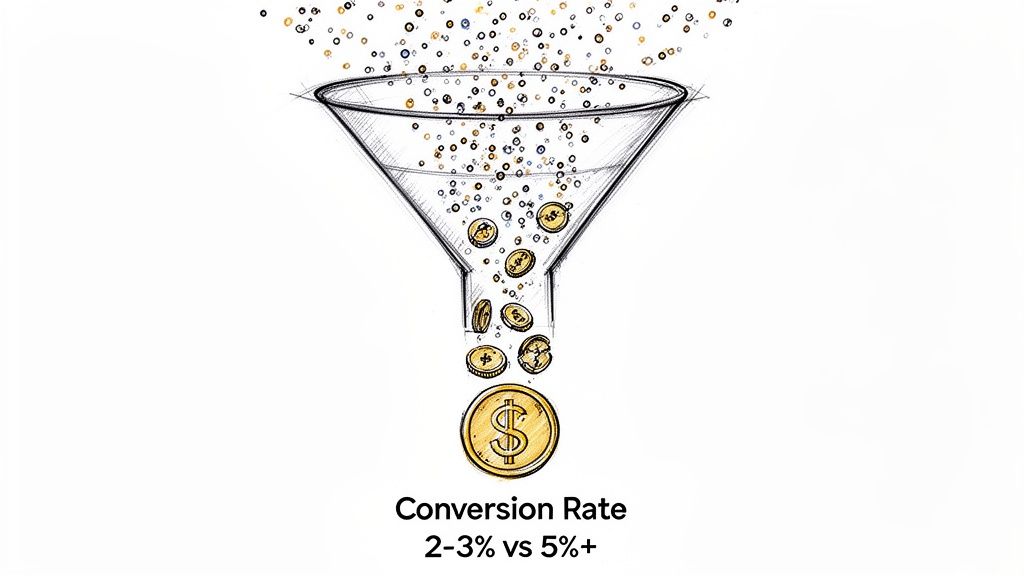
Most merchants hear the global average ecommerce conversion rate is between 2% and 3% and figure they're doing okay. But "average" is where profits go to die. While the official global benchmark is around 2.35%, the stores that are truly crushing it are consistently hitting 3.5% to 5% or even higher.
If your store is stuck in that average zone, you are literally leaving money on the table every single day. Just imagine what doubling your conversion rate from a modest 1.5% to 3% would do for your business. That’s the kind of jump that takes you from just scraping by to explosive growth.
The real cost isn’t just the one lost sale. It’s the wasted ad spend, the missed chance to create a loyal repeat customer, and the bad taste left by a frustrating shopping experience.
Turning Vague Numbers into a Clear Action Plan
Knowing your sitewide conversion rate is the first step, but a single number is pretty useless on its own. You need to dig into your analytics to find out exactly where the leaks are. It all starts by asking the right questions.
- Where is your best traffic coming from? Are your paid ads actually pulling their weight compared to your organic search visitors? You might be surprised.
- Is your mobile experience letting you down? With so many people shopping on their phones, a clunky mobile site is a conversion killer. Check the mobile vs. desktop drop-off rate.
- Where are people bailing? A high bounce rate on product pages points to one kind of problem, while a massive cart abandonment rate signals something entirely different.
Getting a handle on the fundamentals is key, and this guide on how to improve ecommerce conversion rate is a great place to start. Once you start answering these questions, that vague metric transforms into a concrete roadmap for improvement.
Transform Your Product Page Into a Conversion Engine
Let's be blunt: your product page is where the sale is made or lost. This is the moment of truth, the final pitch before a customer either clicks "Add to Cart" or bounces forever. It's time to stop treating this page like a digital catalog entry and start thinking of it as your hardest-working salesperson—one that's on the clock 24/7.
So many Shopify merchants get this wrong. They toss up a few manufacturer photos, copy-paste a generic feature list, and then scratch their heads when the conversion rate flatlines. You're not just selling a product. You're selling an outcome, an experience, a solution to someone's problem.
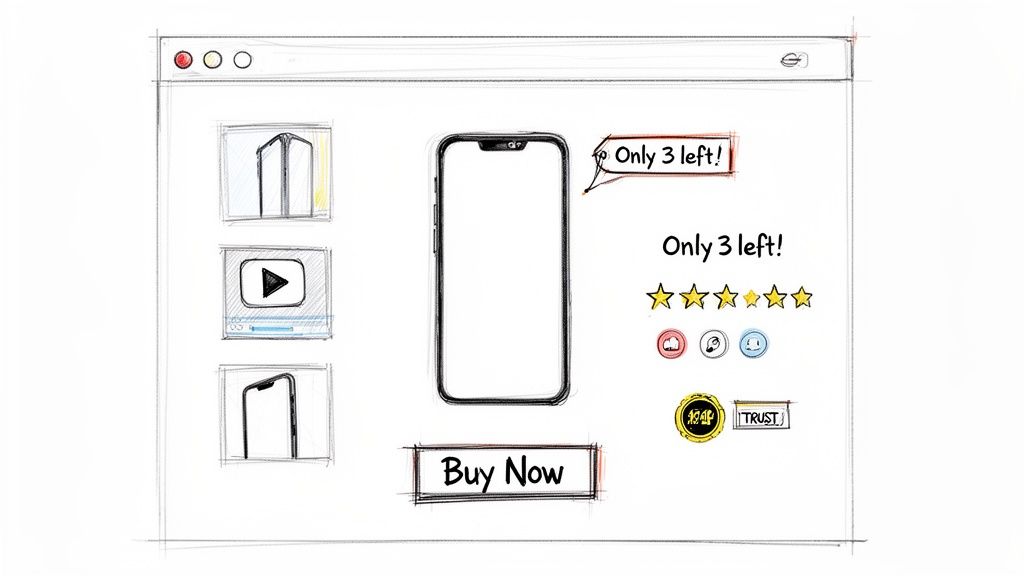
A killer product page has to forge an emotional connection and preemptively answer every single question a potential buyer might have.
Craft a Narrative That Sells, Not Just Describes
Bland, feature-based descriptions are absolute conversion killers. Nobody gets excited about "100% cotton" or a "lithium-ion battery." What they do get excited about is the feeling of that soft, breathable fabric on a hot summer day, or the freedom of a phone that lasts an entire weekend trip.
Your job is to translate every feature into a tangible benefit. Don't just list the specs; tell the customer what those specs mean for them.
Instead of: "Water-resistant coating."
Try: "Caught in the rain? No problem. Our water-resistant coating keeps your gear bone-dry, so you can focus on the adventure, not the weather."
Instead of: "5-blade razor head."
Try: "Get an impossibly close, irritation-free shave every single time. The five-blade design glides effortlessly, cutting hair at the surface for noticeably smoother skin."
Writing truly compelling copy is an art. If you’re staring at a blank page, struggling to blend persuasive language with good SEO, a free product description tool can give you a solid starting point in seconds. If you're also selling on Amazon, a free bullet points tool can help you quickly craft benefit-driven points that convert.
A great product description doesn't just describe the item; it helps the customer visualize a better version of themselves using it. It sells the transformation, not the object.
Build Unshakeable Trust with Visuals and Proof
In e-commerce, your customers can't touch, feel, or hold the product. Your photos and videos have to do all the heavy lifting to bridge that sensory gap. Grainy, low-res images from a single angle are an instant red flag that just screams "amateur hour" and costs you money.
Make your visual strategy a top priority.
- Crystal-Clear, Multi-Angle Photos: Show your product from every conceivable angle—front, back, side, top, and get in close for those detail shots. Let shoppers zoom in and practically feel the texture and quality.
- Lifestyle and In-Context Shots: Get that product off the sterile white background! Show it being used by real people in real-life situations. This is how customers start to picture it in their own lives.
- Must-Have Product Videos: A short, punchy 30-60 second video is one of the most powerful conversion tools in your arsenal. Show the product in action, call out key features, and give a sense of its scale. One study found that shoppers are a staggering 85% more likely to buy after watching a product video.
Beyond your own marketing assets, nothing builds trust faster than authentic social proof. You absolutely need to integrate customer reviews—especially those with photos or user-submitted videos—directly onto your product pages. Seeing a real person loving your product is infinitely more persuasive than anything you could ever write.
For some fantastic real-world examples, check out these inspiring ecommerce conversion success stories.
Create Urgency and Smash Last-Minute Doubts
Okay, your shopper is hooked. They love the story, they trust the visuals, and they're hovering over the buy button. The final piece of the puzzle is giving them a compelling reason to buy right now, not "later."
This is where you can use ethical urgency and scarcity signals to gently nudge them across the finish line.
- Low Stock Alerts: A simple "Only 3 left in stock!" message creates a powerful sense of FOMO (Fear Of Missing Out).
- Limited-Time Offers: A countdown timer for a sale ("20% off ends in 24 hours!") is a classic for a reason—it encourages immediate action.
- Shipping Transparency: Surprise shipping costs are the #1 reason people abandon their carts. Be upfront with the costs, or better yet, use a free shipping threshold ("Free shipping on orders over $75!") to boost your average order value.
When you combine a compelling narrative, trust-building visuals, and smart psychological triggers, your product page transforms from a simple listing into a high-performance engine built to improve ecommerce conversion rates.
Smooth Out Your Checkout and Watch Sales Soar
You did it. You guided your shopper all the way from a browse to an "Add to Cart." The finish line is just a few clicks away, but this is exactly where so many stores drop the ball and hemorrhage sales.
Think of your checkout as the final, most crucial moment in a conversation with your customer. Every extra field, every unexpected cost, every confusing step is a reason for them to get cold feet and walk away. Our mission here is simple: make the path from cart to confirmation so ridiculously easy and fast that they complete the purchase before they can even think twice.
The Big Three Conversion Killers
Time and time again, the data points to the same culprits behind abandoned carts. These aren't just minor annoyances; they're the absolute destroyers of your conversion rate. You need to hunt them down and eliminate them without mercy.
- Surprise Costs: Nothing kills the mood faster than getting to the final step and seeing a bunch of unexpected shipping fees, taxes, or other charges. It feels like a bait-and-switch and instantly shatters the trust you just built.
- Forced Account Creation: Seriously, stop doing this. Asking someone to create yet another online account with a new password just to buy a t-shirt is like asking for a marriage commitment on a first date. It’s a huge turn-off.
- A Marathon Checkout Process: If your checkout feels like filling out a tax return, you’ve already lost. Shoppers today have zero patience for clunky forms, endless pages, and confusing layouts. They’ll just go back to Amazon.
Here's a hard truth: if your checkout takes more than a minute to complete, you are losing money. Guaranteed. The gold standard is a single, streamlined page that feels effortless.
Your Immediate Fixes for a Higher Checkout Conversion Rate
Alright, let's get right into the practical stuff. These aren't just friendly suggestions—they are non-negotiable best practices for any ecommerce brand that's serious about growth.
1. Always, Always Offer Guest Checkout This is the easiest win on the board. Let people buy from you without forcing them into a relationship. You can always ask them to create an account after the sale is confirmed, maybe on the thank you page, by highlighting benefits like order tracking. Secure the cash first, then build the community.
2. Put All Costs on the Table Upfront Be brutally honest about shipping and taxes. Use a shipping calculator right in the cart or have a crystal-clear banner that says "Free shipping on orders over $50." When you remove the financial surprises, you build the last-minute trust needed to get that credit card out.
3. Trim the Fat from Your Forms Every single form field is a tiny piece of friction. Get rid of as many as you can.
- Set up address auto-completion with the Google Maps API. It’s a game-changer.
- Use a single "Full Name" field instead of separate "First" and "Last" name boxes.
- Make the "Shipping address is the same as billing" box checked by default.
Each field you remove lightens the mental load on your customer and makes the whole process feel like a breeze.
Build Rock-Solid Confidence with Trust and Flexibility
Speed and simplicity are huge, but your checkout also needs to scream "your money is safe with us." This is where visual trust signals and payment options become your secret weapons.
First, plaster trust badges everywhere they make sense. We're talking SSL certificates (the little padlock in the browser), security seals from brands like Norton or McAfee, and the logos for every payment method you accept—Visa, Mastercard, PayPal, you name it. These little icons work on a subconscious level, instantly reassuring shoppers that their data is secure.
Second, give people a ton of ways to pay you. Sticking to just credit cards is an old-school move that costs you sales. Modern shoppers expect options.
| Payment Type | Why It's a Conversion Booster |
|---|---|
| Shop Pay & Apple/Google Pay | These are the holy grail of mobile and repeat purchases. They enable one-click checkout, cutting down the process to mere seconds. |
| PayPal | A universally trusted name. It allows millions of users to pay without ever having to type their card details into your site, which is a huge plus for new customers. |
| Buy Now, Pay Later (BNPL) | Services like Afterpay or Klarna are absolute must-haves for higher-priced items. They can skyrocket your conversion rate and AOV by letting customers split payments with no interest. |
By obsessing over speed, transparency, trust, and choice, you’ll transform your checkout from a leaky bucket into a high-powered sales funnel. This is hands-down one of the most direct and profitable ways to improve ecommerce conversion rates and finally capture all the revenue you've worked so hard to generate.
Use Personalization and AI to Guide Shoppers
Let's be honest: a generic, one-size-fits-all store experience is a surefire way to kill your conversion rate. Today's shoppers don't just want a personalized journey—they absolutely expect it. And trying to deliver that kind of bespoke experience manually, at scale? It's simply impossible. This is where AI becomes your secret weapon, turning your store into a custom shopping concierge for every single person who lands on your site.
Imagine having your absolute best salesperson cloned, working 24/7 for every visitor. This clone instantly gets what they need, serves up perfect product recommendations based on what they've been clicking on, and answers even the most complex questions in a snap. This isn't some far-off fantasy; it's what the highest-converting stores are doing right now.
Moving Beyond Basic Product Recommendations
Those standard "you might also like" carousels? They're a decent starting point, but genuine personalization goes so much deeper. We're talking about creating a dynamic, living environment that actively guides customers to the perfect purchase—often before they even realize what they’re looking for. An AI shopping assistant, like Selzee, is designed to be that guide.
For instance, it can proactively jump in and help a shopper who seems to be wandering aimlessly, clicking on multiple product pages without adding anything to their cart. Or, it can discreetly flag a high-value visitor browsing your most expensive items, letting your human sales team step in at just the right moment. It's all about turning hesitation into confident action.
The real magic happens when every customer feels like your store was built just for them. When you make them feel seen and understood, trust shoots through the roof, and your conversion rate follows right behind it.
Using AI to Bridge Gaps and Boost Sales
This kind of intelligent guidance isn't just a fluffy "nice-to-have" for customer experience; it's a direct lever for growing your revenue. It's fascinating to see how shopper behavior varies across the globe. Global benchmarks show the Americas leading with an average ecommerce conversion rate of 3.02%, just ahead of EMEA at 2.88%, and well above APAC's 2.08%. These numbers tell a story: what works in one region might not work in another. For DTC brands using platforms like Shoptet or Upgates, this is a huge opportunity. Deploying an always-on AI assistant can help close those regional gaps by providing tailored, multilingual support.
The same data-driven thinking applies to devices. We know tablets convert at 2.98%, desktops at 2.96%, and mobile at 2.86%. That isn't just trivia; it's a clear signal to double down on creating lightning-fast, touch-friendly mobile experiences. Every millisecond counts.
Look at the top reasons people abandon their carts. These are the conversion killers.
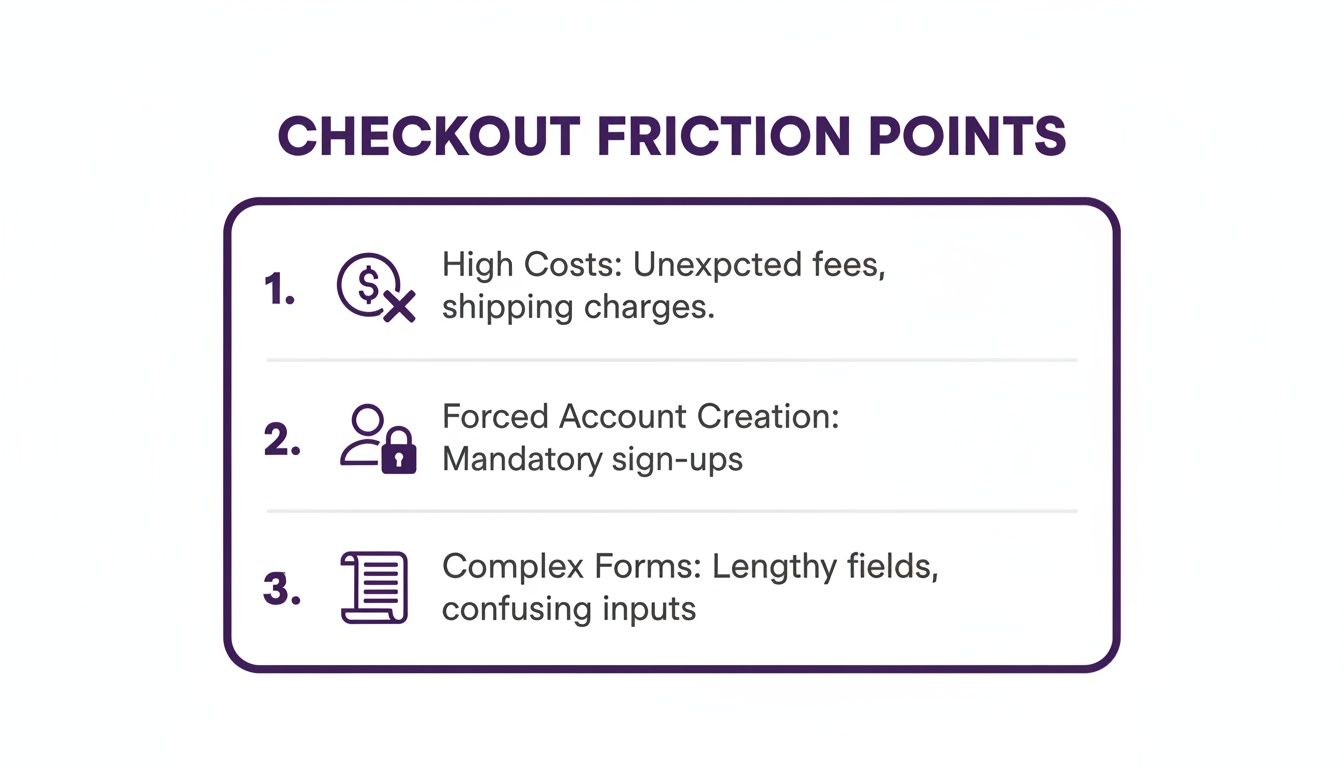
A smart, conversational AI can tackle these head-on by proactively explaining shipping costs, offering a guest checkout option, or simplifying form-filling.
The difference between a basic setup and an AI-powered one is stark. Take a look at the potential lift you can expect.
Conversion Lift Potential Manual vs AI-Powered Personalization
| Feature | Standard Manual Approach | AI-Powered (Selzee) Approach |
|---|---|---|
| Product Discovery | Static "Related Items" based on category. | Dynamic, real-time recommendations based on individual browsing behavior. |
| Customer Support | Reactive live chat or email with human-only agents (often with delays). | Proactive, 24/7 conversational AI answers complex questions instantly. |
| Upselling/Cross-selling | Manual rules for bundling or pop-ups. | Intelligent, context-aware suggestions for complementary products at the right moment. |
| Lead Capture | Simple email pop-up on exit intent. | Engages high-intent shoppers with tailored offers or alerts a human for a VIP touch. |
| Problem Solving | Customer must search FAQs or wait for support. | AI identifies user friction (e.g., checkout issues) and offers immediate help. |
As you can see, AI doesn't just automate tasks—it elevates the entire shopping experience to a level that manual efforts can't replicate at scale.
The Real-World Impact of an AI Sales Assistant
Bringing AI into your store isn't just a tech upgrade; it’s a complete shift in how you connect with customers. It lets you automate the kind of high-touch, consultative selling that, until now, was only possible in a fancy physical boutique.
Here’s how this actually works for real businesses:
- For a beauty brand: A customer asks, "What's the best foundation for oily, acne-prone skin?" An AI assistant instantly scans product attributes and recommends the perfect matte-finish, non-comedogenic option, complete with a direct link to buy. No more endless searching.
- For a furniture store: A shopper is on the fence about a big-ticket sofa. The AI can instantly provide exact dimensions, pull up customer photos of it in real homes, and clarify the return policy, building the trust needed to hit "Add to Cart."
- For a supplements company: A user wonders, "Which of your proteins is best for post-workout recovery?" The AI can break down the benefits of whey isolate versus casein and guide them to the right product for their specific fitness goals.
This level of instant, expert guidance removes friction and crushes doubt at every step. Stores that get this right are seeing double-digit lifts in both AOV and conversion rates. To see exactly how powerful this can be, check out this case study on an AI beauty assistant that completely changed the game for one brand. It’s a perfect example of how to improve ecommerce conversion rates by meeting customers exactly where they are with the precise information they need to buy with confidence.
Turn Shoppers into Superfans with Smart Pricing and Killer Offers
Let's be real: slashing prices across the board is a race to the bottom. It’s a short-term trick that tanks your margins and teaches your customers to wait for the next sale. The real art isn't just closing a deal; it's about making every single order more valuable. This is where strategic offers come into play, boosting both your conversion rate and your Average Order Value (AOV) in one fell swoop.
We’re moving past those tired, generic 10% off codes. Instead, we're going to get into the psychology of deals that are so good, customers actually get excited about spending more. The goal is to frame your offers so that adding that extra item to the cart feels like a massive win for them, not just for your bottom line.
Think Bigger Than Just Discounts
The biggest trap merchants fall into is believing that price is the only lever they can pull. That's a huge mistake. The best results come from creative bundles and incentives that genuinely add value, rather than just cheapening your products.
Here are three powerful strategies you can put into action today:
- Create Irresistible Bundles: Look at your sales data. What products are people constantly buying together? Package them up! Create a "skincare starter kit" or an "ultimate grilling bundle" and offer it for a slightly better price than buying each item separately. This takes the guesswork out of shopping for the customer and gives your AOV an instant lift.
- Gamify Your Discounts with Tiers: This one is pure gold. Instead of a flat discount, make it a challenge. Think: "Buy 2, Get 15% Off; Buy 3 or More, Get 25% Off!" This simple trick gamifies the shopping experience. You'll see customers actively hunting for one more item just to hit that next level of savings.
- Master the Free Shipping Threshold: We all know it: unexpected shipping costs are the #1 reason people abandon their carts. So, let's turn that pain point into your most powerful AOV-booster. Figure out your current AOV and set your free shipping minimum about 15-20% higher. A shopper with $65 worth of products will happily toss in a $15 item to save $7.95 on shipping. It works like a charm, every single time.
Know Your Playing Field
It’s absolutely critical to understand where your store stands in the grand scheme of things. What works like a charm for a beauty brand might completely flop for a furniture store. The benchmarks don't lie.
For instance, 2025 data shows Food & Beverage and Personal Care are crushing it with incredible conversion rates of 6.19% and 6.8%, respectively. Meanwhile, industries with bigger price tags and longer decision-making cycles, like Home Decor, are trailing at just 1.4%. You can explore detailed industry conversion benchmarks to see where you stack up.
This isn't just random data; it's your strategic roadmap. If you're selling beauty products or supplements, you're sitting on a goldmine of potential. Your job is to double down on what works in your niche—like instant answers and personalized recommendations—to push your numbers closer to those industry leaders.
This is where an intelligent assistant can be a massive force multiplier. In these high-conversion industries, AI tools like Selzee can handle up to 94% of customer questions on their own, from "is this vegan?" to "where's my order?". By instantly removing that friction, you’re directly helping to improve ecommerce conversion rates right when it matters most.
The Secret is to Test, Tweak, and Personalize
An offer that smashes records in January could be a total dud during your Black Friday rush. The only way to find out what really clicks with your audience is to test, test, and test again. Don’t just set it and forget it.
Treat your offers like a science experiment. Run a simple A/B test:
- Offer A: Free Shipping on orders over $75
- Offer B: 15% off orders over $100
Let the numbers decide which one actually drives more profit, not just revenue. You might be surprised to find that a smaller incentive with a lower barrier to entry wins out.
And this is where AI truly shines. A tool like Selzee can learn from every single shopper's behavior in real-time. It can spot someone who is on the fence and, at the perfect moment, slide in with a personalized offer—maybe a small, exclusive discount—to nudge them over the finish line. It’s the difference between a surgical strike and a shotgun blast of promotions.
Your Top Ecommerce Conversion Questions, Answered
Alright, we've walked through everything from overhauling your product pages to patching up a leaky checkout. Now, let's get right to it and answer the burning questions I hear from Shopify store owners every single day. Think of this as the rapid-fire round—just clear, practical answers you can run with.
What Is a Good Conversion Rate for a Shopify Store?
Honestly? Stop chasing a mythical, one-size-fits-all number.
While you'll see a global average floating around 2-3%, a "good" rate is completely dependent on what you sell, how much it costs, and where your customers are coming from. A store selling bespoke, high-end furniture might be popping champagne for a 1% conversion rate. Meanwhile, a brand that just went viral with a trendy, low-cost gadget could easily be hitting 6% or more.
The only benchmark that truly matters is your own. If you’re converting at 1.5% today, pushing that to 2.5% is a massive win that will fundamentally change your business. Use industry stats as a compass, not a map. Your real goal is simple: beat last month's number.
How Long Does It Take to See Results from CRO?
This is the classic "it depends" answer, but I can give you a solid framework. How fast you see an impact from Conversion Rate Optimization (CRO) boils down to the size of the change and the amount of traffic you get.
- Quick Wins (Days to a Week): Small, potent tweaks can deliver results almost overnight. I'm talking about things like speeding up your site load time, slapping some trust badges on the checkout page, or rewriting a CTA button that’s just not working.
- Major Projects (Weeks to Months): Bigger swings need more time and data to prove their worth. A complete product page redesign, a reimagined checkout flow, or rolling out a new personalization engine isn't something you can validate in a weekend. You need enough traffic to run a clean A/B test and be confident in the results.
My advice? Start with the low-hanging fruit. Get some quick wins on the board to build momentum (and revenue!), then systematically tackle the bigger, more complex projects. And for a deeper dive into different strategies, you can explore these 7 proven techniques to boost sales.
What Is the Single Best Way to Improve Conversions?
If you force me to pick just one thing, it's your product pages. No question. This is where the magic happens—or doesn't. You can have the best ads and the slickest homepage in the world, but if your product page fails to connect, the sale is lost.
From what I've seen, success almost always boils down to these three elements:
- High-Quality Visuals: This is non-negotiable. You need stunning photos from every angle imaginable, plus a short, snappy video showing your product in action. Let people see themselves using it.
- Benefit-Driven Copy: Don't just list features; sell the outcome. Your descriptions need to anticipate every question and crush every objection before it can even pop into a shopper's head. If you're stuck, you can always try this tool to get the creative juices flowing.
- Powerful Social Proof: Get those customer reviews front and center, especially the ones with real photos and videos. Nothing builds trust faster than seeing other happy customers.
Should I Force Customers to Create an Account?
Absolutely, positively not. Please don't do this.
Forcing someone to create an account before they can buy is one of the fastest ways to kill a sale. It's a huge point of friction and a top reason for abandoned carts. Your mission is to make buying from you as effortless as possible.
Always, always, always offer a guest checkout option. It respects your customer's time and removes a massive hurdle for first-time buyers.
The trick is to encourage them to create an account after the sale is locked in. On the "Thank You" page, give them compelling reasons to sign up—like easy order tracking, a simplified return process, or access to exclusive deals. Make it a benefit, not a barrier. Secure the sale first, then build the relationship.
Ready to turn more of those window shoppers into loyal customers with a smarter, more personal shopping experience? Selzee is the AI shopping assistant that works 24/7 to guide your customers, answer their questions instantly, and give your conversion rate the boost it deserves.