If you've noticed some online stores seem to anticipate your every move, showing you exactly what you want before you even search for it, you've seen a product recommendation engine in action. This isn't just a "related items" widget; it's a powerful sales tool that analyzes shopper behavior and product data to serve up personalized suggestions that directly increase sales and average order value (AOV).
For a Shopify merchant with an active store, this isn't a "nice-to-have" feature. It's a critical upgrade that can give you a significant competitive edge and unlock revenue you're currently leaving on the table.
Why Your Live Store Needs a Recommendation Engine Now
Amazon’s "Frequently bought together" and "Customers who viewed this item also viewed" sections are a masterclass in product recommendations. This technology, once exclusive to retail giants, is now an essential tool for any serious Shopify merchant aiming to scale.
The objective is straightforward: connect shoppers with products they are highly likely to buy but might otherwise miss. This creates a frictionless, personalized shopping journey that makes your store stand out and keeps customers coming back.
The Immediate Impact on Your Bottom Line
Implementing a recommendation engine isn't an expense; it's a direct investment in your store's most critical metrics. The data is clear: personalization can lift revenues by 5-15% and increase marketing efficiency by 10-30%.
Here’s how that translates to real-world results:
- Bigger Carts (Higher AOV): When you strategically suggest a matching accessory or relevant upgrade on a product page, you make it easy for customers to add more to their order. It's the digital equivalent of "Would you like fries with that?"—but far more intelligent.
- More Sales (Higher Conversion Rates): Finding the right product should be effortless. When shoppers see items that match their needs and style, you remove the friction that kills sales. Less guesswork for them means more completed checkouts for you.
- Happier, Repeat Customers (Improved Retention): A personalized shopping experience makes customers feel understood and valued. When your store consistently delivers relevant recommendations, you provide a compelling reason for them to return.
The cost of inaction is steep. Every visitor who bounces because they couldn't find what they were looking for is a lost sale, likely to a competitor who is already using this technology.
This is More Than Just Another App
It’s crucial to understand that a high-quality recommendation engine is far more than a simple "related products" widget. It’s a dynamic system that learns from every click, view, and purchase on your site. Bad recommendations are worse than none at all—they create noise, look spammy, and erode customer trust.
A great system builds shopper confidence. If you notice a specific recommendation isn't converting, it could be a sign that the product listing itself is the weak link. Sometimes, improving the copy with a free product description tool is all it takes to turn a weak suggestion into a bestseller, ensuring your engine is always working with high-quality inventory.
Exploring the Four Core Types of Recommendation Engines
You're ready to add a recommendation engine to your Shopify store. Smart move. But the technology behind those "You might also like" sections varies significantly, and the model you choose will directly impact your results. Let's break down the options so you can make the right call.
Ultimately, the goal is always the same: drive tangible e-commerce growth by boosting average order value (AOV), lifting conversion rates, and building a loyal customer base.
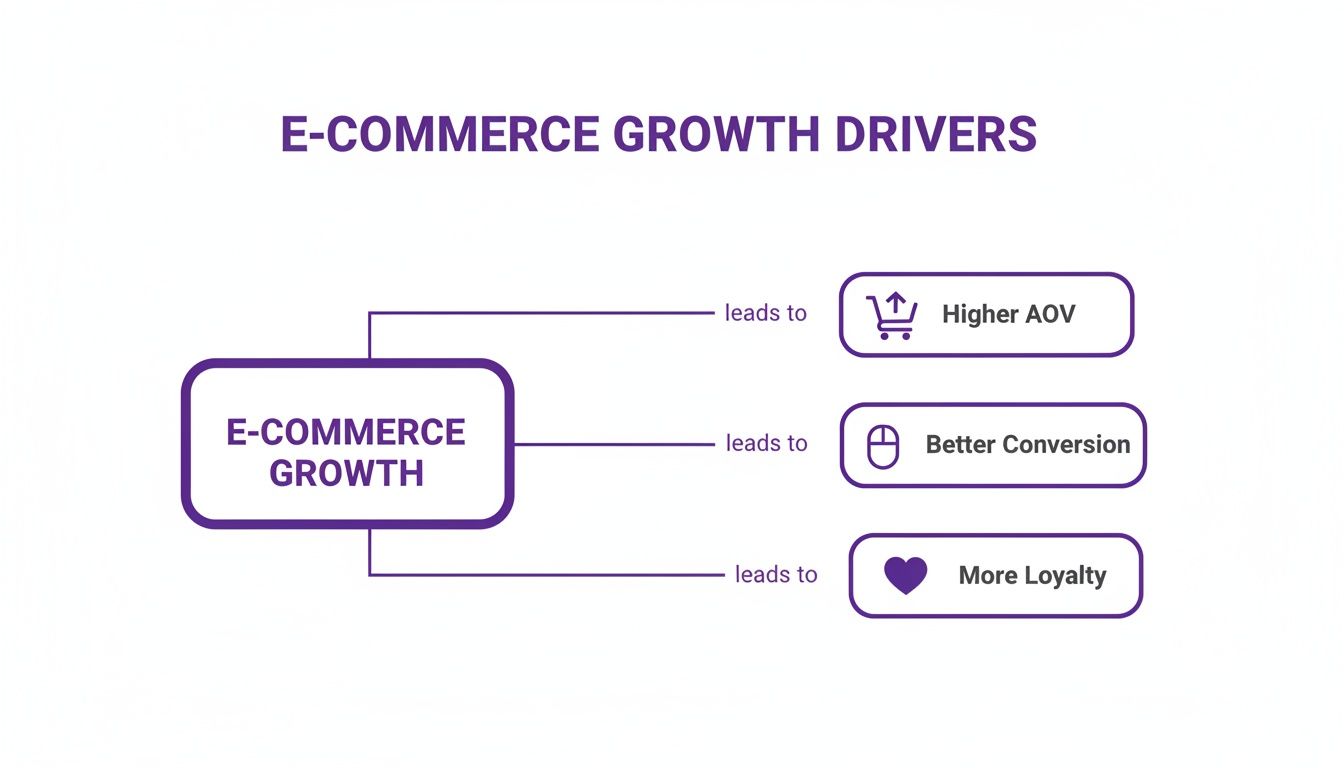
This growth cycle is what you're aiming for. A powerful recommendation engine gets this flywheel spinning faster. Here are the different engine types that make it happen.
H3: Collaborative Filtering: The Power of the Crowd
This is the classic model used by platforms like Amazon and Netflix. Collaborative filtering operates on a simple but powerful principle: "People who bought X also bought Y." It identifies patterns in group behavior to make predictions.
The system notices that Shopper A and Shopper B both purchased the same three running shoes, flagging them as having similar tastes. When Shopper A then buys a new pair of high-tech running socks, the engine recommends those same socks to Shopper B.
This method is exceptional for product discovery. It helps shoppers find items they would never have searched for directly, driven by the collective wisdom of your customer base.
H3: Content-Based Filtering: It's All About the Product
Content-based filtering ignores crowd behavior and focuses exclusively on product attributes. The logic is: "Because you liked this item, you'll probably like this other item that shares similar features."
This model analyzes your product data to connect items based on:
- Category: They're both "women's knit sweaters."
- Brand: They're both from the same designer.
- Color: They're both shades of navy blue.
- Tags: They're both tagged "cashmere" and "winter collection."
If a customer is viewing a specific camera lens, it makes perfect sense to show them other compatible lenses from the same brand. The major dependency here is your product data. If your listings are sparse or inconsistent, the engine has nothing to work with. To ensure your data is rich and structured, use our generator to create detailed and compelling descriptions.
A Quick Comparison of the Models
To make the choice clearer, here’s a side-by-side comparison. Each model has strengths suited for different store types and strategic goals.
Comparison of Recommendation Engine Models
| Engine Type | How It Works (Simple Terms) | Best For... | Potential Downside |
|---|---|---|---|
| Collaborative Filtering | "People like you also liked this." It matches you with shoppers who have similar purchase histories. | Large stores with lots of user data and a diverse catalog. Great for discovery. | The "cold start" problem—it struggles with new products or new users with no history. |
| Content-Based Filtering | "If you like this, you'll like this other similar thing." It recommends items based on shared product attributes. | Niche stores with well-defined product attributes (e.g., electronics, books). | Can lead to overly narrow recommendations; it won't surprise shoppers with new discoveries. |
| Hybrid Models | A mix of both collaborative and content-based logic. It uses one to fill the gaps of the other. | Most e-commerce stores. It provides a balanced and robust approach. | Can be more complex and costly to implement and maintain than a single-model system. |
| AI/ML-Driven | "Based on everything you're doing right now, we predict you'll want this next." It analyzes real-time behavior. | Stores focused on hyper-personalization and maximizing conversions. | Requires significant data and processing power; often comes with a higher price tag. |
Choosing the right model means understanding these trade-offs and selecting the one that aligns with your store's size, catalog, and growth objectives.
H3: Hybrid Models: The Best of Both Worlds
As you might expect, hybrid models combine collaborative and content-based filtering to leverage the strengths of each while mitigating their weaknesses. This creates a more accurate and resilient system.
The classic "cold start" problem illustrates this perfectly. A brand-new product has no sales history, so a purely collaborative engine is useless. A hybrid system, however, switches to its content-based logic, analyzes the new product's features (brand, category, tags), and immediately recommends it to users browsing similar items. Your new arrivals get the visibility they need from day one.
H3: AI and Machine Learning: The Smartest Approach
The most advanced recommendation engines today are powered by Artificial Intelligence and Machine Learning (ML). These systems don't just follow rules; they aim to predict what a shopper wants before they even know they want it.
AI-powered platforms like Selzee learn from every interaction—every click, scroll, and search. They incorporate contextual clues like time of day, shopper location, and browsing path to build a dynamic understanding of a user's current shopping mission.
The result is an engine that adapts its recommendations in real-time, delivering suggestions that feel incredibly intuitive. This moves beyond basic personalization to create a unique one-on-one shopping experience for every visitor.
The Real-World Payoff: AOV, Conversions, and Your Bottom Line
Let's focus on what matters most: your bottom line. A product recommendation engine is a high-performance sales tool designed to boost your key financial metrics. When implemented correctly, it's one of the highest-ROI investments you can make in your Shopify store.
The goal is to shift shoppers from passive browsing to active purchasing, guiding them toward a larger, more satisfying order. Research shows that shoppers who click on AI-driven recommendations spend more, leading to a 26% higher average order value (AOV). That’s a significant revenue increase from your existing traffic.
Boosting Average Order Value with Smarter Cross-Sells
The most immediate win you'll see is a jump in AOV. A smart recommendation engine excels at identifying the perfect cross-sells and upsells and presenting them at the moment of highest purchase intent.
Imagine a customer is viewing a dress. A basic engine shows more dresses. A smart one powers a “Complete the Look” widget displaying the specific earrings and shoes worn by the model in the product photos. This contextual nudge removes guesswork and makes it incredibly easy for the shopper to add more to their cart, instantly increasing the order value.
A recommendation engine doesn't just show related items; it actively builds a bigger cart for you, one intelligent suggestion at a time. It turns single-item purchases into multi-item hauls.
Driving More Conversions Through Effortless Discovery
How many sales have you lost because a shopper with high purchase intent couldn't find the right product in your catalog? For stores with extensive inventories, product discovery is a major conversion blocker. A recommendation engine solves this by acting as a personal shopper for every visitor.
By analyzing a user's real-time behavior—clicks, views, cart additions—the engine surfaces highly relevant products they might never have found on their own. This seamless, personal experience builds trust and guides them toward checkout. When shoppers feel your store "gets" them, they are far more likely to convert from browsers to buyers.
Creating Long-Term Loyalty and Repeat Customers
The value of a great recommendation engine extends far beyond a single transaction. A consistently personalized shopping experience is the foundation of genuine customer loyalty. When your store remembers a customer’s preferences and continues to suggest relevant products on subsequent visits, you give them a powerful reason to return.
You build a relationship that transcends price. Customers come back because they know your store understands them, which dramatically increases their lifetime value (LTV). You can see real-world examples of this in our case studies on ecommerce growth.
This creates a powerful feedback loop: better recommendations lead to more sales, which generates more data, which in turn leads to even smarter recommendations. This is the growth flywheel top brands use to build a loyal customer base and dominate their market. It all starts with showing the right product to the right person at the right time.
Getting a Recommendation Engine Hooked Up with Shopify
For a merchant running on Shopify, integrating a recommendation engine is a straightforward process. Modern tools are designed for seamless integration, allowing you to get up and running quickly without a complex development project.
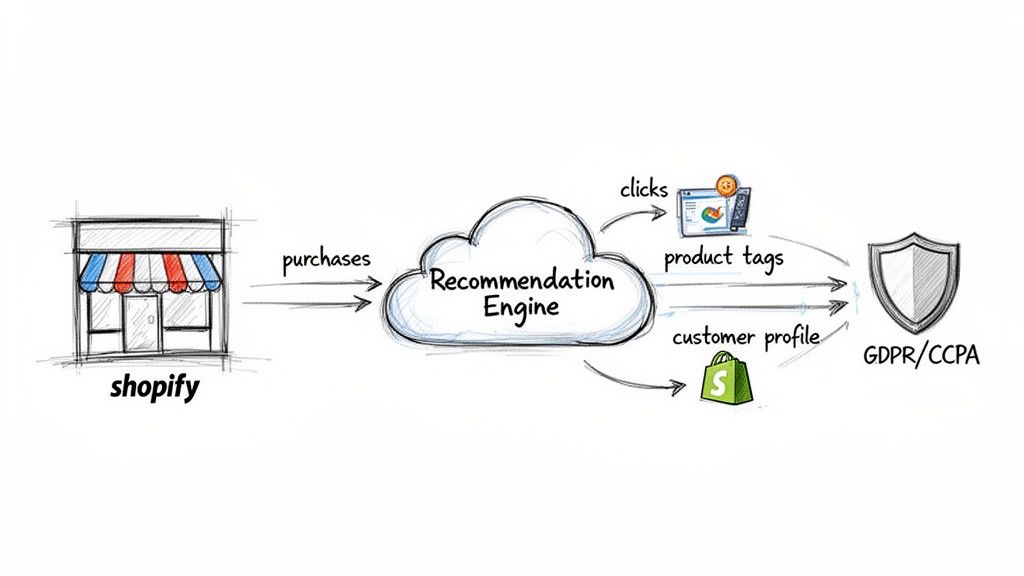
The process connects the engine to two key data sources: your product catalog and your customer behavior. The system needs to know what you sell and, more importantly, how your customers interact with those products in real time.
Plugging in Your Data
A truly intelligent engine synthesizes data from across your store to build a comprehensive view of shopper intent. It's not just about what someone bought last month; it's about understanding what they want right now.
Here’s what a typical integration syncs:
- Product Metadata: The engine ingests your entire catalog—titles, descriptions, tags, collections, prices, and inventory levels. The more detailed your product data, the more effective the recommendations.
- User Behavior Data: This is where the real-time learning happens. The system tracks every click, product view, add-to-cart action, search query, and purchase, analyzing the digital body language of every visitor.
- Customer Profiles: For returning customers, the engine leverages past purchase history and browsing behavior to predict future interests.
For most Shopify apps, this is handled automatically after installation or by adding a small code snippet to your theme. Once connected, the system begins learning from your live traffic immediately, with initial recommendations often appearing within hours.
The Technical Details You Can't Ignore
While setup is typically simple, several technical considerations are non-negotiable. Overlooking these can lead to significant problems.
Data Privacy and Compliance is paramount. Your recommendation engine will process customer data, meaning it must be compliant with regulations like GDPR and CCPA. Verify that any tool you choose is transparent about its data handling, anonymization practices, and consent management. Non-compliance can result in heavy fines and a severe loss of customer trust.
Your responsibility doesn't end at installation. You must update your own privacy policy to reflect the new data processing and ensure the tool you've chosen adheres to legal standards.
Scalability and Performance are also critical. A slow-loading recommendation widget during a high-traffic event like Black Friday will kill conversions. Your solution must be able to handle traffic spikes without impacting page load times. Look for cloud-based tools that scale automatically.
Finally, Real-Time Learning is the secret sauce. A basic tool might use historical data, but a powerful engine adapts during a single session. If a user clicks on three blue shirts, the engine should immediately start showing them more blue shirts and complementary items—not the gardening tools they viewed last week.
This ability to react in the moment is what drives exceptional results and is why the recommendation engine market is projected to reach USD 139.08 billion by 2035. (Learn more about these market projections). You can see how Selzee adapts to user behavior in a live demo to watch how recommendations change with every click.
Dodging the Common Blunders That Sink Your Sales
A product recommendation engine can be a powerful revenue driver, but only if configured correctly. A poorly implemented engine won't just fail to deliver results—it can actively frustrate customers and damage your conversion rates. Avoid these common, costly mistakes.
The biggest trap is the "set it and forget it" mindset. Installing an app with default settings and hoping for the best is a recipe for mediocrity. Your recommendation strategy must be an active part of your business, continually monitored, tested, and optimized to ensure it's helping, not hindering, the customer journey.
The Ultimate No-Go: Showing Sold-Out or Random Products
This is the cardinal sin of product recommendations. Nothing kills a shopper's momentum faster than clicking an exciting recommendation only to land on a "sold out" page. It’s a dead end that breeds frustration and erodes trust. Your engine must have real-time inventory awareness and automatically hide out-of-stock items.
Equally damaging are irrelevant recommendations. If a customer is evaluating a high-end espresso machine, suggesting a cheap novelty mug makes your store look clueless. A smart engine uses AI to understand product context and relationships, making every suggestion feel like a logical and helpful next step.
When your recommendations miss the mark, you don't just lose an upsell. You damage the customer's confidence in your brand's ability to understand their needs.
Hide and Seek: Poor Widget Placement and Visibility
You could have the world's most intelligent algorithm, but it's worthless if no one sees it. Hiding widgets below the fold or on a cluttered cart page guarantees they will be ignored.
For maximum impact, your recommendation placements must be:
- Front and Center: Place "Frequently Bought Together" or "Complete the Look" widgets near the "Add to Cart" button where they are impossible to miss.
- In the Right Context: Use your homepage for "Trending Now" or "New Arrivals." Reserve the cart page for high-margin, low-consideration impulse buys.
- Helpful, Not Annoying: Recommendations should guide, not interrupt. Avoid aggressive pop-ups that break the shopping flow. The goal is to assist, not harass.
Not Seeing the Forest for the Trees: Ignoring the Real Problem
If your recommendation click-through rates are low, don't automatically blame the engine. The problem often lies with the products themselves. The engine can only work with the inventory you provide; if your product presentation is weak, even the best AI can't force a click.
Low engagement may signal a product discoverability issue. Perhaps your product names are generic or confusing, failing to capture attention. Using a product name optimizer can be transformative, helping you craft titles that are both SEO-friendly and compelling to shoppers. By fixing these foundational elements, you provide your ecommerce product recommendation engine with high-quality products to work with, turning it into a true revenue-generating machine.
Measuring Success with the Right KPIs
You’ve launched your new product recommendation engine. Now, how do you know if it's actually working? If you can't measure its impact in hard numbers, you're operating on guesswork. Let’s focus on the Key Performance Indicators (KPIs) that directly link to revenue and prove your engine is delivering ROI.
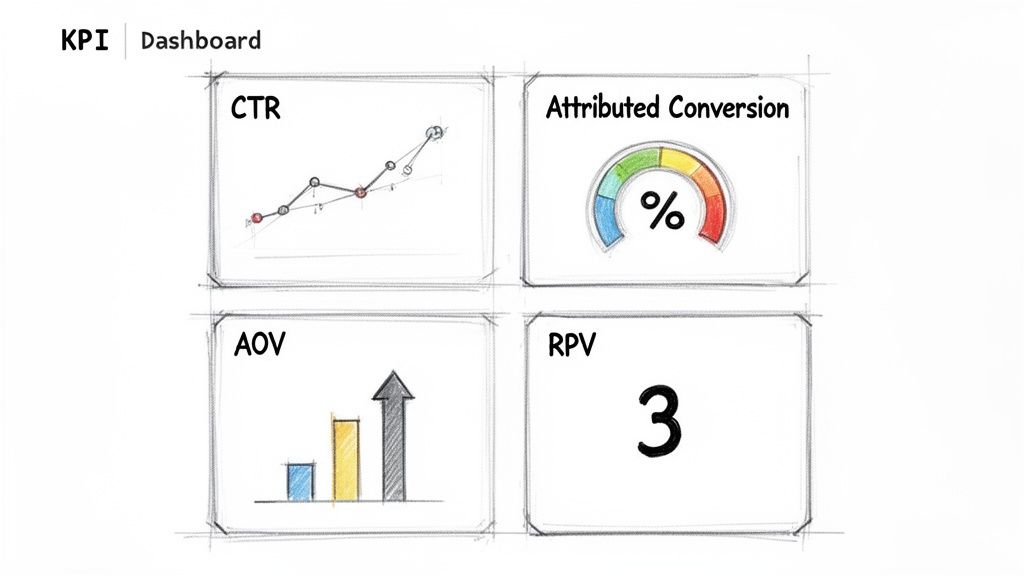
Monitoring these KPIs provides the feedback needed to refine your strategy, optimize placements, and transform a site feature into an indispensable growth driver for your store.
Click-Through Rate on Recommendations
The most fundamental metric is Click-Through Rate (CTR). It measures how many people who see a recommendation actually click on it. This is a direct indicator of relevance.
A high CTR confirms that your recommendations are capturing shopper attention. A low CTR is an early warning sign that your suggestions are irrelevant, poorly placed, or visually unappealing.
Attributed Conversion Rate
Clicks are a good start, but sales are what matter. The Attributed Conversion Rate tracks how many clicks on recommended products result in a purchase.
This KPI directly connects a recommendation to a sale, providing a clear view of your ROI. It answers the critical question: "Are my recommendations convincing people to buy?" For a deeper dive, check out our guide on how to use a conversion rate calculator. A high attributed conversion rate proves your engine is showing the right products at the right time.
Uplift in Average Order Value
A key function of a recommendation engine is to increase how much each customer spends. The uplift in Average Order Value (AOV) measures this directly.
To calculate the true impact, you must compare two segments:
- AOV with Recommendations: The average order value for transactions that included an item from a recommendation widget.
- AOV without Recommendations: The average order value for transactions where no recommended items were added.
The difference is your AOV uplift, a clear dollar figure showing how effectively your engine is increasing cart size.
Revenue Per Visitor
Finally, Revenue Per Visitor (RPV) provides a holistic view of your engine's financial impact by combining conversion rate and AOV.
RPV calculates the average revenue generated by each person who visits your site. If your RPV increases after implementing recommendations, you have definitive proof that your strategy is working. It shows you're not just improving isolated metrics—you're making your entire store more profitable.
Essential KPIs to Track Recommendation Engine Performance
This table summarizes the core metrics that reveal the true performance of your engine.
| KPI (Key Performance Indicator) | What It Measures | Why It Matters | Simple Calculation |
|---|---|---|---|
| Click-Through Rate (CTR) | The percentage of viewers who click on a recommendation. | Shows if recommendations are relevant and engaging enough to grab attention. | (Clicks / Impressions) x 100 |
| Attributed Conversion Rate | The percentage of clicks on recommendations that result in a purchase. | Proves that recommendations are directly driving sales and generating ROI. | (Purchases from Recs / Clicks on Recs) x 100 |
| Uplift in Average Order Value (AOV) | The increase in average cart value for orders containing a recommended item. | Quantifies how much extra revenue your cross-sells and upsells are generating. | AOV with Recs - AOV without Recs |
| Revenue Per Visitor (RPV) | The average revenue generated by each visitor to your site. | Provides a high-level view of the engine's overall impact on store profitability. | Total Revenue / Total Visitors |
Tracking these four KPIs gives you a 360-degree view of your engine's health, moving you from "I think it's working" to "I know it's adding X dollars to our bottom line."
Got Questions? We've Got Answers
"I'm a Small Store. Will a Recommendation Engine Even Work for Me?"
Absolutely. You don't need Amazon-level traffic to get results. Modern AI-powered engines start learning from your first visitor. They analyze your product data and initial user clicks to begin making intelligent suggestions immediately. While more data always improves accuracy, even small stores can see a significant lift in conversions and AOV by effectively guiding customers to relevant products.
"Okay, But How Long Until I See a Real Impact?"
You should see results within days, not months. Once the engine is live on your Shopify store, it begins learning from your real-time traffic. Most merchants see a measurable increase in CTR and AOV within the first 1-2 weeks. The system's effectiveness compounds over time as it gathers more data, leading to progressively smarter and more profitable recommendations.
"I'm Worried This Will Slow Down My Website."
This is a valid concern, but a well-architected recommendation engine will not impact your site speed. Modern systems load asynchronously, meaning they load independently of your core page content. Your product images and "Add to Cart" button load instantly, while the recommendation widgets load in the background without making customers wait.
"Help! My Product Data Is a Complete Mess."
This is a common problem and not a deal-breaker. While clean, detailed product data is ideal, a sophisticated AI can work around imperfections. It can infer relationships between products by analyzing titles, collection structures, and user clickstream data. That said, improving your data quality will always improve results. Spending time cleaning up your listings using a free product description tool can give your engine a significant performance boost.
Ready to see how an AI shopping assistant can completely change the game for your store? Selzee delivers the kind of hyper-personalized recommendations that turn browsers into buyers. Get a personalized demo today and see it for yourself.