You've got a live Shopify store. You have traffic. You're making sales. But growth has flatlined. Ad costs are climbing, and you're wondering, "What's next?"
If you're stuck in that gear, you're not alone. This is the point where random acts of marketing stop working. You can't just throw another discount code out there or boost a post and expect predictable results. It's time to stop guessing and start building a real, repeatable system for growth.
An effective ecommerce growth strategy isn't a secret hack. It's a data-driven plan to attract the right customers, maximize their lifetime value, and build an operational machine that can scale without breaking. It's a cohesive loop connecting customer acquisition, conversion, and retention.
Laying the Foundation for Scalable Growth
The biggest mistake Shopify merchants make is trying to scale on a shaky foundation. They chase shiny new trends, install every app that promises a quick win, and burn cash on ad campaigns without ever truly understanding what's happening under the hood.
The first, most crucial step is to diagnose the "leaky buckets" in your business—the hidden friction points quietly costing you sales every single day. This isn't about blame; it's about clarity.
This diagnostic process boils down to getting a brutally honest look at three core areas of your store.
Perform a Full Store Diagnostic
Before you can fix anything, you have to know your numbers—the real numbers. This means going deeper than just surface-level revenue and traffic stats in your Shopify Analytics or Google Analytics 4. You need to look for the stories the data is telling you.
It's the difference between flying blind and navigating with a GPS.
Start digging into specific reports to find patterns:
- Conversion Rate by Traffic Source: Are visitors from your TikTok ads converting at half the rate of those from Google Search? That’s a huge clue that your ad creative and landing page message are out of sync.
- Top Landing Pages & Exit Rates: If your best-selling collection page has a sky-high exit rate, something is wrong. Maybe the layout is confusing, or the product images are low-quality. It's a red flag you can't ignore.
- Device Performance: This one is a classic. If your mobile conversion rate is 50% lower than desktop, you have an urgent mobile experience problem that is bleeding money.
This isn't just about collecting data; it's about establishing a baseline. From this point forward, every change you make should be measured against these core metrics.
The flowchart below gives you a bird's-eye view of how these foundational pieces fit together. It all starts with a deep dive into your data.
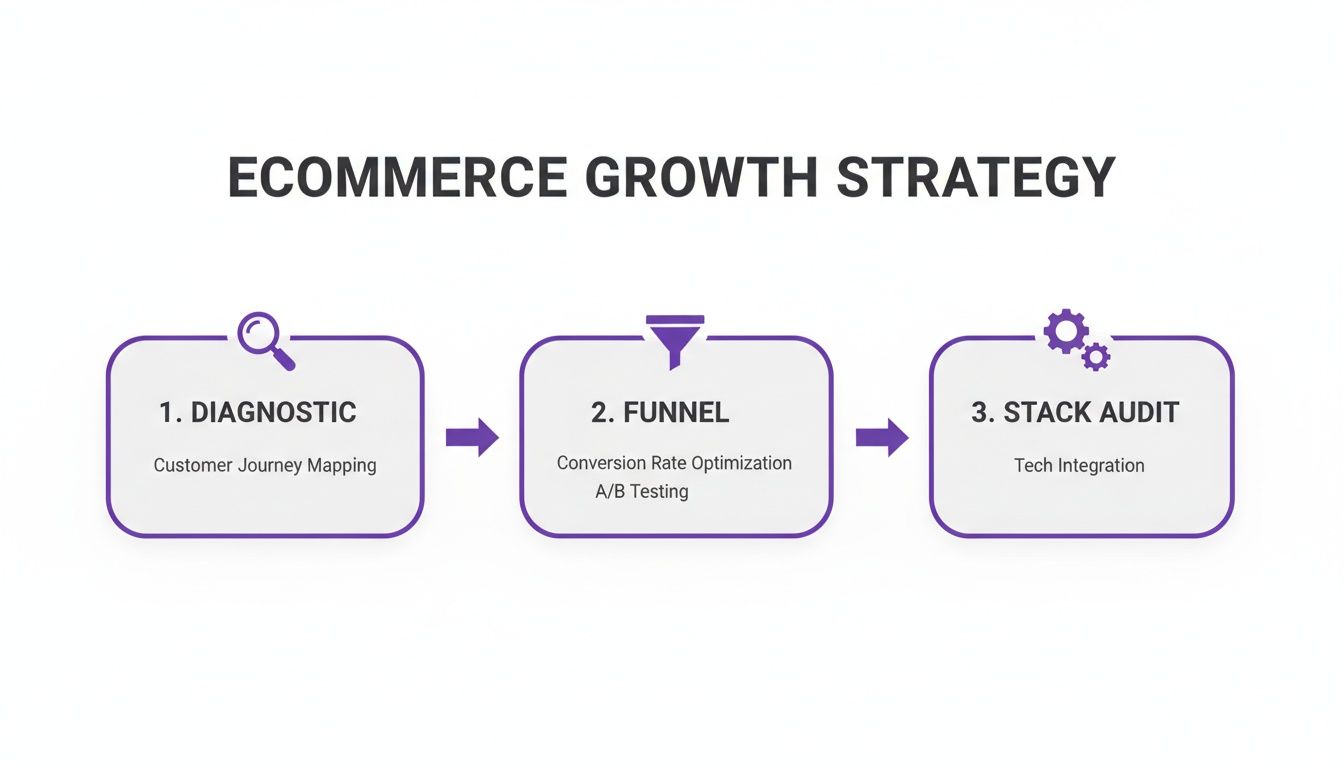
As you can see, a solid strategy is built on diagnostics first, which then informs how you optimize your funnel and your technology.
Identify Funnel Bottlenecks
With your data in hand, it's time to map out the customer journey, from the moment they land on your site to the post-purchase thank you email. Your mission is to find exactly where people are jumping ship.
Is it a confusing product page? A clunky, multi-step checkout process? Or that surprise shipping fee that shows up at the last second? These are the bottlenecks that kill conversions.
Fixing a 2% drop-off at checkout is almost always more profitable—and way faster—than trying to drive 2% more traffic to your store. Focus on plugging the leaks first.
Audit Your Tech Stack
Finally, take a hard look at the apps and tools running your store. Your tech stack should be a growth engine, not an anchor weighing you down with costs and complexity.
Are you paying for five different apps that basically do the same thing? Is that cool-looking but slow-loading app tanking your site speed and frustrating visitors? It's time to be ruthless. If a tool isn't clearly helping you acquire, convert, or retain customers, it's probably dead weight.
A lean, mean tech stack is the backbone of any store ready to scale. And if you're looking to simplify, you might find some useful resources in our suite of free ecommerce tools designed to streamline your workflow.
Ecommerce Growth Levers at a Glance
To bring it all together, think of your growth strategy in terms of distinct "levers" you can pull. Each one has a specific goal and metrics you should be watching like a hawk. Here’s a quick summary to keep you focused.
| Growth Lever | Primary Goal | Key Metrics to Watch |
|---|---|---|
| Market & Customer Analysis | Understand who you're selling to and why they buy. | Customer Persona Accuracy, Market Share, Competitor Benchmarks |
| Customer Acquisition | Drive qualified, profitable traffic to your store. | Cost Per Acquisition (CPA), Return on Ad Spend (ROAS), Traffic by Channel |
| Conversion Rate Optimization | Turn more visitors into paying customers. | Overall Conversion Rate, Add-to-Cart Rate, Checkout Abandonment Rate |
| Average Order Value (AOV) | Increase the amount each customer spends per transaction. | AOV, Items Per Order, Upsell/Cross-sell Take Rate |
| Customer Retention | Turn one-time buyers into loyal, repeat customers. | Customer Lifetime Value (CLV), Repeat Purchase Rate, Churn Rate |
| Analytics & Experimentation | Make data-driven decisions to continuously improve. | A/B Test Win Rate, Key Metric Uplift, Data Accuracy |
Keeping an eye on these levers and their corresponding metrics is how you move from "hoping for growth" to systematically engineering it.
Winning Profitable Traffic with Smarter Acquisition
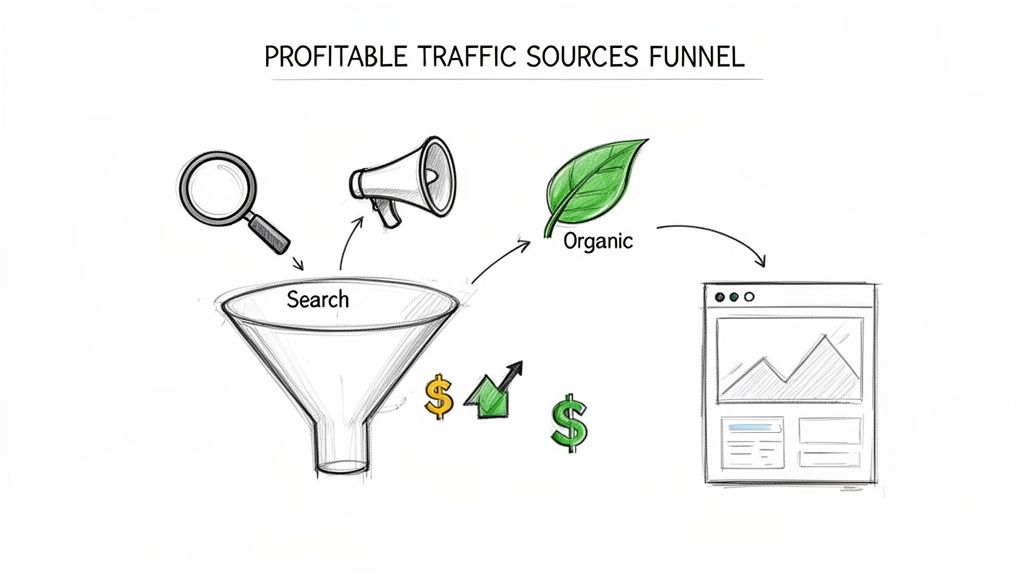
It's easy to fall into the trap of pouring money into ads just to see traffic numbers climb. But raw traffic is a vanity metric. The only number that truly matters is profitable traffic. A real ecommerce growth strategy isn't about buying more eyeballs; it's about attracting high-intent customers who are ready to buy.
This means getting smarter than just boosting posts on Meta or running generic Google Shopping campaigns. You need to build a multi-channel acquisition engine where every part—paid and organic—works in harmony to bring in qualified, cost-effective traffic that actually scales your business.
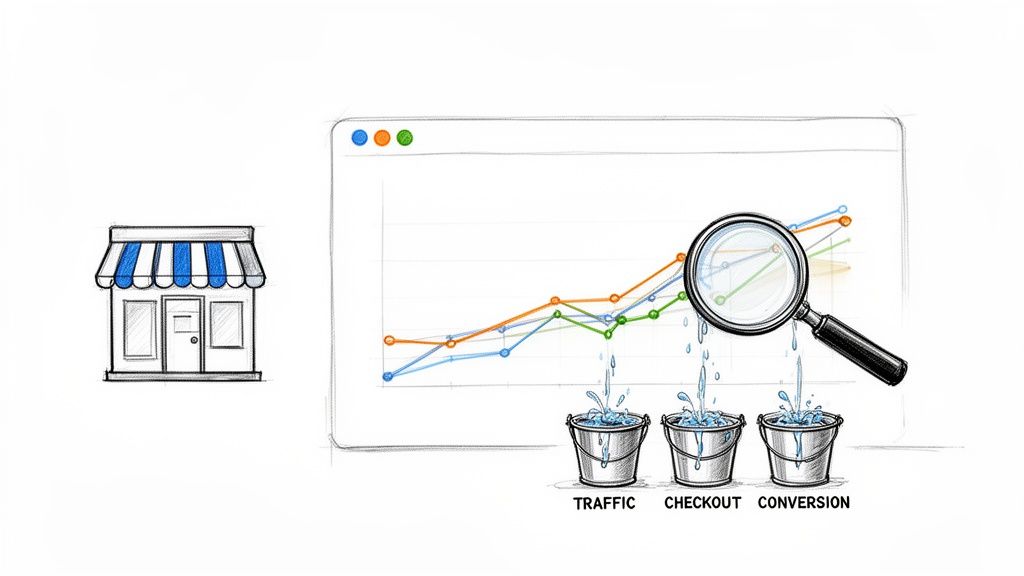
The goal isn't just clicks. It's getting in front of shoppers actively hunting for what you sell. That takes discipline across both paid and organic channels.
Architecting Paid Media for Profitability
Here's a hard truth: the default campaign setups on platforms like Meta and Google are designed to make them money, not necessarily you. To win, you must seize control and build campaigns for profit, not just reach. This means moving from a "spray and pray" broad targeting approach to something far more layered and intelligent.
Think in terms of customer awareness. You wouldn't talk to a total stranger the same way you'd talk to a close friend, right? Your ads should follow the same logic:
- Cold Audiences (Top of Funnel): These folks have no idea who you are. Your job is to grab their attention with killer video ads or authentic user-generated content (UGC). It’s all about awareness and education, not a hard sell.
- Warm Audiences (Middle of Funnel): Now you’re talking to people who’ve shown some interest—site visitors, social media engagers, email subscribers. This is the perfect time to retarget them with product benefits, glowing testimonials, or customer stories.
- Hot Audiences (Bottom of Funnel): These are the people who are this close to buying. Target your cart abandoners and past customers with direct offers, a little urgency, and exciting new product announcements.
The single most expensive mistake you can make in paid media is showing the right ad to the wrong person. A bottom-of-funnel "Buy Now!" ad served to a completely cold audience is just setting your money on fire. Match your message to their journey stage.
Building Your Organic Traffic Flywheel
Paid ads give you a quick hit of traffic and data, but organic traffic is the bedrock of a sustainable, long-term business. This is where many Shopify stores leave massive amounts of money on the table. If you want to acquire profitable traffic consistently, you absolutely have to master search engine optimization. Start by digging into the top 10 ecommerce SEO best practices.
Beyond the basics of on-page SEO, your energy should go into the areas that drive real commercial intent:
- Collection Page Optimization: These are your money pages. Treat them like high-powered landing pages. Add keyword-rich intros, link out to sub-collections, and make your value proposition crystal clear.
- Product Discoverability: Strong product titles are non-negotiable for SEO. If your product names are vague or branded nonsense, you're invisible to search engines. A smart product name optimizer can be a game-changer here, helping you craft titles that capture search demand and pop on Google Shopping.
- Authoritative Content: Solve your customers' problems with genuinely helpful blog posts and guides. For instance, a skincare brand could create "The Ultimate Guide to Building a Routine for Oily Skin," then naturally link to its relevant products throughout the article.
This strategy creates a powerful flywheel effect. The more great content you publish, the more backlinks you earn. That boosts your domain authority, which in turn drives even more organic traffic. It just keeps building on itself.
And don't sleep on specialized markets. The B2B ecommerce world, for example, is projected to hit an incredible $36 trillion by 2026, thanks to a massive post-2020 shift to virtual sales. This market dwarfs B2C and opens up entirely new acquisition channels for Shopify stores ready to explore wholesale or bulk ordering. You can read the full research about these global e-commerce statistics.
At the end of the day, a truly balanced acquisition strategy leans on both paid and organic channels. Paid media gives you immediate data and the ability to scale up quickly, while organic builds a powerful, defensive moat around your business, delivering high-quality traffic for years to come.
Turning Traffic into Sales: Mastering Conversion Rate Optimization
Getting shoppers to your site is a win, but it's only half the battle. The real magic—and the money—happens when you convince them to pull out their wallets. This is where Conversion Rate Optimization (CRO) shifts from a buzzword into the most profitable part of your growth plan. We're not just talking about changing a button color; we're diving deep into the psychology and tech that smash through buying friction.
Most stores leak sales not because their products are bad, but because their website experience is a nightmare. A slow page, a confusing product description, or a clunky checkout process are the silent killers of your conversion rate. Learning how to improve ecommerce conversion rate is the key to printing money from the traffic you already fought to get.
Engineer a Friction-Free Shopping Experience
Think of your store’s user experience (UX) as the red carpet you roll out for customers. It’s not about flashy design. It’s about making the journey from "I like that" to "order confirmed" as smooth as possible. Even tiny bumps in the road cause frustrated visitors to bail on their carts forever.
Start with the high-impact basics:
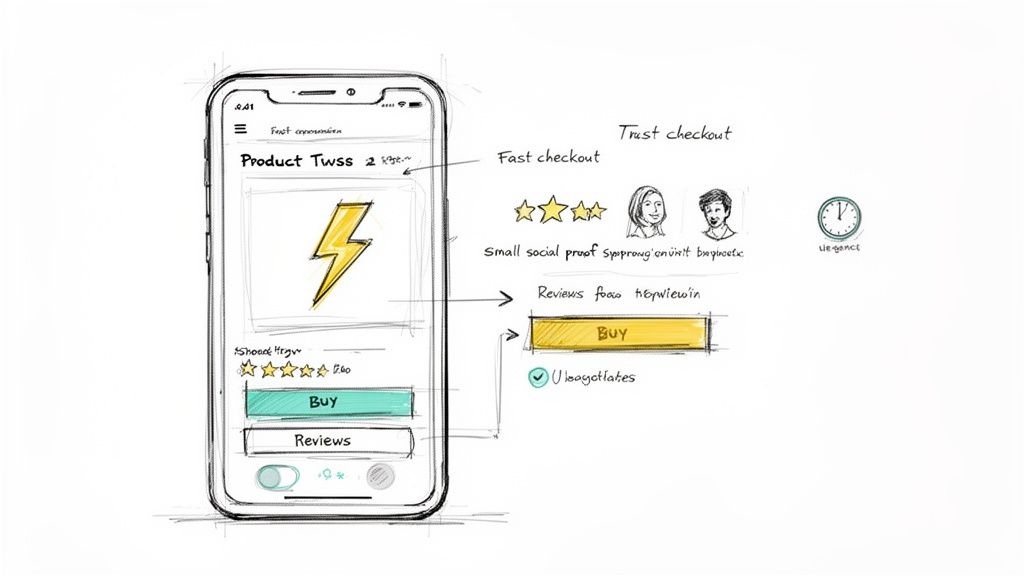
- Make It Fast. No, Faster. Every second counts. A one-second delay in page load time can tank conversions by 7%. Compress your images, audit your apps for bloat, and ensure your theme is built for speed.
- Navigation That Just Makes Sense. Could a new visitor find your best-selling product category in two clicks? If not, your main menu and search bar need an immediate overhaul. A clear site structure isn't a "nice-to-have"; it's a must.
- Live and Breathe Mobile-First. This stopped being a suggestion years ago. Mobile commerce is a juggernaut, on track to own nearly 59% of all online retail sales by 2026. This is precisely why AI sales assistants are becoming mission-critical for Shopify stores, offering instant help to shoppers scrolling on their phones.
A clunky mobile checkout is one of the most expensive mistakes you can make. Grab your phone, go through your entire purchase flow, and fix every broken button, overlapping text, and tiny font. This one audit can deliver a massive return on your time.
Turn Your Product Pages into Sales Machines
Your product page is your #1 salesperson, working 24/7. It needs to anticipate every question, squash every objection, and build an undeniable urge to click "buy." Many stores drop the ball here with boring spec sheets—a huge, costly mistake.
You have to craft copy and visuals that tell a story and sell a solution.
Your product pages absolutely must have these elements:
- Benefit-Focused Copy: Don’t just say "water-resistant fabric." Say, "Stay bone-dry and comfortable, even in a downpour." Connect the feature to the feeling. If you're struggling to find the right words, a free product description tool can help you brainstorm benefit-driven copy.
- Show, Don't Just Tell, with Visuals: You need multiple high-res images, lifestyle shots of the product in action, and short videos. Let shoppers practically touch and feel the product through their screen.
- Slap Social Proof Everywhere: Feature your best customer reviews and star ratings right where people can see them. Over 90% of people read reviews before they buy. Make yours impossible to ignore.
- A Can't-Miss Call-to-Action (CTA): Your "Add to Cart" button should be big, bold, and a color that pops off the page. There should be zero doubt about what the next step is. For marketplaces like Amazon, you can use a free bullet points tool to make your value props even clearer.
Build Unshakeable Trust and a Little Urgency
Okay, so your site is smooth and your product pages are compelling. But some shoppers still hesitate. They need that final nudge, that last bit of reassurance that buying from you is a safe, smart move. This is where trust signals and a touch of ethical urgency work their magic.
Sprinkle these trust-builders all over your site:
- Trust Badges: Display secure payment logos (Visa, PayPal, Shopify Pay) in your footer and at checkout. It’s a simple visual cue that says, "Your info is safe here."
- Clear, Simple Policies: Don't hide your shipping, return, and privacy policies. Make them incredibly easy to find and read. Buried policies feel sketchy.
- Real Urgency: Using low-stock counters ("Only 3 left!") or countdown timers for a sale can be incredibly effective at encouraging action. But they have to be genuine. Faking urgency is the fastest way to destroy trust forever.
By methodically working through these on-site elements, you'll start turning your store from a passive catalog into an active, high-powered conversion engine.
Boosting Profit with AOV and LTV Strategies
Acquiring customers is the most expensive part of running an online store. If your entire game plan is just getting that first sale, you're leaving a massive pile of cash on the table. A truly powerful ecommerce growth strategy isn't about getting more orders; it's about getting more profitable orders.
This is where you need to get obsessed with two metrics: Average Order Value (AOV) and Customer Lifetime Value (LTV).
AOV is about getting customers to spend more right now. LTV is about making them so happy they come back to spend more over and over again. Nailing both is the secret to building a predictable, sustainable business that isn't at the mercy of skyrocketing ad costs.
Driving Higher Average Order Value Today
Want an immediate lift in your daily revenue? Focus on AOV. It's the lowest-hanging fruit on the growth tree. The magic lies in making smarter offers at the exact moment a customer has their credit card out.
Frame these offers as helpful suggestions, not a sleazy, hard-sell pitch.
Here are a few tactics that work wonders:
- Smart Product Bundling: Dive into your sales data on Shopify or Shoptet and see what people are actually buying together. Create a “Complete the Look” or a “Starter Kit” bundle and shave a little off the total price. It’s an easy yes for the customer.
- Gamify Shipping with Tiers: Ditch the generic "Free Shipping on All Orders." Instead, set a threshold. "Spend $75 to unlock Free Shipping!" This psychological nudge encourages shoppers to find one more thing to add to their cart. It works like a charm.
- Post-Purchase One-Click Upsells: The "thank you" page is the most under-utilized real estate in ecommerce. The moment a customer clicks "buy," their trust is at its peak. Use a post-purchase offer app to show them a complementary item they can add to their order with a single click. It's a frictionless way to bump up AOV.
A great upsell isn't about squeezing more money out of someone. It's about anticipating their next need and solving it before they even think to ask. That’s how you add real value.
Playing the Long Game with Customer Lifetime Value
While AOV gives you instant gratification, building LTV creates a brand that lasts. This is about nurturing the relationship you’ve already paid to start. It costs 5 to 25 times more to acquire a new customer than to keep an existing one. Your retention strategy isn't just a "nice to have"—it's a core pillar of profitability.
This is where your email and SMS marketing program becomes an absolute superpower. You've earned their trust once; now it's time to keep the conversation going.
Building a Retention Machine with Email & SMS
Your email and SMS lists are assets you own. An algorithm change can't take them away. A killer communication strategy keeps your brand top-of-mind and drives a steady stream of repeat purchases from your best customers.
You absolutely need to have these automated flows running 24/7:
- Welcome Series: This is your first impression after they've trusted you with their money. Don't just send a generic order confirmation. Kick off a multi-email sequence that welcomes them to the tribe, shares your brand story, and offers tips on getting the most out of their new purchase.
- Abandoned Cart Recovery: This is non-negotiable. Someone liked your stuff enough to add it to their cart but got distracted. A simple three-part email flow can claw back a huge chunk of otherwise lost sales.
- Customer Win-Back Campaign: Has a loyal customer gone quiet for 90 days? Don't let them forget about you! Trigger an automated "We miss you!" campaign with a special offer to entice them back into the fold.
AOV vs. LTV Growth Tactics
While both AOV and LTV are about increasing customer value, the tactics to influence them differ in speed and scope. Here’s a quick breakdown to help you prioritize your efforts.
| Tactic | Primary Impact | Implementation Effort | Example |
|---|---|---|---|
| Product Bundling | AOV (Immediate) | Low-Medium | Creating a "Skincare Essentials Kit" with a cleanser, serum, and moisturizer at a 10% discount. |
| Tiered Shipping | AOV (Immediate) | Low | "Free shipping on all orders over $75." |
| Post-Purchase Upsell | AOV (Immediate) | Medium (App Setup) | Offering a phone case on the "Thank You" page right after a customer buys a new phone. |
| Loyalty Program | LTV (Long-Term) | Medium-High | A points-based system where customers earn rewards for purchases, referrals, and reviews. |
| Email Welcome Series | LTV (Long-Term) | Medium | A 5-part email flow that introduces the brand story and provides product education to new subscribers. |
| Subscription Model | LTV (Long-Term) | High | Offering a "Subscribe & Save" option for consumable products like coffee or vitamins. |
Ultimately, a balanced approach is best. Use AOV tactics to boost your cash flow today while you invest in LTV strategies that build a loyal community for tomorrow. This dual focus is the engine that will power your long-term growth.
Scaling with Smart Automation
You can't hustle your way to a seven-figure store. At some point, you become the biggest bottleneck. If you're still manually handling every little thing, you're not building a business—you're building yourself a high-stress job.
A truly effective ecommerce growth strategy is built on a smart, automated tech stack. This is how you create a well-oiled machine that works for you 24/7. This isn't about firing your team; it’s about empowering them to focus on big-picture ideas that actually move the needle.
Automate the Front Lines: Your Customer Conversations
Your customer service is your brand in action. Slow, clunky support is a fantastic way to lose customers for good. This is where automation delivers an immediate, game-changing win.
Stop letting your team spend their entire day answering the same five questions about your return policy. With the right AI tools, you can provide instant, perfect answers around the clock.
Automation's real goal isn't to sound like a machine. It's to solve customer problems so fast they don't even have a chance to get frustrated. Speed and accuracy build more trust than a cheesy "How can I help you today?"
Modern AI sales assistants are so much more than basic FAQ bots:
- They act as instant personal shoppers, guiding visitors to the perfect product based on what they're looking for.
- They serve up smart, personalized recommendations in real-time, just like a seasoned expert on the sales floor.
- They can even spot a hesitant shopper lingering on a page and proactively offer help before they bounce.
This is how you turn customer support from a necessary cost into a powerful revenue engine that actively drives sales.
Get a 360-Degree View of Your Customer
Your Shopify store is just one part of the story. You've got conversations in your helpdesk like Zendesk or Gorgias, purchase history in your backend, and engagement data in your email platform like Klaviyo. When these systems don't talk to each other, you're flying blind.
Scaling successfully means breaking down these data silos. You need to create one unified view of your customer. Imagine your support agent seeing a customer's entire order history instantly, or your email campaigns automatically adjusting based on a recent support ticket. That's when you can deliver truly personal marketing.
This connected data is the bedrock for powerful automation. If you're curious about how AI can pull all this together to create a seamless journey for your buyers, you should see a demo of AI-powered sales automation to grasp what's possible.
Build Workflows That Grow Your Business on Autopilot
Once your systems are integrated, the real fun begins. You can start building simple "if this, then that" workflows that handle crucial tasks without you lifting a finger. This is how you build a business that can scale without everything falling apart.
Here are a few no-brainer workflows you should set up right away:
- Supercharged Cart Recovery: Don't just rely on the default Shopify emails. Set up a multi-channel sequence that hits customers on email and SMS, personalized with the exact items they left behind.
- Low Stock Alerts: Automatically ping your operations team in Slack when a bestseller's inventory drops below 20 units. Never get caught with a surprise stockout again.
- "Hot Lead" Alerts: Create a workflow that flags any shopper who views a specific product 3 times in 24 hours and automatically adds them to a hyper-targeted retargeting audience on Facebook.
- Post-Purchase Onboarding: Selling something with a learning curve? Trigger a drip campaign that teaches customers how to get the most out of their new purchase. This simple flow crushes buyer's remorse and slashes return rates.
By putting these kinds of operational and marketing tasks on autopilot, you build a resilient, efficient business that can handle a sudden flood of orders without breaking a sweat. This is how you go from running a store to running a growth machine.
Ecommerce Growth FAQs
Every Shopify merchant hits these same roadblocks when trying to scale. Let's cut through the noise and get straight to the answers you need to build a powerhouse growth strategy.
"Where should I even start? I need a quick win."
Forget trying to do everything at once. Your fastest, most profitable wins are hiding right under your nose.
Before you pour another cent into ads, become obsessed with your on-site conversion rate. Think about it: a 1% bump in your conversion rate from the traffic you already have is pure profit. You've already paid to get those eyeballs; now it's time to turn them into customers.
The real money isn't in finding more customers; it's in converting the ones you already have. Get surgical with your checkout process, slash your page load times, and make your product pages irresistibly clear.
Dive into your analytics and find the biggest leak. Is it a pathetic add-to-cart rate? A massive checkout abandonment problem? Pinpoint that one major drop-off point and throw everything you've got at fixing that single bottleneck first. That's your quick win.
"How much money do I need to make this happen?"
There's no one-size-fits-all budget, but you can get smart about it. A solid rule of thumb for stores with traction is to reinvest 10-20% of your total revenue back into growth and marketing.
But the real secret isn't the total number—it's how you slice the pie. Try this 70/20/10 split:
- 70% into What Already Works: Double down on the Google or Meta campaigns that are already printing money for you. No questions asked.
- 20% into Optimization & Scaling: Use this slice to test new audiences within your proven channels. This is also where you fund your conversion rate experiments and A/B tests on your site.
- 10% into Bold Experiments: This is your "what if" money. Use it to dabble in a completely new channel like TikTok or start building a long-term asset like SEO content.
This framework keeps your revenue engine humming while giving you the room to discover your next big growth channel.
"How do I know if this is actually working?"
It all comes down to one number: your Marketing Efficiency Ratio (MER). You might hear it called Blended ROAS, but it's the same thing: total revenue divided by total ad spend. This is your north star metric. It gives you a brutally honest, top-level view of whether your marketing is truly profitable.
While MER is the ultimate scorecard, you need to track the leading indicators that tell you if you're moving in the right direction. Keep a close eye on these weekly:
- Conversion Rate (CVR): The most important health metric for your store. Is it going up?
- Average Order Value (AOV): Are those bundles and upsells actually working?
- Customer Lifetime Value (LTV): Are you turning one-time buyers into loyal fans who come back again and again?
If these three metrics are climbing, your growth strategy is working. Stop getting distracted by vanity metrics like website traffic or social media impressions. Focus on the numbers that actually hit your bank account.