Your Shopify store is live, traffic is flowing, and you've moved past the launch phase. But now, you've hit a plateau. The foundational work is done, but scaling requires a new, more sophisticated playbook. Forget the generic advice; when real revenue is on the line, you need proven, high-impact e-commerce growth strategies that deliver measurable results.
This isn't another beginner's guide. This is a tactical deep-dive into 12 powerful strategies designed for established Shopify merchants who are ready to accelerate performance. We're bypassing the hand-holding and focusing directly on actionable tactics that move the needle.
We'll explore the most significant levers for sustainable growth: boosting your conversion rate, increasing average order value (AOV), and maximizing customer lifetime value (CLV). You'll learn how to implement everything from AI-powered conversational commerce that provides 24/7 sales assistance to advanced abandoned cart recovery automation that recovers lost revenue.
Each strategy is broken down into concrete implementation steps and key performance indicators (KPIs) to track success. If you're ready to move beyond the basics and unlock the next level of profitability, this is your roadmap. Let's get to work.
1. AI-Powered Conversational Commerce
Turn casual browsers into committed buyers, 24/7. AI-powered conversational commerce is one of the most potent e-commerce growth strategies you can deploy today. It goes beyond basic support chatbots by using sophisticated AI to engage customers in real-time, personalized conversations that actively guide them toward a purchase. This isn't just about answering "Where is my order?"; it's about proactively asking, "Looking for a gift? Let me help you find the perfect one."

This strategy transforms customer service from a cost center into a powerful revenue engine. By understanding shopper intent, an AI shopping assistant can deliver immediate, personalized product recommendations, handle complex queries, and even recover abandoned carts through conversation. The common mistake is using a simple FAQ bot that can't handle real sales conversations, leading to frustrated users. To dive deeper into the potential of artificial intelligence for your online store, explore the significant benefits of AI in ecommerce.
How to Implement This Strategy:
- Define a Clear Goal: Start with a focused objective. Do you want to reduce support tickets, increase AOV through upselling, or guide users to the right product category? Map out the ideal conversation flow for that goal.
- Train Your AI: Feed your AI your complete product catalog, past customer service chats, and FAQs. The better the data, the smarter the assistant. Poor training data is a common failure point that costs sales.
- Integrate and Test: Use a Shopify app or integrate a platform like Selzee. Begin by A/B testing different conversation starters and recommendation logic to see what resonates with your audience and drives the most conversions.
2. Dynamic Pricing Optimization
Stop leaving money on the table with static pricing. Dynamic pricing is a powerful e-commerce growth strategy that uses AI to adjust product prices in real-time. Instead of a "set it and forget it" approach, this method analyzes demand, competitor actions, and inventory levels to find the perfect price point at any given moment, maximizing both revenue and conversions.
This isn't just about slashing prices during a sale; it's about surgically optimizing for profit. For stores with large, fast-moving catalogs in fashion or electronics, this can be a game-changer. A common mistake is racing to the bottom on price without setting clear profit margin floors, which can destroy profitability. Amazon famously uses this to adjust prices on millions of items daily, while airlines have mastered it for revenue management.
How to Implement This Strategy:
- Set Clear Boundaries: Define your pricing floor (minimum acceptable margin) and ceiling for each product. This protects your brand perception and ensures profitability, preventing the algorithm from making extreme adjustments.
- Segment and Test: Don't roll out a new pricing model to everyone at once. Start by testing different pricing rules on specific customer segments or product categories to measure the impact on conversion rates and average order value (AOV).
- Integrate and Automate: Leverage a dynamic pricing app from the Shopify App Store. These tools connect to your store and automatically monitor competitors and market signals, adjusting your prices based on the rules you’ve established. This frees you from manual, time-consuming price checks.
3. Personalized Product Recommendations Engine
Show customers exactly what they’re looking for, even before they know it themselves. A personalized product recommendations engine is a game-changing tool in your arsenal of e-commerce growth strategies. It leverages machine learning to analyze browsing history and purchase data to serve up hyper-relevant product suggestions. This isn't just showing "popular items"; it's creating a bespoke shopping experience.
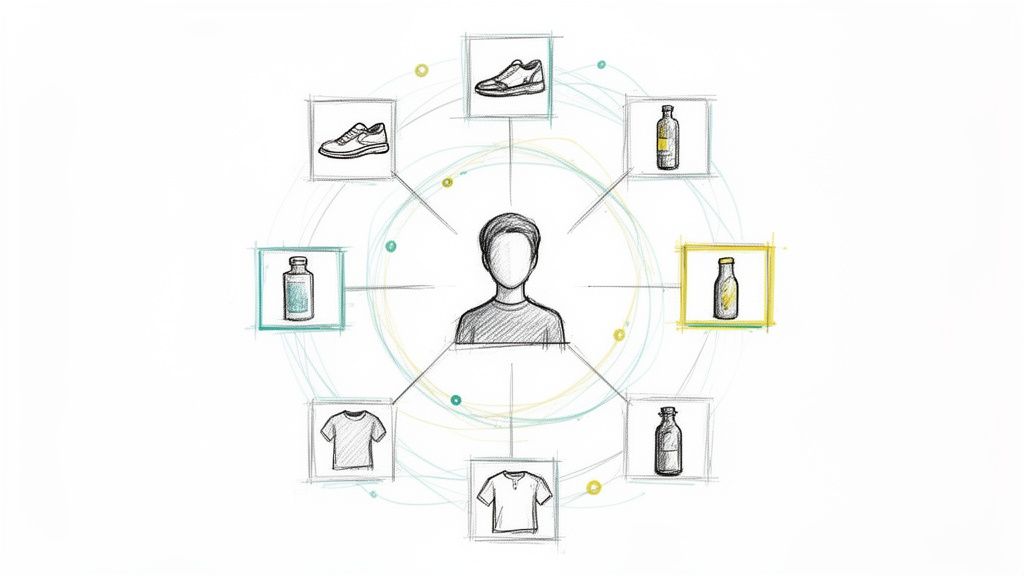
This strategy directly boosts average order value (AOV) and conversions by eliminating friction in the product discovery process. A costly mistake is using a generic app that shows irrelevant recommendations, which annoys customers and wastes valuable on-page real estate. Amazon’s "Frequently Bought Together" is a masterclass in this, turning data into delight. An AI assistant like Selzee can integrate these recommendations into natural conversations, acting as a personal shopper that knows a customer's taste, much like this AI fragrance concierge does for scents.
How to Implement This Strategy:
- Start with High-Impact Pages: Don't try to personalize everything at once. Begin by adding recommendation widgets to your product detail pages (for cross-sells) and cart page (for last-minute upsells). These are your highest-intent areas.
- Choose the Right Algorithm: Use apps that leverage collaborative filtering ("what similar users bought") or content-based filtering ("products with similar attributes"). Shopify apps can get you started without complex coding.
- Integrate and Monitor: Connect the engine to your product feed, ensuring it excludes out-of-stock items. Crucially, track your KPIs: monitor the click-through rate (CTR) on recommendations and the conversion rate of carts that include a recommended product. This data will tell you what's working.
4. Abandoned Cart Recovery Automation
Reclaim the 70% of potential sales that simply vanish. Abandoned cart recovery automation is one of the most impactful e-commerce growth strategies for instantly boosting your bottom line. It targets shoppers who add items to their cart but leave without buying by sending automated, personalized messages to entice them back. The biggest mistake is sending a single, generic reminder email and hoping for the best.
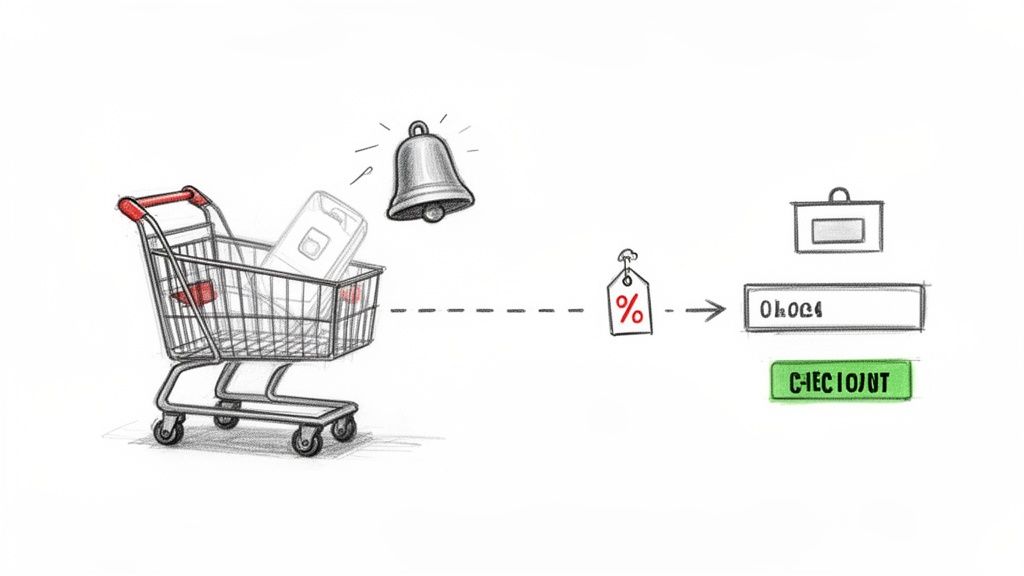
This strategy turns a major leak in your sales funnel into a powerful recovery opportunity. Instead of waiting for shoppers to leave, an AI-powered tool can proactively engage hesitant customers with real-time assistance or a perfectly timed offer before they abandon. For those who still leave, platforms like Klaviyo or Shopify's native features allow you to build sophisticated email and SMS flows that can recover 20-30% of these carts. The key is moving from a passive "we miss you" message to an active, helpful, and persuasive re-engagement campaign.
How to Implement This Strategy:
- Map Your Recovery Sequence: Plan a 3-5 touchpoint sequence over several days using both email and SMS. Send the first reminder within one hour of abandonment, a follow-up in 24 hours, and a final offer or urgency-driven message on day three.
- A/B Test Your Incentives: Determine what truly motivates your shoppers. Test a small discount (e.g., 10% off) against non-discount messaging like free shipping, a reminder of product benefits, or social proof.
- Leverage Proactive On-Site Tools: Integrate an on-site assistant to detect exit intent and cart inactivity. This allows you to offer help, answer last-minute questions, or present a special offer before the shopper even has a chance to leave your site.
5. Customer Lifetime Value (CLV) Optimization
Tired of the endless, expensive chase for new customers? Shifting your focus to Customer Lifetime Value (CLV) is one of the most profitable e-commerce growth strategies because it prioritizes getting more value from the customers you already have. This moves beyond single transactions to maximize the total revenue a customer generates over their entire relationship with your brand. The costliest mistake is focusing 100% on acquisition and ignoring retention.
This strategy is the backbone of sustainable direct-to-consumer (DTC) growth. Subscription services like Dollar Shave Club are built entirely on this model. By understanding what your best customers are worth, you can make smarter decisions about your marketing budget, acquisition costs, and retention efforts. An AI assistant can significantly boost CLV by offering personalized post-purchase support and upselling opportunities that keep customers engaged.
How to Implement This Strategy:
- Calculate and Segment Your CLV: Use your Shopify analytics to calculate the average CLV. More importantly, segment this data to identify your most valuable customer groups (e.g., top 20%). This insight becomes your north star for all marketing.
- Implement Post-Purchase Engagement: Don't let the conversation end at checkout. Use automated email and SMS sequences to offer order tracking, share user-generated content, and provide early access to new products. This builds a relationship, not just a transaction history.
- Create a Tiered Loyalty Program: Reward your high-CLV customers with exclusive perks. Implement a points-based or tiered program (e.g., Bronze, Silver, Gold) that offers better rewards as customers spend more over time.
6. Smart Inventory Management Integration
Stop losing sales because your website promises products you don’t have in stock. Smart inventory management is one of the most critical e-commerce growth strategies for ensuring operational excellence and customer trust. It uses real-time data and predictive analytics to optimize stock levels and prevent costly stockouts or overstock. A common mistake that costs money is manual inventory tracking, which inevitably leads to errors and lost sales.
This strategy directly protects your cash flow and enhances customer satisfaction. For stores with large catalogs, it’s the backbone of a reliable shopping experience. For example, when an AI shopping assistant integrates with your inventory system, it can confidently recommend products it knows are available, preventing the customer frustration of discovering an item is out-of-stock at checkout. To truly master growth, it's crucial to understand what Customer Lifetime Value (CLV) is and how reliable fulfillment impacts it.
How to Implement This Strategy:
- Integrate Your Systems: Connect your inventory management platform (like Shopify Inventory or a dedicated tool) with your key sales channels. Ensure your AI assistant has real-time API access to prevent it from suggesting unavailable items.
- Leverage Predictive Analytics: Use your historical sales data to forecast future demand. Analyze trends, seasonality, and the impact of past marketing campaigns to create a data-driven reordering schedule.
- Set Automated Alerts: Configure your system to notify you when stock for high-demand products hits a minimum threshold (safety stock level). Also, set alerts for slow-moving items that may require a promotion to clear out.
7. Omnichannel Customer Experience Strategy
Create a shopping journey so smooth that customers don't even think about which channel they're on. An omnichannel customer experience is one of the most powerful e-commerce growth strategies for building loyalty. This approach breaks down the walls between your website, mobile app, and social media, creating a single, unified experience where context and conversation follow the customer everywhere. A common mistake is simply being present on multiple channels (multi-channel) without integrating them.
This strategy moves beyond multi-channel to a truly integrated system. A customer might start a conversation with your AI assistant on your website and later get a reminder on Facebook Messenger to complete the purchase, with the assistant picking up the conversation right where it left off. Nike masters this by linking their app, website, and in-store experiences, so a shopper’s digital profile is recognized no matter how they engage.
How to Implement This Strategy:
- Map Customer Journeys: Identify the most common paths your customers take across different channels. Where do they start their research? Where do they purchase? Find the friction points where the experience breaks down.
- Unify Your Data: The core of omnichannel is a single customer view. Integrate your Shopify store, CRM, and marketing platforms to create unified customer profiles that track interactions across every touchpoint.
- Deploy Consistent Tech: Use a unified commerce platform like Shopify and an AI assistant that can operate seamlessly across your website and social media DMs. This ensures a consistent brand voice and that customer history is always available.
8. Performance Analytics and Conversion Optimization
Are you making decisions based on data or just gut feelings? Conversion rate optimization (CRO) is a foundational e-commerce growth strategy that replaces guesswork with a systematic, data-driven process for improving every step of your customer journey. The biggest mistake is testing random ideas without a clear hypothesis, which wastes time and resources.
This strategy turns raw data from platforms like Google Analytics and Shopify into actionable insights. By analyzing user behavior, heatmaps, and funnel drop-offs, you can pinpoint exactly where potential customers are getting stuck. Is your product page confusing? Is the checkout process too long? Analytics provides the clues, and CRO provides the framework to test solutions. Amazon is famous for its relentless testing culture, constantly optimizing everything from button colors to recommendation algorithms.
How to Implement This Strategy:
- Establish a Baseline: Before you test anything, know your numbers. Use Shopify's built-in analytics or Google Analytics 4 to track key metrics like conversion rate, AOV, and cart abandonment rate. You can't improve what you don't measure.
- Create a Testing Roadmap: Prioritize changes based on potential impact and ease of implementation. Focus on high-traffic pages like your homepage, product pages, and checkout first. Use tools like Shopify's own A/B testing apps to run tests on headlines and calls-to-action.
- Analyze and Iterate: Track the results of your experiments rigorously. When you find a winner, implement it. Document every learning, even from failed tests, to build a powerful knowledge base. To understand your key metrics better, use a conversion rate calculator to model potential impacts.
9. Content Marketing and SEO-Driven Traffic
Stop paying for every single click and start attracting a steady stream of qualified buyers. Content marketing and SEO are among the most sustainable e-commerce growth strategies for building long-term, organic traffic. Instead of temporary ad campaigns, you create valuable content like blog posts and buying guides that answer your customers' questions. This content then ranks in search engines, drawing in shoppers who are actively looking for solutions you provide.
This strategy turns your brand into a trusted authority. A common mistake is writing generic, unhelpful blog posts that don't target specific, high-intent keywords, resulting in traffic that doesn't convert. For example, a poorly optimized product description won't rank, but a detailed guide that links to that product will. To get this right, you can use a free product description tool to craft compelling, SEO-friendly copy. The goal is to own the conversation around your niche, making your store the go-to resource and the natural choice when it's time to buy.
How to Implement This Strategy:
- Target High-Intent Keywords: Focus on content that solves problems and guides purchase decisions. Create "best of" lists, product comparison articles, and "how-to" tutorials directly related to what you sell.
- Build Content Hubs: Organize your content around core product categories. If you sell supplements, create a comprehensive hub about "improving sleep" that links to relevant articles, guides, and your sleep-related products.
- Optimize Product Copy: Ensure every product description is unique and optimized for search. Don't just list features; explain benefits. To speed this up, try this tool to generate high-quality copy.
- Uncover Content Gaps: Use insights from customer service chats to identify common questions. If customers repeatedly ask the same questions, that's a perfect topic for a new blog post.
10. Email Marketing Automation and Segmentation
Still thinking of email as just a newsletter? It's time to upgrade. Email marketing automation is one of the most consistently high-ROI e-commerce growth strategies available. This strategy involves using triggered, personalized email sequences to nurture leads, recover sales, and build lasting customer relationships at scale. The biggest mistake is batch-and-blast sending, which leads to high unsubscribe rates and low engagement.
This isn't about blasting your entire list with the same generic offer. It's about strategic segmentation. Imagine sending a special offer for running shoes only to customers who previously bought athletic gear, or an automated reorder reminder to someone who bought a 30-day supply of supplements a month ago. Platforms like Klaviyo excel at this, using deep customer data to power these flows. This targeted approach dramatically boosts engagement and customer lifetime value.
How to Implement This Strategy:
- Segment Your Audience Intelligently: Go beyond basic demographics. Create segments based on purchase history (e.g., first-time vs. repeat buyers), browsing behavior (viewed specific categories), and engagement level (opened last 3 emails).
- Build Core Automation Flows: Start with the essentials: a multi-email welcome series to onboard new subscribers, an abandoned cart sequence to recover lost revenue, and a post-purchase follow-up to encourage reviews and repeat business.
- Personalize and Test: Use dynamic content to insert a customer's name or reference products they've viewed. Constantly A/B test subject lines, send times, and call-to-action buttons to optimize open rates, click-through rates, and, most importantly, conversions.
11. Strategic Paid Advertising and Retargeting
Looking to put your growth into hyperdrive? Strategic paid advertising on platforms like Google and Meta is one of the most direct e-commerce growth strategies for placing your products in front of qualified, ready-to-buy customers. A common mistake is running broad acquisition campaigns without a solid retargeting strategy, which wastes ad spend on visitors who don't convert on their first visit.
This dual approach is essential for scaling. You use platforms like Google Ads to capture high-intent search traffic and social media ads to generate demand. Then, you re-engage those who visited but didn't buy, reminding them of the exact items they viewed. D2C beauty brands master this by using Instagram ads for customer acquisition and then retargeting cart abandoners with a compelling offer. The key is a data-driven approach, constantly optimizing for a higher Return on Ad Spend (ROAS).
How to Implement This Strategy:
- Install Your Pixels: Before spending a single dollar, ensure your Meta Pixel and Google Ads conversion tracking are perfectly installed via your Shopify settings. This is non-negotiable for measuring results and enabling effective retargeting.
- Segment Your Retargeting Audiences: Don't treat all visitors the same. Create separate campaigns for high-intent groups like "viewed product," "added to cart," and "initiated checkout." Tailor your ad creative for each segment.
- Test and Optimize Systematically: Run A/B tests on ad creatives, headlines, audiences, and landing pages. Monitor your Cost Per Acquisition (CPA) and ROAS daily. Be ruthless about pausing underperforming campaigns and reallocating the budget to your winners.
12. Customer Feedback Loop and Voice of Customer Program
Are you making business decisions based on assumptions or on what your customers actually want? A Voice of Customer (VoC) program is one of the most sustainable e-commerce growth strategies because it closes the gap between what you think customers need and what they truly desire. The biggest mistake is collecting feedback (like reviews) but never actually analyzing it for trends or acting on it.
This isn't just about collecting reviews; it's about creating a continuous improvement engine. By actively listening, you can uncover hidden product opportunities, fix friction points in your checkout process, and build a brand that people feel connected to. An AI tool can turn every customer chat into a feedback source, analyzing conversation logs to reveal common questions. Zappos famously built its entire culture around insights gathered from customer service calls, proving that listening directly translates to loyalty and growth.
How to Implement This Strategy:
- Systemize Feedback Collection: Don't wait for feedback to come to you. Actively solicit it using post-purchase email surveys (NPS, CSAT), on-site polls, and by analyzing support tickets and AI chat logs for recurring themes.
- Analyze and Prioritize: Use tools to tag and categorize feedback. Look for high-impact, high-frequency issues. Is everyone asking for a specific product feature or complaining about shipping costs? That’s your priority.
- Close the Loop: This is the most crucial step. When you make a change based on feedback, communicate it back to your customers. Send an email saying, "You asked, we listened!" This shows customers their voice matters and encourages future engagement.
12-Point E-commerce Growth Strategy Comparison
| Strategy | Implementation Complexity 🔄 | Resource Requirements ⚡ | Expected Outcomes ⭐📊 | Ideal Use Cases 💡 | Key Advantages ⭐ |
|---|---|---|---|---|---|
| AI-Powered Conversational Commerce | Medium–High 🔄: integration + training needed | Moderate–High ⚡: AI models, CRM/inventory integration, monitoring | Increased conversion, higher AOV, 24/7 support ⭐📊 | E‑commerce needing real‑time sales/support and personalization 💡 | Real‑time personalized recommendations; capture high‑intent shoppers ⭐ |
| Dynamic Pricing Optimization | High 🔄: complex rules & market data | High ⚡: continuous data feeds, pricing engine, compliance checks | Revenue and margin uplift; improved inventory velocity ⭐📊 | Large catalogs, price‑sensitive categories (fashion, supplements) 💡 | Automated price optimization at scale; rapid market response ⭐ |
| Personalized Product Recommendations Engine | Medium 🔄: ML models and data pipelines | Moderate ⚡: customer/event data, compute for models | Significant AOV lift & conversion improvements ⭐📊 | Multi‑SKU retailers and DTC brands focusing on discovery 💡 | Relevant cross‑sells/upsells; reduces decision paralysis ⭐ |
| Abandoned Cart Recovery Automation | Low–Medium 🔄: trigger setup and sequences | Low ⚡: email/SMS tools, basic personalization | Fast, high ROI recovery of warm leads; immediate revenue 📊⭐ | Stores with high cart abandonment; quick wins for revenue 💡 | High ROI, easy to test and scale; recovers lost sales ⭐ |
| Customer Lifetime Value (CLV) Optimization | High 🔄: cross‑channel modeling & programs | High ⚡: historical data, analytics, loyalty programs | Long‑term profitability, improved marketing ROI ⭐📊 | Subscription and DTC brands focused on retention & margins 💡 | Shifts focus to profitable customers; guides acquisition spend ⭐ |
| Smart Inventory Management Integration | Medium–High 🔄: supplier & channel integrations | Moderate–High ⚡: real‑time inventory, forecasting models | Fewer stockouts/overstocks; better cash flow and fulfillment 📊⭐ | Dropshipping / multi‑SKU retailers with supply complexity 💡 | Reduces carrying costs; improves fulfillment reliability ⭐ |
| Omnichannel Customer Experience Strategy | High 🔄: unify systems and workflows | High ⚡: CDP, channel integrations, organizational alignment | Higher loyalty and cross‑channel conversion; cohesive CX ⭐📊 | Brands with physical + digital presence or many touchpoints 💡 | Seamless experiences across channels; stronger retention ⭐ |
| Performance Analytics & Conversion Optimization | Medium 🔄: analytics setup and testing processes | Moderate ⚡: tracking, experimentation tools, analytics team | Actionable wins, improved conversion and ROI ⭐📊 | Teams wanting data‑driven growth and CRO programs 💡 | Identifies quick wins; reduces guesswork; measurable impact ⭐ |
| Content Marketing & SEO‑Driven Traffic | Medium–High 🔄: content strategy and technical SEO | Moderate ⚡: content creators, SEO tools, time investment | Sustainable organic traffic and brand authority over time 📊⭐ | Brands with content opportunities (beauty, health, guides) 💡 | Cost‑effective long-term traffic; builds trust and assets ⭐ |
| Email Marketing Automation & Segmentation | Low–Medium 🔄: workflow design and segmentation | Low–Moderate ⚡: ESP, CRM, content resources | High ROI, improved retention and repeat purchases ⭐📊 | All ecommerce stores wanting scalable owned channel 💡 | Highly personalized, low‑cost channel with strong ROI ⭐ |
| Strategic Paid Advertising & Retargeting | Medium 🔄: campaign setup and ongoing optimization | Moderate–High ⚡: ad spend, creative, analytics | Immediate traffic and sales; scalable growth if profitable ⭐📊 | Brands needing fast acquisition or scaling demand 💡 | Fast acquisition and precise targeting; measurable ROAS ⭐ |
| Customer Feedback Loop & Voice of Customer Program | Low–Medium 🔄: feedback channels and closed‑loop processes | Low–Moderate ⚡: survey tools, analysis, cross‑team workflows | Product/experience improvements; reduced churn over time 📊⭐ | Brands improving product-market fit and CX continuously 💡 | Direct customer insights for prioritized improvements ⭐ |
From Strategy to Execution: Your Next Move
We’ve covered 12 powerful e-commerce growth strategies, from AI-powered conversational commerce to the foundational necessity of a customer feedback loop. The volume of opportunities can feel overwhelming, but that’s the point. Your store isn’t limited by a lack of options; it’s empowered by a rich playbook of proven tactics waiting for execution. Growth is an active process fueled by data, personalization, and relentless optimization.
The common thread is a deep, unwavering focus on the customer experience. Modern shoppers don't just buy products; they invest in brands that understand their needs, respect their time, and deliver value at every touchpoint. This is where your competitive advantage lies.
Recapping Your Growth Levers
Growth isn't about finding one secret hack. It's about building a multi-pronged system.
- Automation is Your Scalability Engine: Strategies like AI-driven cart recovery, segmented email flows, and smart inventory management aren't just about saving time. They create an operational backbone that can handle 10x your current order volume.
- Personalization is the New Conversion Standard: Generic storefronts are a relic. Personalized product recommendations, dynamic pricing, and targeted content transform a passive browsing session into an active, engaging shopping experience, directly boosting AOV and conversion rates.
- Data is Your North Star: From performance analytics that reveal conversion bottlenecks to insights from your Voice of Customer program, data is the only reliable guide. Every decision and every test must be rooted in what your analytics and your customers are telling you.
Your Actionable Blueprint for Growth
Reading is one thing; doing is another. The difference between a thriving store and a stagnant one is the speed of implementation. Don't let analysis paralysis stall your momentum. Here is your immediate go-forward plan:
- Conduct a Growth Audit: Review the 12 strategies. Where is the biggest leak in your revenue bucket right now? A high cart abandonment rate (Strategy #4)? A low customer lifetime value (Strategy #5)? Or inefficient customer support eating into your margins (Strategy #1)? Identify your single biggest bottleneck.
- Choose Your "First Sprint" Strategy: You cannot boil the ocean. Select ONE strategy to focus on for the next 30-60 days. If cart abandonment is your issue, your entire focus should be on implementing a multi-channel recovery sequence.
- Define Success with Clear KPIs: What does winning look like? Be specific. "Increase AOV by 15% within 45 days." "Reduce cart abandonment rate from 70% to 55% this quarter." Concrete goals are the only way to measure impact.
- Execute, Measure, Iterate, Repeat: Launch your chosen initiative. Track your KPIs obsessively. Gather the data, learn from the results, and refine your approach. Once you've moved the needle, return to your audit and pick your next target. This iterative cycle is the essence of sustainable e-commerce growth.
The strategies outlined in this guide are the active, in-the-trenches tactics that top-tier Shopify brands use daily to outmaneuver their competition. Your journey to scaling your business to the next level begins with the very next action you take. Choose your focus, commit to execution, and let the data guide you to explosive growth.
Ready to put these strategies into action with powerful, AI-driven tools? Selzee provides a suite of solutions designed for ambitious merchants, including free generators to perfect your product copy and SEO. Whether you need to craft compelling descriptions or optimize your product name for better discovery, our tools are built to help you execute faster and more effectively.