Ready to upgrade your Shopify store? Let's talk about Conversational AI, a game-changer for any ecommerce business with active traffic.
Forget clunky, old-school chatbots. Modern conversational AI is your most effective sales associate—available 24/7, with perfect knowledge of your product catalog and every customer's preferences. Best of all? This employee never has a bad day and is always ready to close a sale.
What Is Conversational AI in Ecommerce?
Let's cut to the chase. You’ve seen basic chatbots that react to keywords. A customer types "shipping," and the bot dumps a link to your FAQ page. That’s a glorified search bar, not a sales tool.
Conversational AI for ecommerce is in a different league. Powered by Natural Language Processing (NLP), it doesn't just recognize words—it understands what your customers mean. It gets the context, nuance, and intent behind their questions.
This is where the magic happens for your store.
- An old chatbot hears "blue shirt" and shows every blue shirt it can find.
- Conversational AI hears "I need a durable, light blue shirt for a beach wedding," recommends a specific linen blend, asks about sizing, and suggests matching shorts to complete the look.
The real difference: A traditional chatbot is a reactive FAQ machine. Conversational AI is a proactive sales and support engine that understands shoppers, guides their journey, and actively drives revenue for your store.
How It Works for Your Shopify Store
So, how does this actually help you? A true conversational AI plugs directly into your store’s backend—your product catalog, inventory levels, and customer purchase history. This gives it the power to do much more than just talk. It becomes a fully integrated part of the shopping experience.
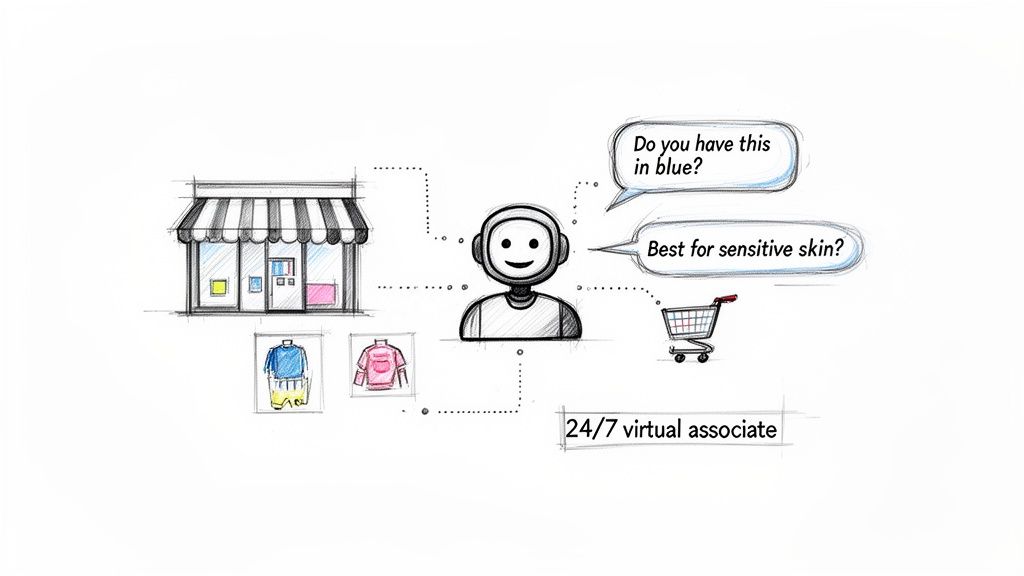
This isn't a futuristic fantasy; it's the new standard. The global conversational AI market is projected to hit $32.6 billion by 2035, with ecommerce claiming the biggest piece of the pie at 21.2%.
Why the massive growth? The results speak for themselves. AI-guided interactions help customers complete their purchases 47% faster. This efficiency is a huge reason why chatbots are expected to drive a mind-blowing $142 billion in global retail sales in 2024 alone. You can discover more insights about AI's impact on retail to see why merchants are jumping on board.
By understanding what a customer is really looking for, the AI personalizes the entire conversation. It remembers what they’ve looked at before and uses that insight to make smart, genuinely helpful suggestions. It feels less like an algorithm and more like a dedicated personal shopper, turning your customer support from a cost center into a powerful sales-boosting machine.
Traditional Chatbot vs Conversational AI
Still not sure about the difference? This quick table breaks it down, showing why conversational AI is a massive leap forward for any online store.
| Feature | Traditional Chatbot | Conversational AI |
|---|---|---|
| Understanding | Keyword-based, follows rigid scripts. | Understands intent, context, and slang (NLP). |
| Interaction | Reactive, answers specific questions only. | Proactive, guides conversation, and anticipates needs. |
| Personalization | Generic, one-size-fits-all responses. | Hyper-personalized based on user data and behavior. |
| Capabilities | Basic FAQs, simple order tracking. | Complex problem-solving, product recommendations, upselling. |
| Business Impact | Deflects simple tickets. | Drives revenue, increases AOV, and boosts conversions. |
Simply put, while a traditional chatbot answers questions, a conversational AI like Selzee builds relationships, creates amazing customer experiences, and actively helps you sell more. It's a fundamental shift in how you can engage with every single person who visits your site.
How Conversational AI Directly Impacts Your Store’s KPIs
Let's talk about the real reason you're here: making more money. How does this AI tech translate into dollars and cents in your Shopify dashboard? It’s time to move past the cool features and get right into the nuts and bolts of your bottom line.
Let's break down the exact eCommerce Key Performance Indicators (KPIs) this technology is built to move.
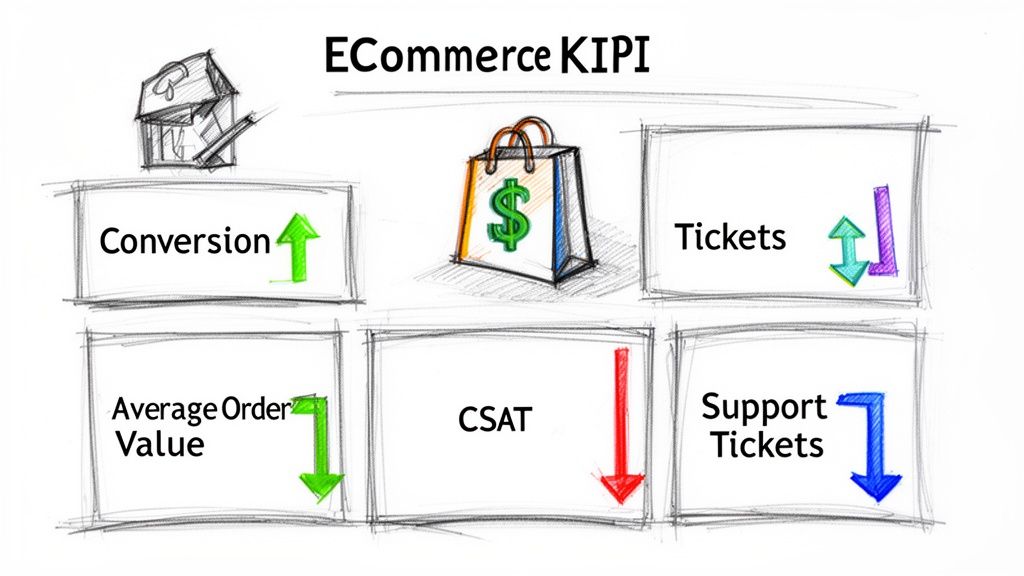
There’s a reason the market projections for AI in eCommerce are absolutely huge. Experts forecast that by 2029, these platforms will be driving a staggering $144 billion in sales. That's not a drop in the bucket; it's set to become 8.8% of all global retail eCommerce. This isn't some far-off prediction—it's happening now because of the immediate, measurable wins you can see in your store's core metrics. If you want to dive deep, you can read the full research about AI's ecommerce forecast and see why this is becoming the new standard.
Supercharge Your Conversion Rate
Every abandoned cart is a sale you almost had. An intelligent AI doesn't just sit back and watch a customer leave. It jumps in at the perfect moment.
Imagine a shopper hovering on a product page for more than 30 seconds, clearly on the fence. Instead of silence, the AI can pop up with a genuinely helpful, "Hey, any questions about the material?" or offer a small, perfectly timed discount to nudge them over the edge.
It’s not just about saving sales, either. It's about making them happen in the first place. When a shopper asks, "Which of these is best for hiking?" and gets an instant, expert answer, that moment of indecision that kills so many sales vanishes. The data backs this up—stores using AI chat see an incredible 4x lift in conversion rates. We're talking about jumping from an average of 3.1% to 12.3% for shoppers who actually chat with the AI. You're turning a passive window-shopping session into an active, guided buying conversation.
Key Takeaway: Conversational AI is your secret weapon for converting hesitant shoppers. By giving them instant answers and proactive support right when they need it most, you eliminate friction, build trust, and directly increase the number of visitors who click "buy."
Boost Your Average Order Value (AOV)
One of the quickest paths to more revenue is getting each customer to spend just a little bit more per order. A great conversational AI is like having the world's best personal shopper on your site—one who uses real-time data to make smart upselling and cross-selling suggestions that feel helpful, not sleazy.
Here’s what that looks like in the real world:
- Intelligent Upselling: A customer adds a standard coffee grinder to their cart. The AI chimes in: "Great choice! For just $15 more, the pro version has a burr grinder for a much more consistent brew. Want to take a look?"
- Smart Cross-selling: A shopper buys a new camera. Bam! The AI follows up instantly: "Perfect! Customers who bought this camera also loved this high-speed memory card and this protective case. Should I add them for you?"
- Strategic Bundling: It can even create custom bundles on the fly. If a customer is looking at three different skincare products, the AI might offer a "Complete Morning Routine" bundle at a sweet little discount, bumping up the total cart value.
These aren't just random guesses. The AI is constantly analyzing the customer's cart, their browsing history, and what other shoppers like them have bought to serve up recommendations that are almost guaranteed to hit the mark.
Elevate Customer Satisfaction and Loyalty
Happy customers don't just buy once; they come back again and again. Offering instant, 24/7 support is a massive driver for positive Customer Satisfaction (CSAT) scores.
When a customer can find out their order status at 2 AM or process a return without waiting for an email reply, you’ve created an experience that feels effortless. That's how you build a loyal following.
This has a direct, positive impact on your support team, too. A well-trained AI can resolve over 90% of common customer questions without any human help at all. This frees up your amazing support agents to focus on the complex, high-value issues, turning your support team from a cost center into a relationship-building powerhouse. The result? A stellar brand reputation, glowing reviews, and a loyal customer base that becomes your most valuable asset.
You might be interested in: Use This Calculator to Model Your Conversion Rate Improvements
The AI Features That Actually Put Sales on Autopilot
Let's dig into the specific AI-powered features that drive sales for you around the clock. This is about plugging a dedicated sales engine into your Shopify, Shoptet, or Upgates store that never stops working to turn browsers into buyers.
These are the core capabilities that separate a simple chatbot from a true partner in growing your revenue. We're moving way beyond those generic "customers also bought" widgets to create a shopping experience that feels genuinely intelligent and helpful.
Act Like a Personal Shopper with Smart Recommendations
Your standard Shopify theme probably has some basic product recommendations, but they often miss the mark. They're usually just based on what's popular, not on what the person looking at the screen right now actually needs. This is where conversational AI completely flips the script.
Instead of a passive, generic widget, the AI becomes an on-demand personal shopper. It pays attention to what a customer is doing in real-time—what they're clicking, what's in their cart, and the specific questions they're asking—to serve up suggestions that are ridiculously relevant.
- Someone asks, "Which of these face creams is best for dry, sensitive skin?" The AI doesn't just spit back a list of products with "sensitive skin" in the title. It can recommend the one with hyaluronic acid and chamomile, explain why it's the perfect match, and then even suggest a gentle cleanser to go with it.
- A customer is checking out hiking boots. The AI can jump in and ask, "Planning a specific trip? I can help you find boots with the right ankle support and waterproofing for your adventure."
See the difference? This shifts the whole interaction from a basic search to a guided consultation. By understanding the customer's intent, the AI delivers personalized advice that builds trust and makes the sale feel natural, not forced. It’s the difference between a shopper feeling totally overwhelmed by choice and feeling genuinely confident in their purchase.
Close More Sales by Proactively Engaging Shoppers
One of the biggest mistakes you can make is just sitting back and waiting for a hesitant shopper to give up and leave. An unbelievable 70% of online shopping carts are abandoned, often because of a last-minute question or a flicker of doubt. Conversational AI doesn't just wait around; it proactively steps in to save the sale.
This is all about perfect timing. The AI can be set up to spring into action based on specific behaviors that scream "I'm not sure about this!"
By spotting a shopper who is lingering on a product page or stuck at checkout, the AI can intervene at the most critical moment. This is your automated defense against lost revenue, turning hesitation into a done deal.
For example, if someone has been idle on the checkout page for 60 seconds, the AI can pop up with a friendly message like: "Having trouble? I can help with shipping questions or apply any discount codes you have." That simple, timely nudge can be the one thing that gets the purchase over the finish line. In fact, we've seen proactive AI chats recover as many as 35% of abandoned carts.
Unlock Global Markets with Effortless Multilingual Support
Selling internationally is a massive opportunity, but it also opens up a huge can of worms. Juggling different languages, product catalogs, and currencies for various markets can become a logistical nightmare for your team. A smart conversational AI handles all of this without breaking a sweat.
Modern AI doesn't just translate words; it truly localizes the experience. This means it can:
- Access Market-Specific Catalogs: Show products and pricing that are actually relevant to the customer's region.
- Understand Local Nuances: Chat naturally in dozens of languages, getting slang and cultural context right.
- Handle Regional Policies: Give accurate info on shipping times and return policies for that specific country.
Picture a customer from Germany landing on your store. The AI can instantly greet them in German, showcase products priced in Euros from your European warehouse, and answer questions about EU-specific shipping rules. This lets you offer a world-class, localized experience 24/7 without needing a massive global support team.
Of course, your AI’s product knowledge is only as good as the data you feed it. To ensure both your customers and the AI are on the same page, your product listings need to be crystal clear. You can always use a free bullet points tool to quickly sharpen your descriptions and make your listings pop.
Getting Conversational AI Up and Running on Your Store
Let's be honest, the thought of adding a sophisticated AI to your store probably brings up images of tangled code and endless developer calls. Good news: that's not how it works anymore.
For anyone on Shopify, Shoptet, or Upgates, getting started with a platform like Selzee is as easy as installing a new app. We’re talking about adding a single line of code—a quick copy-and-paste job that takes maybe 5 minutes. That one snippet unlocks a real-time, two-way conversation between the AI and your store's brain.
The moment it's connected, the AI instantly syncs with your product catalog, live inventory, and customer data. This isn’t a dumb chatbot; it’s a fully informed assistant, ready to give smart, accurate answers and recommendations right out of the gate.
A Smart Rollout Plan for Instant Wins
You don't have to boil the ocean on day one. In fact, you shouldn't. The best way to get started is with a phased approach that delivers clear, measurable results at each stage. This way, your team gets comfortable, and you see a real return on your investment from the get-go.
Here’s a simple, proven 3-step plan:
Phase 1: Automate the Obvious. Start with the low-hanging fruit. Set the AI to handle all those repetitive questions that clog up your inbox: "Where's my order?", "What's your return policy?", "Do you ship internationally?". This immediately frees up your support team's time and gives you an instant, satisfying win.
Phase 2: Recapture Lost Carts. Next up, let's make some money. Turn on the AI’s cart recovery skills. It will spot shoppers who are about to leave and gently nudge them with a helpful question or a perfectly timed discount. This is a direct line to bumping up your conversion rate and saving sales you were about to lose.
Phase 3: Unleash Your Proactive Sales Rep. Once you’ve nailed the basics, it's time to let the AI truly shine. Flip the switch on proactive selling. Think intelligent product recommendations, fun shopping quizzes that guide customers to the perfect item, and smart upsells based on what someone is looking at right now. This is where you’ll see your Average Order Value (AOV) really start to climb.
This step-by-step method means you’re never overwhelmed. You build confidence, gather data, and fine-tune your approach as you go, guaranteeing a smooth and profitable experience.
Why You Absolutely Need an Ecommerce-Specific AI
I can't stress this enough, because getting it wrong can cost you thousands. A generic, one-size-fits-all chatbot is completely useless for a serious online store. They simply don't have the "ecommerce DNA" required to handle the real world of online shopping.
Think about it: a generic AI will short-circuit when a customer asks, "Do you have this t-shirt in a medium, but in the blue colorway?" It has no concept of product variants, live stock levels, or what that specific customer has bought before. It’s just a glorified FAQ page.
An AI built specifically for ecommerce is a different beast entirely. It’s designed from the ground up for these exact situations.
- It instinctively understands product variants like size, color, and material, and can check your inventory in a split second.
- It taps into customer history to offer genuinely personal recommendations based on their past behavior.
- It knows your shipping policies inside and out, providing accurate delivery estimates for each customer.
Choosing an AI that speaks the language of retail is the most critical decision you'll make. It’s the difference between a clunky, robotic dead-end and a smooth, intelligent conversation that actually helps people buy. The best way to see this in action is to schedule a demo with our team and experience it for yourself.
The Biggest Pitfalls to Sidestep When Implementing Conversational AI
Jumping into conversational AI for ecommerce feels like an instant upgrade, but a few common missteps can quickly turn a powerful tool into a costly, frustrating headache. The great news? These traps are completely avoidable. By sidestepping them, you ensure your AI doesn't just work—it becomes a top-performing member of your sales team.
Mistake #1: Picking a Generic, One-Size-Fits-All Chatbot
The single biggest error we see is businesses choosing a generic AI. These tools might be fine for booking a dentist appointment or answering simple FAQs, but they are totally lost in the fast-paced world of ecommerce. They simply can't tell the difference between a size 'Medium' and a color 'Navy Blue', let alone check your live stock for that specific combo. This is a fast track to customer frustration and abandoned carts.
A generic AI is like hiring a receptionist to do a senior salesperson's job—they know how to talk, but they have absolutely no idea how to sell your products. They lack the built-in logic to grasp critical ecommerce concepts:
- Product Variants: They get hopelessly confused by requests for specific sizes, colors, or materials, often spitting out incorrect or "I don't know" answers.
- Inventory Levels: They can't see your live stock, which means they'll happily recommend out-of-stock products. That's a terrible customer experience.
- Customer History: They treat every shopper like a stranger, missing golden opportunities to use past purchases to make smart, personal recommendations.
Choosing a generic chatbot is a classic case of being penny-wise and pound-foolish. Those initial savings evaporate fast thanks to lost sales, annoyed customers, and the inevitable cost of switching to a platform actually built for ecommerce.
Mistake #2: Launching Without a Game Plan (And a Scorecard!)
Another massive mistake is launching your AI without defining what success even looks like. If you don't set clear Key Performance Indicators (KPIs) from day one, how will you ever know if your investment is paying off? You wouldn't run a PPC campaign without tracking conversions, right? Don't deploy an AI without a scorecard.
Before you go live, figure out what you want to achieve. Are you laser-focused on boosting your conversion rate? Do you want to increase your Average Order Value (AOV)? Or maybe the goal is to slash the number of support tickets? Whatever it is, track those metrics like a hawk from the very start.
This three-step approach shows a typical rollout focused on delivering clear ROI at each stage.
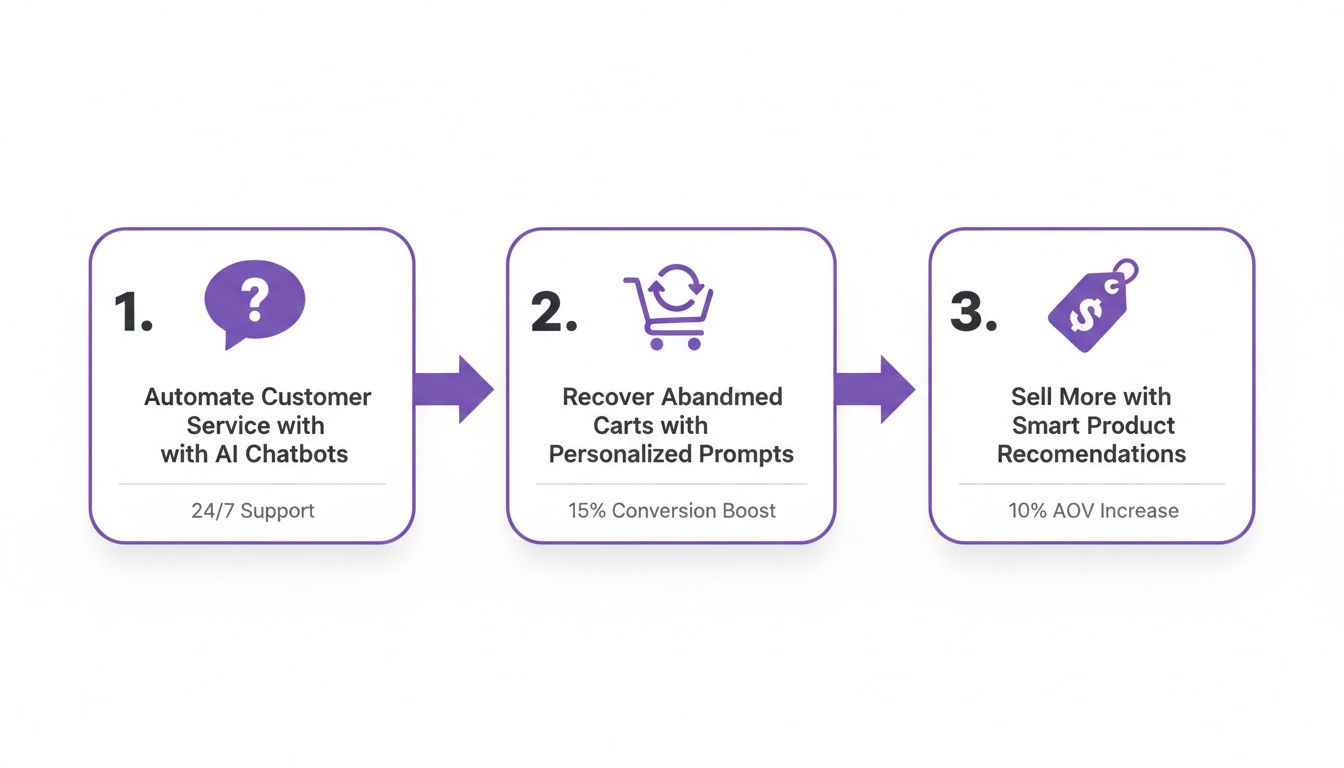
This simple framework—Automate, Recover, Sell—gives you a clear roadmap for measuring success and making sure you see real, tangible returns.
Mistake #3: Forgetting That "Garbage In, Garbage Out" Applies to AI, Too
Your AI might be brilliant, but it’s not a mind reader. Its ability to recommend the perfect product is 100% dependent on the quality of the data in your Shopify, Shoptet, or Upgates catalog. If your product titles are a mess, your descriptions are vague, and your attributes are all over the place, the AI is going to make some truly awful, irrelevant suggestions.
It's the oldest rule in the book: garbage in, garbage out. A poorly named product like "Blue Top 2024" gives the AI nothing to work with. Is it cotton? V-neck? For men or women? The AI can’t make a smart recommendation if it doesn’t have the right information to begin with. A better title, created with a product name optimizer, might be "Men's V-Neck Pima Cotton T-Shirt - Navy Blue." Suddenly, the AI has everything it needs.
Before you even think about implementing an AI, you've got to clean up your product catalog. Writing clear copy is crucial, and a free product description tool can help you quickly generate compelling text that gives the AI the details it needs to sell effectively.
Real-World Examples: How Shopify Stores Win with AI
Let's stop talking theory and get down to brass tacks. What does this actually look like when you flip the switch on a real Shopify store? We've seen it firsthand, and the results are pretty amazing.
We’re talking about real brands who were dealing with the same headaches you probably are—customer service queues that never end, sales numbers that just won't budge, and that sinking feeling of missed opportunities. Let's look at what happened when they put smart AI to work.
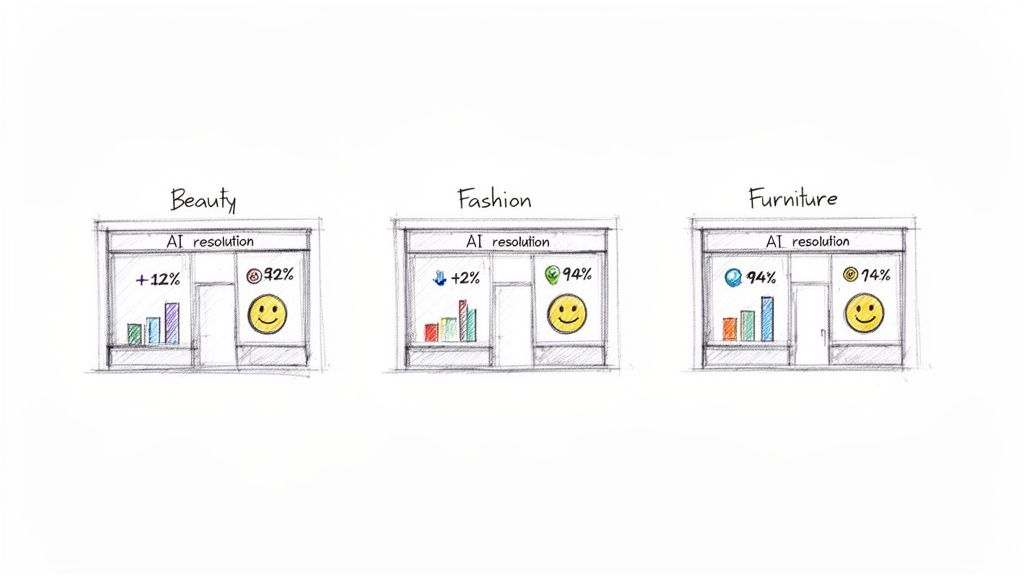
Case Study 1: The Beauty Brand Buried in Questions
Picture this: a fantastic skincare brand is taking off, but their small team is drowning. Every day, it's the same questions over and over—"Is this good for oily skin?", "What are the ingredients?", "Where's my order?"—and every delayed answer is a potential lost sale.
- The Problem: An avalanche of repetitive support questions was bogging down the team and creating a frustrating experience for shoppers.
- The AI Fix: They brought in a conversational AI, trained it on all their product details and FAQs, and set it loose. It immediately became the frontline, handling a staggering 94% of all incoming questions on its own.
- The Payoff: The human support queue instantly shrank by over 90%, freeing up the team to focus on customers who needed genuine, in-depth advice. Better yet, by giving people instant answers anytime, day or night, the store’s conversion rate jumped by 14%.
Case Study 2: The Fashion Store That Couldn't Close the Deal
Here's another classic scenario. A cool online fashion boutique was getting tons of visitors, but people just weren't clicking "buy." They'd look, they'd linger, and then they'd leave. It was clear that uncertainty about sizing, fit, or fabric was stopping them cold.
- The Problem: High cart abandonment and a ton of hesitation on product pages were killing their conversion rate.
- The AI Fix: They set up a proactive AI to gently step in when it sensed a shopper was stuck. It would pop up and offer to help with sizing charts, show off photos from other customers, and answer any questions about the fit right then and there.
- The Payoff: This simple change helped them recover 35% of their abandoned carts. The numbers were incredible—shoppers who chatted with the AI were 4x more likely to buy than those who didn't. That’s a massive win.
This isn't a fluke. We consistently see that when you remove those little points of friction and give people instant help, they complete their purchase 47% faster. You're basically clearing the path from "ooh, I like that" to "it's on its way!"
Case Study 3: The Furniture Retailer Stuck on Singles
A modern furniture brand was doing well selling big-ticket items like sofas, but they couldn't get customers to add anything else to their carts. The Average Order Value (AOV) was completely flat, and they knew they were leaving money on the table.
- The Problem: A stagnant AOV because customers weren't buying complementary items. Major missed upsell and cross-sell potential.
- The AI Fix: They turned their AI into a personal shopper. When someone added a sofa to their cart, the AI would chime in with smart suggestions, like, "Customers love pairing this with our merino wool throw," or show off a rug from the same collection.
- The Payoff: This subtle, helpful approach felt more like interior design advice than a hard sell, and customers loved it. The result? A 21% increase in AOV.
These are just a few examples of what’s possible. If you want to see more proof of how this works, you can dig into our other in-depth case studies.
Got Questions About Conversational AI? We've Got Answers.
Let's be real—jumping into any new technology can feel like a leap of faith. You're probably wondering if an AI bot will sound like a robot from a bad sci-fi movie or if you'll need a developer on speed dial just to get it running.
We hear you. Here are the straight-up, no-nonsense answers to the most common questions we get from merchants on Shopify, Shoptet, and Upgates.
Will an AI Bot Sound Robotic and Hurt My Brand Image?
This is probably the number one fear, and it comes from a very real place: clunky, old-school chatbots. But today's conversational AI for ecommerce is a whole different ballgame. Forget rigid scripts; think natural, flowing conversations that actually help your customers.
The best tools are built to absorb your unique brand voice, so the AI sounds like you. More importantly, they’re designed for smart collaboration. When a question gets too tricky, the AI seamlessly hands it off to a human expert. The point isn't to replace your team—it's to handle the repetitive stuff so your people can shine on the complex, high-value conversations that build loyalty.
How Much Technical Skill Is Needed to Set It Up?
If you can install a marketing pixel, you can install a modern conversational AI. Seriously.
Platforms built from the ground up for ecommerce, like Selzee, are made for merchants, not coders. The setup is usually a simple one-line code snippet you pop into your theme. From there, you get an intuitive dashboard where you can see exactly what’s happening and fine-tune your strategy without ever touching a line of code. All the tricky data syncing with your product catalog happens automatically behind the scenes.
How Is Pricing Structured for a Shopify Store?
The pricing models have gotten much smarter. Gone are the days of being locked into a huge, flat monthly fee whether you have a slow week or a massive holiday rush. The best platforms now run on a usage-based model.
Put simply, you pay for what you actually use. This makes it incredibly cost-effective because the price scales with the value you're getting.
Think about the ROI. If an AI assistant boosts your conversion rate and handles 90% of your common support tickets, it pays for itself almost immediately. Our advice? Steer clear of any platform that wants to lock you into a long-term contract before you’ve seen the proof in your own store.
Ready to see how Selzee can turn your customer chats into your biggest revenue driver? Learn more about our AI shopping assistant and see the results for yourself.