
Let's cut the jargon. You're a busy Shopify merchant, and you need to know one thing: how does this make you more money?
Omnichannel customer service creates a single, continuous conversation with your customer, no matter where they are. They can start on your Shopify store’s live chat, slide into your Instagram DMs, and later reply to an email—and your support team sees the entire story in one place. It’s the fix for the customer pet peeve that costs you sales: having to repeat themselves over and over.
What Omnichannel Service Really Means for Your Shopify Store
Imagine every customer interaction as one continuous story. In an omnichannel setup, every message—from Facebook, email, or chat—is just the next chapter in that same book. It’s not about being present on multiple channels; it’s about weaving them together so they share information and context instantly.
This creates a single, powerful view of every customer. The result? You deliver support that’s smarter, faster, and far more personal. That continuous thread is what separates a world-class experience from a frustrating one that sends shoppers to your competitors.
The Core of the Omnichannel Approach
At its heart, omnichannel service is built on three ideas that directly impact your store's performance:
- Integration Over Isolation: Your channels aren't lonely islands. Your website chat, social media DMs, and email support all talk to each other, feeding into one central hub.
- Customer-Centricity: The entire system is designed around your customer's journey, not your team's convenience. They can hop from their laptop to their phone, from your app to an email, and the conversation never misses a beat.
- Contextual Continuity: This is the magic. An agent (or an AI assistant) immediately knows a customer's entire history—what they bought, what they asked before, and even what pages they were just looking at on your site.
This isn't a "nice-to-have." It’s a serious retention strategy. Companies with strong omnichannel strategies see 89% customer retention rates, crushing the 33% seen by businesses with weak, disconnected approaches. For a deeper dive into how this connects to your entire business, check out this guide on what is omnichannel commerce. That continuity has a direct line to your bottom line, boosting customer lifetime value in ways you can't ignore.
To make this crystal clear, here are the essential features that define a real omnichannel strategy for your store.
Core Elements of a True Omnichannel Experience
| Characteristic | What It Means for Your Shopify Store |
|---|---|
| Unified Customer Profile | One central record for each customer, combining their purchase history, past support tickets, and contact info across all channels. |
| Seamless Channel Switching | A customer can start a chat on your site and finish the conversation via email without losing any context or having to start over. |
| Real-Time Data Sync | When a customer updates their info or makes a purchase, that data is instantly available to agents on every single channel. |
| Consistent Brand Experience | The tone, branding, and quality of support feel the same whether a customer is on your app, social media, or getting an SMS update. |
Ultimately, a true omnichannel experience ensures that no matter where your customers are, they feel like they are interacting with one cohesive, intelligent brand.
An omnichannel customer doesn't just see different channels; they see one brand. Your goal is to ensure that the brand experience is consistent, intelligent, and helpful everywhere they interact with you.
This cohesive approach is how you transform customer support from a cost center into a powerful revenue engine. When you know the full story behind every interaction, you can solve problems faster, build real loyalty, and spot opportunities to create "wow" moments that keep people coming back for more.
Omnichannel vs Multichannel: The Critical Difference Costing You Sales
Many Shopify merchants hear “omnichannel” and think, “I’m on Instagram and I have email support, I’m all set.” This is a massively costly mistake. You’re likely running a multichannel setup, and the gap between that and a true omnichannel strategy is costing you sales every day.
Multichannel just means you’re available on multiple, separate channels. A customer sends a DM on Instagram, then follows up with an email, and your support team is left playing detective, trying to piece the puzzle together. Each channel is its own island. This forces your customers to repeat their story and your team to waste time digging for context.
Omnichannel, on the other hand, is one integrated ecosystem. Every channel talks to every other channel. It’s a single, continuous conversation where data flows freely, creating one seamless customer journey. This isn’t a small upgrade; it's a completely different way of operating your customer relationships.
The Real-World Cost of Siloed Channels
Let's walk through a common scenario. A customer uses your site's live chat to ask if a jacket will be restocked in size medium. Your agent says they'll check and follow up via email. Two days later, an email lands in their inbox saying "yes," but it's too late. They already bought a similar jacket from your competitor who answered their question instantly on social media.
You didn't just lose a sale; you lost that customer's trust. The friction of waiting and switching channels created the perfect opening for another brand to win them over. This happens constantly in siloed support systems.
Now, let's replay that in an omnichannel world. That initial chat query would have instantly updated the customer's profile. That same night, they could see a targeted Instagram ad: "Good news! The jacket you asked about is back in stock in your size." One click, and they're checking out. That’s the power of connected data.
This image drives the point home. It shows how a true omnichannel setup puts the customer in the middle, with all channels feeding into one intelligent hub.
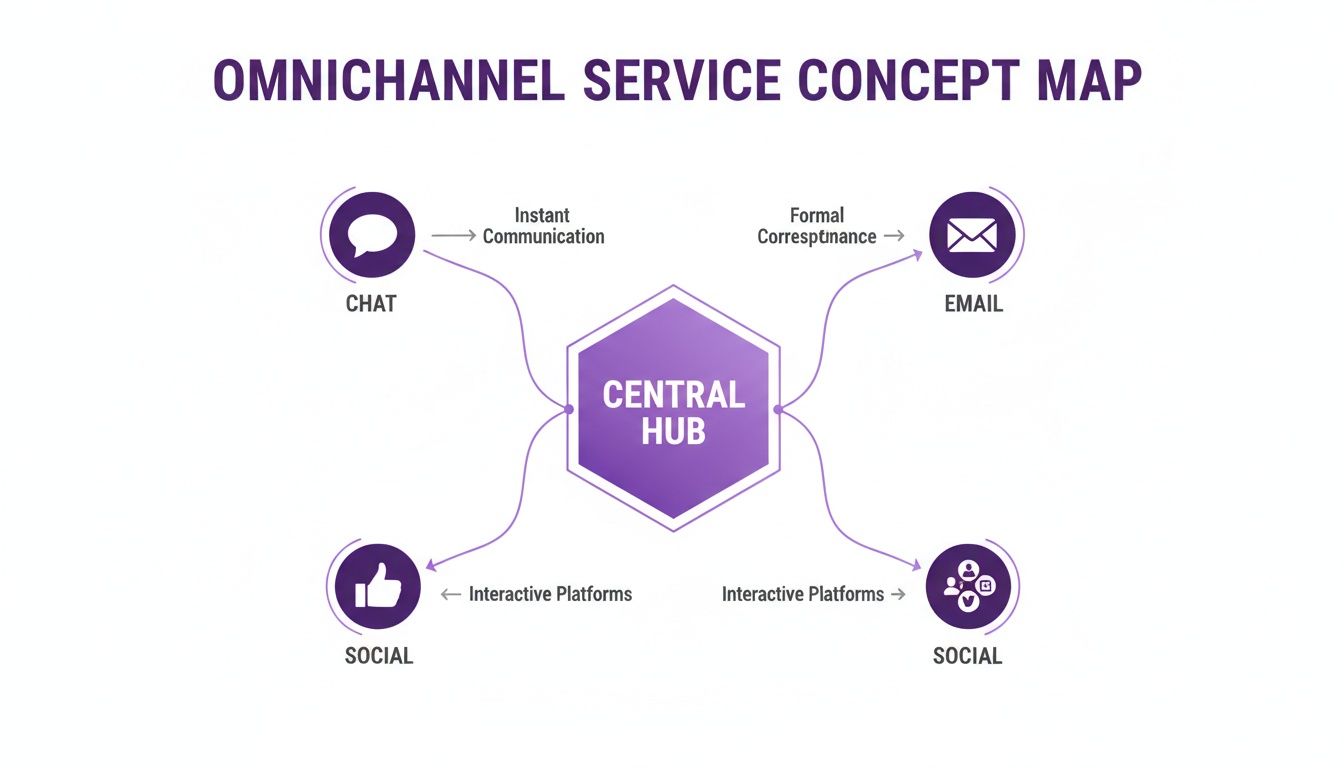
You can see how chat, email, and social media aren't separate paths but interconnected routes, all leading to one unified customer experience.
Why Integration Isn’t Just a “Nice-to-Have”
A disconnected, multichannel approach creates real, tangible costs that eat away at your profitability. These aren't abstract problems; they are concrete drains on your resources and revenue.
- Wasted Support Hours: Your team burns valuable time hunting down previous conversations and order details that should be at their fingertips.
- Lost Sales from Frustration: A shocking number of customers will abandon their cart and buy from someone else rather than repeat their issue on a new channel.
- Lower Customer Lifetime Value (LTV): Every clunky interaction chips away at loyalty. A seamless experience, however, builds it, encouraging repeat purchases and turning shoppers into fans. Businesses with strong omnichannel strategies retain an incredible 89% of their customers, compared to just 33% for those with weak, siloed approaches.
To make this crystal clear, here's how this plays out for your Shopify store.
Multichannel vs Omnichannel: A Head-to-Head Comparison
The difference comes down to how your channels work together—or don't. This table shows the practical impact on your day-to-day operations.
| Feature | Multichannel (Siloed) | Omnichannel (Integrated) |
|---|---|---|
| Customer Experience | Fragmented. The customer has to repeat themselves every time they switch channels. | Seamless. The conversation picks up right where it left off, no matter where it happens. |
| Support Agent View | Agents see isolated tickets. An Instagram DM and an email from the same person look separate. | Agents get a single, unified view of the customer's entire history across all channels. |
| Data & Context | Data lives in silos. The email team doesn't know what the social media team is doing. | Data is shared instantly. A chat agent knows the customer just abandoned their cart or clicked a marketing email. |
| Marketing & Sales | Marketing campaigns are generic blasts. Support can't see which ad a customer came from. | Support can see the exact ad that led to a question, enabling personalized, high-context sales assistance. |
| Efficiency & Cost | Inefficient. Agents waste time piecing together context, leading to higher support costs. | Highly efficient. Faster resolutions, happier agents, and lower cost-per-interaction. |
Ultimately, a multichannel setup means you've opened several doors into your business. An omnichannel strategy connects all those doors with a single, intelligent hallway.
Switching to an omnichannel mindset means you stop thinking about "Instagram support" or "email support." Instead, you just have "customer support"—and it follows your shopper wherever they go, armed with their full history. This shift from siloed channels to an integrated ecosystem is where you unlock serious growth.
Why Your Shopify Store Needs an Omnichannel Strategy—Now
Let's cut to the chase: what does this actually do for your bottom line? Switching to an omnichannel strategy isn't just a tech upgrade. It's one of the most direct ways to boost your conversion rates, average order value (AOV), and customer lifetime value (CLV).
For most stores, your support team is a cost center—a necessary expense to put out fires. An omnichannel approach flips that script. It turns your customer service into a powerhouse that actively drives revenue.
How? By giving your team (and your AI) a superpower: context. When every channel—email, chat, social DMs—feeds into one unified view of the customer, the game changes.
Turn Customer Service Into a Revenue Engine
Picture this: a customer starts a live chat with an AI-powered shopping assistant on your site. The AI instantly sees everything about them—their browsing history, past purchases, and even that sweater they almost bought last week.
With that goldmine of information, it doesn't just solve a problem; it spots an opportunity.
The AI can drop a hyper-personalized recommendation like, "Hey, I see you love our running shorts. The new moisture-wicking shirt that just dropped would be a perfect match." That’s not a spammy upsell. It’s an intelligent, helpful suggestion that makes a bigger sale feel natural. That’s what turning support into sales looks like.
An omnichannel system gives you the power to stop reacting to customer problems and start proactively creating sales opportunities. Every single interaction becomes a chance to understand, personalize, and sell more effectively.
This level of personalization is expected by today’s shoppers. An integrated system makes it possible to deliver that tailored experience around the clock, without burning out your team.
Boost Every Core Ecommerce Metric
The numbers on this are staggering. When you create a seamless journey, customers become more valuable and stick around longer. Shoppers today bounce between channels constantly, and they reward the brands that can keep up.
Omnichannel customers shop 70% more frequently and spend 16% more per order than shoppers who only use one channel. This isn't a small trend; it's a massive shift driven by the 91% of retail consumers who now consider themselves omnichannel shoppers, connecting with brands across an average of nine different places. You can dig deeper into these customer service trends to see just how ingrained this behavior is.
So, how does this translate to your KPIs?
- Higher Conversion Rates: A customer asks about sizing on Instagram. Your team (or AI) follows up via email with a personalized size recommendation and a direct link to buy. Friction is eliminated. Smooth conversations lead to fast "Add to Cart" clicks.
- Increased Average Order Value (AOV): With a complete picture of a customer's history, you can offer smart cross-sells that feel like genuine advice. An AI assistant can see they just bought a tent and suggest the matching sleeping bag during a live chat, bumping up that cart total on the spot.
- Greater Customer Lifetime Value (CLV): Every effortless, context-aware interaction builds trust. When customers feel understood and never have to repeat their story, they come back again and again. You don’t just get a sale; you get an advocate.
Slash Support Costs and Boost Efficiency
Beyond making more money, an omnichannel strategy is about working smarter. A disconnected, multichannel setup is a huge time-waster. Your team spends hours switching between tabs, digging for old conversations, and asking customers the same questions over and over.
An integrated system ends that chaos. When an AI assistant has all the context it needs, it can handle a huge percentage of inquiries on its own—often over 90%—without needing a human agent.
This frees up your human team to focus only on the complex, high-stakes issues where their expertise shines. The result? A leaner, faster support operation that keeps customers happy and brings your cost-per-interaction way down.
Building Your Omnichannel Technology Stack
Let's get into the nuts and bolts. Building an omnichannel system isn't about buying a dozen different tools. It’s about choosing a smart, integrated core—your tech stack—that does the heavy lifting for you.
The goal isn't to create more work. It's to build a system that automates repetitive tasks, gives your agents superpowers, and drives more sales without you needing a giant support department.
The Heart of Your Operation: A Centralized Platform
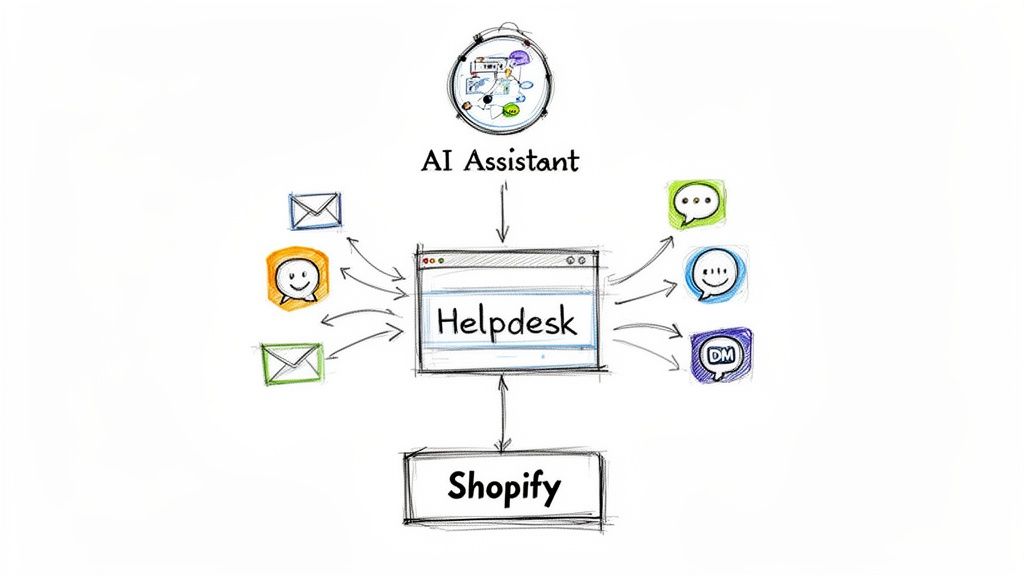
First, you need a single source of truth. This is usually a modern helpdesk that acts as the central hub for every customer conversation.
Forget managing Instagram DMs in one app, live chat in another, and your email inbox somewhere else. That’s a recipe for missed messages and frustrated customers. A unified platform pulls everything—email, live chat, social media messages—into one clean dashboard.
This is all about context. When a customer's entire interaction history is in one thread, your team can see the full story at a glance. That means faster, smarter solutions.
The Non-Negotiable: Deep Shopify Integration
If a platform you're considering doesn't have a deep, native integration with Shopify, walk away. This is critical for any ecommerce brand.
A proper integration means that when a customer contacts you, their entire Shopify profile—order history, shipping status, lifetime value—pops up right next to their message. This instantly transforms your support agents into expert consultants.
- No more tab-switching: Your team doesn't have to jump between the helpdesk and the Shopify admin to look up an order.
- Proactive problem-solving: Agents can spot potential issues, like a delayed shipment, and address them before the customer even asks.
- Personalized sales opportunities: Seeing a customer's purchase history allows for intelligent upsell recommendations that feel helpful, not pushy.
Without this direct line into your store’s data, you're flying blind.
The Brains of the Outfit: An AI Shopping Assistant
This is where you go from being efficient to actively driving revenue. An AI shopping assistant, like Selzee, is the intelligent layer that sits on top of your entire stack. It’s not just a chatbot that answers "Where's my order?"—it’s the proactive brain of your customer service operation.
The AI assistant plugs into your helpdesk and your Shopify data, allowing it to do three game-changing things, 24/7:
- Automate with Full Context: It can handle the vast majority of routine questions instantly, but it does so with the customer's full history in mind. It knows what they’ve bought, what they’ve asked before, and what they’re looking at on your site right now.
- Personalize at Scale: It uses that data to deliver hyper-relevant product recommendations, turning a simple support chat into a high-conversion sales conversation. For example, it can see what a customer has previously purchased and recommend complementary items with better product descriptions, which you can improve with a free product description tool.
- Ensure Seamless Handoffs: When an issue does require a human, the AI has already gathered all the necessary info, summarized the problem, and created a ticket. Your agent steps into a conversation that's already halfway solved.
An AI assistant makes an omnichannel strategy powerful for a growing store. It ensures every conversation, automated or human-led, is rich with data and context, creating a seamless flow of information.
This intelligent automation is how you deliver a world-class, personal experience to every visitor without burning out your team. To see how this works in a real store, you can see a demo of an AI shopping assistant in action to understand its direct impact.
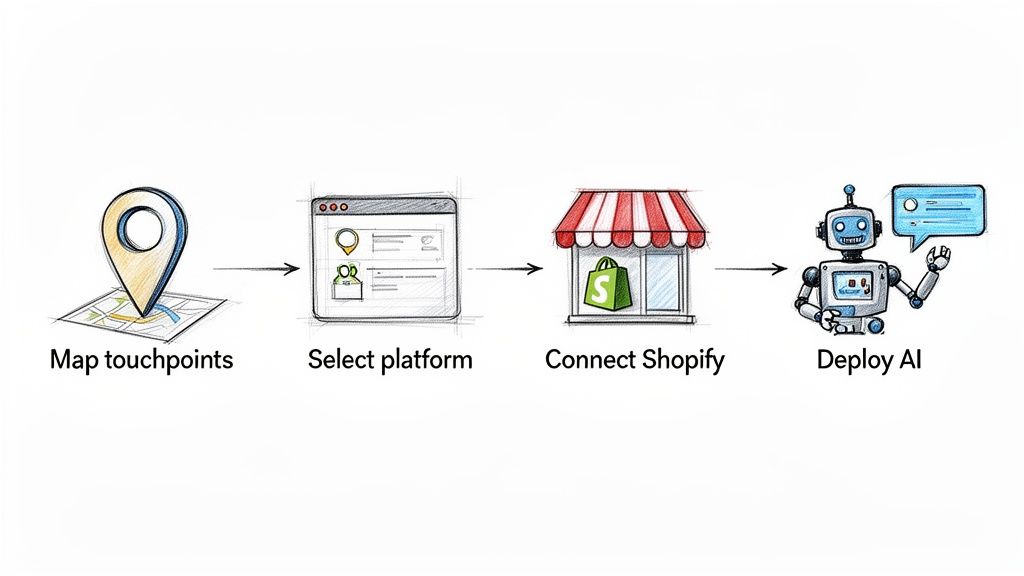
How to Implement an Omnichannel Strategy: A 4-Step Plan
Enough theory. Here's how to make this happen for your store. Shifting to an omnichannel model isn't about ripping everything out and starting over. It's a series of smart, focused upgrades.
This isn't a "flip the switch" situation. It's a gradual build-out that adds value at every stage, without causing chaos.
Step 1: Map Your Customer's Journey
Before you build a superhighway, map the existing roads. Trace every place a customer can possibly interact with your brand. Don't just list channels; follow the actual paths people take.
Put yourself in their shoes. Where do they go to ask a question? What happens when they abandon a cart? This exercise will instantly highlight the friction points—the dead ends where conversations die and customers get frustrated.
Your goal is to find the biggest leaks in your bucket. You might discover that 30% of your Instagram DMs are "Where's my order?" inquiries, which means your social media manager is stuck playing messenger with the support team. That’s a classic bottleneck, and it's fixable.
Step 2: Choose Your Command Center
With your map in hand, pick your central customer service platform. This hub will pull all those different touchpoints into one unified screen.
The make-or-break feature? A deep, native Shopify integration. This is what enriches every conversation with crucial customer data like purchase history and order status.
Pro Tip: Don't try to boil the ocean. Start by integrating your two highest-traffic or most problematic channels first. For most Shopify stores, that’s your on-site live chat and main support email. Get those running smoothly before adding social media DMs or SMS.
Once you’ve picked your platform, connecting it to Shopify is usually straightforward. This one step bridges your store's backend with your new support hub, letting that customer and order data flow freely.
Step 3: Deploy an AI Assistant on the Front Lines
Now for the powerful part: deploy an AI shopping assistant. This is the fastest way to offer instant, 24/7 answers and automate first-level support.
An AI assistant plugged directly into your Shopify data can handle the vast majority of common questions ("Where is my order?", "Do you ship to Canada?") with perfect accuracy. This frees up your human experts to tackle complex, high-value conversations.
Even better, it becomes a proactive sales engine. Because the AI has full context, it can offer personalized product recommendations, notify shoppers about back-in-stock items, and even guide them through checkout. This is how support stops being a cost center and starts generating revenue, even while you sleep. The tools and costs can vary, so it's a good idea to explore different pricing models for AI assistants to see what fits your store's size and goals.
Step 4: Train Your Team on the New System
The tech is only half the battle. The final step is to train your human agents to think and act omnichannely. Their job evolves from reactive problem-solvers to proactive relationship-builders.
Your team no longer has to play detective. Instead, they can focus on using the unified customer view to create "wow" moments that turn shoppers into loyal fans.
Here’s what that training should focus on:
- Seeing the Whole Story: Teach them to scan the unified customer timeline to get the full picture of a customer's history before replying.
- Spotting Sales Opportunities: Show them how to use purchase history and browsing data to make helpful suggestions that naturally increase AOV.
- Mastering the Handoff: If a chat needs to become a phone call, train them on the simple process for ensuring all context travels with the customer, so they never have to repeat themselves.
By following this plan, you can build an omnichannel strategy that not only solves customer problems efficiently but also becomes a powerful engine for growth for your Shopify store.
Key Metrics to Measure Omnichannel Success
You can’t improve what you don’t measure. Switching to an omnichannel strategy needs to be backed up by data. It’s time to move beyond basic stats like response time and focus on the Key Performance Indicators (KPIs) that show how your customer experience is impacting revenue.
The right tech stack will give you a unified analytics dashboard to watch these numbers in real time. This gives you an honest look at what’s working, where customers are still getting stuck, and how your support efforts are directly fueling business growth.
Customer-Centric KPIs
These metrics measure the quality and ease of your customer's experience.
- Customer Satisfaction (CSAT): Your classic "How did we do?" score. In an omnichannel world, you must track it across every channel. Are customers happier on live chat than email? This data is gold for pinpointing which channels need improvement.
- First Contact Resolution (FCR): This tracks the percentage of problems you solve in the very first interaction, with no follow-ups needed. A high FCR is a sign of an efficient, context-aware system where your team has all the information they need from the start.
- Customer Effort Score (CES): My personal favorite. It asks: "How easy was it to get help?" A low-effort experience is the hallmark of a seamless omnichannel setup. If customers are telling you it was hard to get an answer, that’s a massive red flag.
Business-Impact KPIs
This is where you connect support performance directly to the bottom line.
A successful omnichannel strategy doesn't just lower support costs; it actively increases revenue. By tracking these core business metrics alongside your support KPIs, you can prove the ROI of creating a seamless customer experience.
Take a look at how your omnichannel efforts are affecting your store’s core performance:
- Conversion Rates: Are shoppers who interact with your support team more likely to complete a purchase? They should be. A great omnichannel system naturally turns support chats into sales. To dive deeper, you can learn more about this by exploring tools that calculate conversion rates and their direct impact.
- Cart Abandonment Rates: Proactive support is one of the best ways to fight cart abandonment. An AI assistant can pop up with a helpful answer or a small discount just as a customer is hesitating on the checkout page. That's omnichannel support saving a sale in real-time.
- Customer Lifetime Value (CLV): This is the ultimate report card. Effortless, personalized support builds incredible loyalty. When customers feel understood across every touchpoint, they don’t just buy from you once—they become loyal fans who come back again and again, boosting their lifetime value.
Common Questions About Going Omnichannel
Jumping into a full omnichannel strategy can feel like a huge leap. Let's clear up some of the most common concerns we hear from Shopify merchants.
"Isn't This Going to Be Too Expensive for My Store?"
That’s a myth. The idea that omnichannel is some exclusive, enterprise-level luxury is outdated. Modern AI platforms offer flexible, usage-based pricing, putting it well within reach for stores of all sizes.
The key is to start small. You don't have to launch on every channel overnight. Connect your two busiest channels—maybe on-site chat and email. Once you see the ROI from better conversions and higher AOV, you'll find the system more than pays for itself. This is how you turn customer support from a cost into a profit center.
"How Long is This Really Going to Take to Set Up?"
Days, not months. If you choose a platform with a native Shopify integration, you can get a basic setup live in an afternoon. A more complete rollout, connecting all your channels and training your team, might take a few weeks at most.
Forget horror stories of massive IT projects. The new way is about getting quick wins. You implement step-by-step, adding value almost immediately and then building on that success at a pace that works for you.
"Can I Plug an AI Assistant into the Helpdesk We Already Use?"
Yes. The best omnichannel tools are built to integrate with the software you already have, not force you to start from scratch. Think of it as adding a superstar player to your current roster.
For example, an AI assistant can be your frontline hero, handling chats on your website and social media. Then, only when a human touch is needed, it creates a perfectly detailed ticket in your existing helpdesk (like Zendesk or Gorgias). This gives you all the power of 24/7 automation without having to ditch the tools your team already knows and loves.
Ready to see how an AI shopping assistant can tie all your customer conversations together and actually drive more sales? Selzee was built specifically for Shopify stores like yours, designed to turn every single customer chat into a chance to make money.