You have traffic. Now you need revenue. The fastest path to growth isn't more ads; it's converting the visitors you already have. Wasting traffic on a leaky sales funnel is burning money.
This is a no-fluff playbook for Shopify merchants ready for serious results. We're diving straight into 10 high-impact strategies to increase ecommerce conversion rates and plug the hidden leaks draining your profits. Forget the beginner basics. These are actionable tactics to boost average order value (AOV), slash cart abandonment, and turn browsers into buyers. To maximize your store's revenue potential, you must implement top conversion rate optimization best practices.
Each strategy is broken down into practical steps you can implement today, highlighting common, costly mistakes. You'll learn how to deploy conversational AI for instant support, leverage personalization for irresistible offers, and streamline your checkout to eliminate friction. This is your roadmap to turning clicks into consistent, scalable revenue.
1. Deploy Conversational AI for Real-Time Support
A customer with a question is a customer on the verge of leaving. Waiting for an email response is a deal-breaker. Conversational AI acts as a 24/7 sales assistant, instantly answering up to 90% of customer questions about sizing, compatibility, or shipping, preventing abandoned carts before they happen. This isn't just a "Where's my order?" bot; it's a proactive tool that guides customers to the right product, just like a top-tier in-store associate.
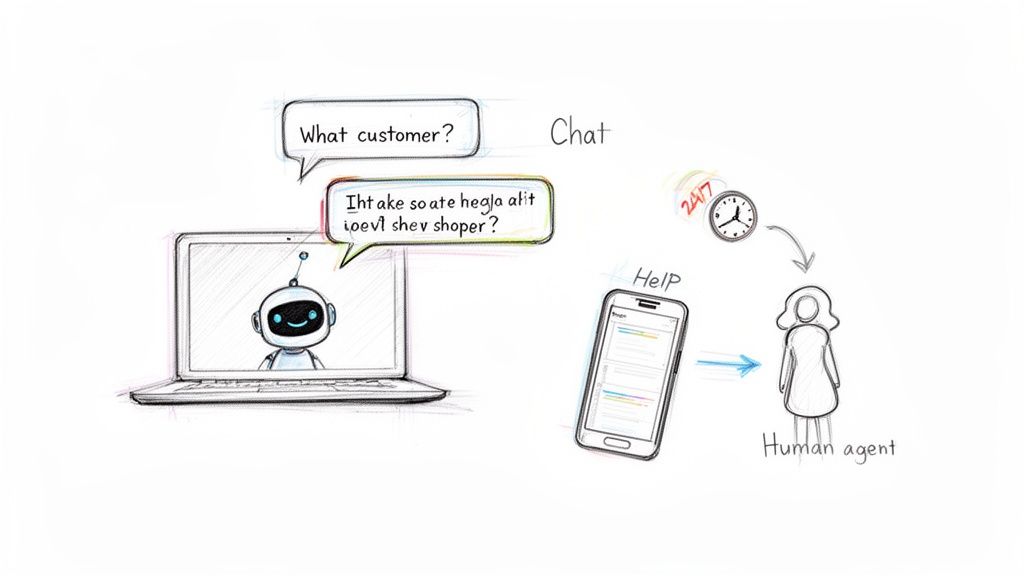
Beauty giant Sephora uses its chatbot to offer personalized product recommendations, while H&M’s AI provides style and sizing advice. This immediate assistance builds buyer confidence and keeps the customer moving smoothly toward checkout—a critical factor to increase ecommerce conversion rates.
How to Implement AI Support Correctly
A simple FAQ bot won't cut it. Your approach needs to be strategic.
- Train with Precision: Your AI is only as smart as your data. Feed it your complete product catalog, detailed FAQs, and historical customer service chats to ensure it provides accurate, context-aware answers. A poorly trained bot is worse than no bot at all.
- Establish Smart Escalation: Define clear rules for when a conversation must be handed off to a human agent. Complex, sensitive, or high-value customer issues should always have a seamless path to your support team.
- Handle Complex Inquiries: Equip your AI and human agents to manage detailed post-purchase questions. This includes providing clarity on nuanced delivery situations, such as explaining what a shipment exception means and what the next steps are for the customer.
- Analyze and Refine: Use conversation analytics to spot recurring customer pain points. This data is a goldmine for improving product descriptions, refining your FAQ page, and identifying new product opportunities.
Mistake to Avoid: Thinking of AI as a replacement for your human team. Its real power is in supercharging them. By automating repetitive queries, you free up your agents to handle high-impact conversations that drive loyalty and sales. Leading platforms like Selzee have achieved up to 94% AI-only resolution rates, demonstrating the massive potential for efficiency. See how it’s done by reviewing these powerful AI case studies.
2. Use a Personalized Product Recommendations Engine
Stop making customers hunt for products. A personalized recommendations engine uses AI to analyze browsing behavior and purchase history to showcase hyper-relevant products shoppers are most likely to buy. This isn't just a generic "you might also like" widget; it's a dynamic sales strategy that reduces decision fatigue and significantly boosts average order value.
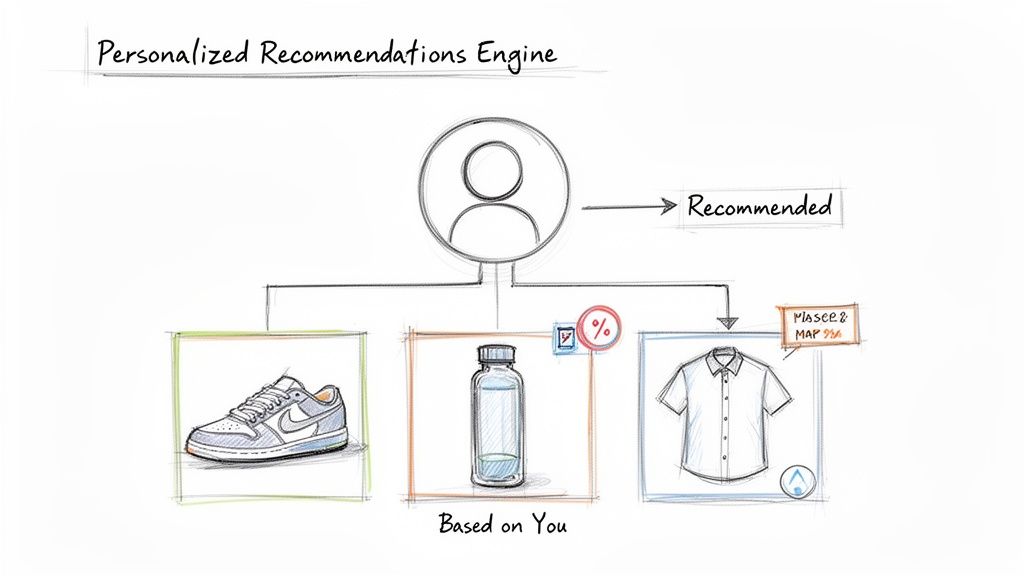
The impact is massive. Amazon attributes up to 35% of its revenue to its recommendation engine. Shopify Plus stores often report AOV lifts exceeding 20% after implementing one. For example, a beauty retailer can automatically show a complementary moisturizer to a customer viewing a face wash, creating an organic upsell. This proactive merchandising is a powerful way to increase ecommerce conversion rates by making the shopping journey feel intuitive.
How to Implement a Recommendations Engine for Max ROI
Installing a generic app isn't enough. It demands a strategic approach to data and placement.
- Segment Your Recommendations: Never show the same suggestions to everyone. Create different models for new visitors (based on best-sellers) versus returning customers (based on past purchases).
- Test Placement Strategically: Experiment with placing recommendation carousels on the product page, cart page, and even the post-purchase confirmation page. These are all high-impact locations to test and optimize.
- Combine Data for Precision: The best algorithms merge multiple data points. Combine product attributes (like color or brand) with behavioral patterns (like items frequently viewed together) for far more accurate and compelling suggestions.
- Optimize and Refine: Continuously monitor which recommendations are driving the most clicks and conversions. Use this data to refine your algorithms and strategically prioritize high-margin or best-selling products.
Mistake to Avoid: Treating personalization as a luxury. It’s an expectation. A smart recommendation engine transforms your store from a static catalog into a dynamic, personal shopping assistant that actively helps customers discover products they'll love. Platforms like Selzee leverage this by recommending relevant variants and bundles, directly driving up order value.
3. Automate Strategic Cart Abandonment Recovery
A customer who abandons a full cart isn't a lost sale; it's a warm lead waiting for a nudge. Strategic cart abandonment recovery turns this near-miss into revenue. By using automated email, SMS, and on-site notifications, you can re-engage these high-intent shoppers and guide them back to complete their order. This is about reclaiming significant lost revenue, not just sending a generic "You left something!" message.
The reason for abandonment is often temporary: a distraction, a question about shipping costs, or price hesitation. A well-timed, personalized recovery message can resolve these issues. Shopify merchants using automated recovery tools see an immediate 10-15% lift in revenue, proving this is one of the most direct ways to increase ecommerce conversion rates.
How to Implement Cart Recovery that Works
A successful recovery strategy requires a timely, persuasive, multi-channel follow-up sequence.
- Act with Speed and Sequence: Send the first reminder within one hour of abandonment while your brand is still top-of-mind. Follow up with a second and third message over the next 48 hours, varying the messaging to create urgency or provide assistance.
- Incentivize Strategically: Not every abandoned cart needs a discount. A simple reminder or an offer of free shipping is often more effective and protects your margins. Test different offers; a beauty brand might see success with a free sample, while an electronics store may benefit from offering extended warranty information.
- Optimize Your Messaging: Include high-quality images of the cart items, compelling customer reviews, and a clear call-to-action in every message. Personalize the content to remind them why they wanted the product.
- Leverage AI for Insights: Use analytics to understand why carts are abandoned. Are customers dropping off at the shipping page? Is a specific discount code failing? This data is crucial for fixing leaks in your checkout funnel.
Mistake to Avoid: Only reacting to abandonment. The goal is to understand and resolve the friction in your buying process. An AI-powered platform can identify abandonment patterns automatically, providing insights to prevent future abandonment and turning a reactive tactic into a proactive growth strategy.
4. Optimize Product Pages with Social Proof
What’s more powerful than you telling customers your product is great? Hundreds of other customers telling them. That's social proof. By strategically embedding customer reviews, ratings, and user-generated photos directly onto your product pages, you build credibility and trust. This is a fundamental conversion driver that addresses buyer hesitation at the most critical point of their journey.
For DTC brands, social proof levels the playing field against established giants. When a potential customer sees real people with real results, purchase anxiety melts away. Fashion brands see a lift when featuring customer styling photos, and beauty brands find that a huge percentage of shoppers actively engage with reviews before buying. Leveraging social proof is a proven way to increase ecommerce conversion rates by letting your happy customers do the selling for you.
How to Implement Social Proof Effectively
Simply having reviews isn't enough. They must be visible, authentic, and easy to consume.
- Make Reviews Unmissable: Display star ratings directly below the product title, "above the fold." Don't make shoppers hunt for validation.
- Emphasize Visual Proof: Encourage customers to submit photos with their reviews. A customer photo showing your product in a real-world setting is more persuasive than a professional studio shot.
- Engage with All Feedback: Respond publicly to both positive and negative reviews. A thoughtful response to a negative review can build more trust than a dozen positive ones by showing you stand behind your products.
- Incentivize, Don't Bias: Offer a small discount or loyalty points for leaving a review, but never require it to be positive. Authenticity is paramount.
- Surface the Best Content: Allow users to sort reviews by "most helpful" and filter by star rating. This helps shoppers quickly find the information most relevant to them.
Mistake to Avoid: Ignoring the marketing gold in your reviews. The language your customers use is the exact language you should use in your ads and product descriptions. This data can also be used to inform personalized product recommendations, creating a powerful feedback loop that drives conversions.
5. Use Exit-Intent Popups and Strategic Offers
An exit-intent popup is a safety net that catches shoppers just as they are about to leave your store empty-handed. By triggering a targeted offer when a user's cursor moves to close the tab, you get one final, compelling chance to convert an abandoning visitor. This isn't about annoying users; it's a strategic intervention to recapture otherwise lost revenue.
When a shopper has browsed but not added to cart, a last-second offer can be the nudge they need. A fashion retailer might present a 10% discount, while a supplement brand could offer a free guide for an email. These strategically timed interactions address hesitation head-on, turning a potential bounce into a sale or a valuable lead. This direct-response tactic is a proven way to increase ecommerce conversion rates.
How to Implement Popups Without Annoying Users
A smart, user-centric approach adds value instead of causing friction.
- Offer More Than Discounts: Test high-value incentives. Free shipping is often more persuasive than a small percentage off. Other powerful offers include a free gift with purchase or early access to new products.
- Segment Your Offers: Don't show the same popup to everyone. Tailor the message based on traffic source, the page the user is exiting, or their cart value. A new visitor might see a welcome discount, while a returning customer gets a loyalty-based offer.
- Optimize for Mobile: A clunky, full-screen popup on mobile is a recipe for frustration. Ensure your mobile popups are smaller, easy to close, and don’t obstruct the page content.
- Respect the User Experience: Make the "close" button obvious. Limit the popup's frequency to once per user session to avoid irritating your shoppers.
Mistake to Avoid: Using popups to trick a user into staying. The goal is to present an offer so relevant and timely that they want to stay. By testing different triggers (exit-intent vs. time-on-page) and offers, you can find the formula to recover 10-15% of your abandoning visitors.
6. Implement One-Click Checkout and Streamlined Payments
A five-page checkout form is a conversion killer. Your goal is to make the final step from cart to confirmation as fast and frictionless as possible, removing every unnecessary click and field. One-click checkouts and digital wallets are your most powerful allies here.
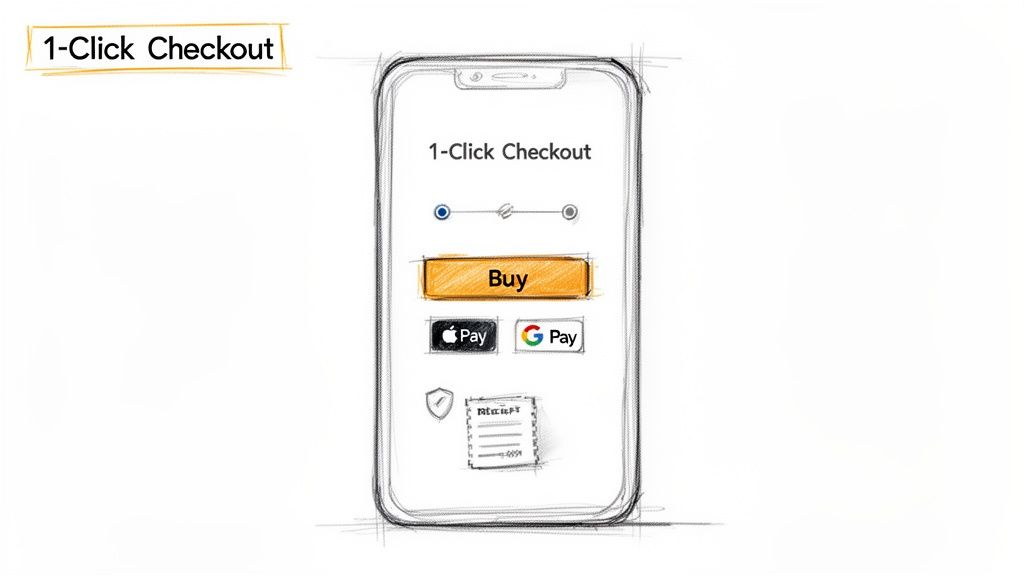
When a shopper can complete their purchase using pre-saved information via Apple Pay, Google Pay, or Shop Pay, the process is reduced to a single tap. The results are undeniable: Shopify reports that checkouts going through Shop Pay increase ecommerce conversion rates by up to 50% compared to guest checkout. For mobile shoppers especially, avoiding tedious data entry is a game-changer.
How to Implement a Frictionless Checkout
Optimizing the final, most critical step of the customer journey requires a focus on speed and simplicity.
- Activate Digital Wallets: Immediately enable accelerated checkout options like Shop Pay, Apple Pay, Google Pay, and PayPal. Place these buttons prominently at the cart and checkout stages.
- Minimize Form Fields: Audit your checkout form. Do you really need their phone number if you aren't using it for shipping updates? Eliminate every field that isn't absolutely essential.
- Show Costs Upfront: Surprise shipping fees are the #1 reason for cart abandonment. Use a simple zip code field to provide accurate shipping estimates early in the process.
- Optimize for Mobile: Ensure checkout buttons have large, easy-to-tap targets and that form fields automatically trigger the correct mobile keyboard (e.g., number pad for credit card fields). Use address auto-completion to reduce typing.
Mistake to Avoid: Treating checkout optimization as a one-time task. It's a continuous process of removing friction. The best checkout experience is the one your customer barely notices.
7. Provide Proactive Guidance with Intelligent Search
Don't leave visitors to endlessly browse or struggle with a generic search bar. Proactive guidance uses AI to initiate a conversation, understand user intent, and deliver hyper-relevant recommendations. This guided selling process turns confusion into confidence and is a game-changer for stores with large or complex catalogs.
When customers don't know exactly what they want, a standard search box fails. An intelligent guidance system solves this by asking qualifying questions. A supplements retailer might ask about fitness goals, while a beauty brand could match products to a customer's skin tone. This approach dramatically reduces friction and is a powerful strategy to increase ecommerce conversion rates.
How to Implement Proactive Guidance Effectively
A guided selling experience that converts requires a strategy focused on simplicity and relevance.
- Keep it Brief and Visual: Limit your qualifying questions to 3-4 before showing results. Use visual selectors like color pickers or icon-based choices to make the process fast and engaging.
- Provide Context for Recommendations: Don't just show a list of products. Briefly explain why each item was recommended based on the customer's answers. This builds trust in the suggestion.
- Allow for Opt-Outs: Always give customers who know what they want a clear path to skip the quiz and use the standard search or navigation instead.
- Analyze and Optimize: Review unsuccessful searches and quiz drop-off points to understand where customers are getting stuck. Use this data to refine your question sequences and improve product tagging.
Mistake to Avoid: Blocking the customer's path. Proactive guidance is about clearing it. You are replicating the expertise of a top-tier sales associate, at scale and available 24/7. Discover how Selzee uses AI to deliver this personalized journey by exploring an interactive proactive guidance and intelligent search demo.
8. Use Dynamic Pricing and Personalized Offers
Your pricing and offers should adapt in real-time. Dynamic pricing isn't about random fluctuations; it's a data-driven strategy to present the most compelling offer to the right customer at the right moment. By leveraging algorithms that analyze demand, inventory, and customer behavior, you can optimize revenue without alienating your audience. This moves beyond one-size-fits-all discounts into intelligent, personalized incentives that drive immediate action.
Imagine a high-intent shopper who has visited a product page three times in one day. A smart system could trigger a pop-up offering a small, exclusive discount to close the deal. This is how you can increase ecommerce conversion rates with precision. It's about aligning price with perceived value, maximizing revenue while delivering a great deal.
How to Implement a Smart Pricing Strategy
A successful dynamic pricing model is built on data, transparency, and strategic implementation.
- Use Behavioral Signals: Base offers on concrete actions like browsing patterns, cart value, or visit frequency rather than personal characteristics. This ensures fairness and avoids discriminatory pricing.
- Align Offers with Inventory: Automatically create urgency by offering sharper discounts on overstocked items or bundling slow-movers with popular products.
- Test and Monitor Incrementally: Avoid drastic price swings that damage brand trust. Test small, targeted adjustments and closely monitor the impact on conversion rates and profitability.
- Personalize Offers, Not Just Prices: Use your data to craft custom bundles, shipping offers, or loyalty rewards. A high-LTV customer might receive a surprise free gift offer in their cart to foster loyalty.
Mistake to Avoid: Focusing only on price. The best personalization comes from direct interaction. By analyzing chat data, a platform can identify a customer's hesitations and empower your team (or the AI) to present a tailored discount or bundle that directly addresses their conversation, turning a support interaction into a high-conversion sales opportunity.
9. Drive Optimization with Analytics and a CDP
Guesswork is the enemy of growth. You must combine systematic A/B testing with a unified view of your customer via a CRM (Customer Relationship Management) or CDP (Customer Data Platform). This combination allows you to form a hypothesis, test it, measure its impact, and then personalize the next interaction based on deep customer insights. It’s the scientific method applied to your bottom line.
This data-first mindset is fundamental to increase ecommerce conversion rates because it replaces assumptions with proof. Knowing which headline, button color, or product recommendation actually drives sales, not just clicks, transforms your store from a static storefront into a dynamic conversion engine.
How to Implement a Data-Driven Strategy
A successful testing and personalization strategy requires discipline and the right tools.
- Establish Clear Hypotheses: Before you change anything, define what you are testing, why, and what you expect the outcome to be. A good hypothesis is specific and measurable: "Changing the CTA button color from blue to orange will increase add-to-carts by 15%."
- Unify Your Customer Data: Implement a CRM or CDP to create a single source of truth for each customer. Integrate data from Shopify, your email platform, and support interactions to build rich profiles that power hyper-targeted personalization.
- Prioritize High-Impact Tests: Start A/B testing on your highest-traffic pages—homepage, product pages, and checkout. Small wins here have an outsized impact on your overall conversion rate. Use a conversion rate calculator to model potential revenue gains.
- Ensure Statistical Significance: Don’t end a test prematurely. Run it long enough to capture a full traffic cycle and reach a statistically significant result. This ensures your findings are reliable.
Mistake to Avoid: Letting data live in silos. The goal is to create a continuous feedback loop. Your analytics reveal what works, while your CDP tells you who it works for. Selzee leverages this by integrating directly with your customer data, allowing its AI to not only resolve issues but also measure the direct conversion lift from its personalized interventions.
10. Adopt a Mobile-First Design (and PWA Strategy)
Over 60% of your store's traffic is on a smartphone. If your mobile experience is a clunky, scaled-down version of your desktop site, you are leaving massive revenue on the table. A mobile-first design strategy forces you to build for the smallest screen first, ensuring a fast, intuitive journey for the majority of your visitors. This directly impacts your ability to increase ecommerce conversion rates.
Progressive Web Apps (PWAs) take this a step further, delivering an app-like experience in the browser without an app store download. Alibaba used a PWA to increase repeat visits by 60%. This strategy combines the reach of the web with the immersive experience of a native app, creating a powerful engine for engagement and repeat purchases.
How to Implement a Mobile-First Strategy
A true mobile-first approach requires a disciplined focus on speed, simplicity, and accessibility.
- Prioritize Performance: Aggressively optimize images using formats like WebP, implement lazy loading, and use a CDN to ensure lightning-fast load times. Every millisecond counts on a mobile connection.
- Design for Thumbs: Keep navigation simple and always accessible. Use large, thumb-friendly buttons and ensure enough space around clickable elements to prevent mis-taps. Place key CTAs in easy-to-reach zones.
- Streamline Mobile Checkout: Make mobile checkout seamless. Feature digital wallet buttons like Apple Pay and Google Pay prominently, as these one-tap options drastically reduce cart abandonment on mobile.
- Test Like a Real User: Don't just rely on desktop browser simulators. Test your entire funnel on actual mobile devices, on different cellular and Wi-Fi connections, to uncover real-world performance bottlenecks.
Mistake to Avoid: Treating your mobile site like a smaller version of your desktop store. It is the primary storefront for most of your customers. Treating it as an afterthought is one of the most expensive mistakes a modern ecommerce brand can make.
10-Point Ecommerce Conversion Strategy Comparison
| Solution | 🔄 Implementation Complexity | ⚡ Resource Requirements | 📊 Expected Outcomes | 💡 Ideal Use Cases | ⭐ Key Advantages |
|---|---|---|---|---|---|
| Conversational AI and Real-Time Customer Support | Medium — integration + model training | Moderate–High (NLP models, integrators, analytics) | Double-digit lift in conversion & AOV | 24/7 support, high-volume Q&A, global audiences | Reduces response time; personalized support at scale |
| Personalized Product Recommendations Engine | Low–Medium — many turnkey options | Moderate (historical data, product taxonomy, integration) | 15–30% AOV ↑; 10–15% conversion ↑ | Large catalogs, upsell/cross-sell, returning customers | Boosts AOV; faster product discovery; continuous learning |
| Strategic Cart Abandonment Recovery | Low — plugins or native tools | Low–Moderate (email/SMS integration, automation) | 15–30% abandoned-cart recovery; 2–5% conversion ↑ | High-abandonment carts, promos, exit intent recovery | Recovers high-intent revenue cost-effectively |
| Optimized Product Pages with Social Proof Elements | Low — many turnkey platforms | Low (UGC collection, moderation, widgets) | ~4.6% conversion lift per positive review; 20–30% return reduction | New customers, DTC brands, trust-building scenarios | Builds credibility, improves SEO and decision confidence |
| Exit-Intent Popups and Strategic Offer Timing | Low — simple code/plugins | Low (design, segmentation, A/B testing) | 5–15% browsing-session recovery; 15–25% email capture | Last-chance offers, list building, abandonment prevention | Captures leaving visitors; grows remarketing lists |
| One-Click Checkout and Streamlined Payment Experience | Medium — payment integration required | Moderate–High (payment processors, security, dev) | 25–50% checkout abandonment reduction; 15–25% conversion ↑ | Mobile shoppers, high-dropoff checkouts, repeat buyers | Dramatically reduces friction; speeds purchase flow |
| Proactive Guidance and Intelligent Product Search | Medium — requires structured data & AI | Moderate (product attributes, search AI, tuning) | 10–20% conversion ↑ for browsing; 2–5x engagement ↑ | Complex catalogs (beauty, supplements, electronics) | Reduces decision paralysis; improves relevance early |
| Dynamic Pricing and Personalized Offer Strategy | High — analytics & constant optimization | High (pricing engine, A/B testing, compliance review) | 5–20% AOV ↑; 10–30% profit margin ↑ | Inventory-sensitive categories, high-variation demand | Optimizes revenue/profits; clears inventory strategically |
| Analytics-Driven Optimization and CRM/CDP Strategy | Medium–High — integrations + analytics expertise | High (CDP/CRM, testing tools, analysts, governance) | 10–20% LTV ↑; 15–30% email ROI ↑; compounded conversion gains | Enterprise personalization, lifecycle marketing, testing culture | Data-driven prioritization; unified customer view for automation |
| Mobile-First Design and Progressive Web App Strategy | Medium — design + technical implementation | Moderate–High (developers, performance engineering, PWA) | 25–50% mobile conversion ↑; 2–3x mobile engagement ↑ | Mobile-heavy traffic, repeat mobile purchasers, global users | Improves mobile UX, speed, and engagement without app stores |
From Tactics to Transformation: Your Next Steps
You now have a roadmap of ten strategies designed to do one thing: increase ecommerce conversion rates for your Shopify store. The goal isn't to implement all ten tactics by next Tuesday. The goal is to shift from learning to doing. Don't let this become just another bookmarked article. Use it as a diagnostic tool for your store's specific challenges.
Recapping Your Conversion Playbook
- Remove Friction, Everywhere: A clunky checkout, a confusing search, a slow mobile site—every moment of friction is a lost sale. One-click payments, mobile-first design, and intelligent search are essential.
- Embrace Proactive Engagement: Don't wait for customers to ask for help. Use conversational AI to guide shoppers, deploy strategic exit-intent popups, and personalize recommendations in real-time.
- Data is Your Co-Pilot: Your analytics, CDP, and CRM are your optimization strategy. Every decision must be informed by real user behavior data.
- Build Trust at Every Touchpoint: Social proof, transparent pricing, and instant, accurate support are the building blocks of trust. They remove the psychological barrier to conversion.
Your First Actionable Step: Find and Fix Your Biggest Leak
Where do you start? Your data has the answer.
- Identify Your Biggest Drop-Off Point: Is it on your product pages? Or is the major exodus between the cart and payment? Your Shopify Analytics conversion funnel will point you directly to the biggest leak.
- Match the Problem to the Solution: Once you’ve identified the weak link, return to the tactics in this article.
- High Cart Abandonment? Focus on implementing a strategic cart recovery sequence or simplifying your checkout.
- Low Add-to-Cart Rate? Your product pages need attention. Enhance them with social proof, deploy an on-site AI assistant, and refine your product copy.
- High Bounce Rate on Homepage? You have a product discovery problem. Implementing a personalized recommendations engine or an intelligent search guide is your highest-impact first move.
Key Insight: To successfully increase ecommerce conversion rates, you don't do everything at once. You apply the right tactic to your biggest problem and build momentum. Choose one area, commit to improving it, measure the results, and then move to the next. This iterative process of test, measure, and refine is what separates stagnant stores from brands that consistently scale.
Pick your battle, launch your first test, and start turning more of your hard-earned traffic into loyal customers. The path to a higher conversion rate begins with a single, data-informed step forward.
Ready to turn real-time conversations into conversions? Selzee is the AI-powered sales assistant built for ambitious Shopify stores, automating everything from proactive customer support and personalized recommendations to cart recovery. Stop losing customers to friction and start converting them with intelligent, 24/7 engagement by visiting Selzee to see how it works.