You've got traffic, but are you maximizing its value? The first step to improving your ecommerce conversion rate is a financial diagnostic of your store. This isn't about vanity metrics; it's about pinpointing the exact pages, audience segments, and funnel steps that are actively leaking revenue.
The goal is to find your most expensive problems first. Fixing those delivers the biggest, fastest impact on your bottom line.
Find Where Your Shopify Store Is Leaking Money
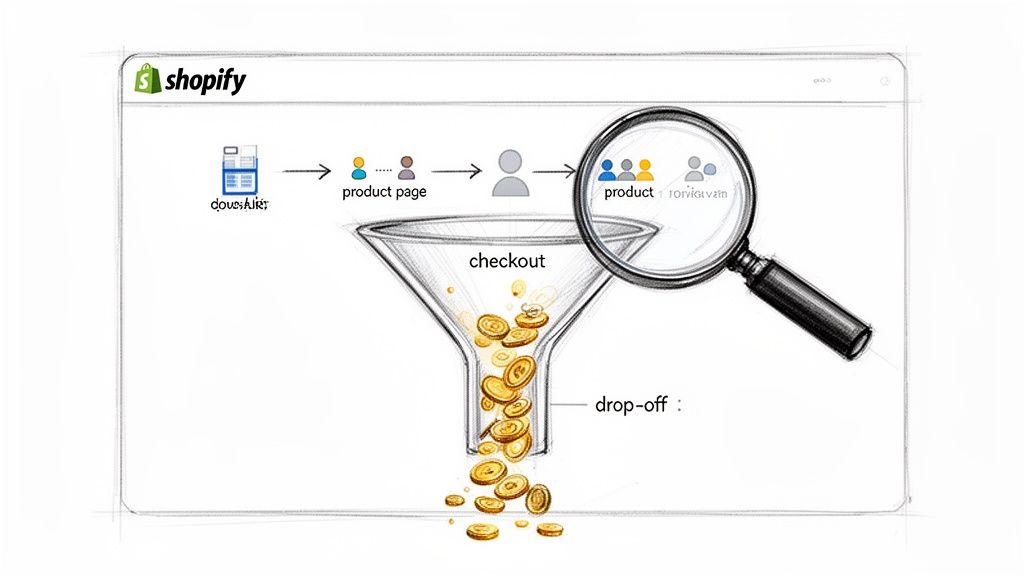
Before changing a button color or rewriting a product description, you must know where to focus your energy. Making random tweaks is a waste of time and money. Your Shopify Analytics and Google Analytics 4 (GA4) hold the data you need to find the broken parts of your conversion funnel.
Forget session counts or bounce rates for now. We're on a mission to find the drop-off points that are bleeding cash from your business. This is about following the money.
Diagnose Your Sales Funnel Drop-Off Points
Your sales funnel isn't a smooth slide from homepage to "thank you" page. It's an obstacle course, and every store has places where shoppers give up and leave. Finding these leaks is the most critical first step.
Use the path exploration report in GA4 to map the main customer journey: landing page to collection, to product page, into the cart, and through checkout. Where's the biggest cliff?
- Losing them after the product page? This is a huge red flag pointing to problems with price, unexpected shipping costs, confusing product info, or a lack of trust. Are your photos convincing? Is your return policy buried?
- Vanishing between cart and checkout? This is a classic. Surprise shipping fees are the number one killer, accounting for a massive chunk of abandoned carts. Other culprits include forced account creation or a clunky interface.
- Bailing during the checkout process? If they get this far and still leave, you might have too few payment options, security concerns, or a form that's too long and complicated.
The average ecommerce conversion rate floats between 2.5% and 3%. If you're trailing this benchmark, a hard look at your funnel will uncover obvious, high-impact fixes you can tackle immediately.
Segment Your Audience to Find Hidden Clues
All traffic is not created equal. A visitor from a hyper-targeted Instagram ad is in a different mindset than someone from a generic Google search. Segmenting your analytics data shows who’s buying and which valuable groups are walking away.
Start by comparing conversion rates based on:
- Traffic Source: Are paid ad visitors converting at a much lower rate than your email list? Your ad copy might be setting an expectation that your landing page isn't meeting.
- Device Type: Mobile conversion rates often lag behind desktop. If the gap is a chasm, you have a serious mobile UX problem that's costing you a fortune.
- New vs. Returning Visitors: If returning visitors aren't converting, it could signal an issue with brand trust or a poor post-purchase experience from their last order.
Understanding these segments helps you prioritize. A low conversion rate from your highest-spending ad campaign is an emergency. A low rate from a tiny referral source? Not so much. For a deeper dive, check out this a comprehensive guide to improving ecommerce conversion rates.
Once you’ve identified your biggest drop-off points and the audiences they affect most, you have a data-backed roadmap. Before you test any changes, benchmark your current numbers. You can model how small tweaks might affect revenue by plugging your numbers into an ecommerce conversion rate calculator. This diagnostic work ensures every action you take is aimed at solving a real, costly problem.
Turn Product Pages Into Conversion Engines
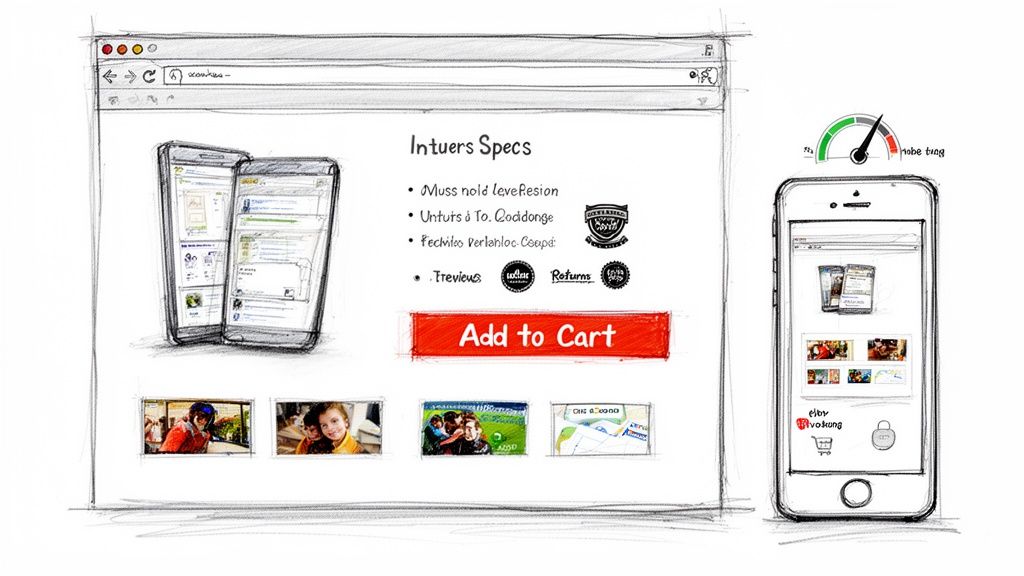
The product page is the most valuable real estate on your site. This is where browsers become buyers. Too many merchants treat this page like a digital catalog entry—a mistake that costs them sales every day. If your analytics pointed to a major drop-off here, this is where you plug the leak.
Forget generic advice like "use high-quality images." That's the price of entry. To pull ahead of your competitors, you need to get surgical, tearing down every point of friction and building absolute confidence at the most crucial moment of the buying journey.
Stop thinking of your product page as a passive listing and start treating it like your best salesperson.
Build Bulletproof Trust and Social Proof
Hesitation is the ultimate conversion killer. Every unanswered question nudges your customer closer to the back button. Your mission is to build a fortress of trust around your "Add to Cart" button using real social proof.
The rookie mistake is dumping a wall of reviews at the bottom of the page. Be more strategic.
- Show Proof at Scale: Use high-level credibility markers like “Trusted by 5,000+ customers” or flagging a product as a “Best-seller” to create instant validation.
- Feature Outcome-Driven Snippets: Don't just show star ratings. Pull review excerpts that solve a problem. Instead of "Great product," feature a review that says, "This cleared my acne in just 2 weeks." That specific outcome speaks directly to a visitor's needs.
- Let Customers Sell with UGC: Photos and videos from real people using your product are pure gold. They are infinitely more persuasive than polished brand shots because they answer the most important question: "Will this work for someone like me?"
A study from Northwestern University found that showcasing customer reviews can boost conversion rates by 270%. Social proof isn't a nice-to-have; it's a core sales driver. Don't bury your best asset.
Answer Questions Before They're Asked
Your product description is a sales conversation, not a spec sheet. People don't read descriptions; they scan them for answers. Make those answers impossible to miss.
Ditch internal jargon and fluffy adjectives like "premium quality." Get straight to the point and focus on real-world results.
| Instead of This (Feature) | Try This (Benefit) |
|---|---|
| "100% organic cotton" | "Soft, breathable fabric that's gentle on your skin" |
| "Water-resistant coating" | "Keeps you dry through unexpected downpours" |
| "Fast-charging battery" | "Go all day without searching for a charger" |
This small shift from what it is to what it does for them changes everything. Use scannable blocks, icons, and bullet points to break up the text. A confused mind never clicks "buy."
Nail the Call to Action and Eliminate Risk
The "Add to Cart" button is the finish line. Every pixel around it should encourage that final click by tackling last-second fears head-on.
Stop Hiding Your Return Policy:
Don't make customers hunt for your return policy. That creates doubt. Surface the benefit right where it matters. A simple line like "Free 45-day returns, no questions asked" placed directly under the CTA can neutralize a huge point of friction.
Create Urgency That’s Real:
Fake countdown timers are dead. Shoppers see right through them, killing your credibility. Real urgency comes from believable limitations.
- "Only 7 left in this size." (Real inventory)
- "Order in the next 3 hours for same-day dispatch." (A real deadline)
- "15 other people have this in their cart." (Real demand)
These signals work because they’re helpful, not manipulative. They give customers real-world context to make an informed decision. And when a customer feels informed, safe, and confident, they are far more likely to buy.
Tame Your Checkout and Stop Bleeding Sales
You turned a browser into a buyer who added an item to their cart. Yet, this is where many sales vanish.
The average cart abandonment rate is around 70%. For every ten people who decide to buy from you, seven walk away without finishing the purchase. This isn't a small leak; it's a massive hole in your revenue bucket.
Fixing your checkout isn’t a minor tweak. It's one of the most powerful ways to boost revenue without spending more on ads.
Ruthlessly Cut the Friction
Every field, every click, every moment of confusion is a reason to bail. Make the journey from cart to "Thank You" page as smooth and quick as possible.
Go through your own checkout as if you were a customer. Be brutally honest.
- Forced Account Creation Is Your Enemy: Do not force people to create an account to buy. It's a top reason for abandonment. Always offer a guest checkout. This is non-negotiable.
- Slash Form Fields: Do you really need their phone number? Is a second address line required? Every field you eliminate increases the likelihood of completion.
- Offer an Express Pass: People expect speed. Integrating one-click payment options like Shop Pay, Apple Pay, and Google Pay is now the standard. These tools autofill tedious details, turning a multi-step chore into a single tap—a game-changer for mobile conversions.
A complicated or long checkout process causes 18% of shoppers to give up and leave. Simplifying your flow is a direct path to more money.
Build Bulletproof Trust at the Final Step
When a customer enters their credit card number, they are on high alert for anything that feels sketchy. You need to go overboard with reassurance.
The biggest trust-killer is surprise costs. Unexpected shipping fees and taxes are the #1 reason people abandon carts. Be transparent about all costs before the final payment screen. Use Shopify's built-in features to show an estimated shipping cost directly in the cart.
Beyond that, use strong visual cues:
- Show Security Badges: Make sure the logos for Visa, Mastercard, PayPal, and other payment providers are front and center. Add security seals like McAfee or Norton if you use them. They’re a powerful visual shortcut for "your information is safe here."
- Remind Them It's Risk-Free: Flash your return policy one last time. A confident line like "Free 30-Day Returns" can be the final nudge they need to hit "Complete Order."
Stop Abandonment Before It Starts
The best way to fix cart abandonment is to prevent it. Shift from a reactive to a proactive approach using smart tools to engage shoppers the moment they hesitate.
Imagine a customer is on the payment page, but their mouse drifts toward the "close tab" button. An exit-intent popup appears. Don't just offer a lame "10% off." Make it an offer they can't refuse, like, "Wait! Finish your order now and we'll upgrade you to free express shipping." For a deeper dive into these tactics, read this guide on how to reduce shopping cart abandonment.
This is also where AI can be a game-changer. An AI-powered shopping assistant can detect when a shopper hesitates on the checkout page. Instead of letting them leave, it can proactively open a chat and ask, "Have any questions about shipping before you complete your order?" If solving checkout friction is a key priority, a tool like Selzee can answer these common questions in real-time, rescuing a sale seconds before it's lost.
Use Personalization and AI to Guide Shoppers to Buy
The one-size-fits-all storefront is dead. Shoppers expect an experience built for them, like on Amazon and Netflix. If your Shopify store gives every visitor the same static experience, you’re leaving cash on the table.
Stop thinking of your site as a catalog and start treating it like a dynamic, intelligent co-pilot. By weaving in smart personalization and AI, you can create a guided journey that anticipates needs, removes friction, and makes buying from you feel like the most obvious decision.
Deliver Dynamic Recommendations That Work
Forget tired "related products" carousels. Real personalization is showing a shopper who just added a tent to their cart the exact sleeping bag and camp stove that other adventurers bought with it.
It's not about showing more products; it's about showing the right products at the right time. The goal is to make customers feel understood.
- Behavior-Based Suggestions: Use a tool that adapts recommendations on the fly based on browsing behavior, cart contents, and past purchases.
- Complementary Upsells: Don't just push a more expensive version of the same product. Offer a bundle that completes their purchase, like suggesting the perfect conditioner to go with that specialty shampoo.
- "Frequently Bought Together" Bundles: This Amazon-style tactic works because it's powered by real purchase data, making it an effective form of social proof.
When a shopper feels you're helping them solve a problem—not just trying to sell them more stuff—their trust skyrockets. This is how you boost Average Order Value (AOV) without being pushy.
Deploy an AI Shopping Assistant That Drives Sales
Think of the best retail employee you've ever met. They don't just stand behind a counter; they greet you, offer help, and share expert advice. An AI shopping assistant does precisely that for your online store, 24/7.
A proactive tool engages high-intent visitors, anticipates their questions about shipping or sizing, and guides them smoothly toward a purchase. This is critical for stopping cart abandonment before it starts.
The reality of cart abandonment is stark. Roughly 70% of all potential sales are lost right before checkout.
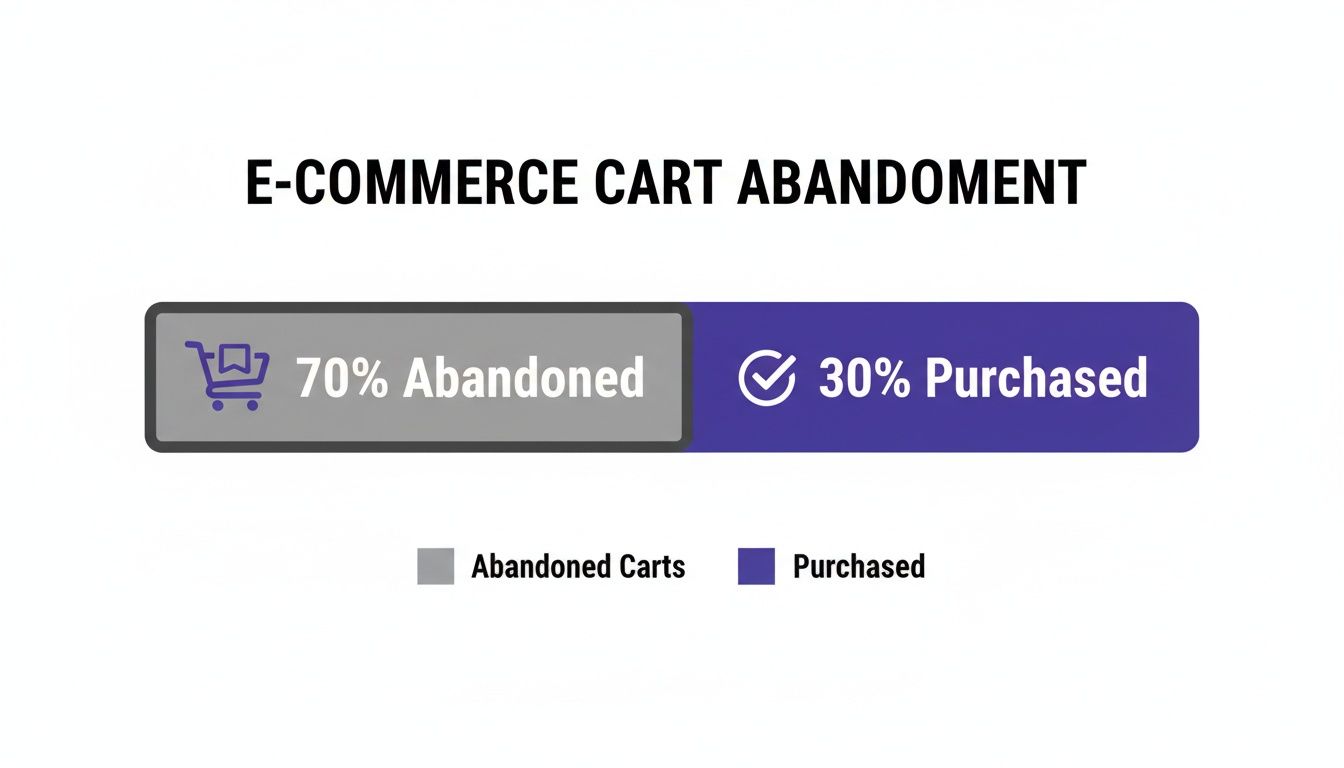
For every three customers who buy, seven walk away. That’s a massive opportunity for recovery. For Shopify merchants looking to leverage AI for this, a solution like Selzee can proactively turn conversations into revenue. Check out a live demo of Selzee in action. This is about actively squeezing more sales out of the traffic you already have.
Benchmark Your Performance Against Your Niche
Knowing where you stand is everything. While the global average e-commerce conversion rate is around 2-4%, that number hides massive differences between industries. Looking at benchmarks is pure gold for setting realistic goals.
Ecommerce Conversion Rates by Industry
| Industry | Average Conversion Rate | Optimization Opportunity |
|---|---|---|
| Personal Care | 6.8% | Shoppers want fast, guided solutions. AI excels here. |
| Food & Beverage | 4.9% | High repeat purchase potential. Personalization is key. |
| Home & Garden | 2.9% | Complex decisions. AI can help with product selection. |
| Fashion & Retail | 1.9% | High browsing behavior. Focus on personalized discovery. |
Source: Industry benchmarks compiled from multiple 2023 reports.
Context is crucial. A DTC nutrition brand on Shopify shouldn't compare itself to the general 1.9% fashion average when its niche has more than double the potential.
By integrating an AI assistant to offer 24/7 support and personalized offers, you can slash friction and watch conversions climb, especially in high-intent categories where customers are ready to buy—if you just give them the confidence to click.
Build a Testing Framework That Fuels Real Growth
The single biggest thing separating amateur store owners from professional growth marketers is a systematic approach to testing. Going with your gut is a fantastic way to waste time and money. It's time to stop guessing and start measuring.
A solid Conversion Rate Optimization (CRO) framework turns your store into a lab for continuous improvement. The game is about making smart, calculated bets, measuring the results precisely, and letting real customer data—not personal opinion—call the shots.
Form a Hypothesis That Matters
Every test worth running starts with a strong, measurable hypothesis. A weak hypothesis is a shot in the dark, like, "I think a green button will work better." A strong one connects a specific change to an expected outcome with a clear reason why.
Use this formula: If I change [X], then [Y] will happen, because [Z].
Let's see it in action:
- Weak Hypothesis: Changing the product page headline will get more sales.
- Strong Hypothesis: If I change the headline from a feature list to a benefit-focused sentence, then "Add to Cart" clicks will increase because we'll be answering the customer's #1 question: "What's in it for me?"
This structure forces you to think through the why behind the test. Even if the test doesn't produce a home run, you still walk away with a valuable insight.
Prioritize Tests for Maximum Financial Impact
You could test a million things on your site, but you don't have a million hours. Focus on changes with the highest potential to move the needle on revenue. Forget testing fifty shades of blue on a button and think bigger.
Use the PIE framework (Potential, Importance, Ease) to set priorities.
- Potential: How much improvement can you realistically expect? A test on your main checkout page headline has more potential than a tweak in your site's footer.
- Importance: How valuable is the traffic on the page you're testing? A product page getting 10,000 visitors a month is more important than a blog post that gets 100.
- Ease: How quickly and cheaply can you get this test live? Swapping a headline is easy. A full checkout redesign is not.
Score each test idea from 1-10 in each category. The ones with the highest scores get tackled first. This system keeps you focused on high-leverage opportunities, which is crucial for improving ecommerce conversion rates.
A classic mistake is calling a test too early. You must let it run until it reaches statistical significance—usually a 95% confidence level—to know the results are legitimate. Ending a test after two days because one version is ahead is making decisions based on random noise, not real user behavior.
Choose the Right Tools for the Job
The Shopify ecosystem is loaded with A/B testing tools. You don’t need an expensive enterprise suite to get started.
- VWO (Visual Website Optimizer): A user-friendly and powerful platform. VWO provides A/B testing, heatmaps, and session recordings in one place—a complete CRO toolkit.
- Shopify Apps: Search the Shopify App Store for "A/B testing." Apps like Neat A/B Testing or the built-in features in Shogun Page Builder make it easy to experiment with different layouts and content without writing a single line of code.
Interpreting Results and Scaling Your Wins
Once a test is done, the work isn't over. A "winning" variation that bumps conversions by 5% is great, but the real gold is understanding why it won. Was it the urgency in the new headline? Was the simplified form easier to use?
These insights become your growth playbook. If a benefit-driven headline crushed it on one product, that’s a huge clue that you should roll it out across your entire catalog. This is how you stack wins and create real momentum. You can see how learnings from one experiment are applied to the next in these AI-driven CRO case studies.
Building a testing framework isn’t about just running tests. It’s about transforming your entire approach to growth. You start thinking like your customers, challenging your assumptions, and building a store that gets quantifiably better, month after month.
Your Burning Shopify Conversion Rate Questions, Answered
Let's get straight to it. You have questions about boosting your Shopify conversion rate, and I have practical, no-nonsense answers from years in the trenches.
What’s a “Good” Conversion Rate for a Shopify Store?
Obsessing over a universal "good" number is a waste of time. A store selling $5,000 custom furniture will have a wildly different conversion rate than one selling $15 lip balm. Context is everything.
Industry benchmarks give you a rough idea. Across the board, averages hover between 2-4%. But even that's too broad. Look at specifics:
- Personal Care & Beauty: Often as high as 6.8%.
- Food & Beverage: Typically land around 4.9%.
- Fashion & Retail: A competitive space, with rates closer to 1.9%.
Forget everyone else. The only benchmark that truly matters is your own. The real question isn't "What's a good rate?" It's "How can I beat my current rate by 15% this quarter?" That's a goal you can build a strategy around.
How Fast Can I See Results from CRO?
This boils down to the size of the change and the volume of your traffic.
On a high-traffic site, a game-changing improvement—like replacing a clunky checkout with a slick one-pager featuring express pay—could show statistically significant results in under two weeks. Foundational fixes, like a dramatic boost to mobile page speed, can lift your conversion rate almost overnight.
Conversely, smaller tweaks on low-traffic pages might need to run for a month or longer to collect enough data. The key is to be patient and methodical. Tackle one major change at a time so you know exactly what moved the needle.
Do I Need Expensive Tools to Get Started?
No. Some of the most powerful insights come from tools that are 100% free. You can make huge strides without spending a dime on software.
Start with the essentials you likely already use:
- Google Analytics 4 (GA4): Free, and still the king for spotting where people drop out of your funnel.
- Shopify Analytics: Great for a quick, high-level pulse check on your store's health.
- Microsoft Clarity or Hotjar: Both have generous free plans. You can watch user session recordings and see where people get frustrated. It's like looking over their shoulder.
Your biggest initial wins will come from fixing obvious issues. These tools are more than powerful enough to shine a spotlight on them.
Ready to turn more browsers into buyers? The Selzee AI shopping assistant engages shoppers 24/7, answering their questions and guiding them from discovery to checkout. See how it works at Selzee.com.