Improving your ecommerce customer experience isn't about some silver bullet solution. It's about systematically hunting down and eliminating every single point of friction that costs you money. The secret sauce is boiling it down to instant support, delivering deeply personal recommendations, and paving a frictionless path to purchase. Nail these three, and you'll see a direct, measurable impact on your conversion rates and customer lifetime value.
Your Customer Experience Is Leaking Revenue—Here’s How to Fix It
You're driving traffic to your store, but the revenue just isn't matching up. Sound familiar? The problem probably isn't your products; it's the experience you’re wrapping around them. Every second of confusion, every unanswered question, and every generic interaction is another hole in your sales funnel. Too many Shopify merchants get hyper-focused on acquisition and completely forget about the on-site experience that actually turns visitors into buyers. That’s a massive, costly mistake.
The reality is, today's shoppers have zero patience. They want immediate answers to their questions. They want product recommendations that feel like they were hand-picked just for them. And they demand a checkout process so slick they barely even think about it. Anything less than that plants a seed of doubt and sends them straight to a competitor who understands the assignment.
The Three Pillars of a High-Converting CX
Ready to plug those leaks? Audit and overhaul your entire customer experience strategy by focusing on three foundational pillars. Mastering these is the fastest way to stop bleeding revenue and start building a tribe of loyal, repeat customers.
- Instant, Proactive Support: Customers simply won't wait. A slow reply to a simple product question is a guaranteed lost sale. You need to be there with the right answer the moment the question pops into their head, not hours later in an email inbox.
- True Personalization: This is way more than just dropping
{{first_name}}into an email. It’s about becoming a personal shopper for every visitor, showing them the exact products they’ll love at the perfect time, all based on how they're behaving on your site. - Frictionless Journey: From the second they land on your site to that final click of the "Complete Order" button, the entire process has to feel effortless. Mandatory account creation, surprise shipping fees, or a confusing navigation menu? Each one is a roadblock costing you sales.
This visual brings home how these three pillars work together to create a high-converting ecommerce experience.
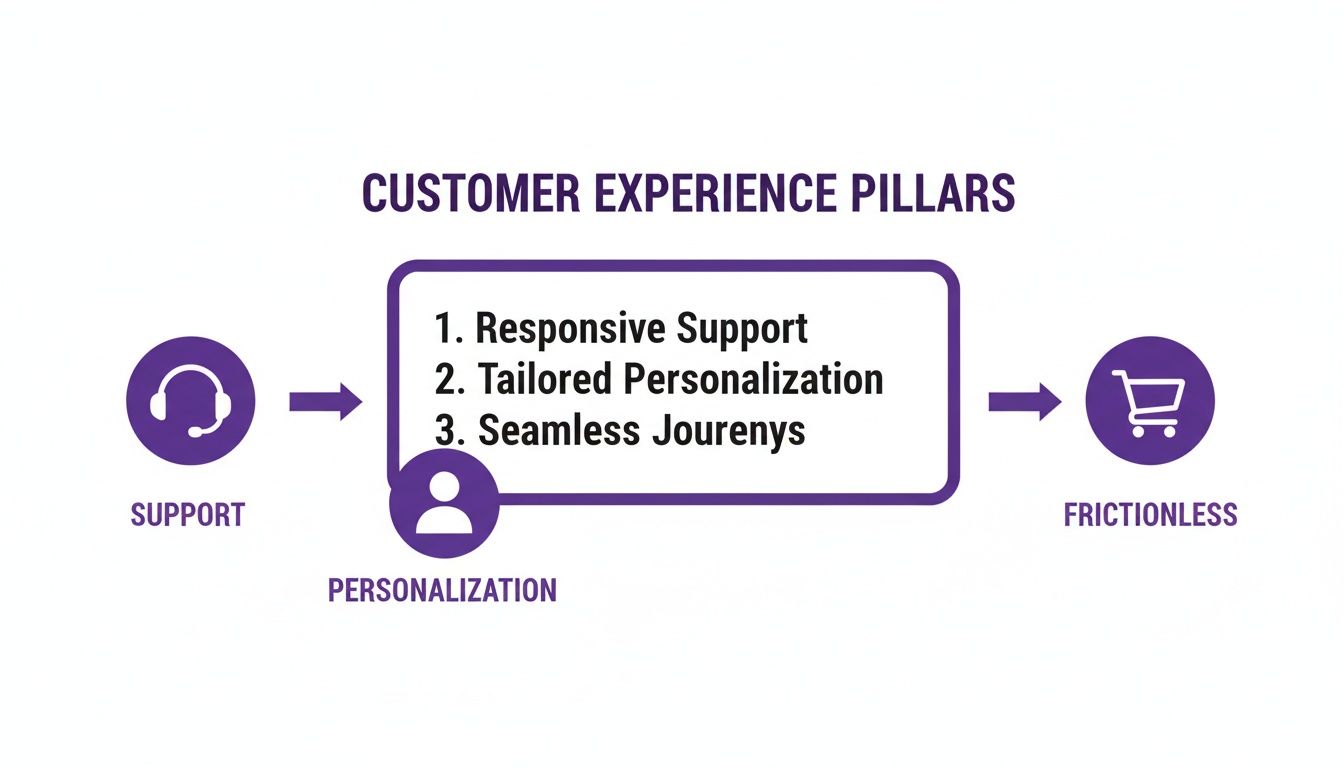
Each pillar directly tackles a major reason for cart abandonment and low conversions, giving you a complete framework to build on.
Pinpointing Your Revenue Leaks
To start fixing these issues, you need to know where to look. Getting practical strategies to boost your ecommerce conversion rates is the first step. When you analyze your store's data through this lens, it becomes painfully obvious where your CX is falling short. Are people dropping off when they see the shipping options? That’s a classic friction problem. Is your bounce rate sky-high on product pages? That screams a lack of immediate support or engaging personalization.
To help you get started, here’s a quick-and-dirty audit table you can use to spot some common culprits and find fast solutions.
Customer Experience Audit Quick Wins
| Experience Pillar | Common Mistake | Quick Win Solution | Potential Impact |
|---|---|---|---|
| Instant Support | Slow email/ticket responses for simple questions. | Add a proactive chat widget on key pages (product, cart). | Reduced bounce rate, increased time on site, higher add-to-cart rate. |
| Personalization | Showing the same generic pop-ups to everyone. | Trigger pop-ups based on user behavior (e.g., exit-intent). | Improved lead capture, lower cart abandonment. |
| Frictionless Journey | Requiring account creation before checkout. | Enable guest checkout and offer social logins. | Higher checkout completion rate, reduced friction. |
| Frictionless Journey | Surprise shipping costs revealed at the last step. | Display a clear shipping cost calculator in the cart. | Lower cart abandonment, increased customer trust. |
This table is just a starting point, but it shows how small, targeted changes can have a big effect on your bottom line.
Pinpointing exactly how much a small CX improvement can impact your bottom line is crucial. A minor lift in conversion from 1.5% to 2% can mean tens of thousands in new revenue.
Understanding the real financial upside makes it so much easier to prioritize these fixes. You can even use a simple tool to model what these small improvements could mean for your business. Our free conversion rate calculator helps you run the numbers for your own store. At the end of the day, this isn't just about making customers happy—it's about making your business wildly more profitable.
Nailing First Impressions and Product Discovery
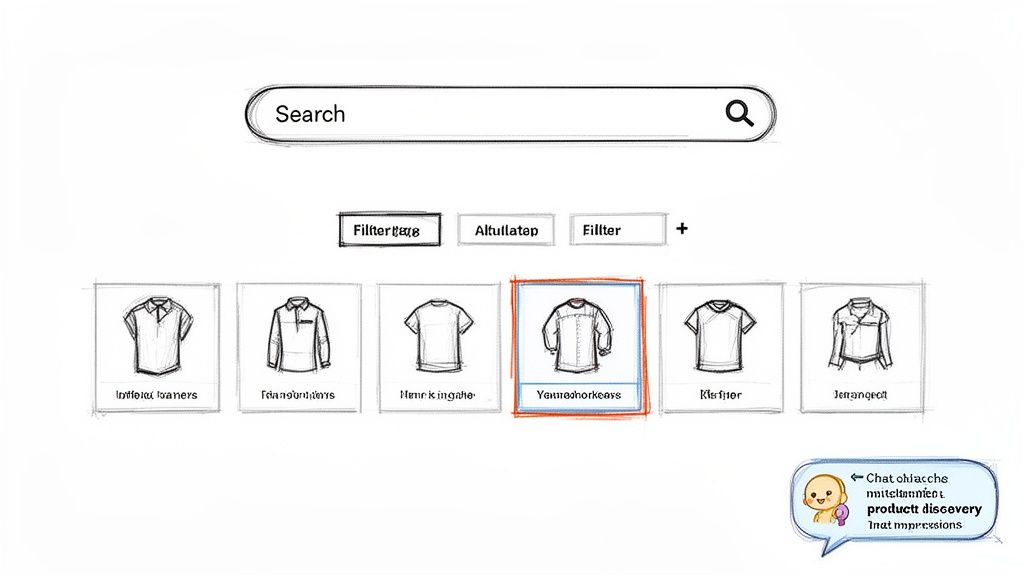
The moment a visitor lands on your site, the clock starts ticking. You have just a few seconds to prove you're the right place, that you're easy to shop, and that you have what they're looking for. A clunky layout or a useless search bar isn't just a minor hiccup—it's a one-way ticket to a sky-high bounce rate. This is where you win or lose the sale before it even gets started.
It's tempting to just roll with your Shopify theme's default navigation and search. I've seen it a hundred times, and it's a massive mistake that leaves a ton of money on the table. A great discovery experience makes your store feel like an expert personal shopper, effortlessly guiding visitors to their perfect product. This isn't just about looking pretty; it's a core conversion strategy.
Beyond the Basic Search Bar
Your on-site search is probably the most important tool for your highest-intent buyers. When someone types into that box, they are literally telling you exactly what they want to buy. A "no results found" page is an absolute conversion killer.
The standard Shopify search often falls flat on its face with simple typos, synonyms, or longer search phrases, sending valuable customers packing.
Upgrading to a smart search solution is non-negotiable for any serious store. These tools are packed with features that actually help people buy:
- Typo tolerance and spell check: So "blak shert" still pulls up a black shirt.
- Synonym recognition: Making sure a search for "handbag" also shows every "purse."
- Visual search results: Displaying product images right in the search dropdown.
- Search query analytics: Uncovering what your customers are desperately trying to find but can't.
These aren't just bells and whistles. They slash friction and help shoppers find what they came for in an instant—which is exactly what they expect.
Personalize the Browsing Experience
A static, one-size-fits-all website feels dated because it is. You have the data to tailor the browsing experience to every single user, making them feel like you get them. And I'm talking about more than just a "recently viewed items" widget.
Consider dynamic product sorting on your collection pages. For a brand-new visitor, you might sort by "Best Sellers." But what about a returning customer who always buys a specific brand? You can dynamically push that brand’s products right to the top for them. It's a simple act of recognition that makes the journey feel personal and relevant.
The same goes for promotional banners. They can be customized based on browsing history or what’s already in the cart, creating a unique path to purchase for everyone. To really nail this, you have to understand the Anatomy of a Perfect Product Listing, because that’s the final destination of their search.
Your goal is to make every visitor feel like the site was designed specifically for them. A customer browsing hiking boots shouldn't be bombarded with promotions for dress shoes. Personalization is the bridge between passive browsing and active buying.
Proactive Guidance with AI Assistants
What if you could have your absolute best salesperson greet and guide every single visitor on your site, 24/7? That’s the power of a modern AI shopping assistant. This isn't about the annoying, rule-based pop-ups from five years ago; this is about providing genuinely helpful guidance in natural language.
Picture this: a visitor is lingering on a product page for a technical jacket, clearly hesitating. An AI assistant, like Selzee, can jump in proactively: "Hey, I see you're looking at our Gore-Tex Pro jacket. Are you curious about its waterproof rating or how it fits compared to our other shells?"
This kind of timely intervention heads off confusion, answers critical questions instantly, and brings that consultative, high-end retail experience online. This tech transforms product discovery from a self-service chore into a guided journey. It can clarify complex product specs, suggest complementary items ("This camera is compatible with these three lenses"), and even help people navigate your store ("Show me all vegan leather bags under $100"). By providing instant, expert-level support right when they need it, you stop shoppers from bouncing and build the confidence they need to click "add to cart."
Mastering the Checkout and Purchase Journey
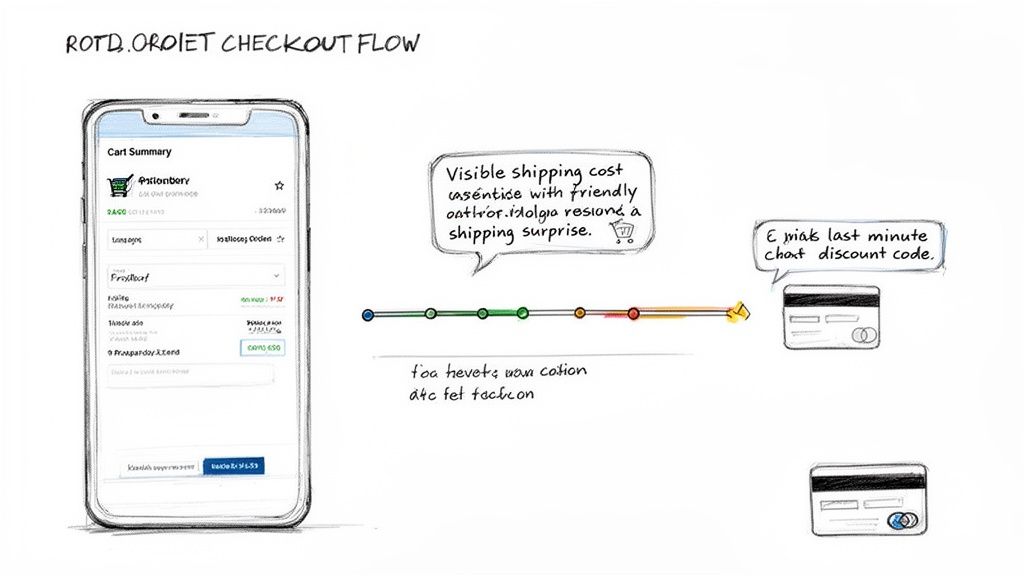
You guided a shopper all the way to the finish line. Their cart is loaded, and they're pulling out their credit card. Then... crickets. This moment is where the biggest revenue leak happens for most online stores, and it's almost entirely preventable. The checkout isn't just a boring form; it's the final, make-or-break test of your customer experience, and any friction here costs you real money.
Cart abandonment is a monster of a problem, but it's not some big mystery. It’s the direct result of friction—those little moments of doubt, frustration, or sticker shock that pop up right when a customer is about to commit. Every Shopify merchant should be obsessed with making this final step as smooth and confidence-inspiring as possible.
Deconstructing Common Checkout Failures
The reasons shoppers bail are shockingly consistent and predictable. Globally, a staggering 70% of all shopping carts are left behind. The data tells a clear story: nearly half of American shoppers bounce because of unexpected costs (hello, shipping fees!), 25% leave when forced to create an account, and 24% give up if the delivery estimate is too slow. It gets even worse on mobile, where abandonment rates rocket past 75%. To dive deeper into the numbers, check out these ecommerce statistics and insights from Sellers Commerce.
Let's get real about the most common mistakes that are draining your bank account at this critical stage.
- Surprise Shipping Costs: This is the undisputed champion of conversion killers. Hitting a customer with the final shipping cost on the very last screen is a surefire way to trigger sticker shock and send them scrambling.
- Mandatory Account Creation: You're asking a brand-new customer to stop, create a password, and fill out a form just so they can give you their money. It’s pure friction that feels totally unnecessary.
- A Clunky Mobile Experience: If your checkout isn’t designed for a thumb on a tiny screen—with big, easy-to-tap form fields, one-click payment options like Apple Pay, and minimal typing—you are actively pushing mobile shoppers out the door.
- Limited Payment Options: Customers want to pay their way. If you don't offer the digital wallets they use every day or popular buy-now-pay-later (BNPL) options, they'll just find a store that does.
Fixing these isn't just about making things "nicer" for the customer; it's about directly recovering revenue you are leaving on the table right now.
Your Tactical Checkout Optimization Playbook
Making your checkout seamless is one of the highest-impact projects you can tackle. This isn't about random tweaks; it demands a systematic approach. Your one and only goal is to remove every single ounce of hesitation and build unstoppable momentum toward that final "Confirm Purchase" click.
Here’s a prioritized checklist to get you started:
- Enable Guest Checkout Immediately: This is completely non-negotiable. Always, always have a big, bold "Checkout as Guest" option. You can always ask them to create an account after the sale is locked in, not before.
- Offer Multiple Express Payment Options: Get one-click payment solutions like Shop Pay, Apple Pay, Google Pay, and PayPal integrated ASAP. These tools autofill everything, slashing the effort required to complete a purchase.
- Be Radically Transparent with Costs: Show estimated shipping and taxes as early as you possibly can—ideally right on the cart page. A simple shipping calculator or a clear banner like "Free Shipping On Orders Over $75" kills those nasty surprises before they happen.
- Simplify Your Forms: Go through your checkout form field by field and be ruthless. Do you really need their phone number? Can you combine "First Name" and "Last Name" into a single "Full Name" field? Use Google Maps APIs to autofill addresses and save them from typing.
A great checkout is an invisible checkout. The customer should move through it so effortlessly that they barely even notice the steps. Every field they have to fill out, every decision they have to make, is a potential exit ramp off your sales highway.
The Game-Changer: Proactive Checkout Support
Even the world's slickest checkout can't prevent every single question. What happens when a discount code isn't working or a customer is confused about shipping to their area? This is where real-time, proactive support becomes an incredible sales recovery tool.
Imagine an AI shopping assistant actively watching the checkout. If it sees a customer lingering on the shipping page for more than 30 seconds, it can proactively pop up with a message: "Have a question about our shipping times? We offer express 2-day shipping to your area!"
This changes the entire dynamic. Instead of just letting a confused customer leave, you're giving them an instant solution right at their point of friction. An intelligent tool like Selzee can be set up to automatically handle these common checkout hurdles—clarifying policies, fixing payment issues, or even offering a last-minute discount to a buyer who seems hesitant. This transforms your checkout from a static, lonely form into a supportive final step that builds trust and, most importantly, closes the sale.
The Post-Purchase Experience: Where Profit and Loyalty Are Made
You've made the sale. Awesome. But don't pop the champagne just yet. The real work—and the real money—is in what happens after the checkout. This is your moment to turn a first-time buyer into a lifelong fan who comes back again and again.
So many Shopify merchants get this wrong. They treat the "thank you" page like a finish line, when it's actually the starting gun for building a real relationship. A killer post-purchase experience is your secret weapon. It’s how you manage expectations, build unshakable trust, and create a feedback loop that fuels your growth. Get this right, and you'll see your customer lifetime value soar while your support costs plummet.
Get Ahead of Their Questions with Proactive Updates
Ever bought something online and then immediately felt that twinge of anxiety? "Did my order actually go through? When will it ship? How do I track it?" That's post-purchase anxiety, and it's a real conversion killer for future sales. Leaving your customers in the dark is the fastest way to clog up your support inbox.
The solution is simple: beat them to the punch with automated, proactive communication. Your job isn't over until that package is safely in their hands.
Set up a simple automated flow that keeps them in the loop:
- Instant Order Confirmation: The second they hit "buy," they should have an email and an SMS message in their inbox. It’s instant reassurance.
- "It's Shipped!" Alerts: As soon as you create a shipping label, an alert should go out with a tracking link they can actually click.
- Delivery Confirmation: A quick "Your package has arrived!" notification is a small touch that shows you care about the entire journey.
These aren't just boring transactional messages. They're trust-building touchpoints that will dramatically cut down on those dreaded "Where Is My Order?" (WISMO) tickets.
Make Returns Ridiculously Easy
Nobody loves returns. But your returns process is one of the most critical moments in the customer journey. A clunky, confusing, or costly return doesn't just lose you a sale—it loses you a customer for good. But here's the flip side: a genuinely hassle-free returns experience can actually boost customer loyalty and encourage them to spend more with you later.
Think of returns as your second chance to wow them. A self-service returns portal isn't a luxury anymore; it's a must-have for any store doing significant volume. It gives customers the power to start a return, print a label, and see the status of their refund without ever having to email you. That kind of autonomy builds massive trust.
A seamless returns process sends a powerful message: "We've got your back, even if this purchase wasn't the right fit." This confidence makes customers 45% more likely to make a repeat purchase in the future.
Let AI Handle the "Where's My Order?" Questions
Even with the best communication, WISMO questions will still pop up. They are the bane of every support team's existence—repetitive, time-consuming, and frankly, a waste of your team's talent. This is the perfect job to hand off to an intelligent AI assistant.
Instead of a human agent spending five minutes looking up a tracking number, an AI can spit out the answer instantly, 24/7.
Picture this: it's 11 PM on a Sunday, and a customer types "where's my package?" into your chat widget. An AI assistant like Selzee can instantly pull up their order, check the latest tracking info from the carrier, and give them a real-time update. No human needed. This frees up your support team to handle the complex stuff that truly requires a human touch, like giving sizing advice or troubleshooting a tricky product issue. We've seen this exact shift transform support teams in our case studies with Shopify merchants.
By automating these common questions, you give customers the instant answers they crave while scaling your support without adding headcount. Suddenly, your post-purchase phase goes from being a cost center to a powerful engine for keeping customers happy and loyal.
Scaling Your Support With Intelligent Automation
Your support team is incredible, but they're only human. They can't be everywhere at once. The reality is, today's customers demand answers right now, 24/7. Every minute they wait for a reply is a minute they might be clicking over to your competitor.
Trying to solve this by just hiring more people is a fast track to bloated overhead. It's time to stop thinking about scaling your headcount and start thinking about scaling your intelligence.
Intelligent automation is the most powerful lever you can pull to deliver world-class support without breaking the bank. By bringing a smart AI shopping assistant into the fold, you can instantly handle the lion's share of incoming questions, transforming your support from a cost center into a lean, mean, conversion-driving machine.
Automate the Repetitive, Empower Your People
Take a peek inside your support inbox. Seriously, go look. How much of it is the same handful of questions asked over and over again?
- "What's your return policy?"
- "Do you ship to Australia?"
- "Where's my order?"
These are absolutely critical questions for your customer, but for your highly-trained team, they're a massive time-drain. This is the low-hanging fruit, the perfect starting point for automation. A well-trained AI assistant from a platform like Selzee can feast on your store policies, product details, and FAQs to serve up instant, accurate answers to these common queries.
The goal here isn’t to replace your human agents. It’s to free them from the monotonous work so they can focus on the high-value conversations that actually build relationships and close tricky sales.
Imagine a customer is trying to decide between three different high-end jackets for a ski trip. They have specific questions about waterproofing, breathability, and fit for layering. That’s a conversation where a human expert can truly shine. By letting an AI handle the simple stuff, you guarantee your team has the bandwidth to absolutely nail those crucial, revenue-generating moments every single time.
Why Response Time Is the New Battleground
In ecommerce, speed is everything. It’s not just a nice-to-have anymore; it's the baseline expectation. We've found that response time has become the defining factor in customer satisfaction.
Check this out: nearly a third of customers expect a response in under an hour, but a massive 38% expect it immediately. On top of that, 72% of shoppers want their issue solved on the very first contact. Slow responses don't just cause a little frustration—they actively kill conversions and poison your customer lifetime value. You can find more data in these key ecommerce statistics on Elementor.
This is where an AI assistant gives you an almost unfair advantage. It doesn't need coffee breaks, it never sleeps, and it can juggle thousands of conversations at once. Every single customer gets an instant response, even at 3 AM on Christmas morning.
Turning Support Chats Into Sales
A truly intelligent shopping assistant does so much more than just spit out FAQ answers. It actively hunts for opportunities to drive sales.
When a customer asks, "Do you have this dress in blue?" the AI can do better than a simple "yes" or "no." It can fire back with, "Yes, we do! Here’s the link. By the way, tons of customers who bought this also loved these matching shoes."
Suddenly, a simple support ticket becomes a dynamic upselling and cross-selling moment.
Here’s how this plays out in the real world:
- Proactive Engagement: The AI can pop up on a high-value product page if a user is lingering, offering to help before they even have to ask. It's like a great retail associate sensing a customer needs a hand.
- Guided Selling: It acts as a virtual personal shopper. It can ask clarifying questions ("Are you looking for something for a casual event or a formal one?") to help narrow down the options and guide the customer to their perfect product.
- Seamless Handover: For the most complex or high-stakes conversations, the AI can seamlessly pass the entire chat history to a human agent, who can jump in with full context to close the deal.
This powerful blend of instant automation and expert human touch is the future of ecommerce support. If you're curious what this feels like on a live store, you can See Selzee in action and book a demo today.
Using Customer Data to Drive Personalization
Generic, one-size-fits-all marketing just doesn't cut it anymore. Today's shoppers have high expectations, and dropping a {{first_name}} tag in an email is the bare minimum. If you want to build a brand that people love, you have to make them feel seen and understood.
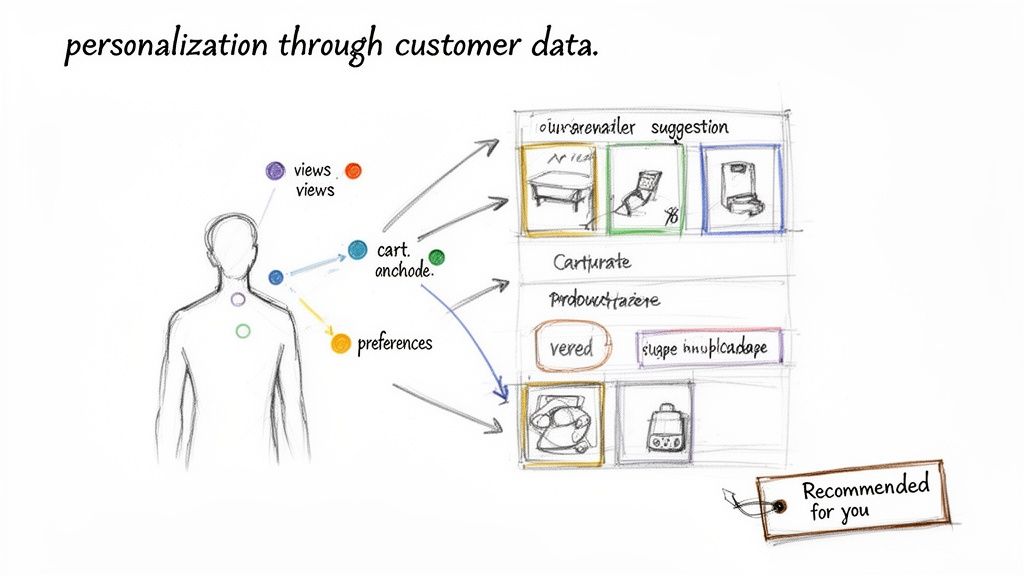
Your customer data is pure gold. It’s the secret to transforming your store from a static catalog into a dynamic, intelligent personal shopper. We're talking about using real-time behavioral data—what people are clicking on, adding to their cart, and have bought before—to craft a unique journey for every single visitor.
From Data Points to Dollars
I see so many merchants sitting on a mountain of data but with no real plan to use it. Collecting data is easy; the magic happens when you connect the dots and use it to actively shape the shopping experience. This is about so much more than just a "you might also like" widget at the bottom of a product page.
Here’s how you can turn that raw data into a powerful sales tool:
- Dynamic On-Site Content: Imagine a customer who bought hiking boots last month returns to your site. Instead of hitting them with the same generic homepage banner, greet them with your new line of outdoor gear or an offer on high-performance socks. Now that's paying attention.
- Behavior-Triggered Offers: Picture this: a shopper has three skincare products in their cart but is hesitating. An AI assistant can pop up with a small, timely discount on a complementary face mask, giving them that final nudge they need to click "buy."
Hyper-Relevant AI-Powered Suggestions
This is where AI shopping assistants really shine. They can analyze a user's session in real-time to make incredibly relevant suggestions that feel genuinely helpful, not creepy. For example, if a customer is toggling back and forth between two different cameras, your AI assistant can proactively offer a side-by-side spec comparison right in the chat window.
That's the kind of high-touch service you'd expect in a luxury boutique, but now you can scale it. An AI assistant like Selzee can bring this consultative experience to your Shopify store, turning passive browsing into an active conversation that builds trust and drives sales.
Personalization isn't just a nice-to-have; it's what customers demand. Research shows that a staggering 91% of consumers are more likely to shop with brands that provide personalized offers, and 71% get actively frustrated by impersonal experiences.
At the end of the day, great personalization is just about proving you're listening. When you make your customer data your most valuable asset, you create an experience that doesn't just boost your conversion rate—it makes your brand impossible to forget.
Got Questions? We've Got Answers.
Still have a few things rattling around in your head about leveling up your ecommerce customer experience? Let's tackle some of the most common questions we hear from Shopify merchants who are serious about growth.
How Do I Actually Measure the ROI of a Better Customer Experience?
You measure it where it counts: your core business metrics. Don't get bogged down in fuzzy "customer satisfaction" scores that don't pay the bills.
Look at the hard numbers that directly impact your bottom line. A fantastic CX will move the needle on:
- Conversion Rate: A smooth, intuitive experience means more people click "Buy Now." It's that simple.
- Average Order Value (AOV): Smart personalization and upselling woven into the shopping journey naturally lead to bigger carts.
- Customer Lifetime Value (LTV): That amazing post-purchase experience and a loyalty program that feels like a real relationship? That’s how you turn one-time buyers into lifelong fans.
- Support Ticket Volume: Getting ahead of common questions with proactive support and smart automation slashes repetitive inquiries, which directly lowers your operational costs.
What's the Single Biggest CX Mistake Shopify Stores Make?
Oh, this one's easy, and it's a killer. The most expensive mistake is sticking to a reactive support model.
Waiting around for a customer to get so frustrated they have to hunt down your contact form and fire off an angry email is a losing strategy. By that point, you haven't just lost their trust; you've probably lost the sale for good.
You have to be proactive. This means using tools like an AI shopping assistant to anticipate questions right on the product page, offer a helping hand during checkout, and give instant, helpful answers 24/7. Immediate engagement isn't a "nice-to-have" anymore—it's the absolute standard.
Should I Fix the Pre-Purchase or Post-Purchase Experience First?
This is a great question. You need to start with the pre-purchase and purchase journey. While post-purchase is where you build incredible loyalty, you can't build loyalty with a customer you never even managed to convert.
Think of it like fixing a leaky bucket. Your biggest, most profitable opportunities are in nailing product discovery, answering those pre-sale questions instantly, and making your checkout ridiculously easy. Plug those leaks in your funnel first, and you'll see the fastest impact on your revenue.
Once you’ve got conversions flowing, then it's time to double down on perfecting that post-purchase experience to send your LTV through the roof.
Ready to stop leaving money on the table? Selzee is the AI shopping assistant built for Shopify that turns conversations into conversions. By providing instant answers, personalized recommendations, and proactive support, we help you deliver a world-class customer experience that drives real revenue.