
Let's cut the fluff. For a Shopify merchant, help desk automation isn't about fancy tech; it's a sales tool. It’s software that instantly resolves common customer queries—like "Where's my order?" or "Do you have this in blue?"—so your team can focus on high-value tasks that actually generate revenue. This is about turning your customer support from a cost center into a lean, sales-generating machine.
What Help Desk Automation Actually Means for Your Bottom Line
Think of a manual help desk like having a single cashier during your Black Friday peak. The line is out the door, questions are flying, and you're bleeding sales from frustrated customers who won't wait.
Now, imagine an entire team of hyper-efficient assistants greeting every visitor, answering questions instantly, and guiding them to checkout, 24/7. That's help desk automation.
This isn't about replacing your human support team; it's about making them more profitable. By automating the repetitive, low-value queries that clog your inbox, you free up your agents to handle complex issues, engage high-value customers, and proactively close sales.
Why This Is Critical for Scaling Stores
Today's shoppers have zero patience. A delay of a few minutes is all it takes to lose a sale to a competitor. Help desk automation eliminates that friction, delivering instant answers that build trust and drive conversions.
At its core, this technology often uses top AI chatbot platforms to field common questions and provide immediate help, preventing cart abandonment before it happens.
This isn't a niche trend; it's a fundamental shift. The help desk automation market was already valued at $5.7 billion this year and is projected to hit $21.5 billion by 2030. This growth is driven by AI and machine learning tools that are essential for high-volume Shopify stores to compete.
Let's break down the practical difference between the old way and the smart way.
Manual Support vs. Automated Help Desk: A Reality Check
| Feature | Manual Help Desk (The Old Way) | Automated Help Desk (The Smart Way) |
|---|---|---|
| Availability | Limited to business hours; customers wait, sales are lost overnight. | 24/7/365; instant answers for customers anytime, anywhere. |
| Response Time | Hours or days, leading to high cart abandonment rates. | Seconds; eliminates wait times and rescues sales. |
| Agent Focus | Answering the same repetitive questions endlessly. | Solving complex issues, upselling, and building customer relationships. |
| Scalability | Expensive and slow; requires hiring more staff for busy seasons. | Effortless; handles 10x the volume without increased headcount. |
| Cost | High labor costs for repetitive, low-impact tasks. | Lower operational costs; a fraction of a full-time agent's salary. |
| Proactive Engagement | Almost non-existent; purely reactive. | Actively engages visitors with targeted messages to drive sales. |
The table makes it clear: running a manual system is like bringing a horse to a car race. You're not equipped for the speed of modern ecommerce.
Key Takeaway: Help desk automation is a practical, powerful sales tool you can deploy on Shopify right now. It directly addresses the modern customer's need for speed, turning your support function into a revenue engine.
For your store, this shift pays off in measurable ways that impact your P&L:
- Slash Cart Abandonment: Instantly resolve last-minute questions about shipping, returns, or product specs before a shopper can second-guess their purchase.
- Boost Conversion Rates: Proactively engage hesitant buyers with helpful information, a discount code, or a prompt to guide them toward the "Complete Order" button.
- Increase Customer Lifetime Value (CLV): Deliver fast, accurate support that makes customers feel valued and encourages repeat purchases.
- Unlock 24/7 Sales Opportunities: Your store is always open; your sales team should be too. Capture orders from night owls and international shoppers without hiring a global support staff.
By offloading simple queries to automation, you give your business the horsepower to scale, exceed sales targets, and create a customer experience that your competitors can't match.
The True ROI of Automating Your Shopify Support
Let's talk numbers—the only thing that really matters for your Shopify store. Investing in help desk automation isn't about faster responses; it's about a measurable impact on your bottom line. We're talking hard cost savings and new revenue streams.
Think of it this way: automation transforms your support team from a reactive cost center into a proactive sales engine. Every automated chat becomes an opportunity to rescue a sale, increase order value, or earn loyalty that drives repeat business.
Slashing Costs and Driving Revenue
The most obvious win is efficiency. Automating repetitive questions frees up your team's brainpower to focus on high-value tasks.
Instead of answering "Where is my order?" for the tenth time, your agents can assist a VIP customer, upsell a hesitant shopper, or solve a complex issue that requires a human touch.
The data is clear. Virtual agents now resolve 65% of issues on the first try. This level of efficiency boosts team productivity by over 50%, allowing your staff to focus on activities that actually generate revenue. For any store with a large or complex catalog, this is a non-negotiable advantage.
The ROI Formula: Automation doesn't just cut operational costs. It proactively closes sales that would otherwise be lost to friction, frustration, or a few minutes of hesitation.
Tracking KPIs That Actually Matter
To see the real impact of help desk automation, ignore vanity metrics like "tickets closed." Focus on the core ecommerce KPIs that directly affect your revenue.
Here’s what you should be tracking:
- Reduction in Cart Abandonment: How many shoppers were about to leave but completed their purchase because a bot instantly answered their shipping question? That's revenue pulled back from the brink.
- Lift in Average Order Value (AOV): A smart automated assistant acts as a personal shopper. When a customer asks about a skincare product, the bot can suggest a matching serum—an instant upsell.
- Increase in Customer Lifetime Value (CLV): Instant, 24/7 support builds confidence. When shoppers know they can get an answer immediately, they're more likely to buy from you again.
- AI-Only Resolution Rate: What percentage of issues are resolved without human intervention? This is your ROI goldmine. Every ticket resolved by AI is a direct cost saving and a potential sale saved.
When you focus on these metrics, the value of help desk automation is undeniable. You'll see fewer abandoned carts, larger orders, and a growing base of loyal customers. To better understand how these improvements impact your growth, play around with our ecommerce conversion rate calculator.
Ecommerce Workflows That Drive Sales and Slash Costs
Theory is fine, but let's get practical. This is where help desk automation becomes a revenue-generating asset for your Shopify store. These aren't generic concepts; they are proven strategies that engage shoppers, solve problems instantly, and drive sales 24/7.
The right automation turns a passive browser into an active buyer. It's a smart assistant that anticipates needs and guides customers from discovery to checkout without friction.
Turning support into a revenue engine is about crushing high-volume tickets, stopping cart abandonment, and finding smart upsell opportunities. Automation excels at all three.
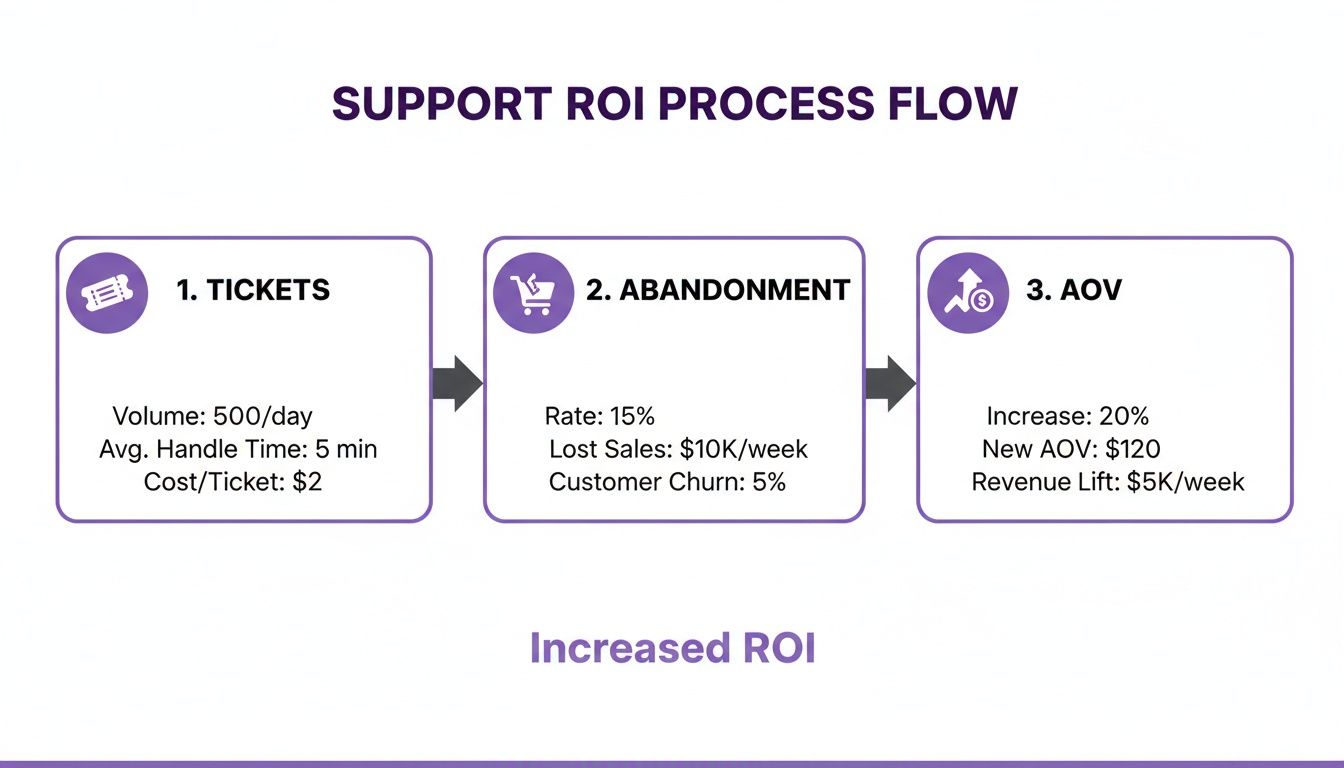
This flowchart illustrates the process perfectly. By automating simple tasks, you free up your team to prevent lost sales and increase your Average Order Value (AOV).
The “Where Is My Order?” (WISMO) Killer
WISMO tickets are the bane of every ecommerce support team. They are relentless and devour a shocking amount of your team's time. Manually looking up order numbers and tracking info is a colossal waste of resources.
Help desk automation eliminates this problem entirely. By integrating directly with your Shopify order data, an AI assistant can provide real-time shipping updates instantly, any time of day or night.
The Result: Your customers get the immediate answers they want, and your support team is freed from mind-numbing repetition. You've just converted a major operational drain into a smooth, trust-building interaction.
The Proactive Cart Saver
Every merchant knows this scenario. A shopper fills their cart, proceeds to checkout, and then... they hesitate. Maybe it's the shipping cost or a last-minute question about your return policy. This is the critical moment.
Proactive automation can detect this hesitation—like a user lingering on the checkout page—and intervene with the right message at the right time.
- "Hey! Just confirming, we offer free shipping on all orders over $75."
- "Great choice on the Vitamin C serum! Customers love pairing it with our hydrating moisturizer for the best results."
- "Need a little nudge? Use code SAVE10 for 10% off your first order."
This isn't just support; it's automated salesmanship that rescues revenue that would have otherwise disappeared.
The Virtual Shopping Assistant
Customers always have specific, deal-breaking questions. "Is this fabric machine washable?" "Are your supplements gluten-free?" "What are the exact dimensions of this desk?" If they can't find an answer immediately, they're gone.
An automated assistant, armed with your product data, becomes an expert on your entire catalog. It can instantly answer detailed questions about:
- Materials and ingredients
- Sizing and fit guides
- Technical specifications
- Product compatibility
For this to work, your AI needs rich, accurate information. A huge bottleneck for many stores is writing detailed copy for hundreds of SKUs. To ensure your automation has the best data, you can use our generator to quickly create compelling, info-packed descriptions. This equips your AI to actually close the sale.
The Intelligent Product Recommender
Let's be honest, generic "You might also like" widgets are outdated and ineffective. True personalization comes from understanding a customer's immediate intent.
When a shopper asks, "Do you have any vegan leather bags in black?" an intelligent automation does more than just say yes or no. It acts like a top-tier salesperson.
It can display a carousel of the top three options, highlight their best features, and even suggest a matching wallet. This transforms a simple query into a guided shopping experience, boosting AOV and making customers feel understood. The AI learns from every interaction, getting smarter about which recommendations convert. Delivering this level of instant, personalized guidance is something a human-only team could never scale.
Your No-Hassle Implementation Checklist
The idea of setting all this up might seem daunting, but it's simpler than you think. Modern help desk automation tools are built for busy merchants, not developers.
Use this checklist as your roadmap for a smooth, successful, and profitable rollout. The key is to start small and target your biggest time-wasters first. You don't need to automate your entire support operation overnight.
Step 1: Nail the Shopify Integration
This is non-negotiable. Your help desk platform must have a deep, native integration with Shopify. A generic tool that can’t see order statuses, customer history, or product data is useless for an ecommerce store.
This seamless connection empowers your AI assistant to pull real-time order information and give customers the accurate answers they expect. Integration headaches are the #1 reason automation projects fail. The global help desk software market is projected to reach $4.17 billion by 2035, with 55% of organizations already using automated platforms. Yet, 27% of companies are stuck with legacy systems that don't integrate well. A smooth connection is everything. Discover more insights about help desk software growth.
Step 2: Configure Your First High-Impact Workflows
Don't try to automate everything at once. Focus on the low-hanging fruit—the repetitive questions that flood your inbox.
Start with these three game-changers:
- “Where Is My Order?” (WISMO): This is your biggest and easiest win. By connecting your automation to Shopify orders, you provide instant, 24/7 tracking updates. This one workflow can eliminate a massive chunk of your support tickets.
- Product & Policy FAQs: Load your AI with answers to common pre-sale questions about shipping costs, return policies, and product details like, "Is this vegan?" or "What are the dimensions?"
- Cart Abandonment Nudges: Set up a simple trigger. If a user lingers on the checkout page for more than 60 seconds, have the AI pop up with a helpful tip or a small discount to close the deal.
Key Takeaway: The goal isn't to boil the ocean. It's to extinguish your biggest fires first. Master these initial workflows to see an immediate drop in manual work and a tangible lift in conversions.
Step 3: Perfect the Human Handoff
Automation is powerful, but it's not a silver bullet. You must design a crystal-clear process for escalating complex or sensitive issues to a human agent. Nothing is worse than trapping a frustrated customer in an automated loop—it's a guaranteed way to lose them forever.
The handoff process should be seamless. The AI should gather all context—the customer's name, order number, and chat history—and pass it to a human agent so the customer never has to repeat themselves. This blend of AI efficiency and human empathy creates a superior customer experience. If you want to see this in action, you can see how Selzee combines AI and human support in a live demo.
Step 4: Plan for Global Growth with Multilingual Support
If you sell internationally or plan to, multilingual support is a necessity. Customers want to shop and get help in their native language.
An automated help desk that can instantly detect a user's language and respond fluently opens up new markets for your brand. Ensure the tool you choose supports multiple languages out of the box. This allows you to scale globally without hiring a large, multilingual support team, turning your support function into a global sales engine.
Common Automation Traps That Are Secretly Costing You Money
Implementing help desk automation can feel like a game-changer, but a few wrong moves can turn it into a profit-killing headache. Knowing what not to do is just as important as knowing what to do.
Too many merchants make the same costly mistakes that alienate customers, damage conversion rates, and create more work. It's like installing a high-tech security system but leaving the back door unlocked. The technology is powerful, but a flawed strategy renders it useless. Let’s cover the most common traps and how to avoid them.
Pitfall 1: No Human Escape Hatch
This is the single biggest mistake you can make. You build an amazing automated system, but it's a digital maze with no exit. A customer with a complex or urgent problem gets stuck in a loop, repeating their issue to a bot that doesn't understand. Their frustration skyrockets, and your brand reputation suffers.
That shopper isn't just abandoning their cart; they're telling their friends about their terrible experience. The cost isn't one lost sale—it's the future sales you'll never see.
The Smart Fix: Always include an obvious and easy "talk to a human" option. The purpose of help desk automation isn't to eliminate your team; it's to free them up for high-impact conversations. A smooth handoff that transfers the full chat history to a live agent can turn a moment of frustration into a loyalty-building experience.
Pitfall 2: Your Bot Sounds…Like a Bot
Your brand has a unique voice and personality. Then your chatbot appears, sounding like a generic template from a 1990s tech manual. This disconnect is jarring and instantly cheapens your brand.
It screams, "We don't care about you; we just wanted to save money on support." This generic approach erodes trust and makes your brand feel impersonal and forgettable—a death sentence in a crowded market. A customer buying a luxury handbag expects a sophisticated tone, not robotic jargon.
The Smart Fix: Give your bot a personality. Infuse your brand's unique voice into its greetings, answers, and even its "I don't understand" responses. Treat it as an extension of your brand, not a sterile add-on.
Pitfall 3: Picking a Tool That Doesn’t Speak Shopify
This mistake is subtle but incredibly damaging. You choose a generic help desk tool because it looks good, but it lacks a deep, native integration with Shopify. It can't pull real-time order data, check inventory, or view a customer's purchase history.
Suddenly, your "automation" is just a glorified FAQ. It can't even answer the #1 question—"Where is my order?"—without forcing the customer to wait for a human. You've paid for a tool that fails at its most critical job, creating a clunky experience that sends customers to your competitors. This is why a dedicated help desk automation tool for ecommerce is essential.
Ensure any platform you consider can handle these Shopify-specific tasks out of the box:
- Real-time Order Tracking: Instantly pull and display tracking info using just an order number or email.
- Product Recommendations: Access your live catalog to suggest relevant upsells and cross-sells during a conversation.
- Customer History: Recognize loyal customers and reference their past orders to provide a personalized experience.
Avoiding these common mistakes is the key to ensuring your automation investment pays off. It’s how you transform customer support from a cost center into a streamlined, on-brand, and highly profitable machine.
We've seen where things can go wrong, and many of these slip-ups are interconnected. A generic bot that can't access Shopify data and has no human escape hatch is a recipe for disaster.
Here’s a quick reference guide to help you sidestep these common errors that can quietly sabotage your automation strategy.
Automation Mistakes and How to Fix Them
| Common Mistake | Why It's Costly | The Smart Fix |
|---|---|---|
| No "Talk to a Human" Option | Traps frustrated customers in endless loops, leading to abandoned carts and negative word-of-mouth. | Always provide a clear, one-click option to escalate to a live agent. Ensure a seamless handoff with full context. |
| Generic, Robotic Tone | It cheapens your brand, breaks customer trust, and makes your store feel impersonal and forgettable. | Inject your brand's unique voice and personality into every automated interaction. Make it sound like you. |
| Tool Isn't Built for Ecommerce | Fails to answer basic questions like "Where is my order?" and can't perform revenue-generating tasks. | Choose a help desk with deep, native integration with your ecommerce platform (Shopify, etc.). |
| Ignoring Your Data | You're flying blind, unable to see what's working, what's not, and where customers are getting stuck. | Regularly review your automation analytics. Track ticket volume, resolution times, and customer satisfaction scores. |
| "Set It and Forget It" Mindset | Customer needs and common questions change. An outdated bot provides wrong answers and a poor experience. | Treat your automation like a garden. Continuously review, update, and refine your automated flows and responses. |
Think of this table as your pre-flight checklist. A quick scan before you launch—and regular check-ins afterward—can save you from serious turbulence and ensure your automation strategy soars.
Scaling Your Support for High-Growth Brands
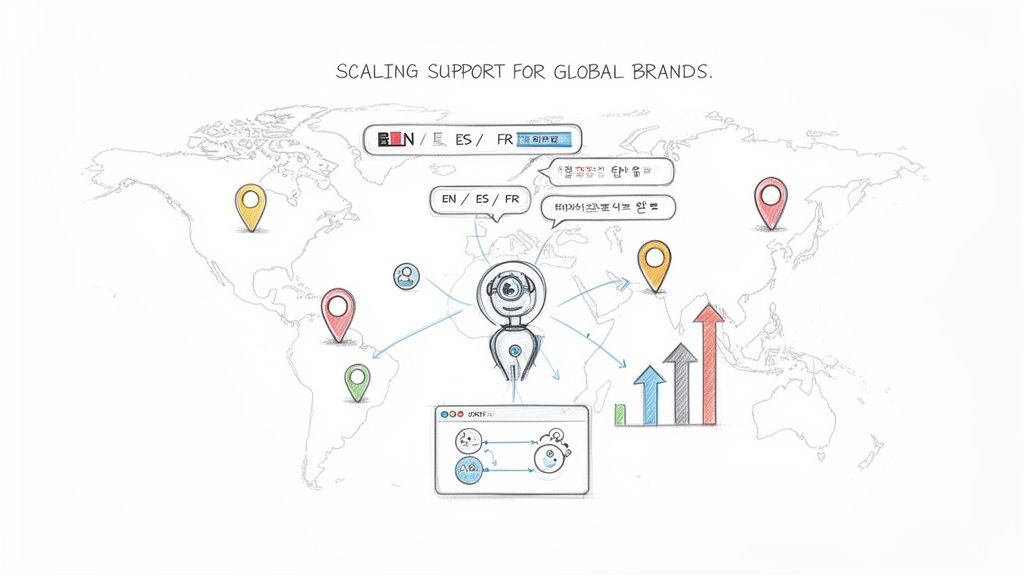
For ambitious Shopify merchants, help desk automation is more than an efficiency tool—it's a strategic playbook for growth. As your store scales, the last thing you want is for customer support to become a bottleneck that kills your momentum. Automation allows you to handle a massive surge in sales without your support payroll spiraling out of control.
This is where you shift from using automation defensively to deploying it as an offensive weapon. It becomes a core part of your expansion strategy, enabling you to conquer new markets and scale operations without friction.
Going Global with Multilingual Automation
Not long ago, international expansion meant hiring a complex and expensive multilingual support team. Today, help desk automation changes the game.
Modern AI can instantly detect a customer's language and reply fluently, offering 24/7 support in Spanish, French, German, or dozens of other languages. This isn't clunky translation; it's true localization. You can set up market-specific automated responses that understand regional holidays, local shipping carriers, and cultural nuances. Suddenly, entering a new country becomes a leaner, smarter investment.
By deploying multilingual bots, you can test new international markets with minimal risk. Let automation handle the initial wave of customer inquiries before committing to hiring local staff.
Your AI as a Top-Performing Salesperson
A sophisticated AI assistant does more than provide answers—it learns. With every customer interaction, it gathers data, identifies patterns, and gets smarter. This is where your automation evolves into your store's most tireless and effective salesperson.
Over time, the AI determines which product recommendations convert best for different customer segments. It can identify hesitant shoppers and proactively offer a nudge—a discount or a shipping update—to close the sale. This continuous learning loop makes your automated upselling and cross-selling more personal and effective every day. For fast-growing brands, exploring customer support outsourcing companies can also be a powerful way to supplement a robust automation strategy.
Building a Unified Customer Profile
Rapid growth can create data silos. Customer conversations happen across live chat, email, and social media, creating a fragmented view of your shoppers. When integrated with your CRM, help desk automation consolidates this data into a single, unified customer profile.
Every automated chat, support ticket, and product question is funneled into one cohesive customer story. This enables a seamless experience:
- Recognize VIPs: Your automation can instantly flag high-value, repeat customers and provide them with exclusive perks or priority support.
- Contextual Handoffs: If an issue requires a human, the AI passes a full conversation history to your agent. No more making customers repeat themselves.
- Personalized Marketing: This rich data can be used to supercharge your email and ad campaigns, making every touchpoint feel relevant.
This unified approach allows your brand to deliver a consistently excellent experience, even when processing thousands of orders a day. It’s a hallmark of top-performing ecommerce brands. You can explore our case studies to see real-world examples of this in action. This is how you build a support infrastructure that doesn't just keep up with your growth—it actively fuels it.
Got Questions About Help Desk Automation? We've Got Answers.
Adopting help desk automation is a significant step, and it's smart to have questions. Let's address some of the most common ones we hear from Shopify merchants to help you move forward with confidence.
What’s This Going to Cost Me?
The honest answer is: it depends on the platform's pricing model. You'll typically encounter a few common structures.
- Per-Seat Pricing: You pay a monthly fee for each support agent using the tool. This model is straightforward but can become expensive as your team grows.
- Per-Ticket/Conversation Pricing: You pay based on the volume of customer chats the automation handles. This is an excellent model for ecommerce, as your costs align with your seasonal sales fluctuations.
- Tiered Plans: These plans bundle a set number of conversations or features for a flat fee. They offer budget predictability but watch out for overage fees during high-volume periods.
The key is to find a pricing structure that scales with your business, not one that penalizes growth.
Will I Lose the Human Touch with My Customers?
No—in fact, it should be the opposite. This is the biggest myth about automation. The goal isn't to replace your support team but to eliminate the tedious work so they can focus on conversations that require a human touch.
Think of your AI as the most efficient front-line agent. It operates 24/7, instantly handling repetitive questions like "Where's my order?". The moment a customer asks something complex, is a VIP, or expresses frustration, a smart system should seamlessly pass the entire chat—with full context—to a real person.
The best help desk automation is designed for a human-AI partnership. The bot handles the volume, while your team provides the empathy and expertise that build customer loyalty.
How Fast Will I Actually See a Return on This?
You'll see the impact in two waves. The first wave is almost immediate. Within the first week, you should see a significant drop in "WISMO" (Where Is My Order?) tickets. That's time and money put right back into your business.
The second, more powerful wave builds over the first few months. As the AI learns from thousands of customer interactions and you refine your automated workflows, you'll see measurable increases in your conversion rate and Average Order Value (AOV). This is where automation starts proactively generating revenue through intelligent upsells and recovered abandoned carts.
Ready to stop treating support as a cost and start leveraging it as your best sales tool? Selzee is an AI shopping assistant built specifically for Shopify stores. It's designed to provide instant answers, boost conversions, and reduce your support costs. See how Selzee can transform your store's support.