
Picture your Shopify store. Customers are browsing, adding items to their cart, ready to buy. But they have a quick question—about sizing, shipping, or compatibility—and there’s no one to ask. What happens? They hesitate, doubt creeps in, and they abandon their cart.
This isn't a hypothetical; it's what happens on a "silent" ecommerce store every day. The fix is conversational customer service—turning your passive website into an active selling environment.
Your Silent Store Is Bleeding Sales
Every unanswered question creates friction and kills conversions. A shopper wondering, "Will this actually fit me?" or "Which of these accessories is the right one?" is a shopper on the verge of leaving.
Let's be direct: research shows 75% of customers expect help within five minutes. Your standard email support queue is a conversion killer. That lag time is a golden opportunity for a competitor with instant answers to steal your sale.
The old model—making a customer file a support ticket and wait hours for a reply—doesn't work for active shoppers. It’s a guaranteed way to lose revenue you should have captured.
Turn Support From a Cost Center Into a Sales Engine
Conversational customer service flips the script. It stops treating support as a post-purchase expense and transforms it into your most effective pre-purchase sales tool. This isn't about solving problems after the sale; it's about engaging shoppers to guide them before they click "buy."

This proactive approach uses smart automation to engage customers at the perfect moment. It doesn't just wait for a question. It sees a customer lingering on a product page and proactively asks, "Hey, got any questions about the fit?"
By delivering instant answers and personalized recommendations, a conversational platform turns a passive browser into an engaged buyer. It overcomes objections in real-time, builds trust, and walks shoppers straight to checkout. It's how you stop that revenue leak and convert more traffic into paying customers.
How Conversational AI Actually Works
A great conversational AI is more than a chat widget. It's an automated system built to turn passive browsing into an active sales conversation. Think of it as a 24/7 personal shopper for every visitor, powered by a trio of smart technologies working in sync to close sales.
The Core Technology Stack
Effective conversational AI for Shopify relies on three key components:
Natural Language Processing (NLP): This is the brain that understands how real people talk. NLP allows the AI to decipher what a customer really means, whether they type "do these run small?" or "what's ur return policy for australia?" This separates a smart sales assistant from a clunky, keyword-based bot.
Recommendation Engines: This is the AI’s deep product knowledge. It connects directly to your Shopify catalog and analyzes customer behavior—like pages viewed or items in their cart—to suggest the perfect products, cross-sells, and upsells at just the right moment.
Shopify Integration: This is the central nervous system. A deep, native integration allows the AI to pull real-time data like inventory levels, shipping options, and order status directly from your store. This ensures every answer is accurate and up-to-the-minute.
A truly effective conversational AI isn't just about answering questions. It's about anticipating needs and actively guiding the customer journey, turning a simple query into a completed purchase with a higher order value.
This combination allows the AI to handle complex, multi-part questions instantly. When a shopper asks, "Do these pants run small and can they ship to Australia?" the AI uses NLP to understand both parts. It then taps into your product data for sizing info and your store's shipping rules to give one clear, immediate answer. No waiting, no friction, no lost sale.
This shift to instant, text-based help is exactly what customers demand. Live chat has become the top channel for conversational customer service, with 41% of consumers ranking it as their number one choice for quick questions—beating phone and email. Satisfaction rates confirm this, with 73% of customers reporting they’re happy with their live chat experiences.
To get a better handle on the nuts and bolts, it's worth checking out detailed guides on AI chatbots for e-commerce and retail. Resources like these break down exactly how these technologies work together to build experiences that not only delight customers but also drive real, measurable revenue for your store.
The Three Ecommerce Metrics You Must Track
Forget vanity metrics. For a Shopify store, only a few numbers actually impact your bottom line. A smart conversational customer service platform isn't just another support channel; it's a sales machine that directly improves the three KPIs that matter most.
These core metrics dictate your store's profitability. Here’s how conversational AI delivers measurable results for each one.
Boost Your Conversion Rate
Every abandoned cart represents a moment of friction—an unanswered question about sizing, shipping times, or your return policy. On a silent website, that small hesitation is a deal-breaker.
Conversational AI eliminates this barrier by providing instant, 24/7 answers. When a shopper can ask, "Do these jeans run true to size?" and get an immediate, helpful response, you erase the doubt that kills sales. This is how you turn hesitant browsers into confident buyers and see a real lift in your conversion rate.
Curious what even a small bump could do for your revenue? Play around with a good conversion rate calculator to see the potential.
Increase Average Order Value (AOV)
A sale is good. A bigger sale is better. The most successful stores are masters at increasing the value of every transaction, and conversational AI is the tool to do it.
Instead of generic pop-ups, it uses the context of the conversation and browsing behavior to make intelligent recommendations. A customer adds a leather jacket to their cart. The AI can chime in with, "Great choice! Customers who bought this jacket also loved our waterproof leather care kit and these matching boots. Want me to add them?"
This relevant, timely cross-selling feels like a helpful personal shopper, not a pushy salesperson. It's a proven way to increase your Average Order Value (AOV) without being annoying.
Modern shoppers crave this kind of instant, chat-based help. They don't want to wait on hold or for an email reply.
The data is clear: when customers need fast answers, the convenience of live chat wins.
Skyrocket Your Customer Resolution Rate
How many team hours are wasted answering the same five questions? "Where is my order?" "What's your return policy?" These are important, but they are low-value, repetitive tasks that drain resources.
Conversational AI can automate the resolution of up to 90% of these routine inquiries. The impact is massive.
Your customers get instant answers, day or night, without needing to speak to a person. More importantly, it frees your human support team from repetitive tickets. They can now focus their energy on high-value conversations—like helping a VIP customer with a complex order or proactively resolving a tricky shipping issue.
The result is a more efficient team and a better customer experience.
Let's put it all together. Here’s the performance lift Shopify stores typically see when they shift from a static site to one powered by a conversational AI sales assistant.
Impact of Conversational Service on Key Ecommerce Metrics
| Metric | Traditional Support (Static Site) | Conversational Service (AI-Powered) | Business Impact |
|---|---|---|---|
| Conversion Rate | 2-3% (Industry Average) | 5-7% | Captures sales from hesitant buyers by answering questions instantly. |
| Average Order Value | $80 | $95+ | Proactively cross-sells & upsells relevant products in-chat. |
| First-Response Time | Hours or Days | < 1 Minute | Delivers instant gratification and builds customer trust 24/7. |
| Resolution Rate | 60% (First Contact) | 90% (Automated) | Frees up human agents for complex, high-value customer issues. |
As you can see, the difference isn't a small improvement; it’s a fundamental shift in how your store operates and earns. By meeting customers with instant, helpful, and personalized conversations, you’re not just providing "support"—you're building a more profitable business.
Getting AI Up and Running Without the Headaches
You're running a business, not an IT department. You don't have time for a complicated project that takes months to launch. The good news is, you don't need one. Implementing a powerful conversational AI is faster and easier than you think if you're smart about it.
The secret is choosing the right tool and rolling it out in phases for quick wins and a fast ROI.
The most critical factor? Choosing a platform with a native Shopify integration. This is non-negotiable. This deep connection gives your AI instant, real-time access to your product catalog, inventory, and customer data—the only way it can give genuinely helpful, sales-focused answers.
Platforms like Selzee are built specifically for Shopify, cutting out the technical complexity. If you're curious what that looks like behind the scenes, you can request a Selzee demo and see how it all connects.
A Phased Rollout for Faster Wins
Don't try to boil the ocean. A strategic, step-by-step approach is far more effective—it lowers risk and delivers results faster.
- Start Where It Counts: Deploy the AI on your highest-traffic product pages first. This is ground zero for pre-purchase questions and your biggest opportunity to prevent cart abandonment.
- Train It to Sound Like You: This addresses the "will it sound robotic?" fear. Before going live, you train it. Feed the AI your past support chats, marketing copy, and FAQs. It learns to adopt your brand's voice and sound like a real member of your team.
- Analyze and Optimize: Once live, monitor the first few hundred conversations. What are people asking? This data is gold. It reveals points of confusion on your product pages and shows you exactly how to expand the AI's knowledge base.
- Expand Your Reach: Once the experience is dialed in on key product pages, roll it out everywhere else—your homepage, collection pages, and anywhere else customers might need guidance.
Modern AI isn't a static script. It's a learning machine. Every conversation makes it smarter, more natural, and better at turning browsers into buyers.
A smart rollout also requires a clear escalation path. When a conversation gets complex or a customer is high-value, the AI must seamlessly hand off the chat to a human agent. This hybrid approach delivers the efficiency of automation without losing the personal touch that closes a deal or saves a customer relationship.
To ensure a smooth launch, use tools like an AI Risk Checklist to identify and mitigate potential issues before they impact customers.
Common Mistakes That Burn Your Cash
A poorly implemented conversational AI is worse than nothing at all. It's like hiring a bad salesperson who annoys visitors and drives away sales. Here are the costly mistakes Shopify merchants make—and how to avoid them.
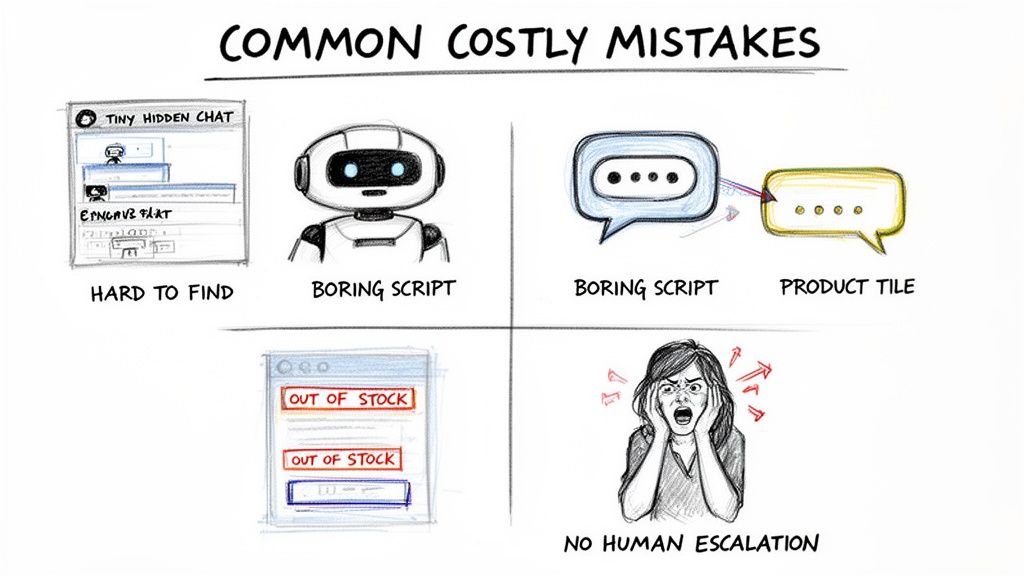
The most common blunder is using generic, out-of-the-box scripts. Greeting every visitor with "How can I help you?" is the digital equivalent of a bored retail clerk. It’s lazy and gets ignored.
This misses the entire point of proactive engagement. A customer viewing a specific pair of jeans doesn't need a generic welcome. They need a specific, helpful prompt like, "Need help finding the right size? Let me know your measurements!" This contextual approach boosts engagement and guides customers toward checkout.
Hiding Your Help Where Nobody Can Find It
You wouldn't lock your only salesperson in a back room. So why bury your chat widget? Many stores hide the chat icon behind a tiny "Help" link or use a color that blends into the background. A customer who needs help is already experiencing friction—don't make them hunt for it.
Your conversational customer service widget should be impossible to miss. Use a contrasting color, ensure it's clearly visible on every page (especially product and checkout pages!), and confirm it's easy to tap on mobile. If they can’t see it, they can’t use it. You're leaving money on the table.
Failing to Sync With Your Store Data
Want to destroy customer trust? Have your AI recommend a product that's out of stock. This happens when your AI isn't connected to your live Shopify inventory, creating a frustrating dead end that screams incompetence.
Any worthwhile conversational tool requires a real-time connection to your store's backend. This is non-negotiable. It ensures the AI only suggests in-stock products, gives accurate shipping estimates, and can offer back-in-stock notifications. Without that sync, you’re setting customers up for disappointment and losing sales.
The biggest mistake of all? Providing no clear or easy path to a human agent. An AI stuck in a loop is infuriating and is the number one cause of rage-quits.
Customers are fine with AI—in fact, 67% of consumers want AI for customer service. But that acceptance comes with a condition: they are far more likely to embrace an AI that acts friendly and human-like.
A huge part of that is knowing when to escalate. You can dig into more of these powerful customer support trends on usepylon.com. Your AI must be smart enough to detect frustration, identify a high-value customer, or recognize a complex question and seamlessly hand the chat over to your team.
A Shopify Store Success Story
Theory is great, but results are what matter. Let's look at a real-world example of a store that transformed its performance with conversational customer service.
This fashion and apparel brand was stuck. Their two-person support team was drowning in repetitive emails about sizing, shipping updates, and returns.
Meanwhile, their cart abandonment rate was high and their Average Order Value (AOV) was stagnant. They were constantly putting out fires instead of growing the business. Their silent store was costing them a fortune.
The Turnaround
Implementing a conversational AI assistant changed everything—fast. The first impact was immediate relief.
The AI began handling over 90% of all incoming support questions autonomously, 24/7. This instantly freed up the founders to focus on marketing and product development. But the real magic was in the sales data.
In the first 90 days alone, the store saw its conversion rate jump by 14% and its AOV climb by 19%. The AI wasn't just a support tool; it was a sales driver.
In practice, this meant a customer asking, "Do you have this dress in blue?" instantly saw the blue version and received a recommendation for a matching handbag in the chat. Another shopper, needing a last-minute gift, was guided to the perfect item and offered expedited shipping to close the deal.
These aren't one-off wins. For more proof, you can check out other Shopify success stories on Selzee.com. This demonstrates that conversational AI isn't an expense—it’s a powerful engine for revenue growth.
FAQ: The No-BS Answers
Won't an AI Chatbot Sound Robotic and Damage My Brand?
No. Modern conversational AI is trained on your brand's unique voice. By analyzing your past customer emails, product descriptions, and marketing copy, it learns to communicate like a seasoned member of your team, not a robot. Smart platforms like Selzee also know when to escalate. They recognize complex situations or high-value customers and seamlessly hand off the conversation to a human agent, ensuring a premium experience where it counts.
How Much of a Headache Is This to Set Up and Maintain?
It's faster than you think. Platforms with native Shopify integrations, like Selzee, can be connected to your store and product catalog in under an hour. Maintenance is minimal. The AI learns and improves from every customer conversation. Your primary task is to occasionally review new questions and add them to the knowledge base to make the system even more effective.
Is This Just Another Support Tool, or Does It Actually Make Money?
While it excels at support, its primary function for a Shopify store is to drive revenue. Think of it as your best 24/7 salesperson. It actively engages shoppers on product pages, answers last-minute questions that prevent cart abandonment, and intelligently cross-sells relevant products. This isn't about deflecting support tickets; it's about directly increasing your conversion rate and AOV.
Ready to turn your store's conversations into conversions? Selzee is the AI sales assistant built for Shopify that boosts your revenue by engaging every shopper. Learn more about Selzee and start your free trial.