Picture this: a salesperson for your Shopify store who works 24/7, never takes a break, and knows exactly what each customer wants. That's not science fiction—that's an AI sales assistant. We're not talking about a basic chatbot that spits out canned answers. This is a revenue engine designed to turn browsers into loyal customers.
Your New 24/7 High-Performance Sales Team
An AI sales assistant is your best in-store employee, available to every single visitor on your site, 24/7. It goes beyond scripted responses to offer personalized recommendations, answer complex product questions, and proactively stop shoppers from abandoning their carts.
These tools are your new always-on sales team. For a deeper dive into maximizing their potential, check out this guide on AI-powered shopping assistants.
This tech doesn't wait; it actively drives sales through smart, helpful conversations. The goal is to create a personalized shopping journey for every visitor and boost your bottom line from day one.
The Shift From Passive Support To Active Selling
Here’s the game-changer: the intent. A traditional chatbot is passive. It waits for a question and serves up a pre-programmed answer. An AI sales assistant is an active seller. It looks for opportunities to guide and sell, just like a great retail associate.
It understands conversation context, remembers a customer's purchase history, and analyzes their real-time behavior to steer them toward the perfect products.
This proactive approach is why the market is exploding. The AI sales assistant software market was valued at $2.447 billion and is projected to hit $24.21 billion by 2035. This massive growth shows how urgently merchants want to automate sales and get a revenue boost from smart assistants.
An effective AI sales assistant doesn't just answer questions—it anticipates them. It identifies hesitation, offers relevant alternatives, and provides the final piece of information a customer needs to click "buy."
Why This Matters For Your Shopify Store
For a busy Shopify merchant, this is huge. You reclaim countless hours while improving your customer experience.
Instead of your team getting bogged down answering the same questions about shipping or sizing, the AI handles it. This frees up your people to tackle complex issues, build customer relationships, and focus on growth. The difference between a basic bot and a true sales assistant is night and day.
AI Sales Assistant vs. Traditional Chatbot
Here's a quick comparison to highlight the difference.
| Feature | Traditional Chatbot | AI Sales Assistant |
|---|---|---|
| Primary Goal | Answer basic FAQs, deflect tickets | Drive sales, increase AOV, convert shoppers |
| Interaction Style | Reactive, follows a rigid script | Proactive, dynamic, and conversational |
| Product Knowledge | Limited to pre-loaded Q&As | Understands the entire product catalog |
| Personalization | Generic, one-size-fits-all responses | Hyper-personalized based on user behavior |
| Business Impact | Reduces support tickets | Directly increases revenue and conversions |
Ultimately, an AI sales assistant is like hiring a dedicated, data-driven sales expert who never sleeps. It works tirelessly to ensure no customer question goes unanswered and no sales opportunity is missed. It's a strategic move that turns your customer support from a cost center into a powerful revenue generator.
How AI Sales Assistants Directly Boost Revenue
Let's get straight to the point: what really matters is results. An AI sales assistant isn't a gadget; it's a tool designed to increase the numbers that count most for your business. It does this by zeroing in on three critical areas of your Shopify store. Here's exactly how this tech turns chats into more money in your bank.
Skyrocket Your Conversion Rates
Every unanswered question or moment of doubt is a sale slipping through your fingers. When a shopper can't figure out their size, compare two products, or find your return policy, they leave. An AI sales assistant jumps in at that moment, acting as an on-demand expert to eliminate friction.
Imagine a customer is stuck between two blenders on your site. The AI can pop up: "Having trouble choosing? The Model X is a beast for smoothies, while the Model Y is amazing for hot soups. What will you be making most?" That immediate guidance clears up their confusion and nudges them toward a confident purchase.
By providing instant, accurate answers and proactive guidance, AI assistants can boost conversion rates by as much as 30%. They turn hesitation into a decisive "yes" right when it matters most.
This is more than a glorified FAQ page. It’s giving a shopper the confidence boost they need to hit "Add to Cart." The result is a direct, measurable lift in your store’s conversion rate.
Dramatically Increase Average Order Value
Getting a customer to buy is one thing. Getting them to buy more is where real growth happens. AI sales assistants master smart upselling and cross-selling because they understand the context of the sale—something static "You might also like" widgets can't do.
Let's say a customer adds a camera to their cart. Instead of showing random accessories, the AI can start a conversation: "Great choice! Pro photographers always grab an extra battery and a 128GB memory card for long shoots. Want me to add them for you?"
It's not a pushy sales pitch; it's helpful advice. The AI can even create product bundles on the fly, offering a small discount for buying related items together. This is a powerful way to bump up Average Order Value (AOV). You can see how this plays out in these real-world ecommerce case studies.
- Intelligent Upselling: Suggesting a premium version of a product based on the customer's stated needs.
- Smart Cross-selling: Recommending products that improve the main purchase (like a waterproof case for a new phone).
- Dynamic Bundling: Creating personalized packages that increase the cart total while giving the customer a better deal.
Build Lasting Customer Lifetime Value
The final piece of the revenue puzzle is loyalty. A single sale is good, but a returning customer is gold. This is where Customer Lifetime Value (LTV) comes in, driven by great experiences. An AI sales assistant helps ensure the first interaction with your brand is flawless and fast.
When a customer gets an immediate answer to a post-purchase question—like tracking their order or asking about the warranty—it builds massive trust. That smooth, helpful experience makes them far more likely to think of you first for their next purchase.
A happy customer who feels heard becomes a brand advocate. They’ll come back, spend more, and tell their friends. The AI assistant is often the first "face" of your brand they meet; making that first impression exceptional lays the groundwork for a long, profitable relationship.
Real-World AI Plays for Your Shopify Store
Ready to see this technology make a real difference? An AI sales assistant is a powerful growth engine for your customer journey. Let's get into a playbook of high-impact strategies you can use right away to fix common problems and drive revenue.
There's a reason this space is exploding. The global AI shopping assistant market, currently at $3.42 billion, is projected to smash $37.45 billion by 2034. Why? Because AI is proven to deliver killer personalized recommendations and solve customer problems fast, with some assistants hitting a 94% AI-only resolution rate. You can dig into the details in the full research on AI shopping assistants.
Here’s a visual of how an AI assistant directly pumps up your most important revenue numbers.
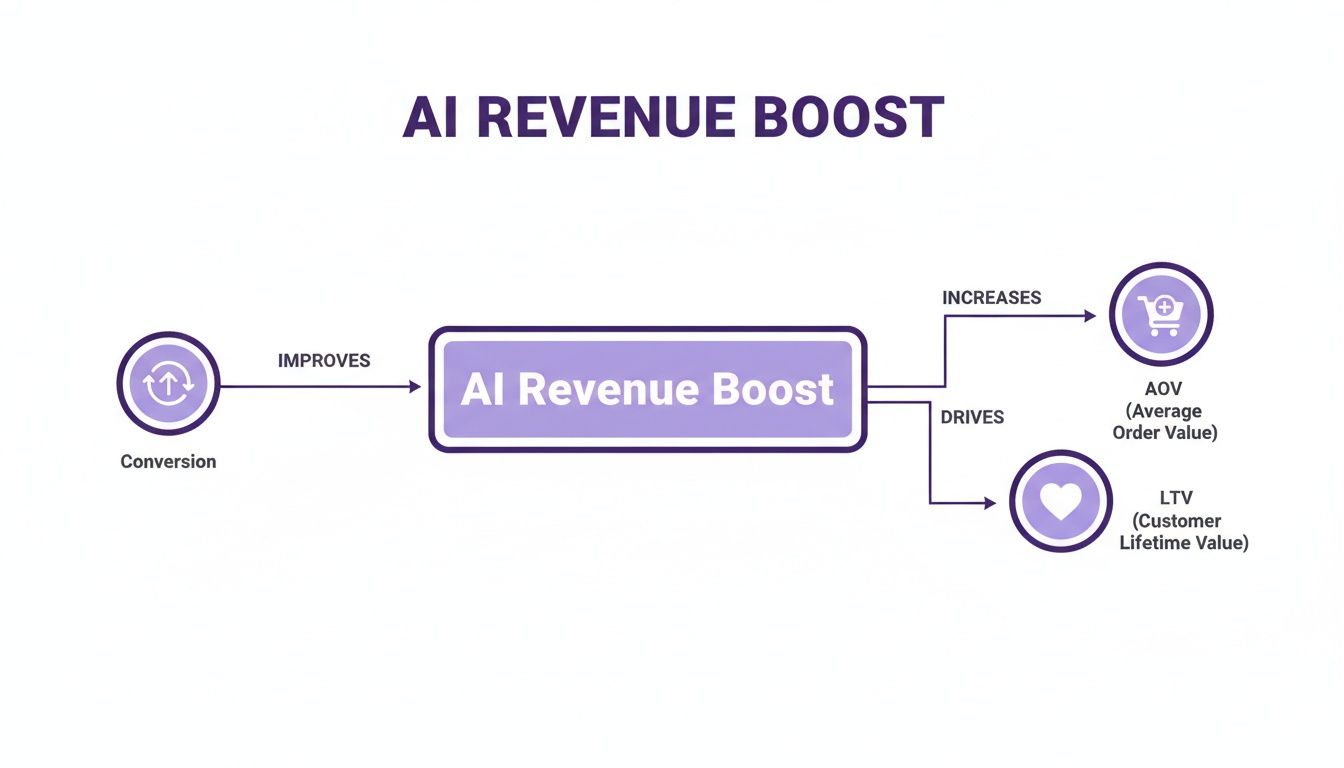
This nails it—you can draw a straight line from launching a smart AI assistant to better conversion rates, a higher Average Order Value (AOV), and a healthier Customer Lifetime Value (LTV).
Proactive Cart and Checkout Recovery
Every Shopify merchant feels the sting of abandoned carts. An AI sales assistant is your secret weapon, proactively intervening when a shopper looks like they're about to leave. It can spot signs—like a mouse cursor heading for the 'X'—and launch a perfectly timed intervention.
Instead of an annoying pop-up, the AI asks a smart question. "Hey, before you go, did you have any questions about our shipping times?" A simple nudge like this can uncover the one thing holding them back, solve it on the spot, and turn a lost sale into a confirmed order.
Guided Selling for Complex Products
Selling products with tons of options like supplements, electronics, or custom furniture? You know "analysis paralysis"—when too many choices make customers buy nothing. Guided selling saves the day.
Your AI acts like a personal shopper, asking a few key questions to understand the customer's needs. From there, it confidently recommends the perfect product.
- Selling supplements? "Are you looking for better sleep, more energy, or muscle recovery?"
- Running a skincare brand? "What's your biggest skin concern—acne, dryness, or fine lines?"
- In electronics? "Will you mainly be using this for gaming, work, or casual browsing?"
This conversational flow makes buying easy and builds trust. It's also a great test for your product copy. If the AI is confused, your customers probably are too. You can give your descriptions a quick upgrade with our free product description tool.
Expert Tip: An AI sales assistant shines when aimed at a specific problem. Don't just flip a switch and hope for the best. Deploy it with a clear mission, whether that’s slashing cart abandonment or simplifying complex buying decisions.
Instant Post-Purchase Support
The customer relationship doesn't end at checkout. What happens after the sale is where loyalty is built. An AI assistant handles the endless stream of post-purchase questions instantly, 24/7.
It can give immediate answers to:
- "Where is my order?"
- "What is your return policy?"
- "How do I set this up?"
This frees up your human support team to focus on complex, high-stakes issues. Your customers get instant answers, and your team's efficiency goes through the roof.
Gather Priceless Data Through Conversation
Every chat is a chance to learn. As your AI sales assistant talks to customers, it collects valuable zero-party data—insights people share willingly.
It learns about their tastes, frustrations, and what they really want. This is gold for your marketing strategy. You can use it to fine-tune your product lineup, improve site navigation, and launch laser-focused campaigns. It's like having a 24/7 focus group on your store, feeding you data to fuel your next wave of growth.
Choosing the Right AI Assistant for Your Store
Not all AI sales assistants are created equal. Picking the wrong one is a costly mistake that wastes time and money. Think of this as a buyer's guide to help you find a tool that actually sells for you, not one that clogs your support queue. The goal is to find a growth partner, not a glorified FAQ bot you'll outgrow in six months.
The first thing to check is deep, seamless integration with your e-commerce platform, whether you're on Shopify, Shoptet, or Upgates. This means the AI must instantly sync with your product catalog, inventory levels, and customer data without clumsy manual uploads.
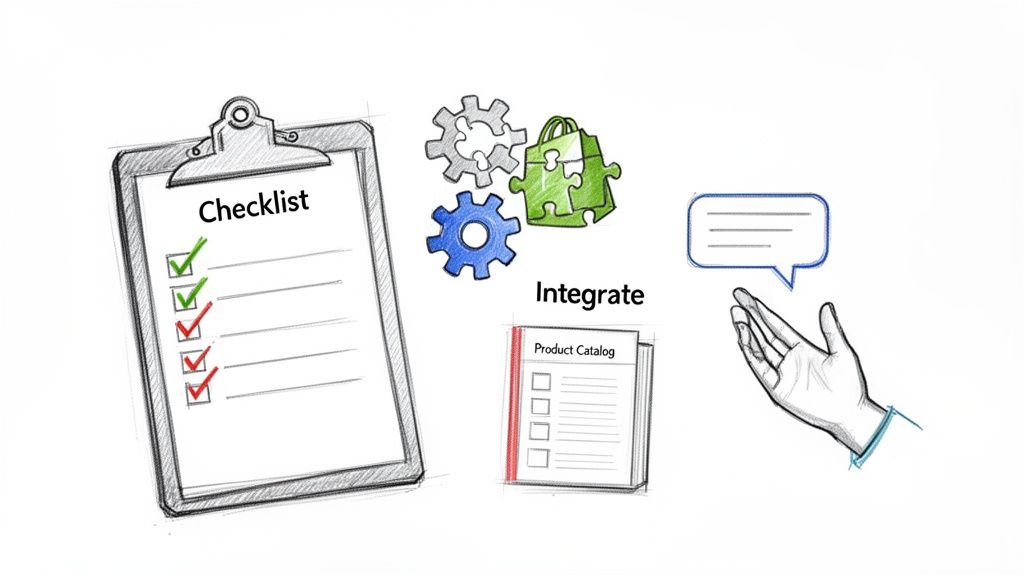
This live connection lets the AI give spot-on, real-time recommendations and answer questions like, "Do you have this in a size medium?" Without it, you’ve just got a generic chatbot that can’t move products.
Distinguishing True AI From Rigid Bots
This is where many merchants get burned. They invest in what they think is an "AI" but end up with a stiff, rule-based chatbot. A basic bot is stuck on a script; if a customer asks a question that isn't on its pre-approved list, it breaks.
A true AI sales assistant is powered by machine learning. It gets smarter with every conversation. It understands context, nuance, and can handle curveball questions with natural, human-like language.
The critical difference is adaptability. A rule-based bot needs you to manually build every conversational path. A machine-learning AI learns on its own from your product catalog, help docs, and past chats to become a genuine expert on your business.
This ability to learn turns it into a powerhouse over time, constantly improving its recommendations and sales game without you babysitting it.
Key Features to Evaluate in an AI Sales Assistant
When comparing AI assistants, cut through the noise and focus on the capabilities that actually drive sales.
| Feature Category | What to Look For | Why It Matters for Sales |
|---|---|---|
| Platform Integration | Native, real-time sync with your product catalog, inventory, and order data. | Ensures product recommendations are always accurate and in-stock, preventing customer frustration and lost sales. |
| Intelligence Engine | Machine learning and Natural Language Processing (NLP), not just pre-programmed rules. | The AI understands customer intent, learns from interactions, and handles complex queries instead of just answering FAQs. |
| Proactive Engagement | Ability to initiate conversations based on visitor behavior (e.g., exit intent, time on page). | Turns passive browsers into engaged shoppers by offering timely help or discounts, directly boosting conversions. |
| Human Handoff | Smooth, context-aware transfer to a live agent when needed. | Prevents dead-end conversations and ensures complex or sensitive issues are handled by a person, protecting the customer experience. |
| Revenue Analytics | A dashboard showing AI-influenced conversion rate, AOV lift, and total sales generated. | Proves the tool's ROI. If you can't measure its direct impact on your bottom line, it's just a cost center. |
| Brand Customization | Options to adjust the AI's tone, voice, and personality to match your brand. | Creates a consistent brand experience, making the AI feel like a helpful team member, not a robot. |
Focusing on these core areas will help you separate the sales-driving powerhouses from the simple support bots.
Questions to Ask Before You Commit
Walk into any sales demo armed with these questions. The answers will tell you everything you need to know.
- How does your AI learn about my products? (The right answer is automatic catalog syncing, not manual data entry).
- Can you show me analytics that prove revenue impact? (Don't settle for "chats started." Demand hard numbers on sales, AOV, and conversions).
- How does the AI handle questions it doesn't know the answer to? (You want to hear about a seamless handoff to a human agent).
- What does your pricing model look like? (Performance-based models are often a great sign, as the provider only wins when you do. You can see how our performance-based pricing works as an example).
- Can I customize the AI's personality to match my brand voice? (A top-tier AI should feel like a natural extension of your team).
Choosing the right AI sales assistant is a massive strategic decision. By zeroing in on deep integration, true learning capabilities, and revenue-focused analytics, you'll invest in a tool that grows your business from day one.
The Big Mistakes That Can Sink Your AI Investment
An AI sales assistant can be a game-changer, but just plugging one in and hoping for the best is a fast track to disappointment. The hype is real, but so are the pitfalls that can turn a powerful tool into a money pit. Let's walk through the most common mistakes Shopify merchants make so you can dodge them.
This isn't just a trend. The AI assistant market is projected to grow from $8,464.9 million to a staggering $35,720.6 million by 2033. As this tech becomes standard, getting the implementation right is how you'll win. You can dig into the full market growth report here to see how big this wave is. Nailing your setup by avoiding these blunders will put you leagues ahead.
Believing in Magic
The single biggest mistake is treating AI like a magic wand. It's a phenomenal tool, but it's not a mythical creature that will triple your revenue overnight. It needs a clear purpose, a solid setup, and ongoing attention to shine.
Think of it like hiring a star salesperson. You'd set clear goals, train them on your products, and track their performance. Your AI deserves the same treatment.
- It can't fix a broken business: If your product has issues or your shipping is a mess, the AI can't magically solve those problems. It can only amplify the great business you've already built.
- It won't be perfect on day one: Machine learning is about learning. Your AI gets smarter with every customer chat. Give it time to ramp up.
Feeding it Junk Data
This is the silent killer of AI projects. Your AI sales assistant is only as smart as the information you give it, learning directly from your product catalog. If your product pages are a disaster—vague descriptions, missing specs, or boring copy—your AI will be lost.
It's the classic "garbage in, garbage out" problem. An AI can't sell a product it doesn't understand. Think of clean, detailed, and persuasive product data as the high-octane fuel for your AI sales engine.
Before you touch an AI tool, be honest about your product pages. Are the descriptions compelling? Are all technical details present? If your copy is lacking, you should use our generator to standardize your listings fast and give your AI the quality info it needs to start closing deals.
Forgetting Who You Are
Another massive misstep is launching an AI that sounds like a generic robot. Your customers have a relationship with your brand and expect a certain personality. A sterile, out-of-the-box AI script shatters that connection and makes you look like everyone else.
Your AI sales assistant should feel like a genuine member of your team. The best tools let you customize the tone. Take the time to infuse it with your brand's unique voice and way of talking to customers. It should be a seamless extension of your brand, not a clunky add-on.
Trapping Customers in a Robot Maze
Never force your customers into an endless loop with the AI. There will always be situations that need a real person—a complex problem, an emotional customer, or a big-ticket sale needing a final nudge. Making it impossible to reach a human is the quickest way to enrage a customer and lose a sale for good.
The goal is a smart, seamless handoff. A well-tuned AI should handle 80-90% of routine questions, freeing up your team for what matters most. When a conversation gets tricky, the AI should gracefully pass it to a live agent with all the context, creating the perfect tag-team of instant 24/7 support and expert human help.
How Do You Actually Know If Your AI Assistant is Making You Money?
If you can't measure it, you can't prove it's working. An AI sales assistant needs to show cold, hard numbers that prove it's a money-making machine, not just another expense. Forget vanity metrics like "chats started"—we're talking about KPIs that directly impact your bottom line. This is how you get a true picture of your ROI.
Focus on AI-Influenced Conversion Rate
First, how many sales is your AI actually helping you close? The most critical number is your AI-influenced conversion rate. This tells you what percentage of shoppers who chatted with your AI went on to make a purchase in that same visit.
This isn't just about the person who clicked "buy" from the chat window. It’s about every customer who got a quick answer, found the perfect product through a recommendation, or had the AI guide them. This is your number one indicator that your assistant is turning conversations into cash.
Measure the Lift in Average Order Value
Next, look at Average Order Value (AOV). A great AI sales assistant doesn’t just close a sale; it makes that sale bigger through intelligent upselling and cross-selling.
Your analytics should make it easy to compare the AOV of shoppers who used the AI against those who didn't. Seeing a significant jump in the AOV for the AI-assisted group is undeniable proof that its recommendations are hitting the mark.
Key Takeaway: When the AI’s AOV is consistently higher, you know your investment is paying for itself by making every transaction more valuable. It’s a core driver of your sales strategy.
Track the AI-Only Support Resolution Rate
Finally, what about efficiency? This is where the AI-only support resolution rate comes in. This metric shows you what percentage of customer questions the AI handles completely on its own, without a human getting involved. Hitting a high number here—the best assistants can reach 90% or more—is a massive win.
Every ticket your AI resolves is time and money saved. It frees up your human support team to tackle the complex, high-touch issues that build customer loyalty. To get a handle on this, a good Shopify sales tracker is essential for pulling together all the data you need.
By keeping a close eye on these three core metrics, you get a crystal-clear understanding of how your AI assistant is performing, making it easy to justify the investment and fine-tune your approach for even better results.
Got Questions About AI Sales Assistants? We've Got Answers.
We get it. Bringing an AI onto your team is a big deal, and you probably have questions. Let's tackle the most common ones we hear from merchants on platforms like Shopify, Shoptet, and Upgates.
How Long Does This Actually Take to Set Up?
Honestly? You can be live in under an hour. A modern AI built for e-commerce doesn't start from scratch. It plugs right into your store and immediately starts absorbing your entire product catalog, help articles, and even old customer service chats.
From there, you'll probably spend another couple of hours dialing it in. Think of it like training a new employee: you’ll fine-tune its personality to match your brand's vibe and set its specific sales goals. It’s a quick ramp-up designed to get you seeing results almost immediately.
Is This AI Going to Replace My Human Team?
Not a chance. It’s going to make them superstars. An AI sales assistant is built to be the first line of defense, handling the flood of repetitive questions that tie up your team. "Do you have this in blue?" "What's your return policy?" "Where's my order?" The AI has it covered.
This frees up your human agents to focus on what they do best: handling the tricky, high-value conversations that need a human touch. Your team becomes more efficient, and your customers get faster help, whether they're talking to a person or the AI.
Can I Make the AI Sound Like My Brand?
Absolutely, and you should. The best AI assistants are chameleons. You can train them on your brand guidelines, website copy, and past emails to ensure every word feels authentic.
Is your vibe fun and quirky? Or more buttoned-up and technical? The AI learns to speak your language, creating a seamless experience. It won't feel like a robot; it'll feel like one of your own.
Ready to see how an AI sales assistant can seriously move the needle for your store? Selzee is designed from the ground up to turn casual chats into sales, pushing up your conversion rates and average order value while making customers happier. Get started today.