
Think of AI customer support software as your store's best employee. It works 24/7, never takes a break, and is trained to answer customer questions, suggest the perfect products, and solve problems in an instant. For a Shopify merchant, this isn't just a support tool—it's the secret weapon that turns a late-night browser into a happy customer, instead of just another abandoned cart.
Why Your Shopify Store Needed AI Support Yesterday
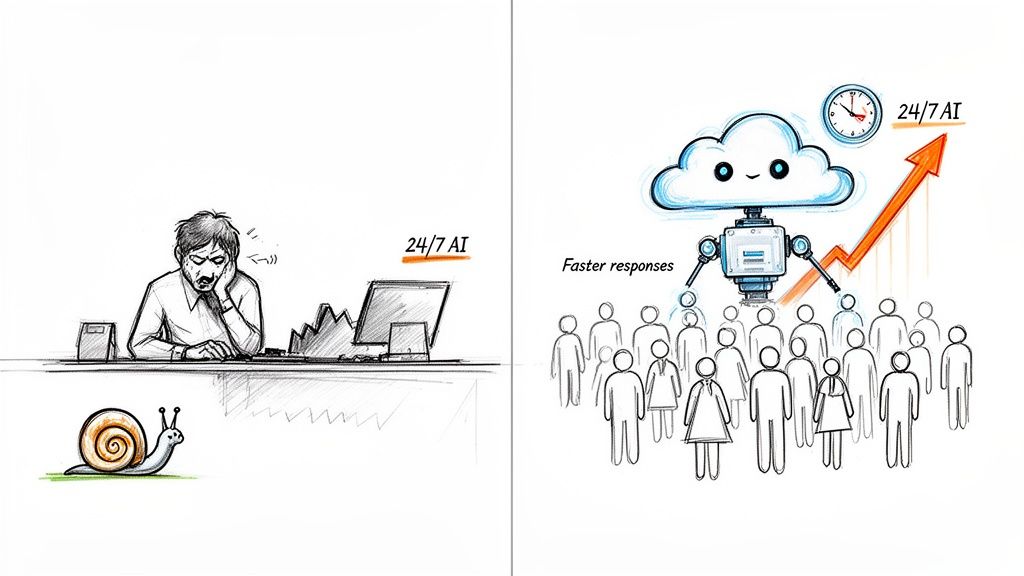
If you're running a busy Shopify store, you know the feeling. Every unanswered question about shipping is a potential sale slipping through your fingers. Every slow reply to a "Where's my order?" query chips away at the trust you've worked so hard to build. As your store grows, manual support just can't keep up—it becomes a bottleneck that costs you real money.
Imagine having one cashier during a Black Friday rush. It’s a recipe for disaster. Customers get frustrated, lines get long, and sales walk right out the door. That's exactly what's happening when your support can't provide instant answers. This is where AI customer support software comes in, not just to fix problems but to act as a tireless sales and retention machine.
The Real Cost Of Inaction
The drain from relying solely on human support isn't just about salaries; it's the slow bleed of missed opportunities. A shopper who can't get an immediate answer about sizing, materials, or return policies is almost guaranteed to click away and buy from your competitor. This isn't a hypothetical problem—it's happening on your site right now.
The old model of making customers wait in a queue for an email response is dead. Today’s shoppers expect immediate, accurate answers, and AI is the only way to deliver that experience at scale, around the clock.
This isn't just a trend; it's a massive market shift. The global AI for customer service market, already valued at USD 12-13 billion in 2024, is expected to explode past USD 80 billion by 2033. This growth shows just how seriously brands are taking this, adopting AI to manage customer conversations without hiring an army of support agents.
From Cost Center To Conversion Engine
The most important mental shift for merchants is to stop seeing customer support as just an expense. With the right AI, it becomes a powerful revenue driver. A smart AI tool doesn't just wait for trouble tickets. It actively engages with shoppers, turning hesitant visitors into confident buyers.
Here’s how that looks in practice:
- Answering Pre-Sale Questions: Instantly clearing up doubts about product features, materials, or shipping times, giving customers the confidence to click "buy now."
- Recovering Abandoned Carts: Proactively engaging a user who's about to leave, perhaps by clarifying a shipping policy to seal the deal.
- Upselling and Cross-selling: Intelligently recommending products that pair perfectly with what's already in a customer's cart, boosting your Average Order Value (AOV) with every interaction.
Let's break down the difference.
Manual Support vs. AI-Powered Support At A Glance
This table illustrates how AI doesn't just replace manual tasks—it transforms the financial and operational reality of running a Shopify store.
| Metric | Traditional Human Support | AI Customer Support Software |
|---|---|---|
| Availability | Limited to business hours (e.g., 9 AM - 5 PM) | 24/7/365, instant responses anytime |
| Response Time | Minutes to hours | < 10 seconds for most queries |
| Cost Per Interaction | $5 - $25+ depending on agent salary and complexity | Pennies per interaction, a fraction of the human cost |
| Scalability | Limited by headcount; expensive to scale for peak seasons | Infinitely scalable; handles 10 or 10,000 chats at once |
| Primary Function | Reactive problem-solving (cost center) | Proactive sales and support (revenue driver) |
| Impact on AOV | None, unless agents are trained salespeople | Actively upsells and cross-sells, directly increasing AOV |
Ultimately, AI handles the repetitive, predictable questions, freeing up your human team to focus on high-value tasks: handling complex escalations for VIP customers, building relationships, and shaping your brand's community. To get a better sense of the industry-wide impact, check out this deep dive into Automation and Artificial Intelligence in Call Centers.
This isn't a future concept; it's a competitive must-have for any Shopify merchant serious about growth.
The Three Core Jobs of AI in Ecommerce
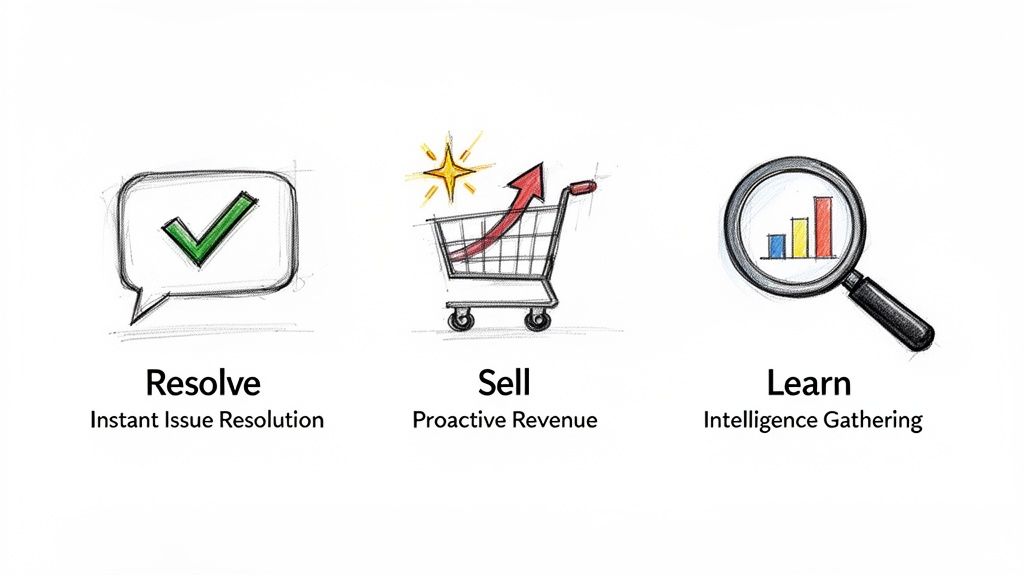
If you're still thinking of AI as just a simple chatbot, you're missing the big picture. This isn't just another app for your Shopify store. This is your newest employee—one that works 24/7 and fills three powerful roles at once.
When you implement modern AI customer support software, you’re not just deflecting tickets. You’re hiring a full-time problem-solver, a savvy salesperson, and a brilliant market researcher all rolled into one. Let’s break down what this "employee" will be doing for you around the clock.
Job 1: Instant Issue Resolution
First, your AI is your frontline defense. Think about the endless stream of repetitive questions that clog up your inbox: "Where is my order?" "What's your return policy?" "Do you ship to Canada?" They’re important, but they’re also a massive time-suck for your human team.
A good AI can instantly and accurately resolve up to 80% of these common inquiries. It hooks directly into your store's backend—pulling live order status from Shopify, grabbing tracking info from carriers, and checking inventory levels—to give customers the right answer, right now.
By taking over the high-volume, low-complexity questions, your AI immediately frees up your human agents. This lets your best people focus on the high-value conversations that need a human touch, like soothing a frustrated VIP customer or guiding someone through a complex buying decision.
This is about meeting today's expectations. Making someone wait hours for a simple tracking update is a fantastic way to earn a one-star review and lose a customer for good.
Job 2: Proactive Revenue Generation
This is where your AI stops being a useful tool and becomes a game-changer for your bottom line. Your AI isn't just playing defense by solving problems; it’s playing offense, actively creating new revenue opportunities.
This function transforms your support chat from a cost center into a 24/7 sales machine. The AI watches shopper behavior in real-time—what they're looking at, what’s in their cart, how long they're hesitating—and jumps in with personalized messages designed to drive a sale.
Here’s what that looks like:
- Personalized Recommendations: A customer is eyeing a specific dress. The AI pops up to suggest the perfect shoes and accessories to go with it, instantly boosting the potential order value.
- Intelligent Upsells: Someone adds the standard version of a product to their cart. The AI chimes in to highlight the benefits of the premium version or a bundle deal they might have missed.
- Cart Recovery: The AI senses a visitor is about to leave with items in their cart. It can engage them by answering a last-second question about shipping or even offering a one-time discount to seal the deal.
This proactive selling turns window shoppers into buyers. It’s like giving every person on your site their own personal shopper.
Job 3: Actionable Intelligence Gathering
Finally, your AI doubles as your on-the-ground detective. Every conversation it has is a goldmine of data, revealing what your customers are thinking, what they're looking for, and where they're getting stuck. This is raw, unfiltered feedback you can use to make smarter business decisions.
Your AI platform doesn't just answer questions—it logs, tags, and analyzes every interaction. This process uncovers powerful insights that would otherwise be buried in thousands of support tickets.
You can suddenly spot crucial trends like:
- Product Page Friction: Are tons of people asking about the dimensions of a specific product? That’s a signal that your product description is missing key info. You can update it with a free product description tool to make things clearer.
- Checkout Hurdles: Is the AI flagging a spike in questions about shipping costs right on the checkout page? You might have a UX problem that's killing conversions.
- Emerging Demand: When customers repeatedly ask for a product feature or a color you don't offer, the AI flags this trend for your product team. It’s free market research.
This feedback loop is incredibly powerful. Instead of guessing what your customers want, you have a direct line to their brain. Your AI becomes a core strategic asset, feeding you the intel you need to constantly improve your products, your marketing, and your entire store experience.
The Features That Actually Drive Revenue, Not Just Deflect Tickets
Not all AI customer support tools are built the same. Many are just glorified FAQ bots that are good at reducing tickets, but the real value is in the features that actively make you money. To spot the difference between a simple cost-cutter and a true revenue-driver, you have to look past basic ticket resolution.
The right AI becomes a genuine part of your sales engine. Every feature should be measured against one question: "Will this help me sell more?" The goal isn't just to answer questions but to create opportunities, drive conversions, and increase your Average Order Value (AOV).
Deep Shopify and E-commerce Integration
This is the most critical, non-negotiable starting point. If your AI can’t connect deeply and in real-time with your Shopify store, it's flying blind. A surface-level integration might parrot back a static knowledge base article, but a powerful AI needs to be plugged directly into the live pulse of your business.
What does "deep integration" feel like for a customer? It’s the difference between a helpful assistant and a frustrating dead end.
Live Order Data: A customer asks, "Where's my stuff?" A basic bot recites your shipping policy. A deeply integrated AI pulls up their specific order, checks the real-time carrier status, and gives them a direct tracking link right in the chat.
In-Chat Actions: Someone wants to make a return. Instead of sending them to a form, a smart AI kicks off the return process right there in the conversation, checks if the item is eligible based on your store's rules, and can even generate the return label.
Real-Time Inventory Checks: A shopper asks, "Do you have this in a size medium?" The AI instantly pings your Shopify inventory and says, "Yes, we do, and there are only 3 left!" instead of "Please check the product page." That urgency closes sales.
This turns a chatbot from a passive FAQ machine into an active, problem-solving powerhouse.
Advanced Natural Language Processing (NLP)
Ever tried to talk to an old-school chatbot that short-circuits if you don't use the exact right keywords? It's frustrating and makes your brand feel dated. This is the problem that Natural Language Processing (NLP) solves. It’s the brainpower that allows the AI to understand how real people talk—typos, slang, and all.
Think of it this way: a basic bot is a keyword search bar. An NLP-powered AI understands intent.
A customer might fire off, "yo wuts ur return policy," and a brilliant AI gets that they're asking the same thing as someone who types, "What is your official return policy?" It deciphers the meaning behind messy, authentic communication, creating a smooth, almost human conversation that builds trust.
This isn't just a "nice-to-have" feature; it's the engine behind the growth of conversational AI in e-commerce. It's a massive force, holding 42.4% of the chatbot market in 2024. With generative AI crafting nuanced responses, this tech is essential for boosting conversions and AOV. We're talking about a projected $290 billion impact on conversational commerce by 2025—you can’t afford to miss out.
Proactive Engagement Triggers
The best AI doesn't wait for a customer to say hello. It jumps into action at the perfect moment. Proactive engagement triggers are rules you set up that tell your AI to pop up with a helpful message based on a shopper's actions on your site. This is how you transform your AI from a reactive support agent into a proactive salesperson.
Imagine these scenarios:
The Cart Saver: A user has items in their cart but moves their mouse toward the exit button. BAM! The AI instantly pops up: "Leaving so soon? Here's a 10% discount to finish your order!"
The Sizing Assistant: A visitor is lingering on your sizing guide for over a minute. The AI can proactively ask, "Having trouble finding the right fit? I can help you find the perfect size in seconds!"
The Big Spender Nudge: Someone has viewed the same $500 jacket three times in the last ten minutes. The AI can slide in with a special offer or a simple, "Looks like you're interested in our best-seller! Any questions I can answer for you?"
These triggers are your secret weapon for converting hesitant shoppers and rescuing sales that would have otherwise vanished. If you're struggling to turn visitors into buyers, check out our guide on how to calculate your conversion rate.
Seamless Human Handoff
No matter how brilliant your AI gets, some conversations need a human. A top-tier AI knows its limits, and the human handoff process has to be seamless and invisible to the customer.
You know a bad handoff when you see it. The AI hits a wall and spits out, "Sorry, I can't help. Please email support@yourstore.com." This is a conversion killer. It forces the customer to start over again in a different channel.
A great handoff is a thing of beauty:
- The AI recognizes it's out of its depth or senses the customer's frustration is rising.
- It says something like, "It looks like you need a product expert for this. Let me connect you with one of our human team members right now."
- A live agent gets a notification and can jump directly into that same chat window, with the full conversation history right there for them to see.
This ensures your customer never feels abandoned and your team can swoop in to save a high-value sale or smooth over a sensitive complaint without missing a beat.
Implementing and Measuring AI for Maximum ROI
Jumping into AI customer support software shouldn't feel like a leap of faith. It's a calculated move to boost your bottom line, and with the right playbook, you can get from launch to profit fast. Forget month-long technical projects; we're talking about a straightforward process built for busy merchants who need results now.
The key is to launch with a focused plan. Instead of trying to automate everything at once, target the areas with the highest immediate impact on your revenue and customer experience.
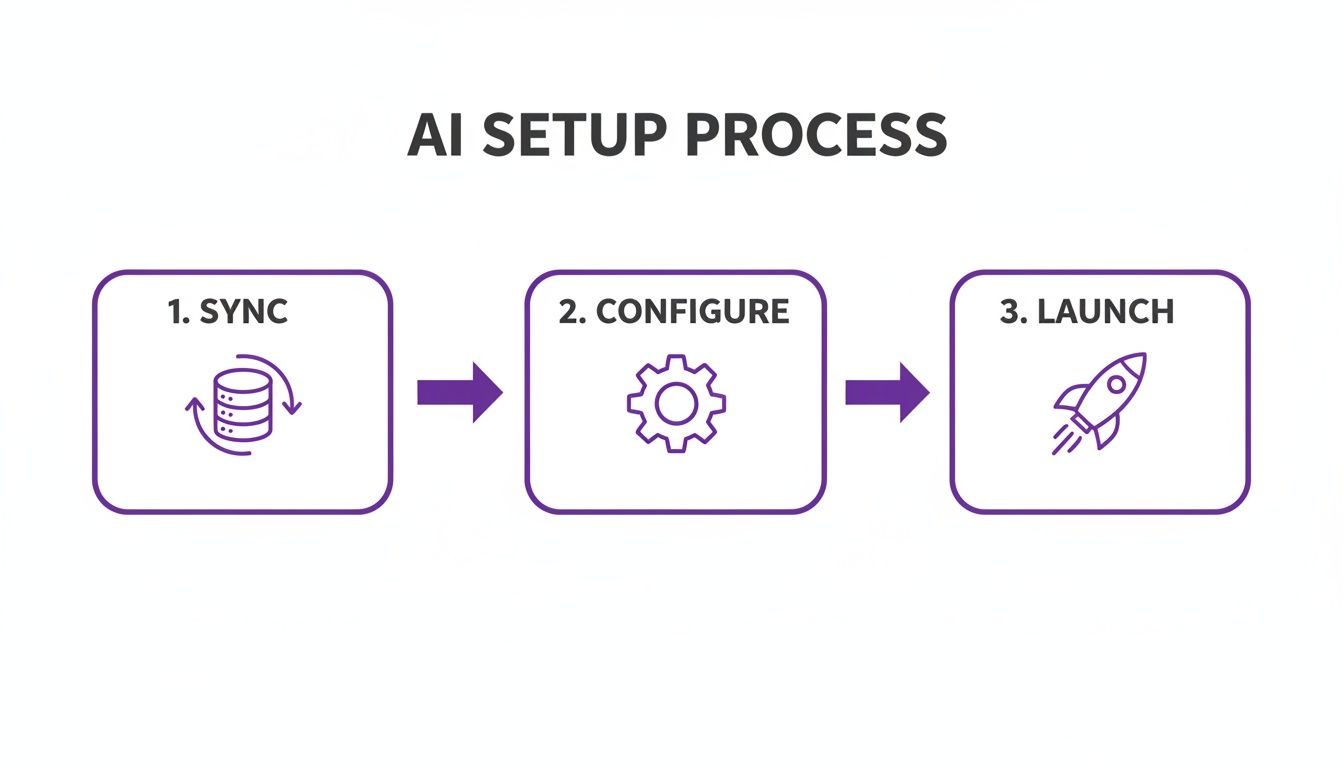
This streamlined approach—syncing data, configuring automations, and launching—is designed to get your AI assistant live and generating value as quickly as possible.
Your Four-Step Launch Plan
Think of this as your minimum viable launch. It’s all about delivering tangible results in the shortest time possible.
- Sync Your Knowledge and Products: First, connect the AI to your existing knowledge base, FAQ pages, and your Shopify product catalog. This is the brain-food for your AI, instantly teaching it about your policies, products, and brand voice.
- Automate Your Top 5 Questions: Dive into your support inbox and pinpoint the top five most repetitive questions you get. Configure your AI to handle these flawlessly—think "Where is my order?," return policy questions, and shipping info. This one move alone can deflect 40-60% of your ticket volume.
- Define Proactive Sales Plays: Now set up simple rules to turn the AI into a salesperson. A great starting point is a proactive message for anyone who has an item in their cart for over two minutes, offering help or highlighting a key product benefit.
- Go Live and Monitor: Flip the switch. The goal isn't perfection on day one; it's to start gathering real-world interaction data you can use to refine and improve performance.
Measuring What Actually Matters
Once you're live, it's easy to get lost in data. But vanity metrics like "total chats" don't pay the bills. You need to zero in on the key performance indicators (KPIs) that directly connect your AI's activity to your store's financial health.
The goal isn't just to reduce tickets; it's to measure the AI's direct contribution to your revenue. A successful AI implementation shows up in your Shopify Analytics, not just your helpdesk dashboard.
Here are the three core metrics you must track:
- AI Resolution Rate: This is the percentage of conversations the AI handles from start to finish without needing a human to step in. A good benchmark is 40-50%, with more advanced setups hitting 70% or more. This tells you how effectively the AI is freeing up your team's time.
- Conversion Rate from Chat: This is your golden metric. Track how many shoppers who interact with the AI actually go on to make a purchase. This directly proves the AI is actively helping you close sales.
- AOV Lift from AI Interactions: This one is huge. Compare the Average Order Value of customers who chatted with the AI versus those who didn't. When the AI is successfully upselling and cross-selling, you'll see a clear, measurable increase in AOV for the group that engaged with it.
By focusing on these revenue-centric KPIs, you move beyond seeing AI as just another support tool. It becomes a core part of your growth engine with a clear return on investment. If you're ready to see how these metrics look in a real-world Shopify environment, you can request a demo to see the platform in action.
Don't Make These Common (and Costly) Mistakes
Adding AI customer support to your Shopify store is a brilliant move. But it's not a magic wand. Just flipping a switch on an AI tool and hoping for the best is a fast track to disappointment. The real trouble starts when you fall into a few common traps that can turn a powerful growth engine into a frustrating, brand-damaging mess.
These are the real mistakes that cost merchants money every day.
Mistake 1: Treating It Like a Glorified FAQ Bot
The single biggest mistake merchants make is boxing their AI in as a simple FAQ bot. If all your AI does is parrot back your shipping policy, you are leaving a staggering amount of money on the table. This mindset overlooks the sales and conversion power that modern AI is built for.
A well-trained AI should be your best salesperson, working 24/7. It should be jumping into conversations, recommending products, suggesting add-ons, and swooping in to save abandoned carts. Limiting it to just "Where is my order?" is like hiring a world-class chef and only asking them to make toast.
The real game-changer with AI isn't just deflecting tickets; it's creating new revenue. Every chat is a golden opportunity to guide a customer to a purchase, boost their cart value, and build loyalty.
Mistake 2: Making the Human Handoff Impossible
No AI is foolproof. Sometimes, a customer just needs to talk to a person. The second cardinal sin is making that jump from bot to human a nightmare. Burying the "talk to an agent" button three menus deep—or worse, not having one at all—is a fantastic way to demolish customer trust.
Imagine a shopper with an urgent issue. They hit a dead end with the AI and can't find an escape route. Their frustration boils over. They don't blame the bot; they blame your brand. You've just created a terrible experience that costs you the sale and any future business.
A seamless handoff to a human agent is non-negotiable. The AI must be able to instantly connect a customer to your team, right in the same chat window, with the full conversation history ready to go.
Mistake 3: The "Set It and Forget It" Mindset
Your AI is not a crockpot. You can't just set it up and walk away for six months. An AI running on outdated product info, old return policies, or expired discount codes isn't just unhelpful—it's a liability that is actively giving your customers wrong information.
Your AI needs regular tune-ups. That means you have to:
- Update its knowledge base the moment you launch new products or change a policy.
- Read the conversation logs to see where the AI is stumbling or getting confused.
- Tweak and refine its automated flows based on how real customers are interacting with it.
This isn't busy work; it's essential maintenance that keeps your AI a sharp, accurate, and trustworthy part of your team.
Mistake 4: Ignoring the Data Goldmine
This last one is the most expensive mistake: ignoring the treasure trove of data your AI is collecting. Every chat log is a direct line into your customers' brains. These conversations tell you exactly what they're confused about, what they're searching for, and where the friction points are on your site.
If you notice dozens of customers asking the AI the same question about a product's materials, that's not a support problem—it's a merchandising problem. It’s a massive sign telling you that your product page is missing key information. Take that feedback and go fix your product description immediately. You can even use our generator to quickly refine your pages based on what customers are asking. By digging into this data, you can spot trends and smooth out the customer journey before those little friction points cost you another sale.
Got Questions About AI Customer Support? We've Got Answers.
You've seen what AI can do, but maybe you've still got a few nagging questions. Let's tackle those common "what ifs" head-on so you can feel confident about adding an AI assistant to your team.
Will It Sound Like a Robot?
Not the good ones. We've come a long way from the clunky, keyword-spotting bots of the past.
Modern AI customer support software is built with sophisticated Natural Language Processing (NLP). This means it gets the nuance—it understands slang, typos, and the actual intent behind what a customer is asking. The best tools can even be trained on your past support tickets and brand guidelines to adopt your unique voice.
And for those moments that truly need a human, the handoff to your team is seamless. It’s not about replacing your people; it’s about giving them superpowers.
Do I Need to Be a Tech Wizard to Set This Up?
Nope. If you can install an app from the Shopify App Store, you have all the technical skill you need.
These tools are built for merchants and marketers, not developers. Everything is managed through a simple dashboard where you connect your help docs and click a few buttons to set your rules. The goal is to get you live in hours, not weeks.
This means you can spend your time on your customer strategy, not wrestling with code.
Can This AI Thing Actually Make Me More Money?
Absolutely. This is the biggest mindset shift for merchants. You're not just adding a chatbot; you're hiring a 24/7 sales associate who never sleeps.
A smart AI doesn't just answer "Where's my order?". It proactively engages shoppers, offering personalized product recommendations, suggesting add-ons to increase Average Order Value (AOV), and even swooping in with a timely discount to rescue an abandoned cart.
When a customer is hesitating on a product page, the AI can jump in and answer a quick question about sizing or shipping, pushing them over the finish line. It turns your support from a necessary expense into a revenue-generating machine.
What if the AI Gets Stumped?
A great AI system is designed with a safety net. It never leaves a customer hanging. If it hits a question it truly can't answer, it has a clear plan B.
It might ask a clarifying question to get more context or automatically create a support ticket for your team. Most importantly, it will offer a one-click option to chat with a live person right then and there.
This ensures that the tricky or sensitive issues always get the human touch they deserve, all without making the customer start over. It's the perfect backup plan that keeps your customers happy and your brand looking sharp.
Ready to turn your support into a revenue machine? At Selzee, we've built an AI shopping assistant that integrates seamlessly with your Shopify store to boost conversions, increase AOV, and delight your customers 24/7. Learn how Selzee can transform your customer experience.